
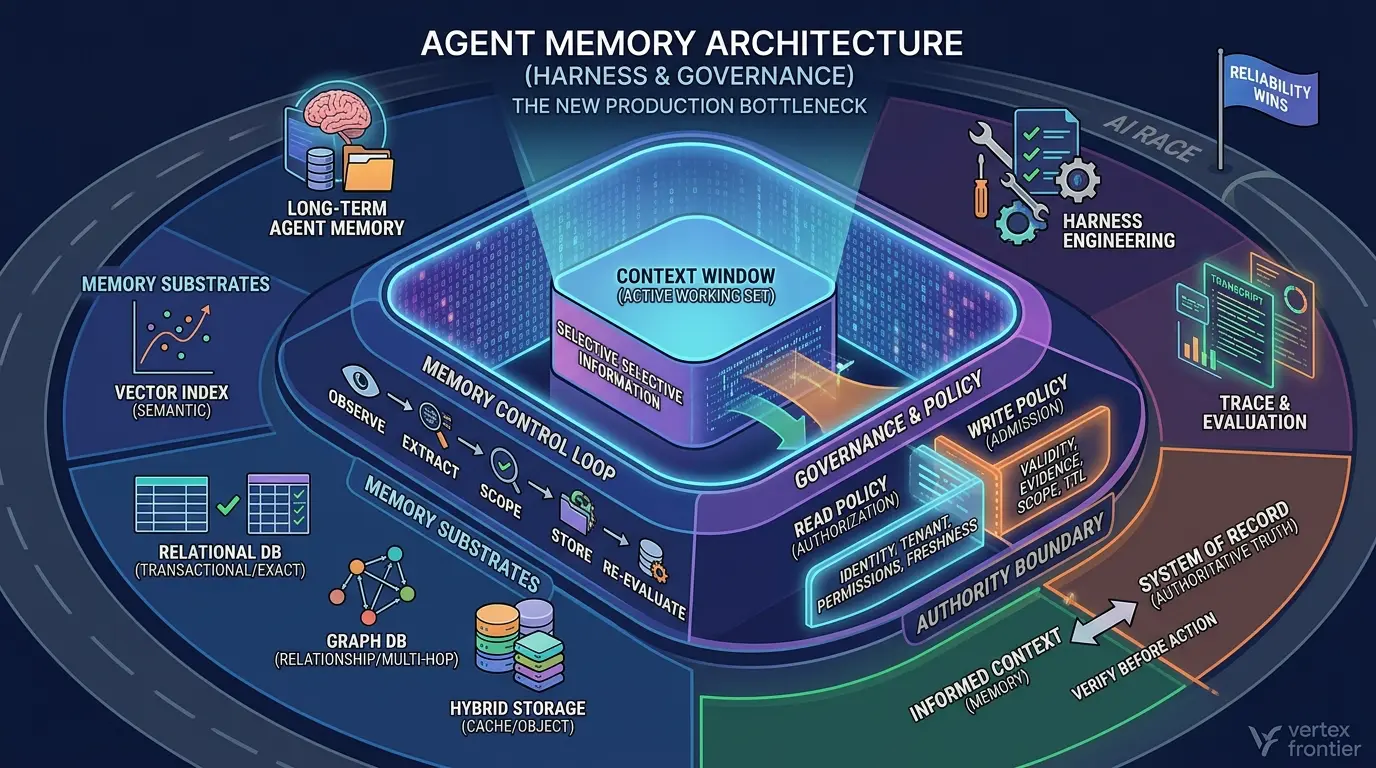

The most expensive mistake in agent engineering is easy to describe: a team upgrades the model, expands the context window, adds a vector database, and expects the agent to become reliable.
A larger model or a larger context window may improve a demo; neither change, by itself, establishes that the production system can preserve state, enforce authority, or recover safely.
A real agent has to remember a customer preference without treating it as a permanent truth. It has to preserve a task checkpoint across failures. It has to retrieve the right decision from three weeks ago, ignore an obsolete one from yesterday, respect tenant boundaries, and explain why a piece of memory influenced an action. In a multi-agent workflow, it also has to avoid turning shared memory into a distributed race condition.
That is a different problem from giving a language model more text.
The emerging strategic question is therefore not simply which teams use the strongest LLMs. It is which teams treat memory as governed, testable system state rather than as a pile of embeddings. This is an editorial inference from the documented constraints and evaluation guidance, not a measured market split.
The phrase “memory is the new context window” is useful as a provocation. It should not be read as a literal technical replacement. A context window is the model’s current working set. Memory is the selective state that an agent decides to preserve, update, retrieve, and place back into that working set. The two layers are complementary.
Key takeaways
Click any topic to expand or collapseContext Window vs. Durable Memory
A larger context window does not give an agent durable memory. Context is the active working set; memory is selective, persistent, scoped state that must be retrieved into that working set.
Production Memory Questions
The production problem is not “Which vector database should we buy?” It is “What should be remembered, who is allowed to see it, when does it become authoritative, and how do we know retrieval helped?”
Memory Substrates Diversity
Relational, vector, graph, cache, file, and hybrid systems solve different query and lifecycle problems. There is no universal memory substrate.
Harness Engineering
Harness engineering turns memory into a system discipline: tools, checkpoints, artifacts, tests, traces, context fitting, feedback, and recovery around the model.
Memory Architecture as Constraint
For long-running, stateful, workflow-heavy, and enterprise agents, memory architecture can become the binding constraint. That is a strategic hypothesis—not proof that memory always matters more than model capability.
The context window is working memory, not continuity
Anthropic’s context-window documentation defines context as the information a model can reference while generating a response. That includes the system prompt, messages, tools, tool results, media, and depending on the model and API, generated output. It is closer to working memory than to a database.
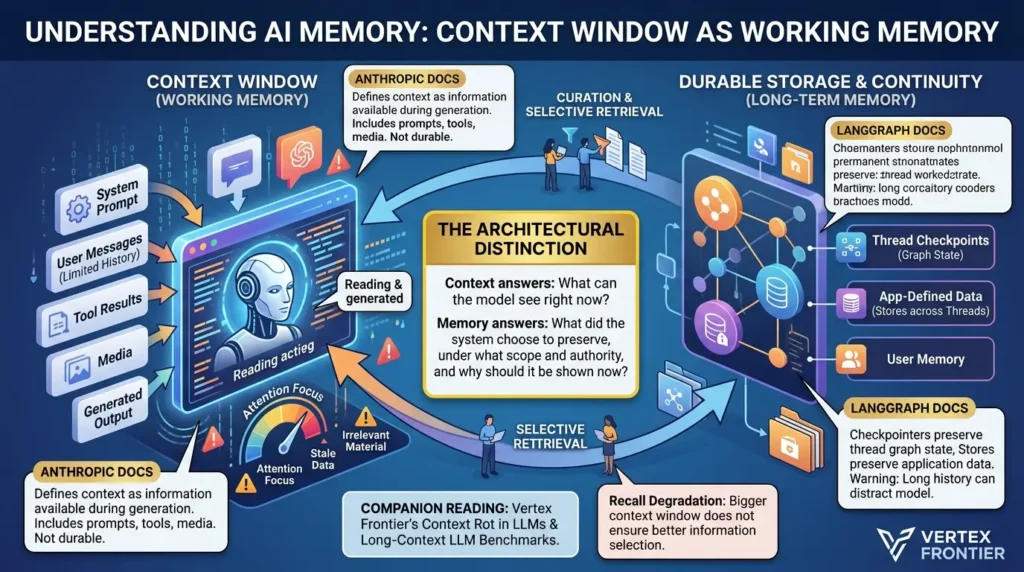
A context window can contain a conversation, but it does not automatically create a durable record of what mattered in that conversation. Nor does it decide which statements remain valid after the world changes.
This is why “stateless” needs a precise definition. In one system, it may mean that no conversation survives a process restart. In another, it may mean that the model receives no cross-session state but the application still stores durable records. A third system may persist thread checkpoints while keeping user memory separate. Those are materially different architectures.
LangGraph’s persistence documentation makes the distinction concrete: checkpointers preserve a thread’s graph state, while stores can preserve application-defined data across threads. Its memory documentation also warns that a long history can overflow the model window, or fit while still distracting the model with stale or irrelevant material.
That distinction matters because a bigger window can increase the amount of information available without improving the quality of information selected. Anthropic’s explanation of context engineering for AI agents makes the same point: more context is not automatically better, and recall can degrade as irrelevant material accumulates.
Vertex Frontier’s own Context Rot in LLMs and Long-Context LLM Benchmarks provide useful companion reading here. The practical lesson is not that long context is useless. It is that context must be curated like a scarce operational resource, even when the hard token limit becomes very large.
Context answers: What can the model see right now? Memory answers: What did the system choose to preserve, under what scope and authority, and why should it be shown now?
Why persistent memory is a policy, not a vector index
The common architecture is familiar: split documents into chunks, create embeddings, store them in a vector database, and retrieve the nearest chunks at inference time. That is a useful retrieval pattern. It is not a complete memory architecture.
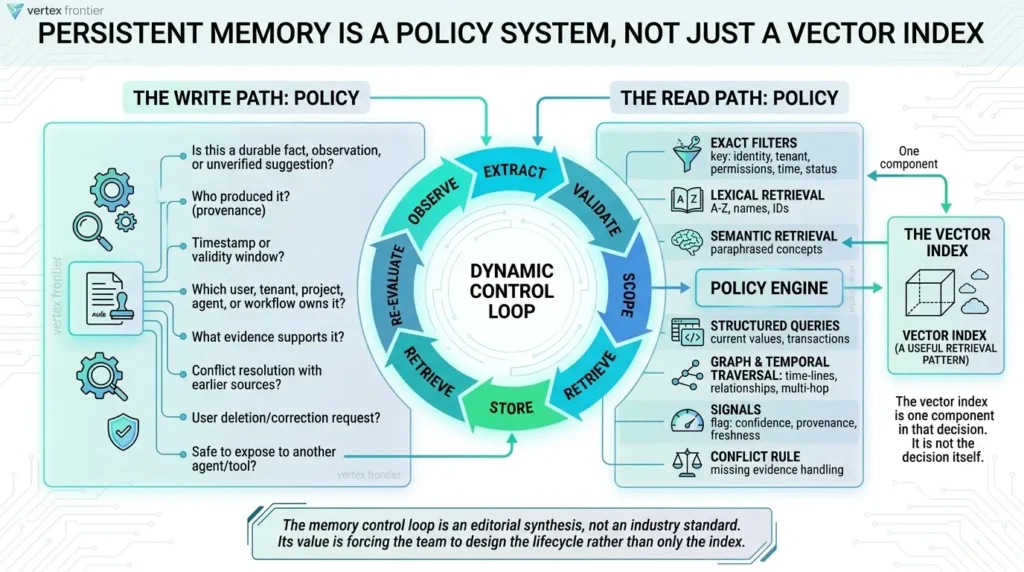
A memory system has at least two separate paths:
- The write path: deciding what deserves to become a durable state.
- The read path: deciding what deserves to enter the model’s next context.
Both paths need policy.
LangChain’s memory guide describes a trace-to-analyze-to-update loop: observe an interaction, analyze it, and update memory. Oracle’s AI Agent Memory architecture similarly emphasizes typed memory, scope, promotion gates, and lifecycle controls. LlamaIndex documents short-term history alongside fact-extraction and vector memory blocks in its agent-memory documentation.
Taken together, these systems point to a more useful model:
Observe → Extract → Validate → Scope → Store → Retrieve → Re-evaluate
The memory control loop is an editorial synthesis, not an industry standard. Its value is forcing the team to design the lifecycle rather than only the index.
What belongs in the write policy?
A write policy should answer questions such as:
- Is this a durable fact, a temporary observation, a task checkpoint, or an unverified suggestion?
- Who or what produced it?
- Does the statement have a timestamp or validity window?
- Which user, tenant, project, agent, or workflow owns it?
- What evidence supports it?
- What happens when a later source conflicts with it?
- Can the user request deletion or correction?
- Is the memory safe to expose to a different agent or tool?
Without these controls, a vector index may preserve everything and govern nothing. That is how stale preferences become “facts,” old business rules survive a policy change, and private text crosses a tenant boundary because it was semantically similar to the query.
What belongs in the read policy?
The read path needs its own discipline:
- exact filters for identity, tenant, permissions, time, and status;
- lexical retrieval for names, IDs, and exact terms;
- semantic retrieval for paraphrased concepts;
- structured queries for current values and transactions;
- graph or temporal traversal for relationships and multi-hop questions;
- confidence, provenance, and freshness signals;
- a rule for what to do when evidence conflicts or is missing.
The vector index is one component in that decision. It is not the decision itself.
RAG is not the same thing as agent memory
The original Retrieval-Augmented Generation paper describes RAG as combining a model’s parametric memory with non-parametric memory accessed through a retriever. That framing remains foundational, but production agents add another layer: continuity.
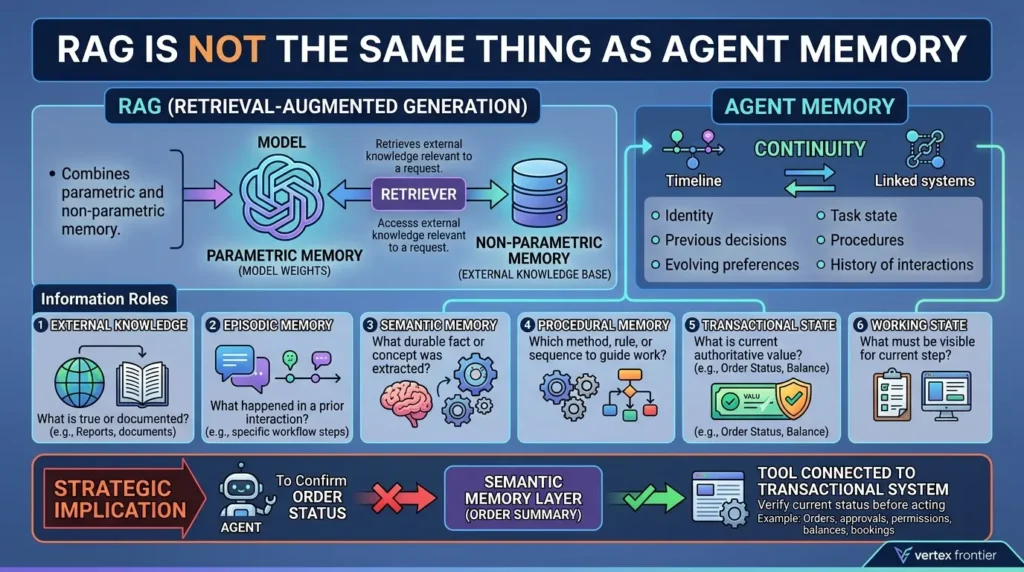
A RAG system typically retrieves external knowledge relevant to a request. An agent-memory system may need to represent identity, previous decisions, evolving preferences, task state, procedures, and the history of interactions. The same document can be useful as external knowledge without becoming a personal memory. A conversation can be a candidate memory without being authoritative knowledge.
The distinction is not absolute. Many systems combine RAG, user memory, workflow state, and tool data. The important question is the role a piece of information plays:
- External knowledge: What is true or documented in the world or an organization?
- Episodic memory: What happened in a prior interaction or workflow?
- Semantic memory: What durable fact or concept has been extracted?
- Procedural memory: Which method, rule, or successful sequence should guide future work?
- Transactional state: What is the current authoritative value?
- Working state: What must be visible for the current step?
MongoDB’s RAG documentation openly lists stale data, missing domain data, and hallucination as limitations that retrieval pipelines try to mitigate. Retrieval can improve access to evidence; it cannot guarantee that the evidence is current, correctly filtered, or correctly interpreted.
The strategic implication is simple: do not use a semantic memory layer as the source of truth for mutable orders, approvals, permissions, balances, or bookings. The agent can retrieve a summary of an order, but a tool connected to the transactional system should verify the current status before the agent acts.
Vector database vs. relational database: the wrong winner-takes-all debate
Founders often ask whether a vector database or a relational database is better for agent memory. The useful answer begins by rejecting the singular noun “memory.” Different memory types create different access patterns.
| Memory need | Best first question | Likely substrate | Failure if chosen blindly |
|---|---|---|---|
| Current order, entitlement, approval | What is the authoritative value now? | Relational or transactional store | A stale semantic match is treated as truth |
| Paraphrased knowledge or prior discussion | Which content is semantically relevant? | Vector retrieval, often with metadata filters | Relevant-sounding but unauthorized or stale results |
| Names, IDs, codes, exact clauses | Does this exact term occur? | Lexical or structured search | Embeddings blur important exact distinctions |
| Relationships across entities and time | How are these facts connected? | Graph or temporal graph, sometimes hybrid | Nearest-neighbor retrieval misses the path |
| Large working artifacts and checkpoints | What must survive and be inspected? | Object/file storage plus metadata and checkpoints | The agent hides state inside an opaque prompt |
The pgvector repository documents exact and approximate vector search, including HNSW and IVFFlat trade-offs. It also warns that filtering behavior with approximate indexes can affect recall depending on the configuration. Weaviate documents hybrid BM25 and vector search. Pinecone documents metadata-filter expressions, including logical operators and field constraints. Neo4j presents GraphRAG for relationship-heavy retrieval.
These are capabilities, not proof of a universal winner.
A relational database is attractive when the application needs transactions, constraints, joins, precise filters, authorization boundaries, audit trails, and an existing operational system. A specialized vector store is attractive when semantic retrieval is the dominant access pattern and the team wants a retrieval system optimized for that job. A graph store can be valuable when relationships and multi-hop traversal are central. A hybrid design is often the honest answer because the query shapes are heterogeneous.
The database decision should therefore follow the memory contract, not precede it.
A practical storage decision guide
- List the queries the agent must answer, including exact, semantic, temporal, transactional, and multi-hop queries.
- Mark which fields are authoritative and which are merely contextual.
- Write down freshness, deletion, tenant isolation, and audit requirements before comparing products.
- Measure retrieval quality and end-to-end task success on the same workload, rather than comparing vendor demos.
- Keep the source-of-truth boundary explicit: memory can guide an action; the system of record should authorize the action.
The architecture boundary: what moves where, and what remains authoritative
A memory design becomes easier to review when the data movement is explicit. The model should not be treated as the database, and retrieved text should not silently become permission to act.
Reference boundary for a production agent
- Sources of truth: transactional systems, approved documents, identity providers, and policy services.
- Memory services: extraction, validation, scope assignment, versioning, expiration, deletion, and retrieval.
- Context assembly: the bounded selection of current task state, recalled memory, tool results, and instructions.
- Model and tools: reasoning, proposed actions, tool calls, approvals, and structured outputs.
- Trace and evaluation: records of writes, reads, filters, tool paths, outcomes, regressions, and user corrections.
Boundary rule: memory can inform an action; the authorized source-of-truth or approval step should decide whether the action is allowed.
This boundary also clarifies where a failure belongs. A stale answer may be a refresh problem, a wrong tenant result may be an authorization problem, an omitted decision may be a write-admission problem, and a correct answer produced through an unsafe tool path may be a harness problem. Without the boundary, every failure gets mislabeled as “the model hallucinated.”
Minimum architecture review checklist
Before selecting a database or memory product, document these interfaces:
| Interface | Required decision | Evidence to retain |
|---|---|---|
| Write admission | What qualifies for durable memory? | Source event, extractor version, confidence, reviewer or rule |
| Read authorization | Who may retrieve this record? | Principal, tenant, scope, applied filter, decision |
| Authority boundary | Is this context, evidence, or current truth? | Source-of-truth pointer, timestamp, validity, conflict status |
| Refresh and deletion | When does it expire, update, or disappear? | Version, TTL, tombstone, derived-index cleanup result |
This is a design checklist, not a claim that every implementation needs the same schema. The exact controls depend on the workload, data sensitivity, and deployment model.
The five-minute memory contract
Before choosing a memory store, write down what the memory is allowed to mean. This short contract prevents a team from confusing a useful recollection with an authoritative record.
- What exactly should this agent remember? Separate facts, episodes, procedures, preferences, checkpoints, and temporary observations.
- Who can read and write it? Name the user, tenant, agent, workflow, service account, or reviewer that owns each scope.
- What remains authoritative? Identify the source of truth to consult when memory conflicts with current state.
- When does it expire or require revalidation? A memory without a freshness rule is an unbounded claim.
- How does correction or deletion propagate? Include summaries, embeddings, caches, exports, traces, and derived indexes.
Practical rule: if the team cannot answer these questions, it is too early to debate which database is “best.”
The complete contract can become a lightweight review artifact: memory name, owner, type, scope, source-of-truth pointer, write rule, read rule, freshness window, conflict policy, deletion path, and evaluation metric.
The hidden bottleneck is the write path
Most teams obsess over retrieval because retrieval is visible in the demo. The harder problem is deciding what the system should remember in the first place.
A bad write path creates a bad read path permanently. If every conversation is summarized into “memory,” the store becomes a landfill of preferences, guesses, temporary plans, and contradictory statements. If the system only stores explicit user facts, it may lose the workflow decisions that explain why an action was taken. If background extraction is used, the next request may arrive before the memory update is complete.
Oracle’s documentation and product material emphasize expiration, scope, cascading deletion, hybrid retrieval, and governed memory. Its 2026 update also describes foreground and background extraction paths. That is useful evidence for a policy-centric design, but it is still vendor-specific architecture, not independent proof that one database design produces better outcomes.
A reliable write path should make the following visible:
- Admission: Why did this observation qualify for memory?
- Type: Is it an episode, fact, procedure, preference, checkpoint, or trace?
- Scope: Who can see it and for how long?
- Authority: Is it a source of truth, a hypothesis, or a pointer to a source of truth?
- Freshness: When should it expire or be revalidated?
- Conflict: Which newer or more authoritative record wins?
- Deletion: How does correction propagate across derived summaries and embeddings?
- Audit: Can the system explain when and why it wrote or retrieved the memory?
This is why the strongest agent-memory designs look less like a “memory plugin” and more like a data-governance system with an LLM attached.
Drift, refresh, and conflict matrix
Memory is not finished when it is written. It is finished when the system can tell whether it is still valid.
| Failure mode | Typical symptom | Control to test |
|---|---|---|
| Stale memory | The agent repeats an old preference or procedure | Validity windows, source re-check, expiry, and stale-read rate |
| Conflicting memory | Two records describe incompatible current states | Authority ranking, versioning, conflict flag, abstention |
| Background-write lag | A follow-up request cannot see a just-created memory | Read-after-write contract, queue monitoring, retry and reconciliation |
| Derived-index residue | Deleted content remains retrievable through an embedding or cache | Tombstones, cascading cleanup, deletion test, audit evidence |
The matrix is deliberately operational. It turns “memory quality” into observable failure classes rather than a single recall score.
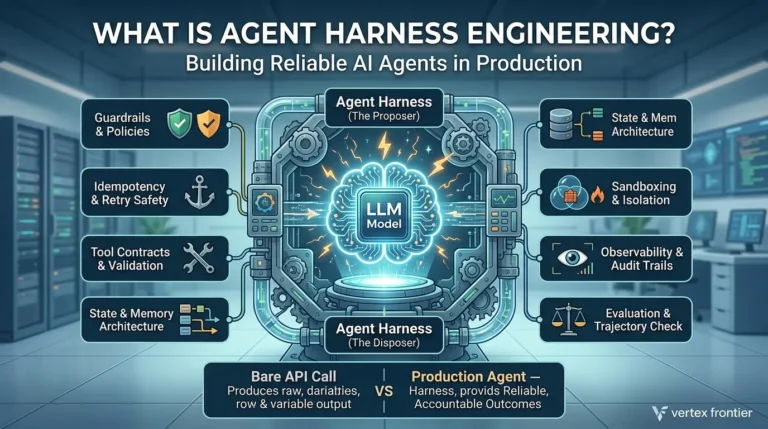
Harness engineering: the system around the model becomes the product
A model is only one part of an agent. The rest of the system determines what the model can inspect, what it can change, how it recovers, and whether a human can understand the trajectory.

Martin Fowler’s discussion of harness engineering frames the harness as the surrounding system that enables an agent to work effectively. Anthropic’s article on effective harnesses for long-running agents describes practical controls such as initialization, progress artifacts, tests, and continuation across long tasks. Databricks’ AI agent harness guide adds tools, sandboxes, memory, guardrails, and observability to the picture.
The term is new enough that some engineers will reasonably ask whether it is a rebranding of good software engineering. That criticism is fair. The value of the term is not novelty; it is focus. It tells teams to evaluate the model together with the environment that shapes its behavior.
For memory, the harness includes:
- Context fitting: selecting and compressing state before each model call.
- Tool boundaries: preventing the model from treating recalled text as permission.
- Artifacts: storing plans, progress, files, and checkpoints outside the prompt.
- Feedback: exposing test results, tool errors, and reviewer signals.
- Traceability: recording what memory was retrieved and what it influenced.
- Recovery: allowing a failed run to resume without replaying everything blindly.
- Evaluation: grading the path, not just the final answer.
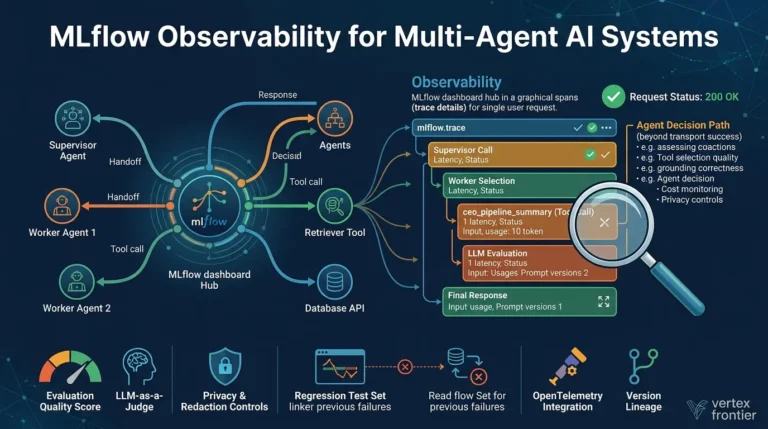
Vertex Frontier’s guides on reliable AI-agent harnesses and multi-agent observability with MLflow extend this idea into production operations: a correct final response may still conceal a dangerous tool path, a failed retry, an unauthorized retrieval, or a memory write that will damage future runs.
For a working definition of agent harness engineering as a production discipline, one that separates the model, the prompt, the tool layer, the runner, the runtime, and the harness as the engineering layer that makes them work together, see our primer on what harness engineering actually covers and what it does not.
For a concrete, code-level implementation of that harness, typed AgentState, hot/warm/cold memory tiers, retry and circuit-breaker policies, evals that gate deploys, and OpenTelemetry spans, see our walkthrough on building a production agent harness in Python.
Memory security is a control-plane problem
Persistent memory increases capability and risk together. The system now stores information that may be personal, confidential, operationally sensitive, or wrong but persuasive.
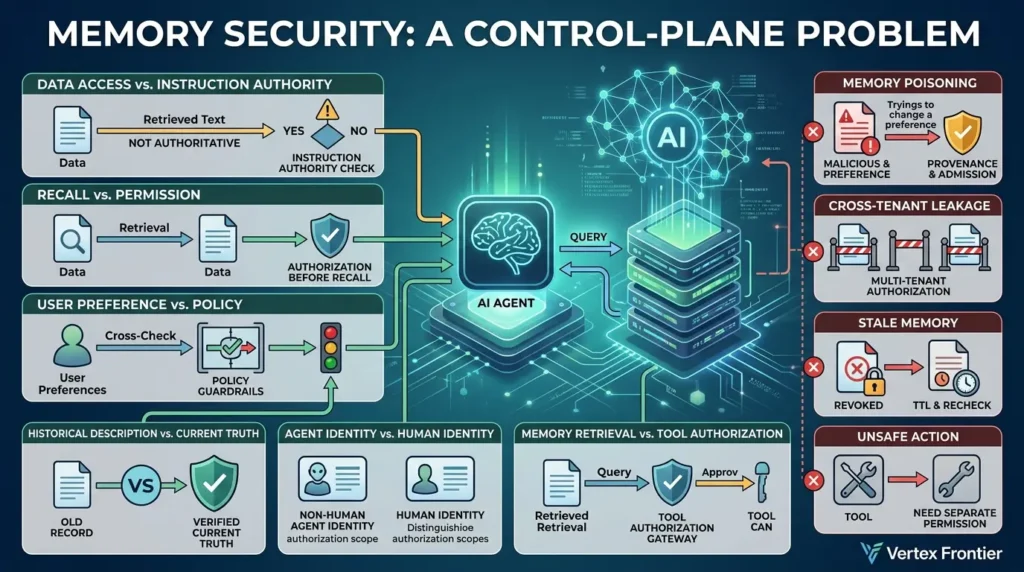
OpenAI’s agent safety guidance covers prompt injection, private-data leakage, approvals, guardrails, and trace grading. These concerns apply directly to memory. Retrieved text is data, not authority. A document that says “ignore previous instructions” should not gain control merely because it was retrieved from a trusted index.
A production memory layer should therefore separate:
- Data access from instruction authority.
- Recall from permission.
- User preference from policy.
- Historical description from current truth.
- Agent identity from human identity.
- Memory retrieval from tool authorization.
Vertex Frontier’s enterprise RAG security architecture and non-human identity blueprint are relevant internal links because they treat retrieval and agent access as security boundaries, not just relevance problems.
In a multi-tenant product, metadata filters are not enough unless the application verifies that the filter itself cannot be manipulated and that the retrieved record is authorized for the current principal. In a multi-agent system, shared memory needs ownership, versioning, conflict handling, idempotency, and replay rules. Otherwise, “shared memory” becomes a distributed systems problem wearing an AI label.
Four memory threats every production team should test
Persistent memory changes the threat model because an incorrect or malicious record can influence future runs. The following matrix is a starting point for a security review, not a claim that these controls eliminate risk.
| Threat | Failure example | First control to test |
|---|---|---|
| Memory poisoning | A false preference or instruction becomes durable | Provenance, admission rules, confidence, review, and correction |
| Cross-tenant leakage | A semantically similar record from another tenant is retrieved | Authorization before retrieval, immutable scope, and adversarial tests |
| Stale memory | An old policy or configuration is treated as current | TTL, source re-check, versioning, and abstention |
| Unsafe action | Retrieved text is treated as permission to call a tool | Separate recall from authorization, approvals, and scoped credentials |
The test should include an attacker-controlled document, a wrong-tenant query, a revoked policy, and a memory that requests an unauthorized tool action. The goal is to observe whether the system refuses, escalates, or rechecks, not merely whether the model produces a plausible answer.
The real evaluation target is the model-plus-memory system
A final-answer benchmark can hide a broken memory layer. The agent may produce the right answer by luck, by rereading the entire transcript, or by using a tool that bypasses the memory architecture entirely.
OpenAI’s agent-evaluation guidance recommends traces, graders, datasets, and evaluation runs. Anthropic’s agent-evaluation guide similarly frames evaluation around transcripts, outcomes, harnesses, multiple trials, and regression testing.
LongMemEval, the academic benchmark for long-term conversational memory, tests capabilities such as information extraction, multi-session reasoning, temporal reasoning, knowledge updates, and abstention. Its reported accuracy drop is a benchmark observation for its tested tasks and systems, not a universal production failure rate.
A serious evaluation suite should test at least five layers:
| Layer | Questions to test | Useful evidence |
|---|---|---|
| Write quality | Did the system preserve the right fact and reject noise? | Admission decisions, labels, provenance |
| Retrieval quality | Did it find the relevant, authorized, current record? | Recall, precision, filters, freshness, abstention |
| Context fit | Did useful memory enter the prompt without drowning the task? | Token use, relevance, conflicts, truncation |
| Trajectory | Did tools, retries, and decisions follow a safe path? | Traces, tool calls, approvals, error recovery |
| Outcome | Did the workflow achieve the business goal without harmful side effects? | Task success, regression, latency, cost, deletion tests |
This evaluation approach changes the buying conversation. A memory vendor that reports impressive retrieval accuracy may still leave unanswered questions about write errors, access control, stale updates, deletion, and end-to-end task reliability.
A reproducible memory evaluation protocol
If a team wants to claim that one storage architecture is better, it should run a workload-specific comparison rather than rely on a vendor demo. The following protocol is the highest honest level available without new test data:
- Freeze the model version, system instructions, tools, corpus snapshot, embedding model, token budget, and retrieval filters.
- Create a labeled task set containing exact lookup, semantic recall, temporal update, conflict, permission, deletion, and abstention cases.
- Run each architecture with the same query set and the same number of trials. Record raw traces, not only final answers.
- Score write admission, authorized retrieval, freshness, context fit, tool path, task outcome, latency, token use, and cost separately.
- Repeat after a corpus update, a policy change, a deletion request, and a simulated queue failure.
- Publish the workload, versions, configuration, exclusions, and raw result definitions before describing a winner.
This protocol is not a benchmark result. It is a way to prevent an unsupported architecture preference from being presented as one.
Implementation appendix: templates you can use before building
If you are not packaging these materials as a separate download, they can live directly in the article as copyable working templates. They are deliberately frameworks and worksheets, not claims that every team needs the same fields or scoring model.
1. Copyable agent memory contract
Complete this contract for each memory type instead of defining “agent memory” as one undifferentiated store.
| Contract field | What to document | Example question |
|---|---|---|
| Memory name and type | A stable name plus fact, episode, procedure, preference, checkpoint, or observation | What kind of state is this? |
| Owner and scope | User, tenant, project, workflow, agent, or global scope | Who owns it, and who may inherit it? |
| Write admission | Rule, event, reviewer, or confidence threshold that permits persistence | Why should this survive the current interaction? |
| Source and authority | Provenance, source-of-truth pointer, and whether the record can authorize action | Is this evidence, context, or current truth? |
| Read policy | Identity, tenant, permission, query mode, ranking, and abstention rule | When may it enter context? |
| Freshness and conflict | Validity window, version, revalidation trigger, and winner-selection rule | What happens when a newer record disagrees? |
| Deletion and correction | How updates propagate to summaries, embeddings, caches, exports, and traces | Can the user correct or remove every derived copy? |
| Evaluation owner | Metric, test set, alert, and person or team responsible | How will we know this memory is helping? |
A contract is useful precisely because it exposes missing decisions. A blank field is not a failure of documentation; it is a design risk that should be resolved before the memory is allowed to influence an irreversible action.
2. Memory-substrate decision scorecard
Use a workload-specific score from 1 to 5 only after defining the query and governance requirements. The numbers are team judgments, not a universal benchmark.
| Criterion | Weight for this workload | Relational | Vector | Hybrid / graph |
|---|---|---|---|---|
| Authoritative transactions and constraints | __/5 | __/5 | __/5 | __/5 |
| Semantic retrieval and paraphrase tolerance | __/5 | __/5 | __/5 | __/5 |
| Exact filters, tenant isolation, and authorization | __/5 | __/5 | __/5 | __/5 |
| Freshness, versioning, and deletion | __/5 | __/5 | __/5 | __/5 |
| Relationships, multi-hop access, and traceability | __/5 | __/5 | __/5 | __/5 |
| Weighted total | __/25 | __/125 | __/125 | __/125 |
Do not select the highest total automatically. A design that scores well on semantic retrieval but fails an authorization or deletion requirement may be unacceptable despite its aggregate score. Treat security and authority as gating criteria when the workload requires them.
3. Evaluation worksheet for a first production pilot
Record these fields before and after the pilot so a future model upgrade is not confused with a memory improvement:
Workload and owner:
Model and version:
Memory policy version:
Storage configuration:
Corpus or event snapshot date:
Query/task set size and composition:
Tenant and authorization assumptions:
Token budget and tool configuration:

Write admission result:
Authorized retrieval result:
Freshness and conflict result:
Context-fit result:
Tool-path and approval result:
End-to-end task result:
Deletion and correction result:
Latency, token, and cost observations:
Known failure cases and next mitigation:
This worksheet records an evaluation setup; it does not create a benchmark result by itself. Publish numerical outcomes only with the workload, versions, configuration, metric definitions, and raw-result boundary that produced them.
Oracle’s “last line of defense” thesis, and its limit
Oracle is making a clear architectural case for a governed, unified memory core inside the database. Its AI Agent Memory product material describes capabilities such as scoped metadata, expiration, deletion, and hybrid retrieval. Its technical articles argue that a database can bring relational, vector, lexical, graph, lifecycle, and governance capabilities closer together. That argument is strategically important because it reframes memory as an enterprise state rather than an isolated AI feature.
But the phrase “No Memory, No Harness: Why the Database Is the Last Line of Defense” should be handled carefully. The research package verifies it as the title of a Kay Malcolm talk listed for AI Engineer World’s Fair, where Malcolm is identified as Oracle VP Product Management. It does not verify the phrase as a formal Oracle corporate doctrine or as an independently proven industry law.
The strongest use of the Oracle thesis is therefore as a case study:
- A database can centralize state, scope, auditability, and multiple retrieval modes.
- A governed store can make deletion and lifecycle controls more explicit.
- A shared memory broker can simplify coordination across agents.
- A database cannot fix bad extraction, incorrect reasoning, unsafe tools, stale source data, or poor evaluation.
- A unified database is one design choice; polyglot systems may be better when workload boundaries and team expertise justify them.
Oracle reports LongMemEval results for separate configurations in its materials. Those figures should be attributed to Oracle, kept separate, and not combined into a new number. They are not an apples-to-apples independent comparison against every vector, graph, relational, or file-based architecture.
That limitation actually strengthens the larger argument. The debate is not “Oracle versus vectors.” It is whether the organization has a coherent memory contract and can measure it.
Before and after: what changes in a production architecture?
Consider an agent that helps a support team resolve enterprise incidents.
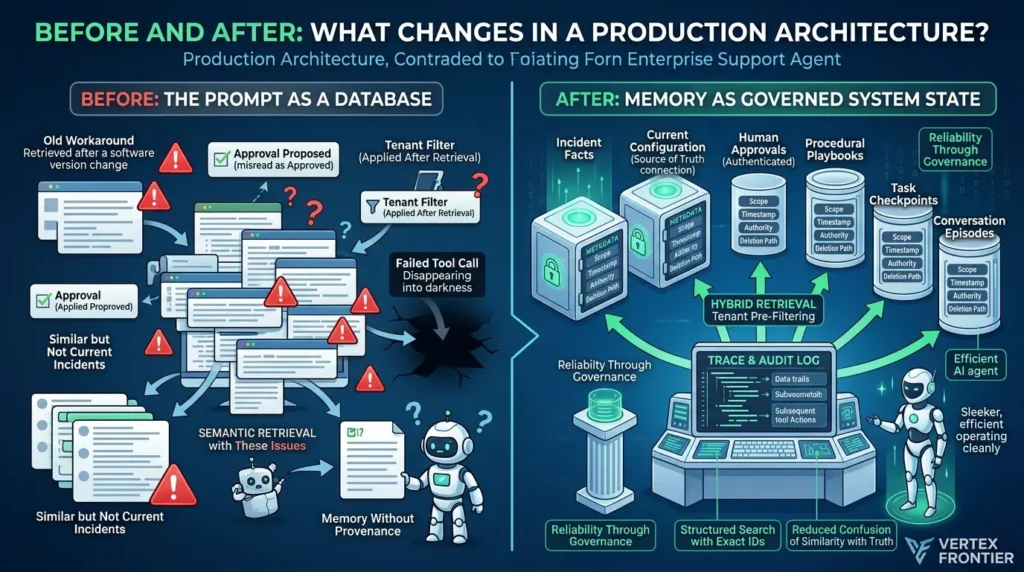
Before: the prompt as a database
The first version stores the conversation, summarizes it at the end, embeds the summary, and retrieves the nearest summaries for the next ticket. It looks simple. It also creates predictable problems:
- an old workaround is retrieved after the software version changes;
- the summary says the customer approved a change, but the approval was only proposed;
- a tenant filter is applied after semantic retrieval rather than before it;
- a failed tool call disappears into the transcript;
- the model sees similar incidents but cannot tell which one is current;
- a new agent inherits a memory without knowing its provenance.
After: memory as governed system state
The improved architecture separates incident facts, current configuration, human approvals, procedural playbooks, task checkpoints, and conversation episodes. Each memory has a scope, timestamp, authority, and deletion path. Exact identifiers use structured search. Current configuration is fetched from the source of truth. Prior incidents use hybrid retrieval. A trace records which memories entered the context and which tool actions followed.
The result is not necessarily a smarter model. It is a system with fewer ways to confuse similarity with truth.
That is the contrarian point: memory architecture often improves reliability by reducing what the model is allowed to believe, not by giving it more information.
Common mistakes teams make with agent memory
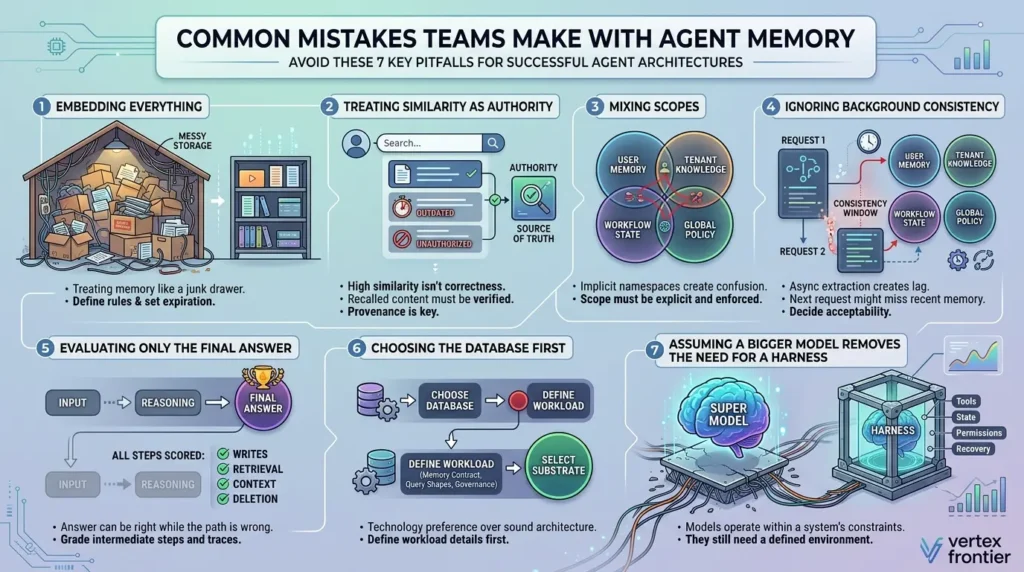
1. Embedding everything
A memory store is not an attic. If every message becomes a durable vector, retrieval quality and governance degrade together. Define admission rules and expiration before increasing storage.
2. Treating similarity as authority
A highly similar record can be outdated, unauthorized, or descriptive rather than prescriptive. Use source-of-truth tools for mutable state and return provenance with recalled content.
3. Mixing scopes
User memory, tenant knowledge, workflow state, and global product policy should not share an implicit namespace. Scope should be explicit in storage and enforced outside the prompt.
4. Ignoring background consistency
Asynchronous extraction can keep the response path fast, but it creates a window in which the next request cannot see the new memory. Decide whether that is acceptable for each memory type.
5. Evaluating only the final answer
The answer can be right while the memory write, authorization check, or tool path is wrong. Grade traces, writes, retrieval, context assembly, and deletion as well as outcomes.
6. Choosing the database before defining the workload
The correct sequence is memory contract, query shapes, authority and governance, evaluation workload, then substrate. Reversing that sequence turns a technology preference into an architecture.
7. Assuming a bigger model removes the need for a harness
A stronger model may reason better, but it still operates within the tools, state, permissions, context selection, and recovery mechanisms the system provides.
A founder’s decision framework
The practical question is not whether memory will “win” the AI race in the abstract. It is whether memory is the current bottleneck in your product.
Use this test:
- If the agent fails because it cannot reason about a novel problem, improve model capability, decomposition, or tool design.
- If it fails because it forgets decisions, retrieves stale state, loses workflow progress, or violates scope, memory architecture is probably the bottleneck.
- If it fails because the underlying data is wrong or late, fix data freshness and ownership before adding another retrieval layer.
- If it fails because nobody can explain what happened, invest in harness observability and trace evaluation.
- If it fails because the business cannot accept its actions, improve approvals, policy enforcement, and source-of-truth boundaries.
That is the strategic shift. The LLM remains important, but the model is no longer the whole product. The durable advantage may sit in the system that decides what the model sees, remembers, trusts, and is allowed to do.
Production-readiness check
Use this short checklist before calling an agent-memory layer production-ready:
- Can it reject irrelevant, untrusted, or out-of-scope memory?
- Can it identify stale and conflicting records?
- Are authorization filters applied before a record reaches the model?
- Can a deletion request remove derived summaries, embeddings, caches, and exports?
- Can the team trace which memory influenced a tool call?
- Can the system abstain when authoritative evidence is missing?
- Can a failed background write be retried and reconciled?
Interpretation: a “no” is not automatically a reason to stop shipping. It is a visible risk that should have an owner, a mitigation, and a test.
The future winners will optimize memory economics, not only model intelligence
A useful prediction follows from the evidence: in long-running and enterprise agents, teams that explicitly manage memory admission, retrieval, scope, provenance, freshness, deletion, and evaluation will outperform teams that only enlarge prompts, assuming comparable model, data, and operating conditions.
That is a hypothesis, not a universal benchmark result. It can be tested.
Run the same agent workflow with different memory policies and substrates. Hold the model, task set, corpus, token budget, permissions, and evaluation criteria constant. Measure not only final-task success, but also memory precision, harmful recall, stale-memory rate, authorization failures, latency, token cost, recovery quality, and deletion correctness.
If memory architecture is the bottleneck, those measurements will move before a model leaderboard does.
The race, then, is not between “LLM versus database.” It is between systems that treat memory as an afterthought and systems that make it a first-class engineering discipline.
FAQ: AI agent memory architecture
What is AI agent memory architecture?
AI agent memory architecture is the design of how an agent writes, stores, scopes, retrieves, updates, expires, deletes, and evaluates information across tasks or sessions. It includes memory policy and governance—not only a vector index.
Is agent memory the same as a context window?
No. A context window is the model’s active working set for a request or interaction. Agent memory is durable or semi-durable state that the system selectively retrieves into that working set.
Should agent memory use a vector database or a relational database?
Choose according to query shape and governance. Vectors help with semantic retrieval; relational systems help with transactions, exact filters, constraints, and authoritative state. Many production systems use hybrid retrieval or multiple stores.
Can a vector database be the system of record for an AI agent?
Usually it should not be the sole system of record for mutable transactional facts such as approvals, permissions, balances, or order status. Use semantic retrieval for context and a controlled source-of-truth system for current authoritative values.
What does harness engineering mean for AI agents?
Harness engineering is the design of the tools, artifacts, context management, memory, tests, feedback loops, permissions, traces, and recovery mechanisms around the model. It evaluates the model as part of a working system.
How should agent memory be evaluated?
Evaluate the complete system: whether it writes the right memories, retrieves relevant and authorized records, fits them into context, handles stale or conflicting facts, follows a safe tool path, achieves the task, and correctly supports deletion and correction.
Is Oracle’s database “last line of defense” thesis proven?
It is a useful Oracle-associated architecture thesis and the phrase is verified as a Kay Malcolm talk title. It is not independently proven as a universal rule or verified as formal Oracle corporate doctrine. A database can centralize state and governance, but it cannot solve every reasoning, retrieval, security, or tool problem.
📋 Article Timeline & History
Successfully updated on September 25, 2026 with the latest details.
This article was originally published on September 19, 2026.

Was this article helpful?



[…] and which source of truth wins when memory conflicts with current state. Vertex Frontier's guide to agent memory architecture unpacks that layer separately from both long-context prompting and RAG retrieval, because the write […]
[…] retrieved, expired, and treated as authoritative rather than merely similar, see Our guide to agent memory architecture, which treats that boundary as a separate production layer, not an extension of the session […]
[…] each with its own write-admission, read-authorization, freshness, and conflict rules. Our guide to agent memory architecture unpacks the distinction in detail, including why a semantic retrieval layer should never be treated […]
[…] and deletion propagation across summaries, embeddings, caches, exports, and traces. Guide to agent memory architecture unpacks those controls as a control-plane problem, which is the same shape of evidence a regulator […]
[…] notes that in-memory persistence disappears on restart. Vertex Frontier’s coverage of agent memory architecture goes deeper into provenance, authority, freshness, and read/write […]