


A context window is an input-capacity number. It tells you the largest prompt a model’s interface will accept before it truncates or rejects the request. It does not tell you whether the model can find a fact buried in that prompt, connect it to three other facts scattered across the same document, summarize the result faithfully, or do any of that without quietly getting worse as the input grows.
That gap between advertised capacity and reliable performance is the entire subject of long-context benchmarking. A model can accept 200,000 tokens and still fail a task at 40,000 tokens that it handled easily at 4,000. The teams behind NVIDIA’s RULER, BABILong, NoLiMa, and HELMET each test this from a different angle, but they converge on the same underlying finding: performance degrades with length, and the degradation curve is not predictable from the number on the pricing page.
This article gives you a working vocabulary for the problem, a taxonomy of the benchmark families you’ll encounter, a step-by-step protocol for building your own test, and a scorecard for comparing models on more than one number. It does not hand you a ranking of “the best” long-context model, no current public dataset supports that claim across providers, and treating one would mislead you the moment a model version changes.
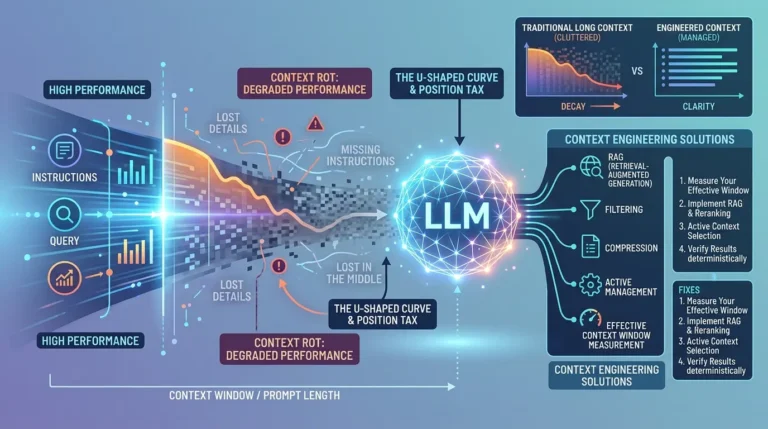
Vertex Frontier’s guide to context rot in long-context models goes deeper into the mechanics behind this specific failure mode.
Key Takeaways
Click any topic to expand or collapseTest at multiple context lengths, not just one.
A context window is a capacity number, not a quality guarantee — test at multiple context lengths, not one, since a single data point can’t show a degradation curve.
Vary information positions across the prompt.
Move the relevant information to different positions in the prompt (start, middle, end) instead of always testing with the answer near the top.
Add realistic distractors to test robustness.
Add distractors that look similar to the real answer — a model that passes a clean needle-in-a-haystack test can still fail once realistic noise is present.
Score retrieval, reasoning, and output separately.
Score retrieval accuracy, reasoning accuracy, and output quality separately — they are different failure modes, and averaging them hides which one broke.
Always establish a short-context baseline.
Always run a short-context baseline. A model that fails at 4K tokens isn’t demonstrating context rot at 64K — it’s demonstrating that the task itself is hard.
Build a private, representative holdout test.
No public benchmark score is proof of production readiness. Build a private, representative holdout test from your own documents before deciding.
What is a long-context LLM benchmark?
A long-context LLM benchmark is a structured test that measures how a model’s ability to retrieve, reason over, and generate from information changes as the amount of input text grows. It is not the same as a capacity test. A capacity test asks, “will the API accept this many tokens?” A long-context benchmark asks, “does the model still perform the task correctly once that many tokens are in play?”
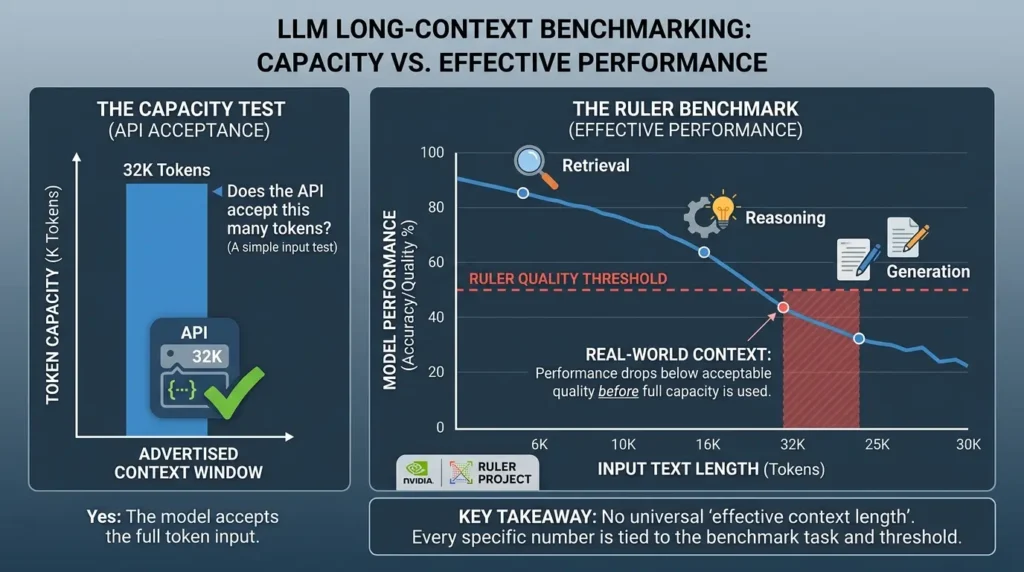
The distinction matters because the two numbers move independently. NVIDIA’s RULER project was built specifically to interrogate this gap, framing itself around the question of what a model’s “real” context size is, as opposed to the one printed in its documentation.
RULER’s published results show that a meaningful share of models advertising context windows of 32K tokens or more do not clear RULER’s own quality threshold once you actually test them at 32K, a finding that’s specific to RULER’s tasks and threshold definition, not a claim about every benchmark or every model.
That threshold-specific framing is important, and it recurs throughout this article. No benchmark defines a universal “effective context length” that transfers cleanly to your application. Each one defines its own quality floor, its own tasks, and its own way of counting. Treat every specific number you read, including the ones in this article, as attached to the benchmark, model version, and task that produced it, not as a portable fact about a model in general.
A long-context LLM benchmark measures whether a model’s retrieval, reasoning, and generation quality holds up as input length increases, distinguishing that measured performance from the model’s advertised or accepted maximum context size.
Context window versus effective context
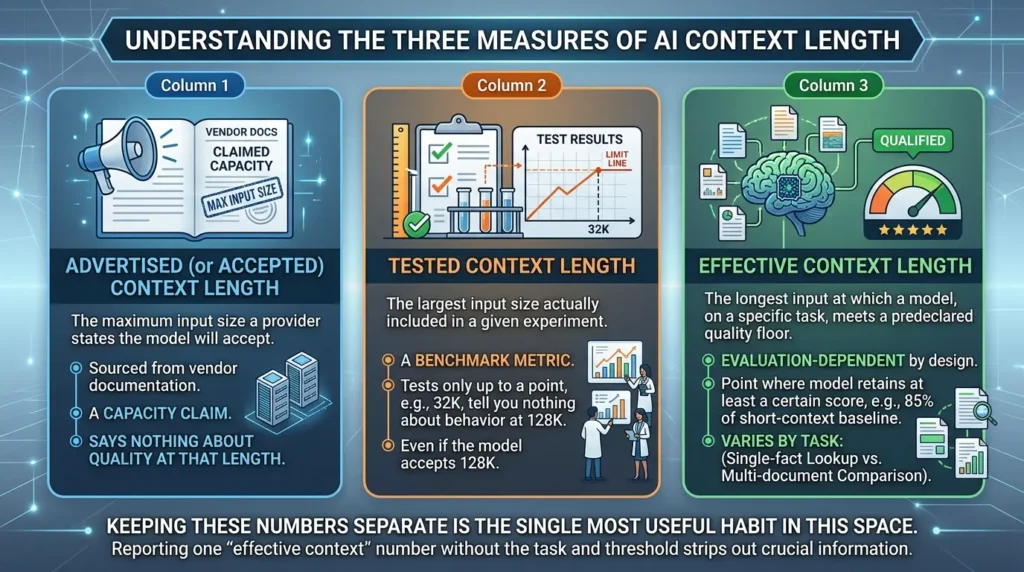
Three different numbers get used interchangeably in casual conversation, and keeping them separate is the single most useful habit in this space.
- Advertised (or accepted) context length: The maximum input size a provider states the model will accept. This is a capacity claim, sourced from vendor documentation, and it says nothing about quality at that length.
- Tested context length: The largest input size actually included in a given experiment. A benchmark that only tests up to 32K tells you nothing about behavior at 128K, even if the model accepts 128K.
- Effective context length: The longest input at which a model, on a specific task, with a specific prompt and grader, still meets a predeclared quality floor. This number is evaluation-dependent by design. NoLiMa’s methodology defines effective length as the point at which a model retains at least 85% of its short-context baseline score, and its authors are explicit that this threshold is part of the benchmark’s operational definition, not a law of nature. BABILong’s analysis uses a similar 85%-accuracy convention.
Because effective length is defined relative to a threshold and a task, the same model can have a long effective window for single-fact lookup and a much shorter one for multi-document comparison, contradiction resolution, or long-form synthesis. Reporting one “effective context” number for a model, without naming the task and threshold that produced it, strips out the information that made the measurement useful in the first place.
A useful planning ratio, borrowed from how these benchmarks already report their own results, is:
effective-window ratio = longest acceptable input length ÷ advertised context length × 100
This ratio is a way to compare how much of a model’s advertised window survives contact with a specific task and threshold, not an intrinsic property of the model, and not comparable across benchmarks that use different thresholds. Use the calculator below to compute it for your own test results.
Effective-Window Ratio Calculator
Compute your model’s context efficiency based on empirical evaluation.
Measurement boundary: this ratio is meaningful only when the numerator and denominator use compatible token accounting and the quality floor is stated. It should not be used to compare models measured with different tasks, tokenizers, prompts, evaluators, or thresholds.
Advertised context is a ceiling, not a promise. Effective context is a measurement you make yourself, against your own task and your own bar for "good enough."
Why basic Needle-in-a-Haystack tests are not enough
The original needle-in-a-haystack (NIAH) test is simple by design: plant a fact inside a long stretch of unrelated text, ask the model to retrieve it, and sweep the fact's position and the total length. The public NIAH repository includes multiple test variants and run metadata. Before reproducing a result, inspect the current repository revision and record the exact prompt, corpus, model identifier, token-counting method, and configuration used. That run-level record is a useful reproducibility pattern, but repository contents can change over time.
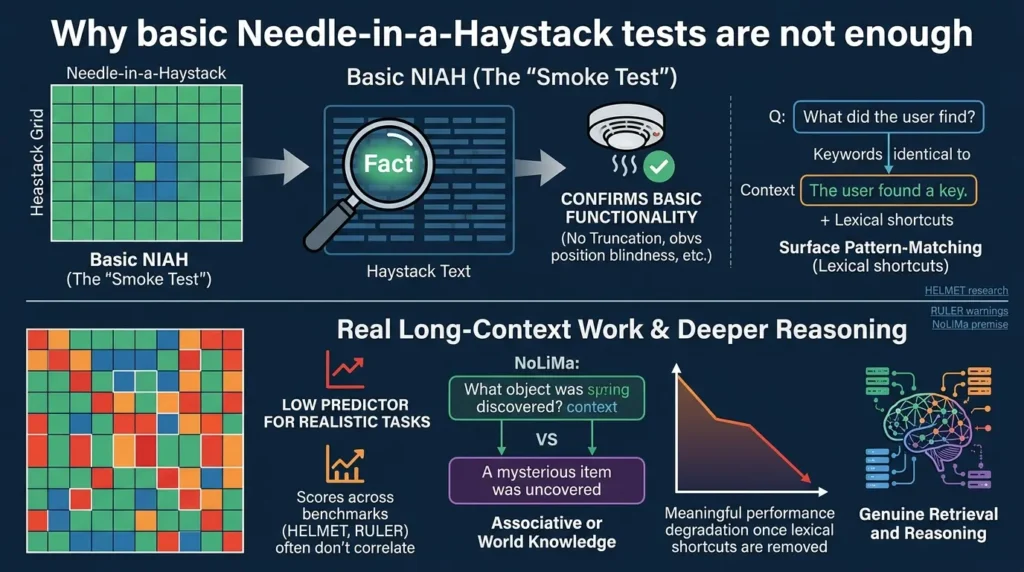
The conceptual limitation is what makes vanilla NIAH insufficient on its own. If the question shares distinctive words with the planted fact, the model can succeed through surface pattern-matching rather than genuine retrieval and reasoning. HELMET's research found that NIAH-style scores are a poor predictor of performance on more realistic, application-centric tasks, and that scores across different benchmark categories often don't correlate well with each other.
RULER's own documentation makes a related point directly: it warns that its expanded task suite is not comprehensive and cannot replace realistic evaluation, even though it goes well beyond vanilla NIAH. NoLiMa's entire premise is a response to this same weakness, its needles are built to minimize literal word overlap with the question, forcing the model to rely on associative or world knowledge rather than lexical matching, and its authors report meaningfully faster degradation once that lexical shortcut is removed.
Rule of thumb: treat a clean NIAH heatmap as a smoke test that rules out gross failures, truncation bugs, obvious position blindness, tokenizer mismatches, not as evidence that a model can do real long-context work.
The main dimensions of long-context evaluation
Long-context capability isn't one skill. It decomposes into distinct stages, and a model can be strong at one and weak at another. HELMET's authors frame this as a reason no single synthetic score can stand in for the whole picture. The stages below are a useful mental model for organizing any test suite.
Retrieval accuracy across context positions
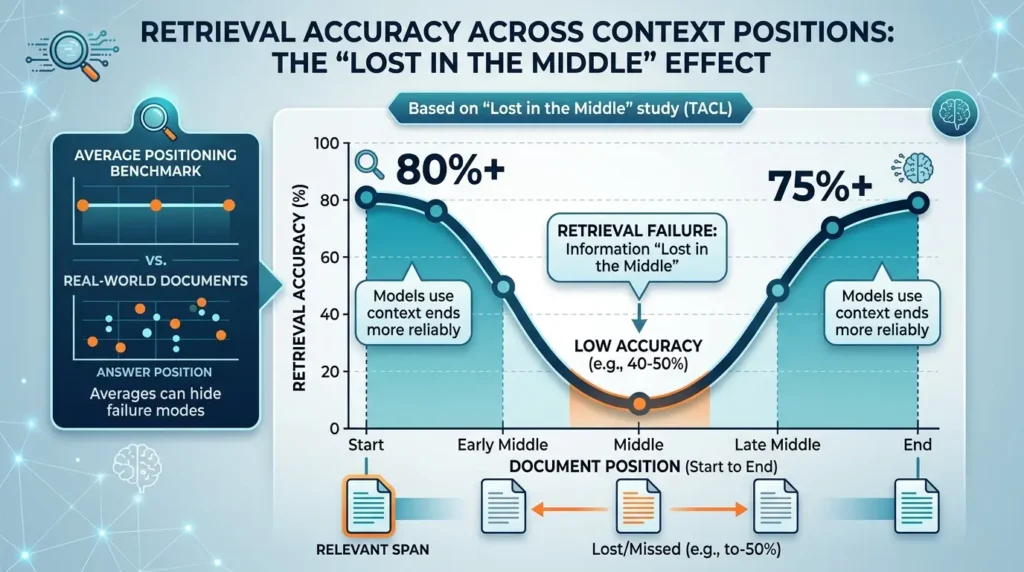
Can the model find the relevant span at all, and does that ability change depending on where the span sits in the prompt? The Lost in the Middle study, published in TACL, is the foundational evidence here: across multi-document QA and key-value retrieval tasks, it found a consistent pattern where models used information placed near the beginning or end of the context more reliably than information placed in the middle, a U-shaped performance curve that held even for models marketed as long-context systems.
This is not a footnote. It means a benchmark that only reports an average across random positions can hide a failure mode that matters enormously in practice, because real documents put the answer wherever the answer happens to be, not conveniently at the start.
Distractor resistance
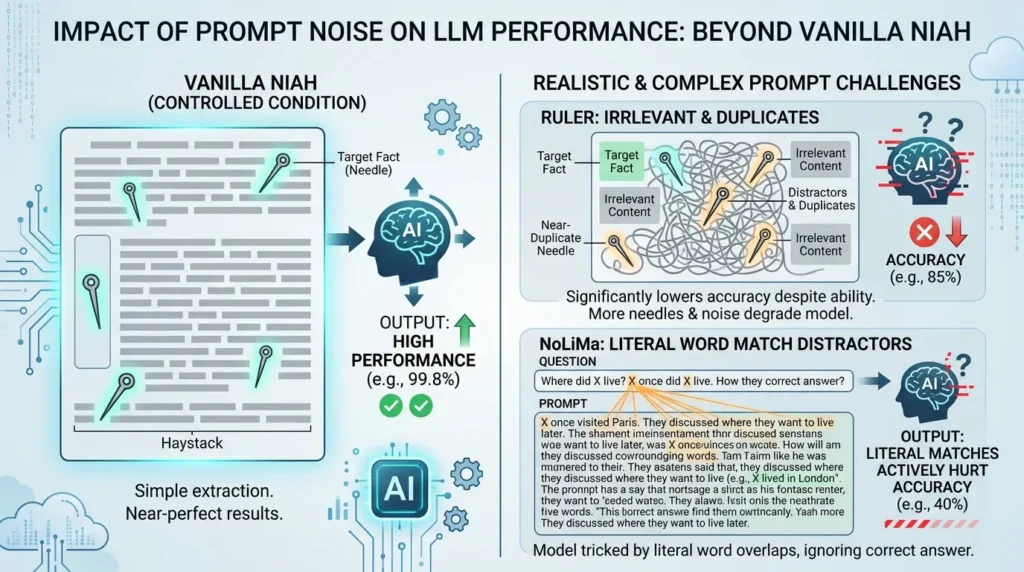
Real prompts rarely contain only relevant information. RULER's task design deliberately adds irrelevant and near-duplicate content alongside the target fact, and its reported results show that near-perfect vanilla-NIAH performance does not protect a model from significant degradation once distractors and multiple needles are introduced.
NoLiMa goes further and shows that distractors sharing literal words with the question can actively hurt accuracy, even when the correct answer is present elsewhere in the prompt.
Multi-needle and multi-hop retrieval
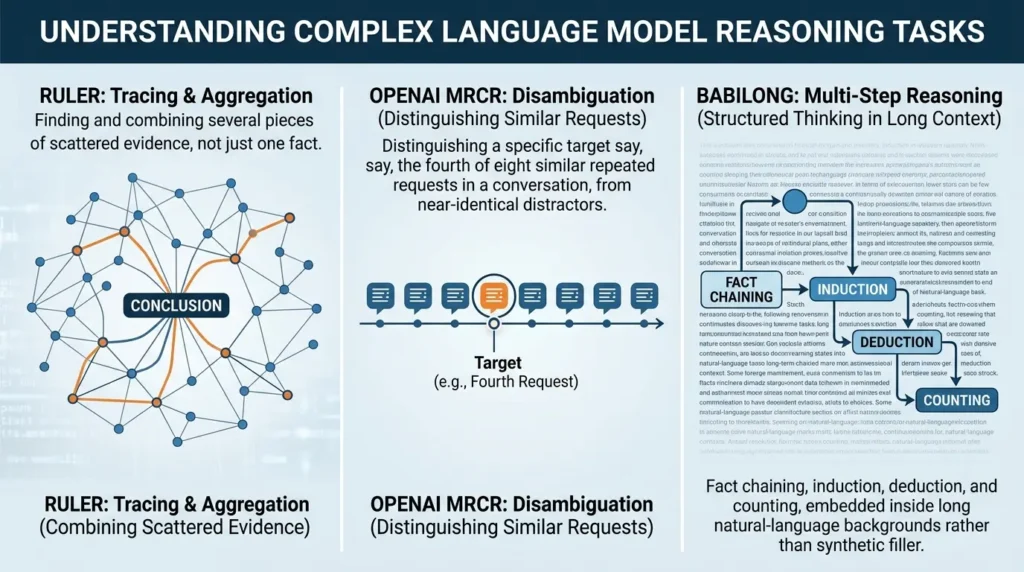
Some real tasks require finding and combining several pieces of scattered evidence, not just one fact. RULER's tracing and aggregation tasks were built for exactly this. OpenAI's MRCR (Multi-Round Coreference Resolution) dataset tests a related but distinct skill: distinguishing a specific target say, the fourth of eight similar repeated requests in a conversation, from near-identical distractors, which is a disambiguation problem rather than a pure lookup problem.
BABILong extends this into structured multi-step reasoning: fact chaining, induction, deduction, and counting, embedded inside long natural-language backgrounds rather than synthetic filler.
Long-document question answering
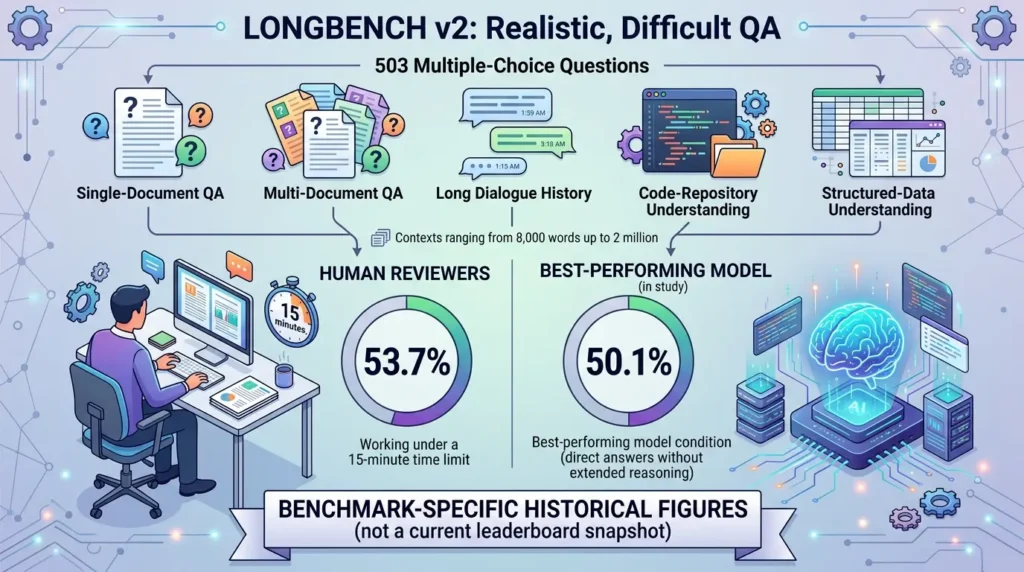
LongBench v2 is built around exactly this kind of realistic, difficult QA: 503 multiple-choice questions spanning single- and multi-document QA, long dialogue history, code-repository understanding, and structured-data understanding, with contexts ranging from 8,000 words up to 2 million.
In the study reported alongside the benchmark, human reviewers working under a 15-minute time limit reached 53.7% accuracy, and the best-performing model condition in that same study reached 50.1% on direct answers without extended reasoning, both benchmark-specific historical figures tied to that particular study, not a current leaderboard snapshot.
Summarization and synthesis
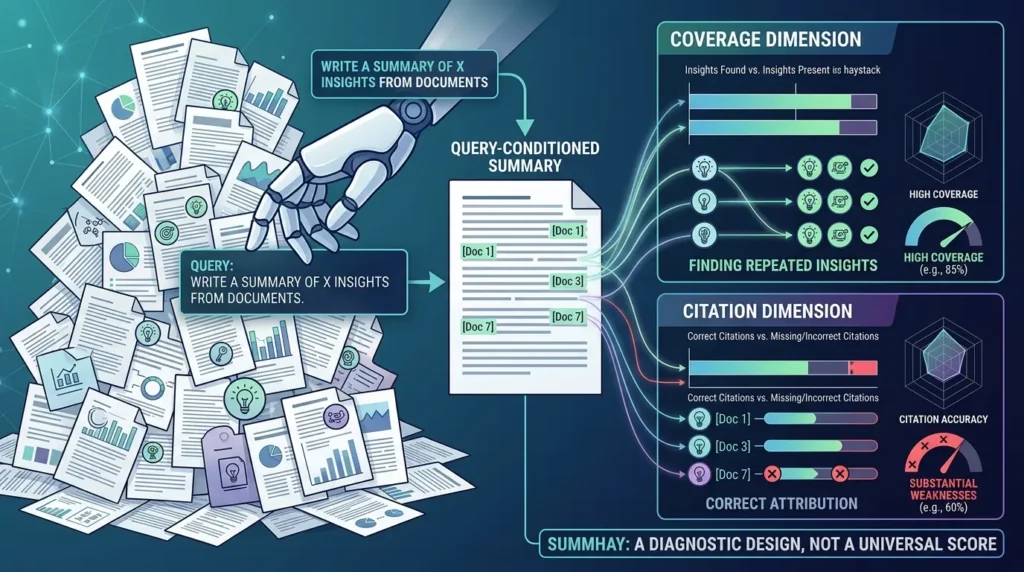
Retrieval alone doesn't prove a model can produce something useful from what it found. SummHay tests this directly: it builds haystacks of documents containing repeated insights and asks a model to write a query-conditioned summary that both covers the relevant insights and correctly cites which documents they came from, scored on separate Coverage and Citation dimensions.
In the paper's reported experiments, full-context systems and systems given oracle-quality retrieval both showed substantial weaknesses on the combined coverage-and-citation task. The exact result depends on the paper's models, prompts, and grading setup, so use SummHay as a diagnostic design rather than a universal long-context score.
Codebase understanding
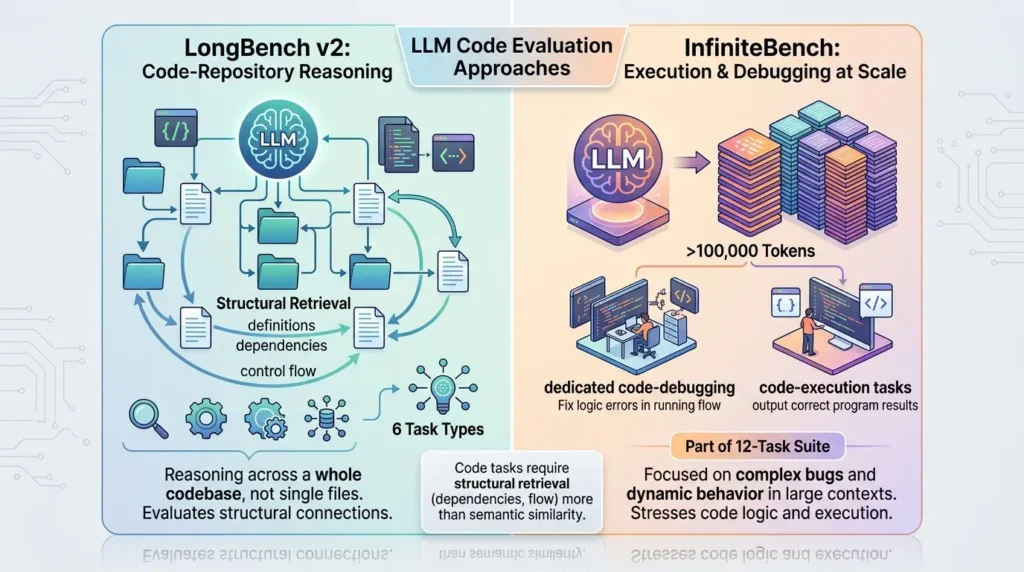
LongBench v2 includes a code-repository understanding category as one of its six task types, testing whether a model can reason across a codebase rather than a single file. InfiniteBench takes a related but distinct approach with dedicated code-debugging and code-execution tasks inside its broader 12-task suite designed for contexts above 100,000 tokens.
Code tasks stress a slightly different capability than prose QA: they require tracking definitions, dependencies, and control flow across files, which is a structural retrieval problem more than a semantic one.
Multilingual and multimodal performance
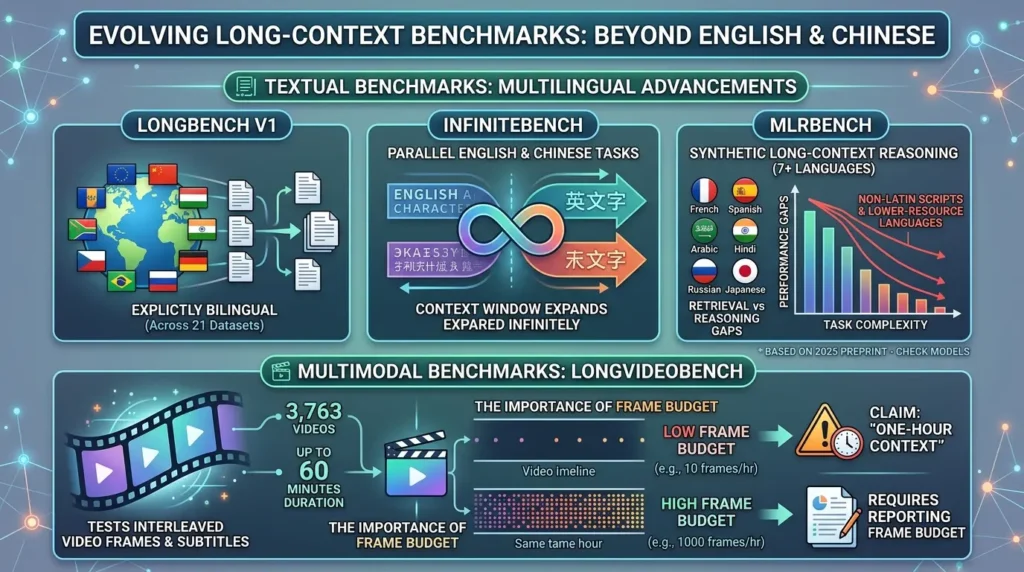
Most of the widely-cited long-context benchmarks are English-only or English/Chinese, which limits how much they tell you about a multilingual product. LongBench v1 is explicitly bilingual across its 21 datasets, and InfiniteBench includes parallel English and Chinese tasks.
MLRBench extends synthetic long-context reasoning across seven languages and reports that gaps between retrieval and reasoning performance widen for lower-resource and non-Latin-script languages as task complexity increases, a finding from a 2025 preprint that should be checked against its exact model set and version before being generalized.
On the multimodal side, LongVideoBench tests interleaved video frames and subtitles across roughly 3,763 videos with durations extending to 60 minutes, using explicit frame-budget controls in its loader. This matters for a simple reason: a "one-hour video context" claim means very different things depending on how many frames were actually sampled from that hour, so frame budget has to be reported alongside any score.
Latency, cost, and reliability
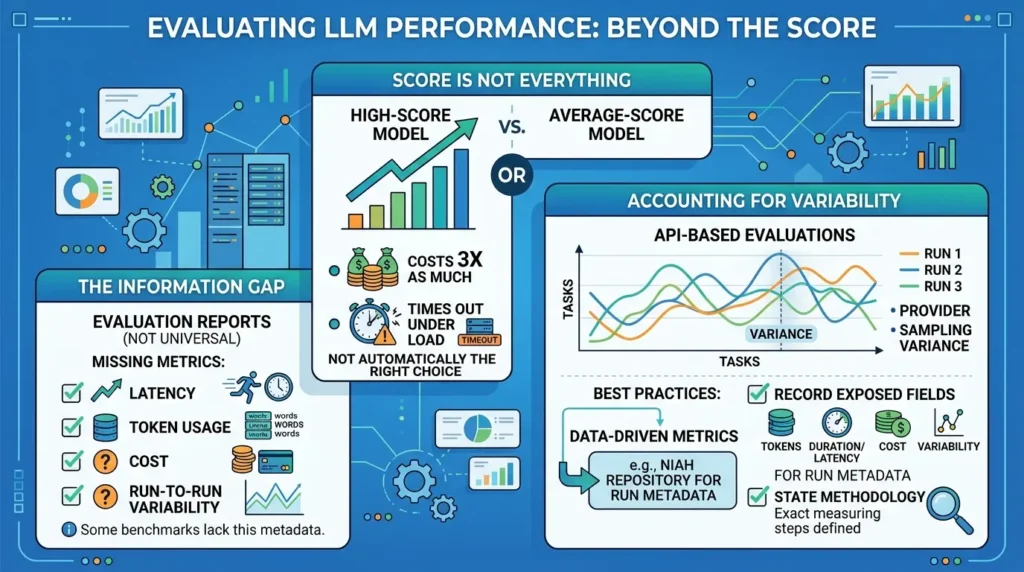
A model that scores well but costs three times as much per task, or times out under load, is not automatically the right choice. Some benchmark implementations and evaluation reports record latency, token usage, cost, or run-to-run variability, but this is not universal.
The public NIAH repository includes run metadata such as token usage and duration, while API-based evaluations may vary across runs because provider behavior and sampling can introduce variance. Record these fields when the benchmark or provider exposes them, and state exactly how each field was measured.
Which benchmark should you use?
The right benchmark depends on the failure mode you need to isolate. Use this matrix to choose a starting point rather than treating the benchmarks as interchangeable leaderboards.
| If you need to test… | Start with… | Add this layer | What the result can tell you | What it cannot establish by itself |
|---|---|---|---|---|
| Basic retrieval across length and position | Needle-in-a-Haystack | A position-balanced custom task | Whether the model can retrieve a planted fact under controlled conditions | Real-world reasoning, citation quality, or domain performance |
| Multi-needle retrieval, tracking, and aggregation | RULER | Your own multi-document tasks | Whether several controlled long-context skills degrade as input grows | Production readiness or performance on your document distribution |
| Resistance to literal word-overlap shortcuts | NoLiMa | Domain-specific low-overlap questions | Whether retrieval remains reliable when the question does not repeat the needle’s wording | General reasoning quality or every type of long-context task |
| Distributed-fact reasoning | BABILong | A short-context control and task-specific rubric | Whether the model can connect facts embedded in longer backgrounds | Whether failures come from length, task difficulty, or both without a baseline |
| Realistic multi-task long-context understanding | LongBench v1/v2 | Open-ended tests from your workload | How a model behaves across several realistic task families | A single transferable model ranking across all applications |
| Extreme-length mixed-task behavior | InfiniteBench | Cost, latency, and failure logging | Whether the model remains usable at very long input lengths across varied tasks | Why a model failed or whether the same behavior holds on your corpus |
| Application-centric retrieval, RAG, citation, and synthesis | HELMET | Human-audited samples and current configuration records | How performance differs across application-oriented categories | A universal score or a substitute for private holdout testing |
| Repeated similar requests or coreference disambiguation | MRCR | Multi-turn and tool-state tests if relevant | Whether the model can identify the correct instance among similar requests | General long-document comprehension |
| Query-conditioned summarization with attribution | SummHay | Human citation review | Whether coverage and citation attribution fail separately | Faithfulness for every domain or every summary style |
Editorial note: This matrix is a selection aid synthesized from the cited benchmark scopes. It is not a new benchmark result and should not be presented as an empirical ranking.
The most useful long-context benchmarks
No single benchmark covers every dimension above. The table below summarizes what each one is actually built to measure, where it falls short, and when it's the right tool to reach for. Treat every score you see attached to these benchmarks as tied to a specific paper version, model snapshot, and configuration, repositories update, and old leaderboard numbers age quickly.
| Benchmark | Main task | What it measures | Strength | Limitation | Best use |
|---|---|---|---|---|---|
| Needle-in-a-Haystack (NIAH) | Locate a planted fact across varying length/position | Basic retrieval, position sensitivity | Simple, reproducible, well-documented v2 runner with recipe logging | Easily saturated; exact-match rewards surface cues, not reasoning | Smoke test to catch gross failures before deeper testing |
| RULER | Retrieval, multi-needle, variable tracking, aggregation, QA | Controlled degradation across multiple sub-skills as length grows | Configurable, task-diverse, explicit about not being comprehensive | Synthetic distribution; doesn't reproduce real document structure or citation demands | Regression testing and model-development diagnostics |
| NoLiMa | Retrieval with minimal question–needle word overlap | Whether a model relies on lexical shortcuts vs. genuine association | Strong counterweight to literal-match bias in other tests | Still a deliberately controlled, synthetic task | Shortcut-resistance layer alongside standard NIAH |
| BABILong | Fact chaining, induction, deduction, counting in long natural text | Distributed-fact reasoning as length and complexity increase | Tests reasoning explicitly, not just lookup; includes a 0K control condition | Some tasks are hard even with no distractor text, which can confound length-degradation claims | Stress-testing reasoning beyond single-fact retrieval |
| LongBench v1 / v2 | Single/multi-doc QA, dialogue, code, structured data, summarization | Realistic, difficult, multi-task long-context understanding | Broad realistic coverage; v2's multiple-choice format improves grading reliability | Multiple-choice format can differ from open-ended production behavior | Cross-model screening on realistic task diversity |
| InfiniteBench | QA, summarization, code, math, retrieval, dialogue | Behavior at extreme length (100K+ tokens) across mixed task types | Explicitly designed to exceed the ~10K-token ceiling of earlier suites | Heterogeneous metrics across tasks make a single average hard to interpret | Testing behavior specifically at very long lengths |
| HELMET | Recall, RAG, reranking, citation, long QA, summarization, in-context learning | Broad, application-centric long-context performance | Model-based grading with reported human-agreement checks; explicit about low cross-category correlation | Operationally heavy; large data and compute footprint | High-coverage external reference when the operational cost is acceptable |
| MRCR (OpenAI) | Disambiguate a specific instance among repeated similar requests | Multi-needle order and disambiguation under camouflage | Harder and more realistic than plain UUID lookup | English-only synthetic conversations; surface-similarity grading | Testing multi-needle disambiguation specifically |
| SummHay | Query-conditioned summarization with source citation | Multi-document synthesis, coverage, and attribution | Separates coverage from citation accuracy — two different failure modes | Default pipeline uses model-based grading; disclose evaluator and calibration | Evaluating summarization and citation quality together |
| Lost in the Middle (protocol) | Move the same evidence to different positions in the prompt | Position bias under a fixed task | Foundational, simple to replicate on your own task | A diagnostic protocol, not a complete benchmark on its own | Include in every custom test where document order might matter |
Scroll horizontally on mobile to see all columns.
When you write down a result from any of these benchmarks, attach five things to it: benchmark name, repository commit or paper version, exact model ID, task/threshold definition, and date. A score without that context can't be compared to anything, including a re-run of the same benchmark six months later.
Separate the model test from the system test
A long-context evaluation becomes easier to interpret when it separates three layers that are often mixed together:
| Layer | Controlled or measured component | Example question | Typical failure |
|---|---|---|---|
| Model layer | Model ID, prompt, context length, decoding settings, output limit | Can the model answer correctly when the relevant evidence is present? | Retrieval failure, reasoning failure, malformed output |
| Context-construction layer | Document selection, ordering, tokenization, chunking, compression, deduplication, and distractors | Did the right evidence enter the context in a form the model can use? | Truncation, lost metadata, duplicated evidence, misleading order |
| System layer | Retrieval, reranking, memory, authorization, retries, queueing, tools, and observability | Does the complete application remain accurate, safe, and affordable? | Wrong retrieval, permission leakage, timeout, retry amplification, stale data |
A benchmark that mixes all three layers can still be useful for product evaluation, but it cannot explain which layer caused a failure. For diagnosis, run at least one model-isolated test with a known context and one system-level test using the real retrieval or agent pipeline. Report the boundary explicitly.
Non-proof boundary: a model-only result does not prove that a production RAG or agent system will behave the same way, and a system-level result does not isolate the model from retrieval, prompt construction, authorization, or infrastructure effects.
Create a dataset card before running the benchmark
A compact dataset card prevents a benchmark from becoming an undocumented collection of prompts. Record the following before evaluation:
| Field | Record |
|---|---|
| Dataset name and version | A stable name and revision identifier |
| Intended workload | The product or engineering task the set represents |
| Document types | Reports, contracts, tickets, code, transcripts, policies, or other types |
| Language and domain | Languages, specialist vocabulary, and regional assumptions |
| Document count and size distribution | Counts, minimum/median/maximum token lengths, and relevant percentiles |
| Source and permission basis | Where the documents came from and whether they may be used for evaluation |
| Gold evidence | The source span, document ID, or evidence set supporting each answer |
| Distractor policy | How irrelevant, similar, conflicting, or unauthorized material is constructed |
| Position policy | How evidence locations are sampled and randomized |
| Task mix | Retrieval, multi-hop reasoning, summarization, coding, citation, abstention, or other tasks |
| Split policy | Development, calibration, test, and private holdout separation |
| Contamination checks | Known public sources, overlap review, or an explicit limitation |
| Sensitive-data handling | Redaction, access restrictions, retention, and deletion plan |
| Evaluation owner and date | Responsible person/team and dataset creation date |
How to design a fair long-context model test
This is a practical protocol for testing models against your own workload. It adapts ideas used across RULER, NoLiMa, BABILong, and the Lost in the Middle evaluation protocol without treating any one benchmark as a complete production test.
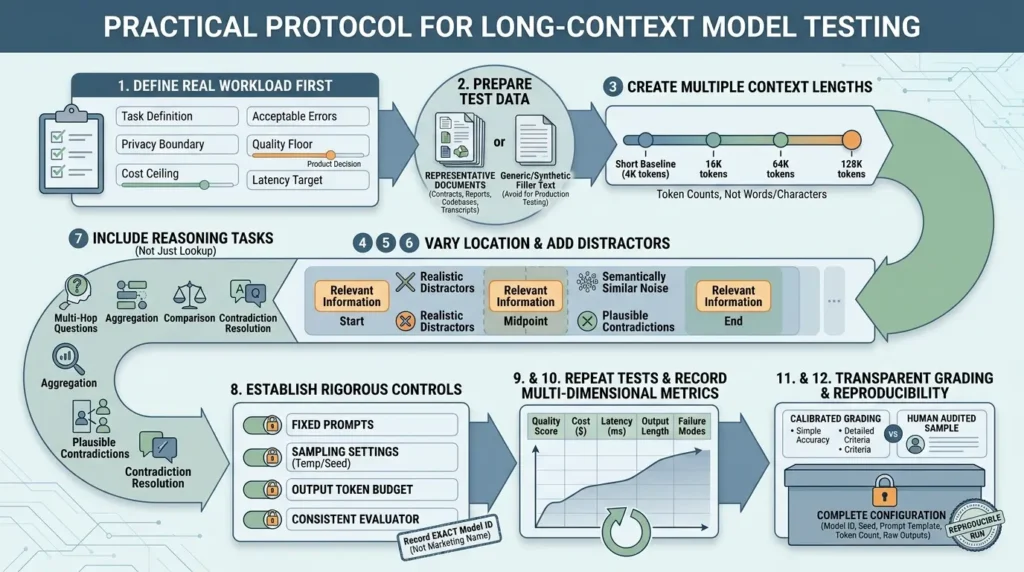
Define the real workload first
Write down the task, the acceptable error types, your privacy boundary, your quality floor, your cost ceiling, and your latency target before you run a single test. The quality threshold is a product decision, not a benchmark constant. Decide what "good enough" means for your use case before you start measuring against it.
Select representative documents
Use documents that resemble what your system will actually process, contracts, reports, transcripts, codebases, not generic filler text. Synthetic haystacks are fine for diagnosing retrieval mechanics, but they can't tell you how a model handles your domain's structure and terminology.
Create multiple context lengths
Test a short baseline (where you already know the task is solvable) plus several progressively longer lengths, using actual token counts from the model's own tokenizer rather than word or character counts. A model that fails at 4K tokens isn't demonstrating context rot at 64K, it's demonstrating that your task is hard at any length, and you need that baseline to tell the two apart.
Vary the location of relevant information
Test with the answer near the start, at the midpoint, and near the end, and randomize where possible. This adapts the core Lost in the Middle protocol, and skipping a position sweep can hide an important failure mode.
Add realistic distractors
Include irrelevant noise, same-domain distractors, and this is the harder and more revealing case, distractors that are semantically similar to the correct answer or that plausibly contradict it.
Test single-needle and multi-needle retrieval
A model that finds one fact reliably can still fail badly when it needs to locate and combine several. Test both explicitly rather than assuming one predicts the other.
Include reasoning and synthesis tasks, not just lookup
Add multi-hop questions, aggregation, comparison, and contradiction-resolution tasks alongside simple retrieval.
Fix prompts and generation settings across every model you compare
Same task set, same answer key, same output-token budget, same temperature or sampling settings, same retry policy, same evaluator, unless you're deliberately studying one of those variables. Record the exact model ID, not a marketing family name, since provider aliases can point to different backends over time.
Repeat each test
Run enough trials to expose sampling variance and position effects. For deterministic settings, record the seed if the provider exposes one; for stochastic settings, record how many trials you ran and how you aggregated them.
Record cost, latency, output length, and failures alongside quality
A model that's 3% more accurate but twice as slow or three times more expensive is not automatically the better choice for your application, that's a trade-off decision, and you need both numbers to make it.
Score outputs with transparent, predeclared criteria
Use exact matches only where an exact answer genuinely exists. For open-ended answers and summaries, use a calibrated grading approach and keep a manually audited sample, since model-based grading can reward verbosity or stylistic similarity over correctness.
Save the complete configuration for reproducibility
Model ID, prompt template, context construction recipe, document IDs, shuffle seed, exact token count, and raw outputs. If you can't reconstruct the exact run six months later, the result isn't reproducible, and a provider's silent model update can invalidate it without you knowing.
The protocol's whole point is to stop a benchmark pass from hiding a production failure. A model can ace single-needle retrieval and still fail your actual workload if that workload needs multi-document synthesis, position-independent retrieval, or citation accuracy, which is exactly why steps 3 through 7 exist as separate, non-optional checks.
Choose an evaluation tier
Not every team needs a research-scale benchmark. A tiered design makes the trade-off explicit while preserving the most important controls.
| Evaluation tier | Appropriate use | Minimum design | Output to retain | Main limitation |
|---|---|---|---|---|
| Smoke test | Early screening and obvious integration failures | Short baseline, two or more lengths, start/middle/end positions, basic retrieval | Raw prompts, outputs, errors, token counts | Too small to support a production decision |
| Diagnostic suite | Comparing candidate models or prompt strategies | Distractors, multi-needle, multi-hop, contradiction, citation, repeated trials | Per-task and per-length results, failure taxonomy, evaluator notes | Still may not represent the full production distribution |
| Release gate | Pre-production approval | Private holdout, system-level pipeline, cost/latency/load tests, authorization and abstention tests | Versioned dataset, configuration, raw outputs, audit sample, approval record | Requires ownership, maintenance, and periodic refresh |
| Research evaluation | Publishing or making a general methodological claim | Public or shareable data, documented sampling, baselines, ablations, statistical analysis, reproducible code | Full artifact bundle and methods documentation | More expensive and still bounded by the chosen tasks and data |
A larger tier is not automatically better. The appropriate tier depends on the consequence of failure, the stability of the workload, the sensitivity of the data, and the decision the benchmark is supposed to support.
Metrics that matter
Accuracy alone tells you less than it seems to. The table below is a reporting checklist, use whichever rows apply to your task, but don't drop a row just because the number looks worse than a competitor's headline accuracy figure.
| Metric | What it captures |
|---|---|
| Retrieval accuracy | Whether the model located the relevant span or document at all |
| Exact match | Whether the output matches a known correct string exactly — appropriate only for tasks with one correct answer |
| F1 / task-specific correctness | Partial-credit correctness for span- or set-based tasks where F1 is meaningful; use a task-specific rubric for other open-ended outputs |
| Answer faithfulness | Whether the answer is actually supported by the provided context, not just plausible-sounding |
| Citation / evidence accuracy | Whether cited sources genuinely support the claims attached to them |
| Completeness | Whether a summary or synthesis task covered the required insights, not just some of them |
| Position sensitivity | How much accuracy changes depending on where the relevant evidence sits in the prompt |
| Failure rate | Refusals, malformed output, truncation, and timeouts — not just wrong answers |
| Latency | End-to-end response time, including retrieval and retries where relevant |
| Cost | Input/output token cost at a stated provider price date, including retrieval or reranking overhead if applicable |
| Throughput | Performance under realistic concurrency, not a single isolated request |
| Variance across repeated runs | How much a score moves across repeated trials at the same configuration |
Two of these deserve emphasis because they're the ones most often skipped. Failure rate matters because an aggregate accuracy score can hide a model that quietly refuses or truncates on a meaningful share of long-input requests, HELMET's documentation specifically flags that API-based long-context results can vary due to backend randomness, which is a reliability signal in its own right, not noise to average away.
Citation and faithfulness matter because SummHay's results show that even models given ideal retrieval can produce summaries that cover the right insights but attribute them incorrectly, or vice versa, coverage and citation are genuinely separate failure modes, not two views of the same score.
Classify failures instead of reporting only a single accuracy number
A failure taxonomy turns a score into an engineering diagnosis. Use one primary label per failed case and preserve secondary labels when more than one cause is plausible.
| Failure label | Operational definition | Useful follow-up test |
|---|---|---|
| Capacity or truncation failure | The request is rejected, silently truncated, or exceeds the usable input budget | Compare provider token accounting with the actual serialized prompt and test a smaller length |
| Position failure | Accuracy changes materially when the same evidence moves through the context | Run a controlled beginning/middle/end sweep |
| Retrieval failure | The relevant evidence is present but the answer does not identify or use it | Ask for an evidence span or document ID before asking for the final answer |
| Distractor failure | Similar, irrelevant, or conflicting material pulls the answer away from the supported evidence | Add near-duplicate and contradiction distractors |
| Reasoning or aggregation failure | The model retrieves individual facts but cannot combine them correctly | Use a multi-hop or structured aggregation task with an explicit answer key |
| Grounding or citation failure | The answer is plausible but unsupported, incomplete, or cites the wrong source | Score claim-to-evidence alignment separately from answer fluency |
| Abstention or authorization failure | The model answers when evidence is absent or the requester is not authorized to see it | Add unanswerable, restricted, and cross-tenant cases |
| Format or tool failure | The content is correct but the required schema, citation format, tool call, or procedure is invalid | Validate structured output and tool traces independently |
| Operational failure | Timeout, rate limit, retry loop, queue delay, or cost overrun prevents useful completion | Repeat under stated concurrency and record end-to-end latency |
| Evaluator failure | The judge or rubric disagrees with a blinded human review or rewards style over correctness | Calibrate the judge on an audited sample and report disagreement |
If a failure cannot be assigned confidently, label it undetermined rather than forcing a causal explanation. The benchmark can show that the system failed without proving why it failed.
Calibrate model-based grading before using it at scale
A model-based judge can reduce the cost of reviewing open-ended answers, but it should not become an invisible source of ground truth. Use this minimum calibration procedure:
- Define the rubric before seeing the candidate model results. Specify what counts as correct, partially correct, unsupported, incomplete, or incorrect.
- Create a blinded calibration sample that includes correct answers, plausible wrong answers, incomplete answers, unsupported citations, and abstentions.
- Have qualified human reviewers score the calibration sample independently.
- Run the judge on exactly the same sample without revealing the reference model identity.
- Compare judge decisions with the human rubric and record disagreement by category, not only as one overall agreement number.
- Revise ambiguous rubric language, not the labels merely to make the judge agree.
- Freeze the rubric and judge configuration before evaluating the held-out test set.
- Report the judge model, prompt, version/date, temperature or sampling settings, and human-audit size.
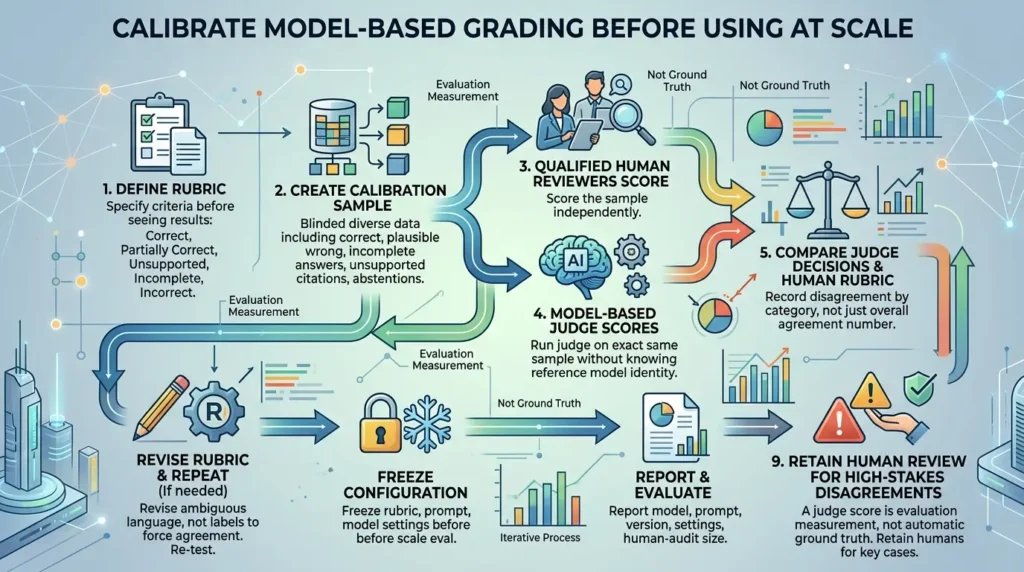
If the judge and human reviewers disagree materially on a high-stakes category, report that limitation and retain human review for the affected cases. A judge score is an evaluation measurement, not ground truth by default.
A practical model comparison scorecard
Adapt this template for your own comparisons. The point of a scorecard over a single leaderboard number is that it forces every model into the same reporting structure, which makes trade-offs visible instead of hidden inside an average.
| Field | Model A | Model B | Model C |
|---|---|---|---|
| Exact model ID and version | |||
| Access date | |||
| Advertised context limit (source) | |||
| Tokenizer / accounting method | |||
| Short-context baseline score | |||
| Score at each tested length (8K / 32K / 64K / 128K) | |||
| Position curve (beginning / middle / end) | |||
| Distractor sensitivity | |||
| Multi-hop / aggregation score | |||
| Citation or faithfulness score (if applicable) | |||
| Failure / refusal rate | |||
| P50 / P95 latency | |||
| Cost per task | |||
| Notes (prompt version, evaluator, known caveats) |
Scroll horizontally on mobile. Copy this table into your own spreadsheet or WordPress page to fill in.
Leave any cell blank rather than filling it with an estimate, a blank scorecard cell is honest; a guessed number dressed up as a measurement is not.
Report the result as a curve and an error profile
A defensible result should let a reader see where quality changes, not only who has the highest average. Use a reporting table like this:
| Model ID | Task family | Baseline | Length | Position | Distractor condition | Quality score | Failure label | P50 latency | P95 latency | Input/output tokens | Cost per task | Evaluator/version |
|---|---|---|---|---|---|---|---|---|---|---|---|---|
[exact ID] | [retrieval/reasoning/etc.] | [score] | [tokens] | [start/middle/end] | [none/similar/conflicting] | [score] | [label] | [ms] | [ms] | [in/out] | [currency] | [rubric/date] |
Then summarize three separate views:
- Quality curve: score by context length, with the short-context baseline shown.
- Position curve: score by evidence location at comparable lengths.
- Failure profile: percentage of cases in each failure category, including refusals, timeouts, malformed outputs, unsupported citations, and confident errors.
Do not collapse these views into one weighted score unless the weights were declared before testing and the reader can inspect the underlying components.
Example benchmark test cases
These are illustrative templates for designing your own tests, not measured results from any published run.
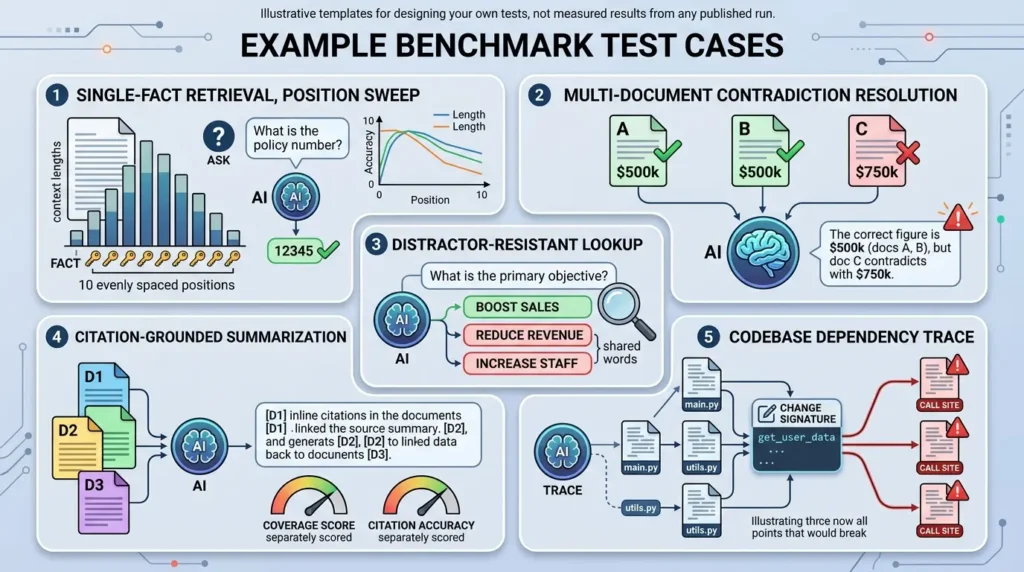
- Single-fact retrieval, position sweep: Insert one clearly stated fact (a policy number, a date, a decision) into a document at 10 evenly spaced positions and five context lengths. Ask a direct question about it. Score exact match and plot accuracy by position and length.
- Multi-document contradiction resolution: Provide three documents where two agree and one contradicts them on a specific figure. Ask the model to state the figure and note the discrepancy. Score whether it surfaces the contradiction rather than silently picking one source.
- Distractor-resistant lookup: Plant the correct answer alongside two distractors that share vocabulary with the question but are factually wrong. Score whether the model is pulled toward the lexically similar distractor.
- Citation-grounded summarization: Ask for a summary of a multi-document set with inline citations to source documents. Score coverage of key points and citation accuracy separately, following SummHay's dual-metric approach.
- Codebase dependency trace: Ask the model to explain what would break if a specific function's signature changed, using a real (not synthetic) multi-file codebase. Score whether it correctly identifies all call sites, not just the most obvious one.
Common mistakes when benchmarking long-context models
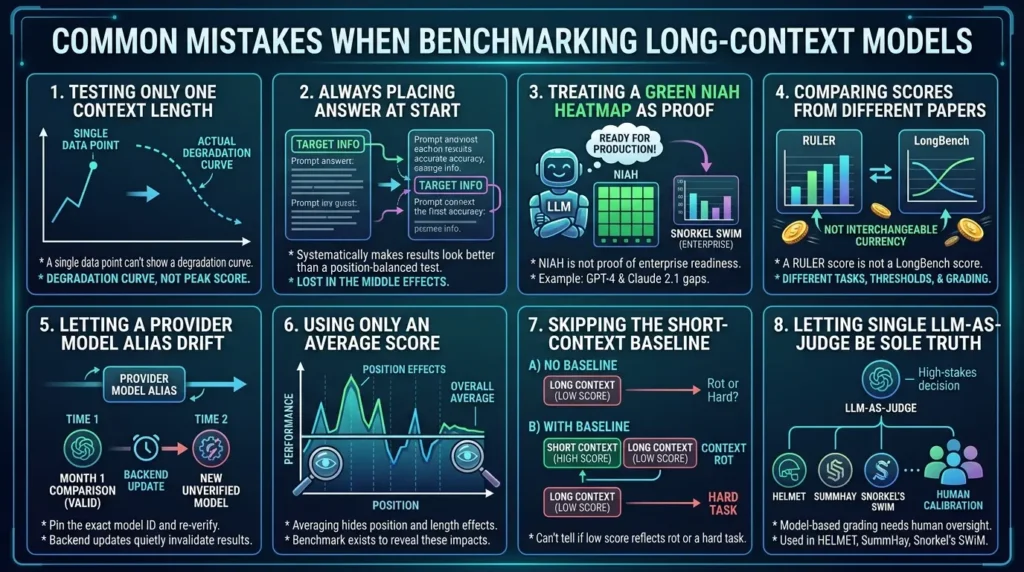
Testing only one context length
A single data point can't show a degradation curve, and it's the curve, not the peak score, that tells you whether a model is reliable at the lengths you'll actually use.
Always placing the answer at the start of the prompt
This can systematically make results look better than a position-balanced test, because the Lost in the Middle study found that accuracy changes when the location of relevant information changes.
Treating a green NIAH heatmap as proof of production readiness
Snorkel AI's own reported testing found that GPT-4 and Claude 2.1 scored near-perfectly on their NIAH setup while performing markedly worse on SWiM, their enterprise-document benchmark, a concrete illustration of exactly this gap.
Comparing scores from different benchmark papers as if they were on the same scale
A RULER score and a LongBench score are not interchangeable currency; they use different tasks, different thresholds, and often different grading methods entirely.
Silently letting a provider model alias drift
If you don't pin the exact model ID and re-verify it, a comparison you ran in one month can be quietly invalidated the next when the provider updates the backend behind that alias.
Using only an average score across positions or lengths
Averaging hides exactly the position and length effects the benchmark exists to reveal.
Skipping the short-context baseline
Without it, you can't tell whether a low score in a long context reflects context rot or simply a task that was already hard.
Letting a single LLM-as-judge be the sole source of truth on a high-stakes decision
Model-based grading is useful and scalable, but every benchmark that uses it, HELMET, SummHay, Snorkel's SWiM, pairs it with some form of human calibration for a reason.
Long context versus RAG: which should you test?
This is a workload-conditional decision, not a universal one, and treating it as universal is one of the more consequential mistakes in this space.
Databricks ran a large-scale study, more than 2,000 experiments across 13 models and multiple RAG datasets, specifically to test how performance changes as the amount of retrieved context grows. Their central finding was that longer retrieved context does not uniformly help: performance improved up to a point and then declined, and that turning point differed by model and by dataset, rather than sitting at one fixed length across the board.
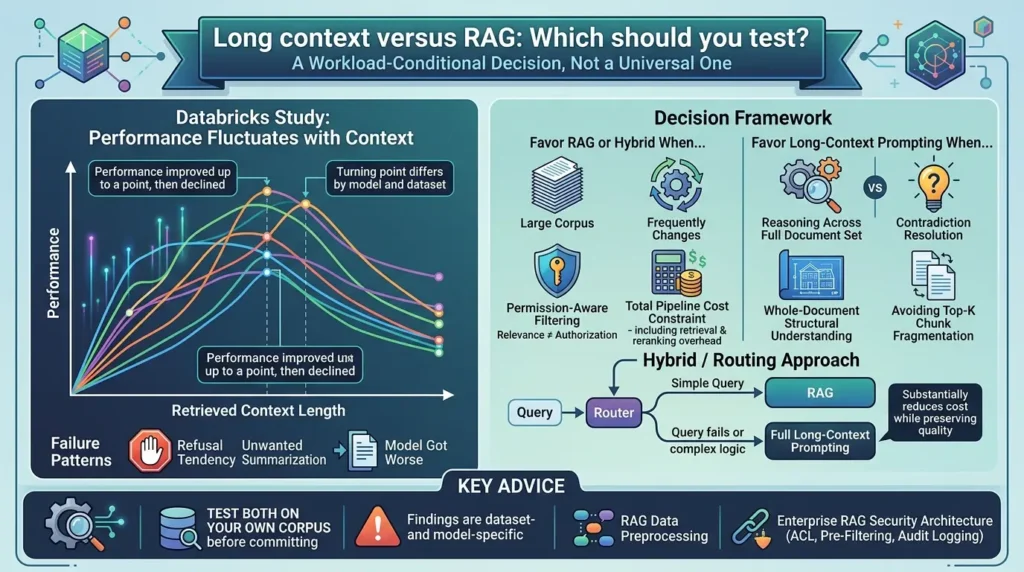
They also observed distinct failure patterns in different models, including a tendency toward refusal or unwanted summarization behavior under certain conditions, a good reminder that "the model got worse" can mean several genuinely different things.
A separate controlled comparison of long-context prompting against RAG and a hybrid "self-route" approach found that routing between the two, sending a query to RAG first and falling back to full long-context prompting only when needed, could substantially reduce cost while preserving quality under the paper's specific conditions.
That result is tied to the models, datasets, and cost assumptions in that particular study and shouldn't be read as "RAG is always cheaper" in general; total cost depends heavily on retrieval and reranking overhead, which isn't automatically smaller just because fewer tokens reach the model.
Decision framework:
- Favor RAG or hybrid retrieval when your corpus is large relative to any single query, changes frequently, requires permission-aware filtering, or when total pipeline cost (including retrieval and reranking) is a hard constraint. Vertex Frontier's guide to document-level access control in RAG covers why relevance and authorization are not the same check, a retrieved passage being "correct" doesn't mean the requester was allowed to see it.
- Favor long-context prompting when the task genuinely requires reasoning across the full document set at once, contradiction resolution, whole-document structural understanding, or cross-referencing that a retriever's top-k chunking would fragment.
- Favor a hybrid or routing approach when query difficulty varies significantly, letting simple queries use cheaper RAG paths while harder ones escalate to full context, following the self-route pattern above.
- Test both, on your own corpus, before committing. The Databricks and self-route findings above are strong evidence that the answer is dataset- and model-specific, not evidence for a specific answer in your case.
For the pipeline half of this decision, chunking, metadata, and retrieval quality, which materially affect any RAG-versus-long-context comparison, see Vertex Frontier's guide to RAG data preprocessing.
If your evaluation needs to hold up under a real production security boundary rather than a clean benchmark corpus, Vertex Frontier's enterprise RAG security architecture guide covers the pre-filtering, ACL, and audit-logging design that a benchmark corpus typically doesn't have to deal with.
Compare architectures by workload, not by slogan
| Workload condition | Long-context prompting may be a fit when… | RAG may be a fit when… | A hybrid may be a fit when… | Test explicitly |
|---|---|---|---|---|
| Corpus size | The relevant corpus fits within the tested and affordable range | The corpus is much larger than one request | Query difficulty varies across users or tasks | Quality by context length and retrieved-token budget |
| Evidence relationship | The answer requires cross-document comparison or global structure | A small set of passages can answer the query | Easy questions need retrieval; hard questions need broader context | Retrieval recall, synthesis accuracy, and contradiction handling |
| Freshness | The input is assembled at request time from current sources | The corpus changes frequently and requires index updates | Critical sources need retrieval while stable background stays in context | Update latency, stale-answer rate, and reindex behavior |
| Access control | The full input is already authorized for the requester | Documents require filtering before model exposure | Different evidence paths have different permissions | Unauthorized retrieval, cross-tenant leakage, and audit evidence |
| Cost and latency | The extra input tokens are acceptable under the measured workload | Retrieval reduces the model input enough to meet the target | A router can reserve full-context calls for difficult cases | Total cost, P50/P95 latency, queueing, retries, and throughput |
| Debuggability | The complete context can be inspected and versioned | Evidence IDs and retrieval traces are valuable | Both the router decision and evidence path must be logged | Reproducibility and failure attribution |
This matrix is a planning framework, not an empirical claim that one architecture wins. Measure the complete pipeline, including retrieval, reranking, context construction, model generation, retries, and authorization checks.
How to interpret results responsibly
A few habits separate a defensible benchmark reading from a misleading one:
- Never generalize a benchmark-specific threshold into a universal capability claim. "Only about half of models claiming 32K context exceeded RULER's threshold at 32K" is a true, useful, specific statement. "Half of all long-context models don't actually work" is not the same claim, and treating them as equivalent overstates what was measured.
- Don't average across task categories that measure different things. HELMET's own research found low correlation between its task categories, a model's recall score doesn't predict its summarization score, so an aggregate number across categories can obscure more than it reveals.
- Treat model-as-judge results as evaluator-dependent evidence, not ground truth, and check for a reported human-agreement rate wherever one exists.
- Watch for benchmark contamination risk, particularly on datasets built from widely available web text. This is a documented risk factor discussed in general benchmark literature, not a specific accusation against any named benchmark, and it's a reason to prefer benchmarks with synthetic or held-out data where the stakes are high.
- A public benchmark score is a starting point for model selection, not proof of production performance. Build a private, representative holdout set from your own workload before making a final call. The benchmark papers and reports reviewed here all have explicit scope limits, so a public score should be treated as evidence for a defined task rather than proof of production performance.
Use a release gate instead of a leaderboard threshold
A model should not be approved for production merely because it crosses an accuracy threshold on a public benchmark. Define a release gate that reflects the consequences of failure:
| Gate | Example question | Pass condition to define before testing |
|---|---|---|
| Quality | Does the system answer the target task correctly? | Minimum score by task family and context length |
| Robustness | Does performance survive position changes and distractors? | Maximum allowed position gap or distractor degradation |
| Grounding | Are claims supported by the supplied evidence? | Minimum citation/evidence precision and maximum unsupported-claim rate |
| Abstention | Does the system decline when evidence is missing or restricted? | Required abstention behavior on unanswerable and unauthorized cases |
| Operations | Can the service meet its user-facing constraints? | P50/P95 latency, timeout, throughput, and cost limits |
| Reproducibility | Can the team reconstruct the result? | Versioned dataset, prompt, model ID, configuration, and raw outputs |
| Governance | Are data exposure and access boundaries acceptable? | Documented retention, authorization, audit, and incident-handling controls |
The gate values are product requirements to define for the specific application, not universal constants supplied by this article.
Beyond passive QA: evaluating long-context agents
Everything above assumes a single prompt in, a single answer out. Once a long-context model is wrapped in an agent, calling tools, holding state across turns, executing multi-step plans, the evaluation problem gets a new layer, and a passing QA benchmark score stops being sufficient evidence on its own.
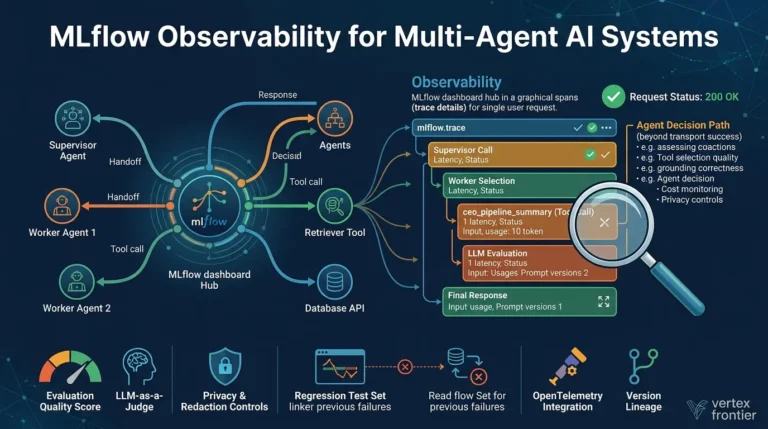
Closing that gap in production, going beyond a 200 OK to inspect the agent's actual decision path across supervisor, worker, and tool-call spans, is exactly what multi-agent observability with MLflow is designed to support
Vertex Frontier's guide to harness engineering for reliable AI agents makes the underlying point directly: the model generates decisions, but the harness around it, context management, tool scope, verification, and stop conditions is what determines whether those decisions turn into reliable behavior.
This also changes what a fair comparison looks like. Two agents built on the same underlying model can post very different benchmark results purely because of prompt, harness, or tool-scaffolding differences rather than any real gap in model capability. Vertex Frontier's guide to recursive language models and agent harnesses walks through exactly this kind of matched-evaluation caveat, and it's worth applying the same discipline here: before concluding that one model "beat" another on an agentic long-context task, confirm the harness, tool exposure, and retry policy were actually held constant.
If the agent has access to tools, external memory, or side-effecting actions, benchmark design also has to account for authorization, not just task success, a benchmark that only scores "did it get the right answer" and ignores "was it allowed to see that source" is measuring half the problem. Vertex Frontier's agentic AI security and enterprise risk guide covers the identity, permission, and containment questions a long-context agent benchmark needs to answer alongside accuracy.
Conclusion
The advertised context window on a model's spec sheet answers one question: how much text will the API accept. Everything that actually matters for your application, can it find the right fact, combine it with others, avoid the wrong distractor, cite its source correctly, and do all of that at the length your documents actually run, is a separate, measurable, and workload-specific question.
The path through this isn't a single leaderboard number. It's a degradation curve over context length, a position sweep, a distractor test, a separation between retrieval and reasoning and output quality, and a private holdout set built from your own documents before you ship anything. Use the public benchmarks in this article to shortlist candidates and to catch obvious failures early. Use your own protocol, run against your own workload, to make the actual decision.
If you're building the retrieval side of that decision, Vertex Frontier's guides to context rot in long-context models and RAG data preprocessing go deeper into the mechanics behind why performance degrades and how a retrieval pipeline changes the picture.
FAQ
What is a long-context LLM benchmark?
A structured test that measures how a model's retrieval, reasoning, and generation quality change as input length grows, kept separate from the model's advertised or accepted maximum context size.
Is a larger context window the same as better long-context performance?
No. A larger window is a capacity claim. RULER's published results show that a meaningful share of models advertising 32K-plus context do not clear RULER's own quality threshold once actually tested at 32K, which is direct evidence that capacity and measured quality are separate things.
What is an effective context window?
The longest input length at which a model still meets a predeclared quality threshold on a specific task. It's evaluation-dependent by definition — NoLiMa and BABILong both define it relative to a stated accuracy threshold rather than as a fixed model property.
Is Needle in a Haystack enough to compare long-context models?
No. It's a useful smoke test for catching gross failures, but HELMET's research found NIAH scores are a poor predictor of downstream application performance, and RULER's own documentation states it is not a comprehensive substitute for realistic evaluation.
What does RULER measure that vanilla NIAH doesn't?
RULER adds multi-needle retrieval, variable tracking, multi-hop tracing, and aggregation across four task categories and thirteen tasks — testing whether a model can combine and track multiple pieces of evidence, not just retrieve one isolated fact.
What does NoLiMa add beyond a standard needle test?
NoLiMa minimizes literal word overlap between the question and the relevant fact, so a model can't rely on surface pattern-matching to locate the answer — it has to use associative or world knowledge instead, which its authors report leads to earlier and steeper degradation than literal-match tests show.
How should I test "lost in the middle" behavior?
Take the exact same task and move the relevant evidence to different positions in the prompt — beginning, middle, and end — while holding everything else constant, then plot accuracy by position. This replicates the core protocol from the original TACL study.
Is long context better than RAG?
Neither is universally better. Databricks' large-scale study found that longer retrieved context helps only up to a point that varies by model and dataset, and a separate study found that routing between RAG and full-context prompting can cut cost while preserving quality under its specific conditions. Test both on your own corpus.
How many context lengths should a model comparison include?
At minimum, a short-context baseline plus several progressively longer lengths up to your target range — a single length can't show a degradation curve, which is the whole point of the measurement.
Can I compare scores from different benchmark papers directly?
No. Different benchmarks use different tasks, thresholds, and grading methods. A RULER score and a LongBench score are not on the same scale, even when they're describing the same model.
📋 Article Timeline & History
Successfully updated on September 17, 2026 with the latest details.
This article was originally published on September 15, 2026.

Was this article helpful?


[…] to measure that degradation on your own models rather than trust the vendor's window number, our Long-Context LLM Benchmarks guide walks through the benchmark families and a fair-test […]
[…] The original Needle in a Haystack test harness remains useful as a stress test. But a single needle task should not be treated as a complete long-context evaluation. For a working taxonomy of these benchmark families and a step-by-step protocol for designing your own test, see our guide to Long-Context LLM Benchmarks. […]
[…] For the benchmarks behind that finding — NoLiMa, RULER, and Lost in the Middle — and a working protocol for testing long-context models on your own workloads, see our dedicated context rot analysis and our practical guide to Long-Context LLM Benchmarks […]