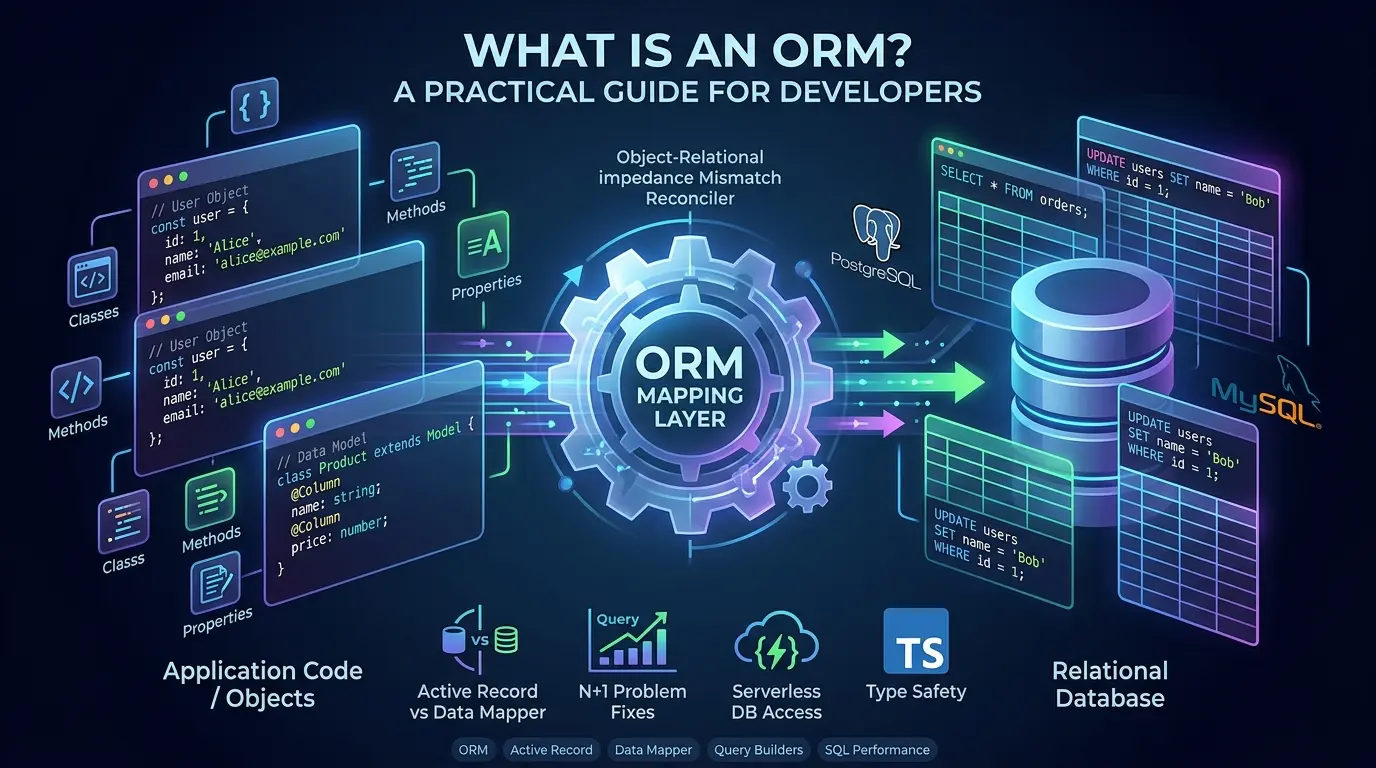

I spent my first two years as a developer writing SQL by hand. Building strings, forgetting a comma, running the query, staring at a syntax error, fixing the comma. Then I joined a team running Ruby on Rails, and I watched a senior engineer write Order.where(status: “pending”).includes(:customer) and pull back fully formed objects with zero SQL in sight. It felt like a trick.
It wasn’t a trick. It was an ORM, an Object Relational Mapper, and understanding what it actually does, rather than what it looks like it does, is the difference between using one well and getting quietly burned by one in production.
This isn’t another “ORMs let you skip SQL” explainer. Those exist by the thousand, and most of them stop right where the useful information starts. This one covers what happens when an ORM’s assumptions collide with real infrastructure, including how Shopify had to rewrite parts of ActiveRecord itself to keep scaling, and why that story matters more than any feature comparison.
Key Takeaways
Click any topic to expand or collapseThe core function of an ORM
An ORM translates between code objects and relational database rows, reconciling two fundamentally different data models — not just abstracting SQL syntax.
The development speed vs. SQL visibility trade-off
ORMs trade lower-level control for initial dev speed by hiding SQL — which creates blind spots during slow query debugging, lock contention, or N+1 query amplification.
Infrastructure scale limits (Shopify & ActiveRecord)
Scale exposes abstraction limits: Shopify patched ActiveRecord core internals for database sharding when infrastructure outgrew the ORM’s default architectural assumptions.
Declarative SQL vs. Imperative code loops
SQL is a declarative language optimized by database query planners. Most N+1 bugs originate from forcing imperative code loop logic onto relational databases.
Active Record vs. Data Mapper pattern architectures
Active Record (Rails, Eloquent) couples data and behavior; Data Mapper (Hibernate, SQLAlchemy) isolates them — utilizing Identity Map and Unit of Work mechanisms to prevent lost updates.
Serverless connection pool exhaustion
Relational databases designed for long-lived TCP connections exhaust pool limits under short-lived serverless functions without explicit HTTP proxies or poolers like PgBouncer.
Type safety & modern query builders (Prisma, Drizzle, sqlc)
Modern ORMs (Prisma, Drizzle) emphasize compile-time type validation over boilerplate reduction, while lightweight tools like Kysely and sqlc deliver safety without ORM overhead.
The necessity of raw SQL mastery
SQL proficiency remains essential — it is the definitive layer required as soon as ORM abstractions hit performance, locking, or complexity limits.
What an ORM Actually Solves (Not Just What It Is)
The textbook definition is accurate but thin: an ORM lets you interact with a database using your programming language's objects instead of SQL strings. True, but it undersells the problem being solved.
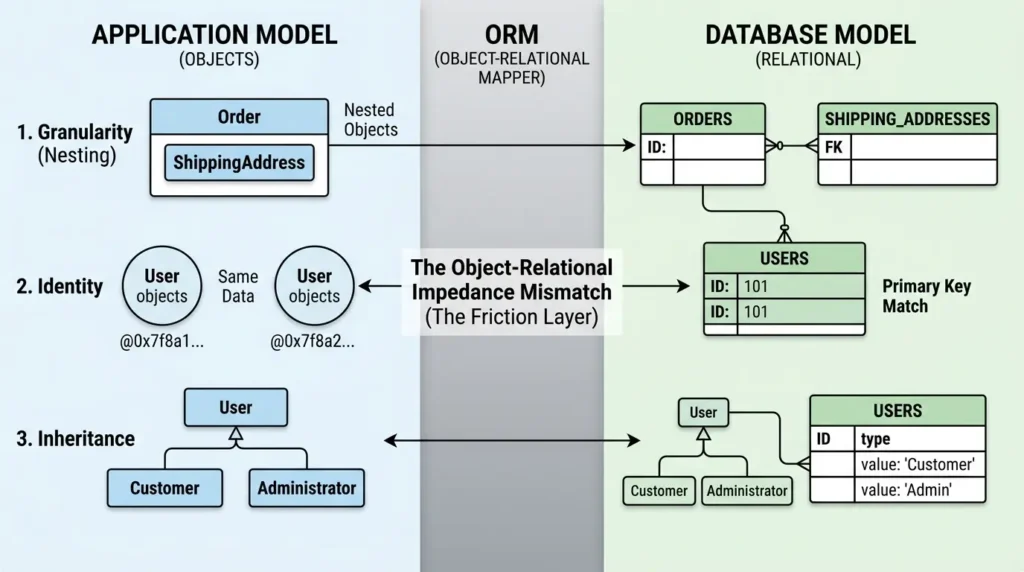
Your application thinks in objects, a User has properties, methods, maybe an inheritance chain. Your database thinks in tables, rows, and foreign keys. Computer scientists have a name for the friction between these two models: the object-relational impedance mismatch. It shows up in a few specific ways that a "translation layer" framing glosses over:
- Granularity — an object can nest other objects (an Order containing a ShippingAddress object); a relational table typically can't nest a row inside a column without extra work.
- Identity — two objects are the same if they occupy the same memory address; two rows are the same if their primary keys match. Those aren't the same rule, and ORMs have to reconcile them (this is why most ORMs maintain an in-memory identity map per request).
- Inheritance — class hierarchies in code don't map cleanly onto tables, which is why ORMs offer several competing strategies (single-table, class-table, concrete-table inheritance) with real trade-offs in each.
An ORM's job isn't just "write less SQL." It's absorbing all three of those mismatches so you don't have to think about them on every query. That's genuinely useful, until one of them leaks through, which is most of what the rest of this article is about.
Two Architectures, Not One: Active Record vs. Data Mapper
Most comparisons treat "ORM" as a single category. It isn't. Underneath the syntax, every ORM commits to one of two competing architectural philosophies, and which one it picked shapes how your codebase will feel five years from now.
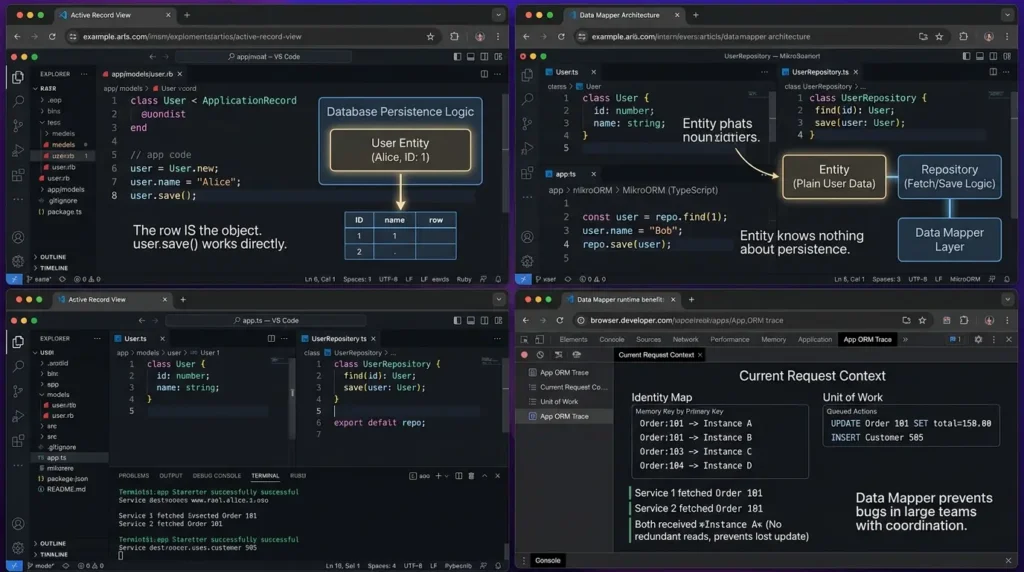
Active Record bundles the data and the database logic into the same object. The row is the object; the object knows how to save itself. That's why you can write user.save(), the User instance carries both its properties and the behavior for persisting them. Rails' ActiveRecord (the pattern is literally named after it), Laravel's Eloquent, and TypeORM all follow this model. It reads cleanly and gets you moving fast, especially on CRUD-heavy apps, because there's barely any ceremony between "I have an object" and "it's in the database."
Data Mapper refuses that bundling on purpose. The entity, a plain object describing a User, knows nothing about how it's persisted. A separate layer, often called a repository, handles moving that entity in and out of the database. Hibernate (Java), SQLAlchemy (Python), and MikroORM (TypeScript) all follow this pattern. It takes more code to wire up, but the entity stays a plain object you can unit-test without touching a database, and swapping your persistence strategy later doesn't mean rewriting your domain objects.
That extra setup buys something specific, and it's worth naming: an Identity Map. A sophisticated Data Mapper keeps one in-memory copy of each entity per request, keyed by primary key, so if three different services fetch the same Order during a single request, they get the same object instance, not three separate reads that can silently drift out of sync and overwrite each other's changes on save (a classic "lost update"). Pair that with a Unit of Work, which batches all the changes made during a request into a single coordinated write instead of firing them off one at a time.
Developers who reach for raw SQL on a large team sometimes rediscover the need for both patterns the hard way, after a production bug where two code paths silently clobbered the same row. That's the real argument for tolerating a Data Mapper's setup cost on a complex system, not "it's more elegant," but "it prevents a specific, hard-to-reproduce class of bug."
| Aspect | Active Record | Data Mapper |
|---|---|---|
| Object knows about DB? | Yes — data and persistence live together | No — entity is a plain object; a mapper persists it |
| Setup effort | Low — extend a base class and go | Higher — entities, mappers, and repositories to wire up |
| Unit testing | Harder to isolate from the database layer | Easier — entities are plain objects |
| Best fit | CRUD apps, small-to-mid teams, fast iteration | Complex domain logic, large teams, long-lived systems |
| Examples | Rails ActiveRecord, Eloquent, TypeORM | Hibernate, SQLAlchemy, MikroORM |
Neither pattern is "more correct." Active Record optimizes for the common case, most objects in most apps really do just need to load and save themselves, and paying a Data Mapper's setup cost for that is often wasted effort. Data Mapper optimizes for the uncommon case, a domain layer complex enough that keeping business rules and database concerns apart actually pays for itself. The mistake is picking one for reasons that have nothing to do with either, because it's the default in your framework, without ever deciding on purpose.
Everything above applies to relational databases (PostgreSQL, MySQL, SQL Server) — tables, rows, foreign keys. Document databases like MongoDB don't have that structure, so they use a different tool with a similar job: an ODM, or Object Document Mapper. Mongoose is the standard example for MongoDB. The concept — map application objects to however the database stores data — is the same. The mechanics underneath are not, because there's no relational schema to map to.
SQL Isn't "Low-Level" — That Framing Is the Trap
Most ORM pitches start from an unstated assumption: SQL is the primitive, low-level layer, and the ORM is the high-level abstraction sitting above it. That framing is backwards, and it matters more than it sounds like it does.
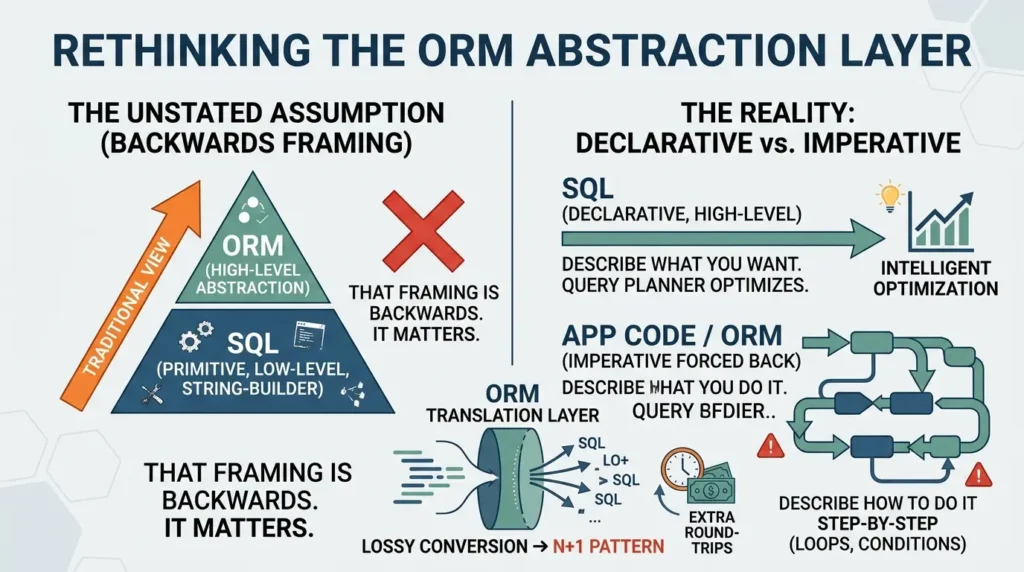
SQL is a declarative language, you describe the result you want, and the database's query planner decides how to get it, choosing indexes, join order, and execution strategy on your behalf. That's not a primitive string-builder; it's arguably a higher level of abstraction than most application code, which is typically imperative, a sequence of steps describing exactly how to do something.
An ORM often forces that imperative mental model back onto a declarative language: instead of describing the result you want in one query, you write code that loops, checks conditions, and issues queries step by step, which is precisely how an N+1 pattern is born. The bug isn't that the ORM "doesn't understand SQL." It's that translating an imperative loop into declarative SQL is a lossy conversion, and the loss shows up as extra round-trips the query planner never got a chance to optimize away.
Master ORM Architectures Without Production Outages
Stop guessing in production. Get our one-page developer quick reference for Active Record vs Data Mapper, instant N+1 fixes, and serverless pool setups.
Raw SQL vs. an ORM: What the Code Actually Looks Like
Fetching blog posts from PostgreSQL without an ORM, in Node.js:
JavaScript:
const { Client } = require('pg'); const client = new Client({ connectionString: process.env.DATABASE_URL });
await client.connect(); const result = await client.query('SELECT * FROM blog_posts'); const posts = result.rows;
You're managing the connection by hand, writing a SQL string, and pulling .rows off the result. Misspell blog_posts or change the schema, and nothing warns you until it breaks, usually in production.
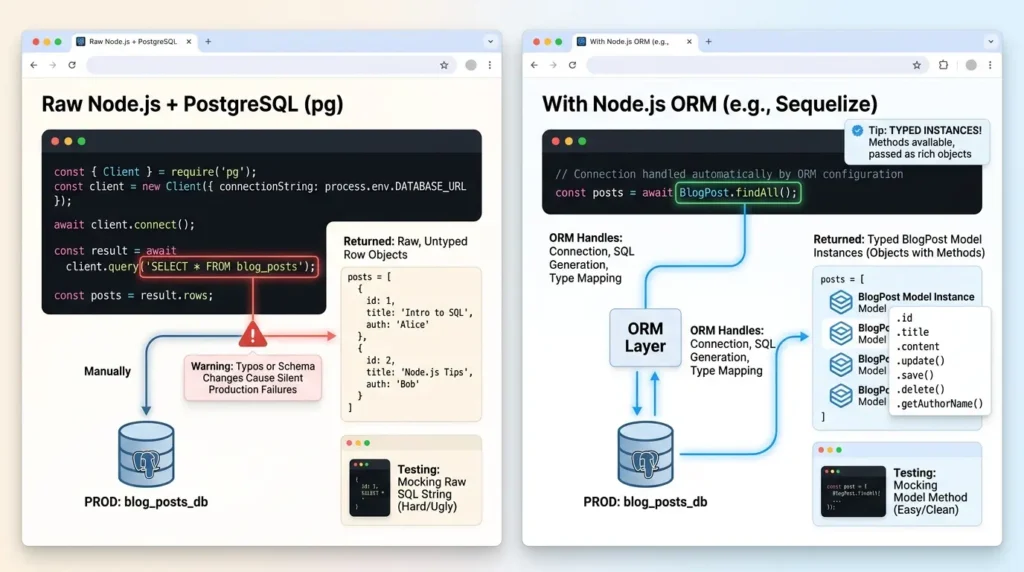
With an ORM, the same task:
JavaScript:
const posts = await BlogPost.findAll(); No SQL string, no manual connection handling, no .rows. The ORM resolved the table name, built the query, ran it, and handed back BlogPost instances, objects with methods, not raw data.
That's not a cosmetic difference. It changes how you test the code (you can mock a model method; mocking a raw SQL string is uglier), how you refactor (rename a column once, in one place, instead of hunting every query string), and how new team members read the codebase.
When an ORM retrieves data, it returns typed instances of your model class, not raw row objects. That's why you can call methods on them and pass them through your app like any other object.
Data Models: The Blueprint the ORM Reads
An ORM works from a model, a definition of what your data looks like:
JavaScript:
class BlogPost extends Model { static fields = { id: { type: Integer, primaryKey: true }, title: { type: String, required: true }, content: { type: Text }, createdAt: { type: DateTime, default: Date.now } }; } The ORM reads that and generates (or updates) the matching table. You don't hand-write CREATE TABLE.
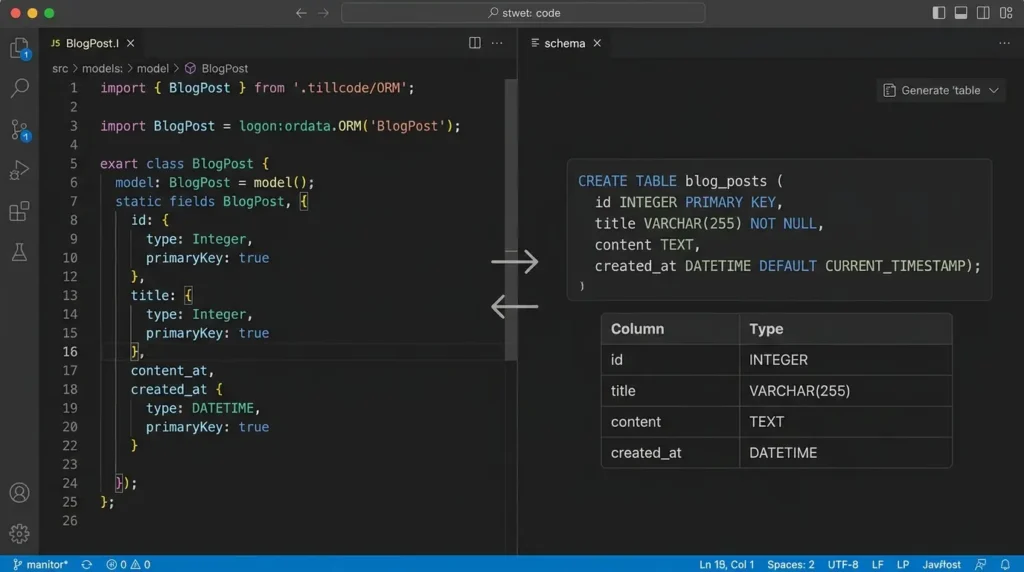
Worth knowing: ORMs disagree on how migrations should work, and the choice affects your team's workflow more than most people realize. Prisma and Django generate migration files you review before applying. Rails historically leaned on auto-generated migrations plus a schema.rb snapshot, a pattern efficient enough at small scale, though as you'll see below, it becomes its own bottleneck once a schema has years of migration history behind it. Neither approach is objectively better; they encode different assumptions about how much you trust automatic schema diffing.
Using the model in an Express route:
JavaScript:
app.post('/posts', async (req, res) => { const newPost = new BlogPost(req.body); await newPost.save(); res.json(newPost); }); The ORM writes the INSERT, escapes the values, and stores it. No SQL touched.
Relationships: Where the "R" in ORM Actually Does Work
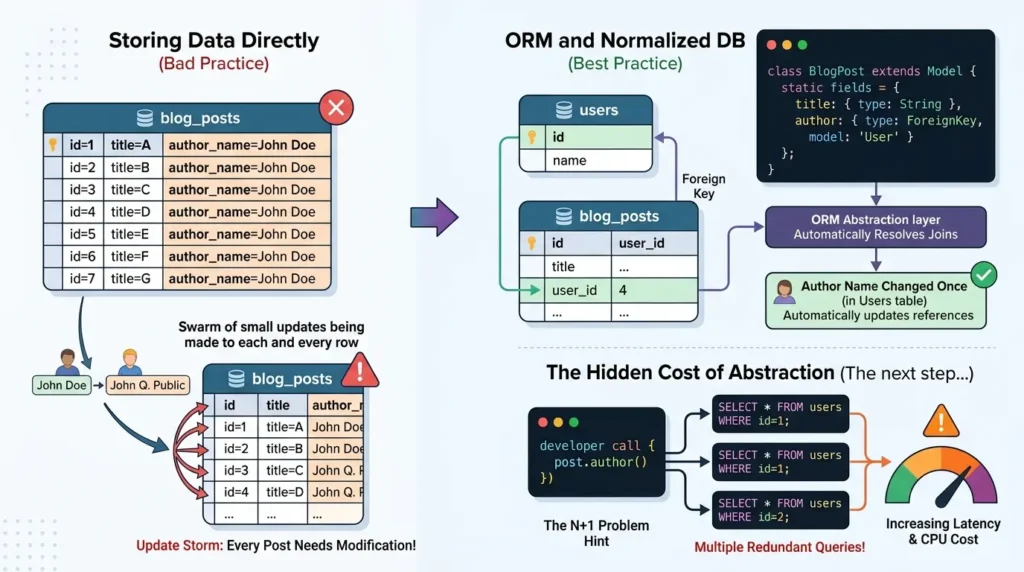
Blog posts have authors. You don't store the author's name directly on blog_posts, a name change would then require updating every post row. Instead, a users table, and a foreign key on blog_posts pointing to it.
JavaScript:
class BlogPost extends Model { static fields = { title: { type: String }, author: { type: ForeignKey, model: 'User' } }; } Now post.author resolves the join for you. One-to-many, many-to-many, nested relationships, all declared in the model instead of written as SQL joins.
This convenience is also exactly where the ORM's abstraction starts costing you something, which is the subject of the next two sections.
The N+1 Problem: The Mistake That Teaches Everyone the Hard Way
Load 100 blog posts, then access post.author on each one inside a loop. If the ORM is lazily loading relationships, which is the default in most of them, that's one query for the posts and 100 more for the authors. 101 queries where a single JOIN would have done it.
If your ORM is issuing far more queries than the page logically needs, you've hit N+1. Check your ORM's query log during development — seeing 50+ queries for one page load is the tell.
Every major ORM has a fix, and they're all the same idea under different names: tell the ORM up front which related records you'll need, so it fetches them in one extra query instead of one-per-row. In Django, that's select_related() for single-valued relationships (it uses a SQL JOIN) and prefetch_related() for many-valued ones (it runs a second query and stitches the results together in Python), the mechanics are documented in Django's QuerySet API reference.
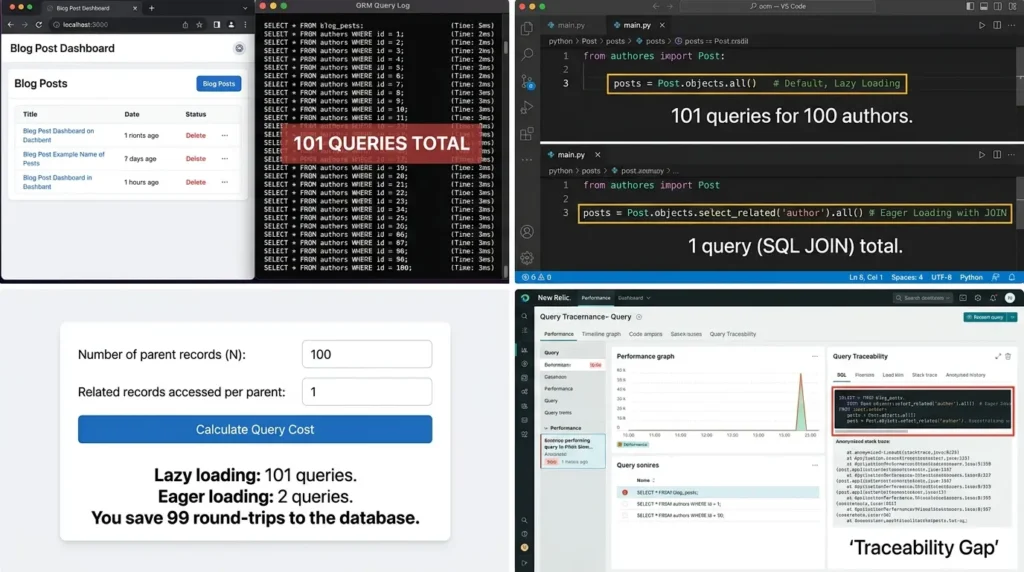
In Rails, it's includes. In Prisma, it's the include option on a query. The pattern is universal because the problem is universal, it isn't specific to any one ORM or language.
Use the calculator below to see how fast this compounds:
The deeper issue isn't just query count. When an ORM generates a bad query, you usually can't answer three questions without extra tooling: which line of code triggered it, whether a lock is being held longer than it should, or why it behaved differently in production than it did locally.
That's a traceability gap, not just a speed problem, and it's a big part of why experienced engineers treat ORM adoption as an architectural decision, not a library install.
Case Studies: What Happens When ORM Assumptions Meet Real Scale
Most ORM articles stop at "here's the N+1 problem, use eager loading." That's the classroom version. Here's what it looks like at companies operating past the point where a single database can keep up.
The challenge: After Shopify's Shop app saw a surge of new users, its Ruby on Rails backend — running on MySQL — approached the limits of a single database. The team needed to shard the database horizontally, using Vitess, MySQL's open-source sharding layer.
The problem with the ORM: ActiveRecord's default relationship conventions — has_many, belongs_to, has_one — generate queries that assume a single database. Vitess can't route those queries to the correct shard without knowing the sharding key, and ActiveRecord had no built-in way to carry that key through an object's lifecycle.
The decision: Shopify's engineers built a patch that let ActiveRecord identify and pass the sharding key through save, update, delete, lock, and reload operations, and added a custom join_condition option so associations could be scoped to a single shard.
The outcome and the lesson: Shopify horizontally scaled the Shop app's backend while staying on Rails and ActiveRecord, as Shopify's engineering team documented. The lesson isn't "ActiveRecord is flawed." It's that an ORM's conventions encode assumptions about your infrastructure. When you outgrow those assumptions, you don't always get to swap the ORM out — sometimes you have to open it up and change how it behaves.
The challenge: Slack ran MySQL in an active-active configuration from its early days. As traffic grew, that setup stopped scaling.
The decision: Slack began migrating its data layer to Vitess in 2017 — choosing sharding keys, retrofitting the application to work with a sharded backend, and migrating table by table rather than all at once.
The outcome: By the time Slack's engineering team published the retrospective, the migration had reached 99% of MySQL query traffic, serving 2.3 million queries per second — up from zero at the start of the project three years earlier.
The lesson: Three years for one migration, at a company with a dedicated infrastructure team, is the realistic timeline for changing the ground an ORM stands on. If your growth projections assume you'll "shard later," later needs to start earlier than most teams expect.
Both stories point at the same underlying truth: an ORM's abstraction is a bet that your infrastructure will keep matching its assumptions. That bet pays off for the overwhelming majority of applications. It stops paying off exactly at the scale where Shopify and Slack were operating, which is a scale most applications never reach, and a good reason not to over-engineer for it prematurely either.
ORMs as a Design Contract, Not Just a Library
Choosing an ORM isn't just picking an API you like. It's a decision that shapes:
- How your schema evolves as the product changes
- How you debug production incidents
- How easy slow queries are to find and fix
- How quickly new engineers understand the data layer
- How transactions and locks behave under real load
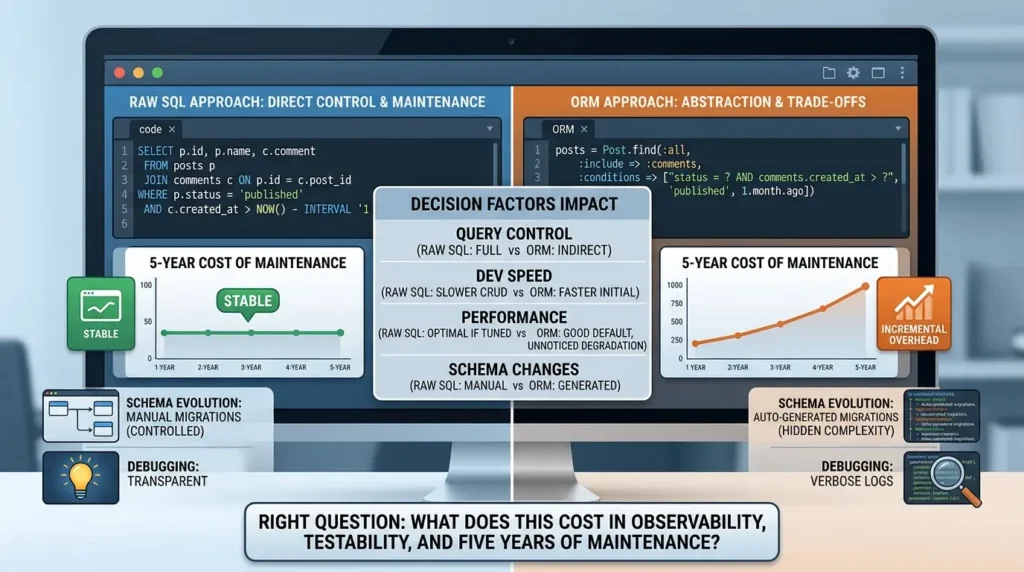
That list is why the right question isn't "which ORM has the nicest syntax." It's "what does this choice cost me in observability, testability, and five years of maintenance."
| Factor | Raw SQL | ORM |
|---|---|---|
| Query control | Full control | ORM decides; can be overridden |
| Dev speed | Slower for CRUD | Faster, less boilerplate |
| Performance | Optimal if written well | Good by default; can degrade unnoticed |
| Debugging | Query is visible | Query is generated; needs logging |
| Security | Manual parameterization required | Parameterized by default |
| Schema changes | Manual migration scripts | Generated or semi-automatic |
| DB portability | Dialect-specific | Abstracted across most dialects |
Quick takeaway: raw SQL trades speed of development for total visibility; an ORM trades some of that visibility for speed and consistency. Neither trade is free, the table above is really a list of where the cost shows up.
Common Mistakes Developers Make With ORMs
The N+1 problem gets most of the attention because it's the easiest to demonstrate. It's not the only way teams get hurt.
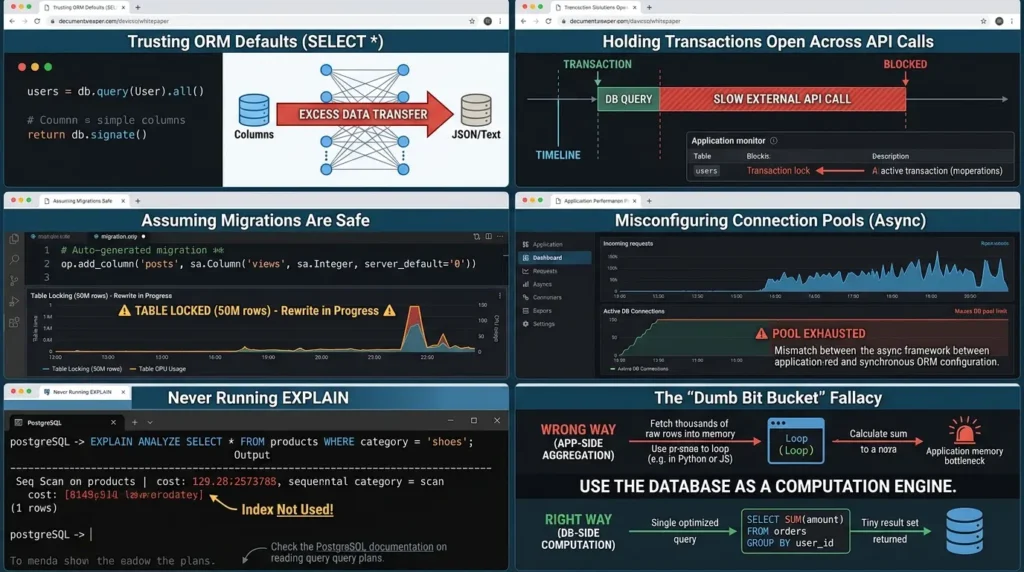
- Trusting the ORM's default SELECT * behavior: Most ORMs fetch every column by default unless you scope the query. On a table with a large JSON or text column, that means dragging bytes you don't need across the wire on every request.
- Holding a transaction open across an external API call: It's easy to do without noticing when the ORM manages the transaction boundary for you. A slow third-party API inside that transaction can hold a database lock far longer than intended.
- Assuming migrations are safe because the ORM generated them: Auto-generated migrations don't know your table has 50 million rows. An ADD COLUMN with a default value can lock a large table for the duration of a rewrite on some databases.
- Not setting connection pool limits correctly under an async framework: ORMs built for synchronous frameworks and dropped into an async one can quietly exhaust the connection pool under concurrent load, the code looks fine; the pool configuration is what's wrong.
- Never running EXPLAIN on a query the ORM generated: The query works, so it's assumed to be fine. Whether it used an index is a different question, and the ORM won't answer it for you, PostgreSQL's own documentation on reading query plans is the place to check.
The deeper version of this mistake deserves its own name: treating the database as a "dumb bit bucket." A modern relational database isn't just a place rows sit until you fetch them, PostgreSQL alone ships JSONB operators, window functions, full-text search, and Common Table Expressions capable of doing real computation close to the data. ORMs make it easy to forget all of that exists, because the model layer nudges you toward pulling rows into application memory and looping over them there instead.
The pattern is easy to spot once you know to look for it: an endpoint fetches a few thousand rows, then filters, groups, or aggregates them in application code, work a single GROUP BY or window function would have done inside the database, without ever sending the raw rows over the wire.
It's not that the ORM caused this. It's that treating the database purely as storage, instead of as a computation engine with decades of query-optimization work behind it, throws away most of what you're paying for in database infrastructure.
None of these are ORM bugs. They're what happens when a tool that hides mechanism meets a developer who's stopped checking the mechanism.
Before vs. After: What Actually Changes When You Adopt an ORM
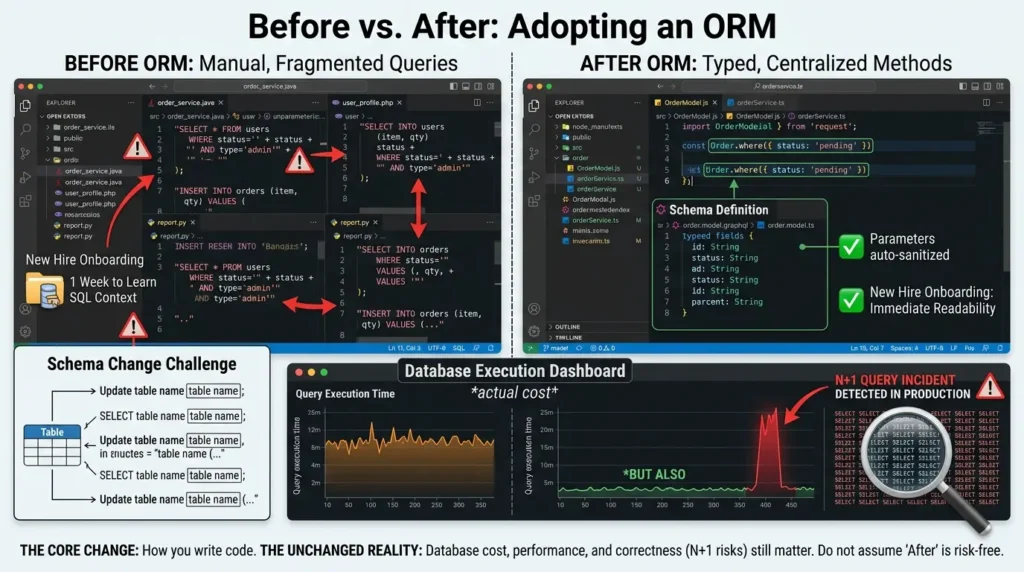
Before: every query is a hand-built string. A schema change means finding every place that string exists. A new hire needs a week just to learn where the queries live. Security depends on every developer remembering to parameterize input, every time.
After: queries are method calls on typed objects. A schema change updates in one model definition and ripples outward. A new hire can read Order.where(status: "pending") and understand it without knowing SQL. Parameterization happens by default, not by discipline.
What doesn't change: the database still has to execute a real query, with a real cost. The ORM changes who writes the query and how visible it is, not whether performance and correctness still matter. Teams that treat the "after" state as risk-free are the ones who get surprised by their first N+1 incident in production.
ORM Suitability by Workload Type
The "ORM vs. SQL" debate usually skips the actual variable that matters: what you're building.
- CRUD-heavy apps (SaaS, blogs, admin tools)
- Schemas that change frequently
- Teams with mixed SQL experience
- Apps that might switch databases
- Prototypes and MVPs
- High-volume reporting and analytics
- Latency-sensitive microservices
- Complex aggregations
- Heavily tuned transactional systems
- Systems needing fine-grained lock control
The Third Option Nobody Puts on the Comparison Chart: Query Builders
Most "ORM vs. raw SQL" articles present exactly two choices, which skips the option a large share of experienced developers actually reach for: a query builder. It's neither, it's the middle ground.
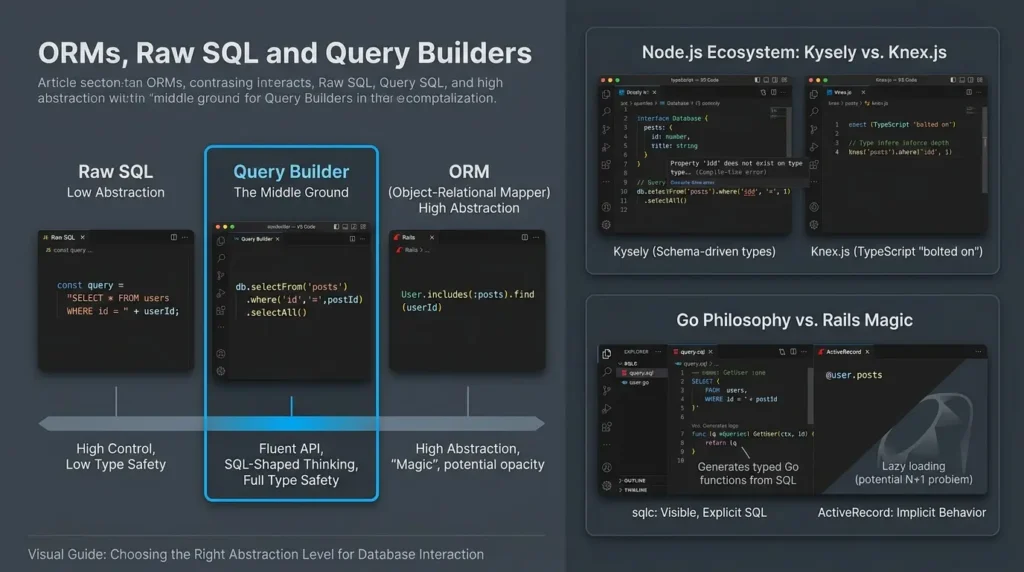
A query builder gives you a fluent, chainable API to construct SQL (db.selectFrom('posts').where('id', '=', postId).selectAll()), without an ORM's model layer, identity mapping, or relationship magic sitting on top. You get SQL-shaped thinking with none of the raw string concatenation, and with a modern one full type safety.
Knex.js has been the standard in the Node.js ecosystem since 2012: broad database support, a huge plugin ecosystem, TypeScript support bolted on after the fact rather than designed in from day one. Kysely, built specifically for TypeScript, flips that: it infers types directly from your schema definition, so referencing a column that doesn't exist becomes a compile-time error, the same guarantee Prisma offers, but Kysely stays a pure query builder, with no ORM abstraction layered on.
The trade-off versus a full ORM: you write more explicit queries, and you don't get automatic relationship loading or model classes with built-in behavior. What you get back is total visibility into the SQL being sent, and no N+1 problem to accidentally create, because there's no lazy loading to trigger it. For teams that want type safety without inheriting an ORM's opacity, a query builder is often the more honest tool for the job.
This same instinct, preferring visible, explicit code over a framework that decides things for you, is close to a cultural default in Go. The Go community's skepticism toward ORMs like GORM isn't a fringe opinion; it reflects the language's broader design philosophy of explicit error handling and minimal hidden behavior.
The tool that has absorbed that preference is sqlc: you write the SQL yourself, and it generates fully typed Go functions from it at build time, compile-time safety with zero runtime reflection, and never a mystery about which query is actually running. Contrast that with Ruby on Rails, a framework built around embracing ORM "magic" as a feature, and you have two ecosystems with opposite defaults for the exact same trade-off: development speed through abstraction versus performance and clarity through explicitness.
Neither culture is wrong, they're optimizing for different failure modes, and it's worth noticing which one your team actually values before picking a tool that assumes the other.
ORMs at the Edge: The Problem Serverless Creates
Every example so far has assumed your application lives on a server that stays running, holding a stable pool of database connections open. Deploy that same assumption to AWS Lambda, Vercel Functions, or Cloudflare Workers, and it breaks in two specific ways.
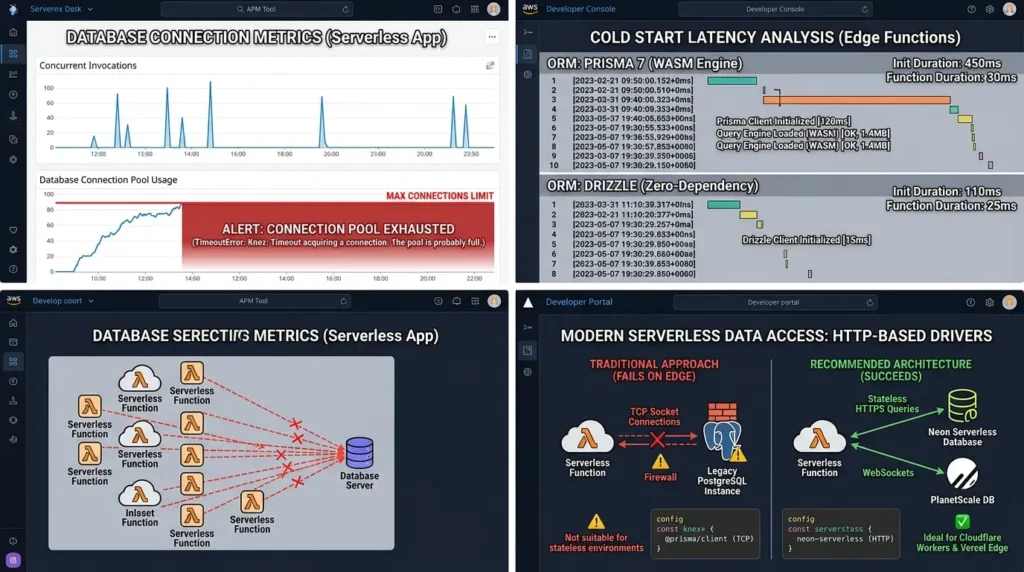
Connection pool exhaustion
A traditional ORM opens a handful of long-lived TCP connections per instance and reuses them. A serverless function is often a fresh instance per invocation, spin up, run, tear down.
Instantiate a new database client on every cold start, under real concurrent traffic, and you can exhaust your database's connection limit in seconds; the resulting errors, a connection pool timeout, or a database rejecting connections outright, are a well-documented failure mode in Prisma's own guidance on deploying to serverless platforms, which is one reason the team built Prisma Accelerate, a managed connection pooler and query cache designed specifically for serverless and edge traffic.
Cold starts
Client weight adds real milliseconds to the time before your function can serve its first request, which matters when "first request" happens on every cold start, not just once at boot.
This is where two ORMs with the same feature set can behave very differently, and it's worth being precise about it rather than repeating outdated benchmarks: Prisma historically shipped a Rust-compiled query engine binary that ran alongside your application code, powerful, but heavy enough (roughly 14MB) to hurt cold starts and complicate edge deployment.
Prisma 7, released in late 2025, replaced that binary with a pure TypeScript/WASM engine, cutting the bundle by around 90% and improving serverless cold starts substantially.
Drizzle, by contrast, was built without an engine layer from the start, it compiles directly to SQL strings client-side, which is why it's kept a real edge on raw bundle size and cold-start latency even after Prisma's rewrite. The practical takeaway isn't "Drizzle beats Prisma", it's that "engine-based" and "zero-dependency" are two different architectural bets, and if your deployment target is edge-first, the bet your ORM made before you ever wrote a query matters more than any feature comparison.
The current fix on the JavaScript side isn't one tool, it's a category: HTTP-based database drivers that skip TCP entirely. Neon's serverless driver queries Postgres over HTTP or WebSockets instead of a persistent connection; PlanetScale's @planetscale/database driver does the same over plain HTTP, purpose-built for platforms like Cloudflare Workers and Vercel Edge Functions where a long-lived TCP socket isn't an option at all.
If you're deploying an ORM-based app to the edge in 2026, the real architectural decision isn't "which ORM", it's "does my database access path survive a stateless, short-lived execution environment," and that's a question the ORM alone won't answer for you.
The Contrarian Take: an ORM Doesn't Remove Complexity — It Relocates It
Most pitches for ORMs sell "less complexity." That's not quite honest. The complexity of the object-relational mismatch doesn't disappear when you add an ORM, it moves from your application code into the ORM's internals and your team's understanding of how the ORM behaves.
That's often a good trade. A well-maintained ORM has solved the mismatch problem more rigorously than most teams would solve it themselves, under time pressure, on a deadline. But "relocated" is a more accurate word than "removed," because relocated complexity can still surface, usually at the worst possible time, in production, under load the ORM's defaults weren't tuned for.
Teams that internalize this stay curious about what's happening under the hood. Teams that believe the complexity is gone are the ones who get paged at 2 a.m.
Popular ORMs by Language and Platform
| Language / Platform | Popular ORMs | Notes |
|---|---|---|
| JavaScript / TypeScript | Prisma, Drizzle, TypeORM, Sequelize | Prisma and Drizzle lead on type safety; Drizzle stays closer to raw SQL |
| Python | SQLAlchemy, Django ORM, Peewee | Django ORM ships built-in; SQLAlchemy is the more flexible standalone option |
| Java | Hibernate, EclipseLink, OpenJPA | Hibernate remains the dominant JPA implementation |
| PHP | Eloquent (Laravel), Doctrine, Propel | Eloquent is known for clean, readable syntax |
| C# / .NET | Entity Framework Core, NHibernate | EF Core is the standard in most .NET apps |
The Real Pros and Cons of Using an ORM
✅ The case for an ORM
- No SQL required for common cases: you work in the language you already know.
- Fewer string-formatting bugs: a whole category of error disappears.
- Single source of truth: update the model once; the change propagates correctly.
- Parameterized queries by default: a real reduction in SQL injection risk.
- Database portability: swapping engines doesn't mean rewriting every query.
- Generated migrations: most ORMs can draft schema changes for you to review.
- Faster CRUD development: what takes minutes in SQL takes seconds here.
⚠️ The case against
- Real learning curve: every ORM has its own conventions and gotchas.
- Performance ceiling: hand-tuned raw SQL usually beats generated queries at the margins.
- Opacity: you can't see the SQL without turning logging on.
- N+1 risk: careless relationship access multiplies queries fast.
- One more dependency: to install, patch, and keep current.
- Confusing edge cases: unusual failures produce deep, unfamiliar stack traces.
Type Safety Is the New Value Proposition
The old pitch for ORMs was "less boilerplate." The pitch in 2026 is "compile-time safety." Prisma and Drizzle lean into this hard: define a model, and your editor knows the exact shape of every query result. Reference a field that doesn't exist, and TypeScript flags it before the code ever runs, not at 2 a.m. when a production error page shows up.
That's a genuine shift in what the tool is for. It's less about saving keystrokes and more about catching a category of bug before it ships.
Before shipping an ORM query to production, ask: "Can I explain exactly what SQL runs, what locks it holds, and what happens if it fails?" If not, read the query-logging docs before you rely on it under load.
How to Debug ORM-Generated SQL
- Turn on query logging in development — every major ORM supports it. Leave it on; don't wait for a problem to enable it.
- Count queries per page load. If the number is far higher than the number of distinct data sources on the page, you likely have an N+1 pattern.
- Run EXPLAIN ANALYZE on anything slow. Take the generated SQL straight from the log and run it in your database console, see PostgreSQL's guide to reading query plans for how to interpret the output.
- Tag or comment your queries where your ORM supports it, so a slow query in a production log can be traced back to the code that issued it.
- Drop to raw SQL for the hard cases. Every mature ORM has an escape hatch for parameterized raw queries. Using it isn't a failure, it's the tool working as designed.
A Quick Security Note: ORMs and SQL Injection
Concatenating user input into a SQL string is how SQL injection happens, a value like '; DROP TABLE users; --turns into executable SQL instead of data. ORMs sidestep this by using parameterized queries by default: user input is always passed separately from the query structure, never spliced into it.
That doesn't eliminate every security risk, but per the OWASP SQL Injection Prevention Cheat Sheet, parameterized queries are one of the primary defenses against this entire class of attack, which is exactly what a properly used ORM gives you without extra effort.
So Should You Use an ORM?
For most applications, typical CRUD workloads, small-to-mid-sized teams, products that will keep changing shape, yes. It will save time, cut a category of bugs, and keep the codebase readable for whoever joins the team next.
Go in with your eyes open, though. Turn on query logging before you need it. Understand the N+1 problem before it finds you in production. Know your ORM's raw-SQL escape hatch. And remember Shopify: even a well-run ORM eventually meets infrastructure it wasn't designed for, and the fix is understanding the tool deeply enough to bend it, not abandoning it at the first sign of friction.
Don't treat the ORM as permission to stop learning SQL. They're complementary skills. The developers who are strong at both write better code with either one.
Pick an ORM that fits your stack, spend a few hours in its documentation, and build something small with it. Watch the query log while you do. That will teach you more than any comparison table, including this one.
If you're working in Python, our tutorial on building a tested REST API with Python and FastAPI shows how to pair SQLAlchemy with Pydantic models, dependency injection, and tests, the same patterns you'd use in a real service rather than a standalone ORM demo.
Ready to Try an ORM?
If you're working in TypeScript or JavaScript, Prisma is a solid starting point. Read the official docs and build a small Express or Next.js project with it.
Visit Prisma Docs →FAQ: Object Relational Mappers
What does ORM stand for?
Object Relational Mapper. It's a software layer that maps objects in your application code to rows and tables in a relational database, handling the translation so you don't write raw SQL for common operations.
Do I still need SQL if I use an ORM?
Yes. You can skip it for basic CRUD work, but debugging a slow or wrong query means reading the SQL the ORM generated. SQL knowledge is what turns an ORM user into someone who can actually fix problems when they show up.
What is the N+1 problem?
It happens when you load a list of N records and then access a related record on each one inside a loop, triggering one query per item instead of a single joined query — one query for the list plus N more, hence N+1. Eager loading (select_related, includes, or a query's include option, depending on your ORM) fixes it.
Which ORM should I use for TypeScript?
Prisma is a strong default for its type safety and developer experience. Drizzle is gaining ground for staying closer to raw SQL while still typing your queries. Sequelize and TypeORM are older and more established, with larger communities to draw on.
Are ORMs slower than raw SQL?
For most web apps, the difference is negligible. At very high query volumes — the kind Shopify and Slack operate at — hand-tuned raw SQL usually wins. Optimize when you have a measured problem, not preemptively.
Do ORMs protect against SQL injection?
Most do, by parameterizing queries by default instead of concatenating user input into SQL strings. That significantly reduces injection risk, though it doesn't replace good input validation elsewhere in your application.
What is a data model in an ORM?
A class or schema definition describing a piece of data's structure. The ORM reads it to create or update the matching database table, and uses it again to map query results back into the correct object shape in your code.
Can ORMs handle complex relationships at scale?
They handle one-to-one, one-to-many, and many-to-many relationships well by default. At real scale — sharded databases, high write volume — you may need to extend the ORM yourself, the way Shopify patched ActiveRecord to work with Vitess sharding.
What's the difference between Active Record and Data Mapper ORMs?
Active Record bundles data and persistence logic into one object, so the object can save itself (Rails, Eloquent, TypeORM). Data Mapper keeps the entity as a plain object and handles persistence in a separate layer (Hibernate, SQLAlchemy, MikroORM). Active Record is faster to start with; Data Mapper is easier to unit-test and keep decoupled in large, complex systems.
Do ORMs work well in serverless environments?
Not by default. Traditional ORMs assume long-lived TCP connections, which serverless platforms don't provide — each function invocation can open a fresh connection and exhaust your database's limit under load. The fix is a connection pooler (like Prisma Accelerate or PgBouncer) or an HTTP-based driver built for serverless, such as Neon's serverless driver or PlanetScale's database driver.
What's the difference between an ORM and a query builder?
An ORM maps database rows to model objects and typically manages relationships, migrations, and identity tracking. A query builder like Knex.js or Kysely gives you a fluent API to construct SQL without that extra layer — you get type safety and no string concatenation, but you write more explicit queries and don't get automatic relationship loading.
Is an ORM the same as an ODM?
No. An ORM maps objects to a relational database (PostgreSQL, MySQL). An ODM — Object Document Mapper — does the same job for a document database like MongoDB, where data is stored as documents rather than rows and tables. Mongoose is the standard ODM for MongoDB.
Why do Go developers avoid ORMs?
It reflects Go's broader design philosophy: explicit code over hidden behavior, and no runtime reflection overhead where it can be avoided. Tools like sqlc generate fully typed Go functions from SQL you write yourself, catching invalid queries at build time without an ORM's abstraction layer. It's a cultural default as much as a technical one — contrast it with Ruby on Rails, where ORM "magic" is treated as a core feature rather than something to avoid.
Is Prisma or Drizzle faster for serverless deployments?
Prisma 7 replaced its Rust query-engine binary with a TypeScript/WASM engine, substantially cutting bundle size and improving cold starts compared to earlier versions. Drizzle still has the smaller footprint because it was built without an engine layer from the start, compiling directly to SQL. For most applications the database round-trip dominates total query time either way — the gap matters most at the extreme edge-latency end of the spectrum.
📋 Article Timeline & History
Successfully updated on September 17, 2026 with the latest details.
This article was originally published on August 12, 2026.

Was this article helpful?




[…] What Is an ORM? A Practical Guide for Developers Who Actually Ship Code […]
[…] What Is an ORM? A Practical Guide for Developers Who Actually Ship Code […]
[…] What Is an ORM? A Practical Guide for Developers Who Actually Ship Code […]
[…] What Is an ORM? A Practical Guide for Developers Who Actually Ship Code […]
[…] What Is an ORM? A Practical Guide for Developers Who Actually Ship Code […]
[…] An API can protect a database from direct access, limit which fields leave a service, and apply business rules before a change is accepted. That is why an API is an application boundary, not a synonym for the storage behind it. If you want the complementary application/database view, see Vertex Frontier’s guide to what an ORM is. […]
[…] manual review; it cannot reliably infer every rename or semantic data change. Vertex Frontier’s practical ORM guide is a useful companion when you move from this repository to a relational persistence […]