
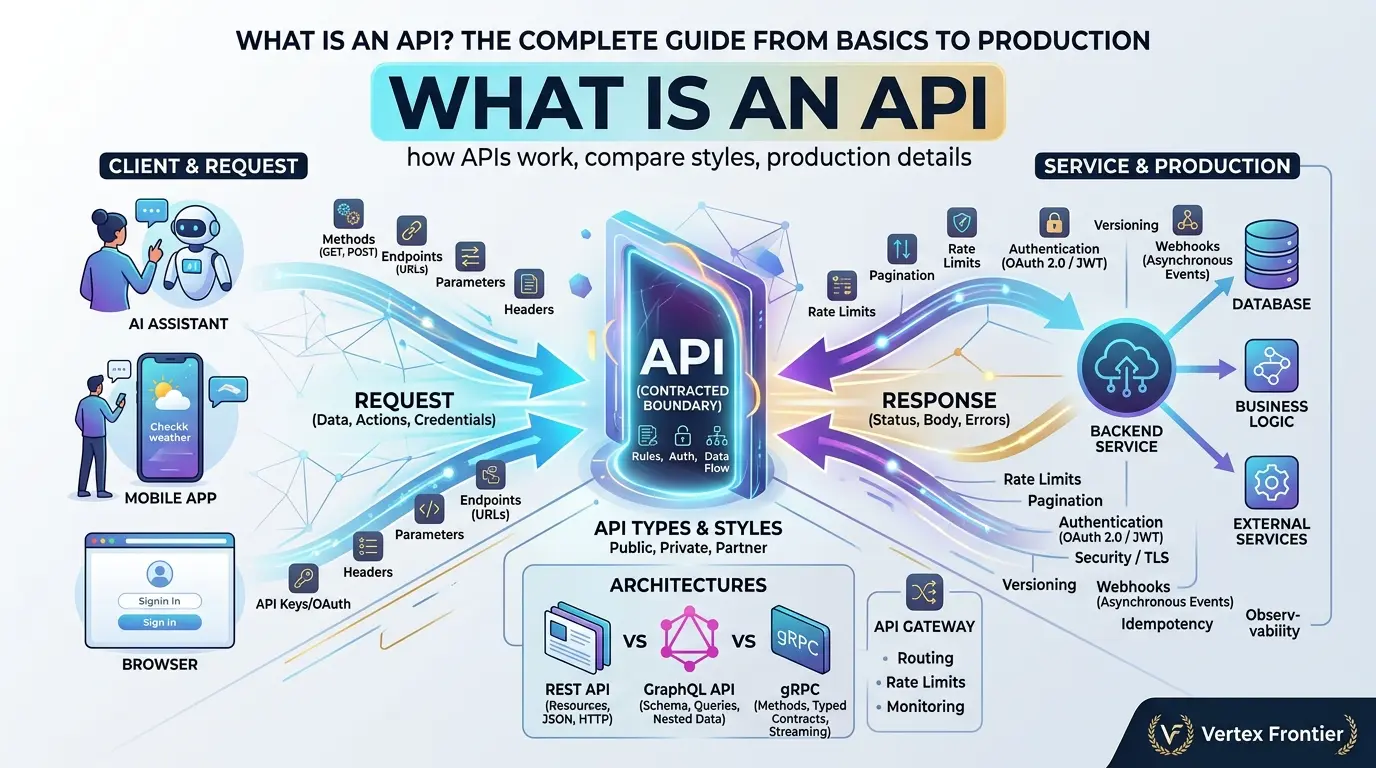

If you have checked the weather in an app, paid for something online, signed in with Google, or asked an AI assistant to retrieve information, you have used an API. The screen is only the visible part. Behind it, one piece of software asks another for data or an action, then receives a structured result.
An API, or application programming interface, is a documented interface and set of behavioral rules that lets one software component request data or capabilities from another. The contract can describe operations, inputs, outputs, authentication, permissions, errors, limits, versioning, and whether work happens immediately or later.
An API is not necessarily a website, database, endpoint, or JSON document. A web API is one category of API that uses web protocols such as HTTP. Libraries, operating systems, databases, message brokers, and software frameworks expose APIs too.
This guide starts with a plain-English mental model, then follows one complete request and response. It separates API types that describe access from styles that describe architecture, compares REST, GraphQL, SOAP, and gRPC, and finishes with the production details that turn a demo integration into a dependable one.
Key Takeaways
Click any topic to expand or collapseAn API is a contract between software components
It is not merely a URL; it defines how software components communicate and interact with each other structuredly.
HTTP API Request-Response Cycle
An HTTP API usually receives a request and returns a response containing a status code, headers, and optional content.
API Categories & Technical Approaches
Public, private, partner, and composite describe access or composition; REST, GraphQL, SOAP, and gRPC describe technical approaches. These categories can overlap.
Authentication vs. Authorization
Authentication answers “who or what is calling?” Authorization answers “what may that caller do?”
Production Requirements Beyond the Happy Path
The first successful request is the happy path. Production also requires limits, timeouts, retries, idempotency, pagination, versioning, safe errors, observability, and security.
What is an API in simple terms?
Think of an API as a controlled doorway between programs. The caller does not need to know how the service stores data, which database it uses, or how its internal code is organized. It needs to know what the doorway accepts and what it promises to return.
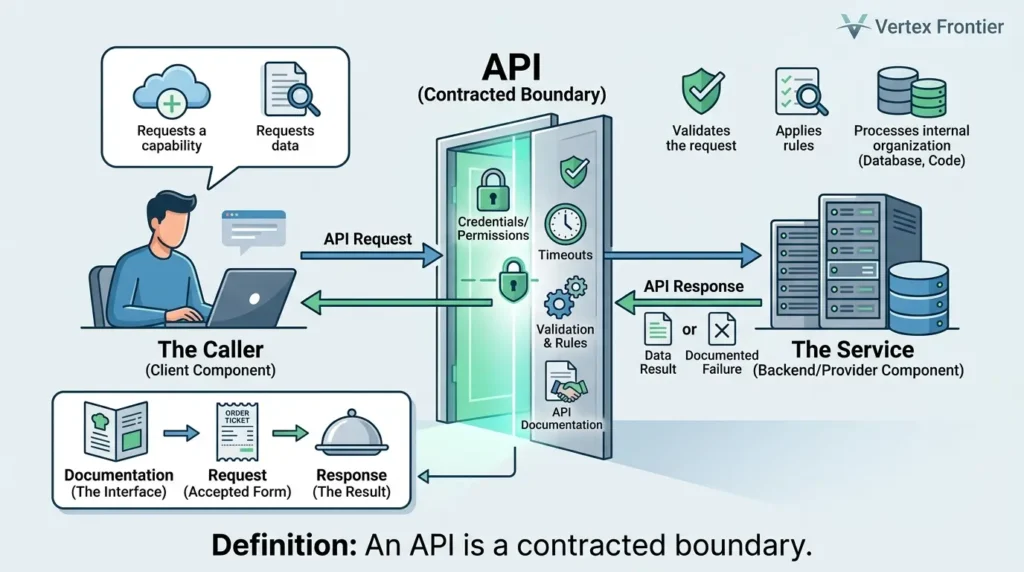
A restaurant menu is a useful first analogy: you choose an item, place an order in an accepted form, and receive a result without entering the kitchen. In software, the menu resembles documentation, the order resembles a request, the kitchen resembles the service, and the meal resembles the response.
The analogy stops where real systems become difficult. APIs must handle malformed input, credentials, permissions, timeouts, quotas, retries, duplicate requests, version changes, and machine-readable errors. Those details are part of the contract, not optional decoration.
The most practical definition is therefore this:
An API is a contracted boundary. One component requests a capability or piece of data; another component validates the request, applies its rules, and returns a result or a documented failure.
API versus endpoint, SDK, library, webhook, and database
Beginners often use these terms as if they were interchangeable. They are related, but each names a different layer.
| Term | What it is | Relationship to an API |
|---|---|---|
| API | An interface and behavioral contract. | The umbrella concept. |
| Endpoint | A particular address and operation entry point. | One part of many HTTP API designs. |
| SDK | A toolkit that may include libraries, helpers, models, and generated clients. | A convenient way to consume or build against an API. |
| Library | Reusable code called by another program. | It may implement, wrap, or expose an API. |
| Webhook | Provider-initiated event delivery, often over HTTP. | A communication pattern, not a universal protocol. |
| Database | A system for storing and querying data. | An API may use a database internally without exposing it directly. |
An API can protect a database from direct access, limit which fields leave a service, and apply business rules before a change is accepted. That is why an API is an application boundary, not a synonym for the storage behind it. If you want the complementary application/database view, see Vertex Frontier’s guide to what an ORM is.
When someone says “the API,” ask whether they mean the whole contract, a single endpoint, a client library, or the service behind it. Precision prevents design and debugging mistakes.
How do APIs work?
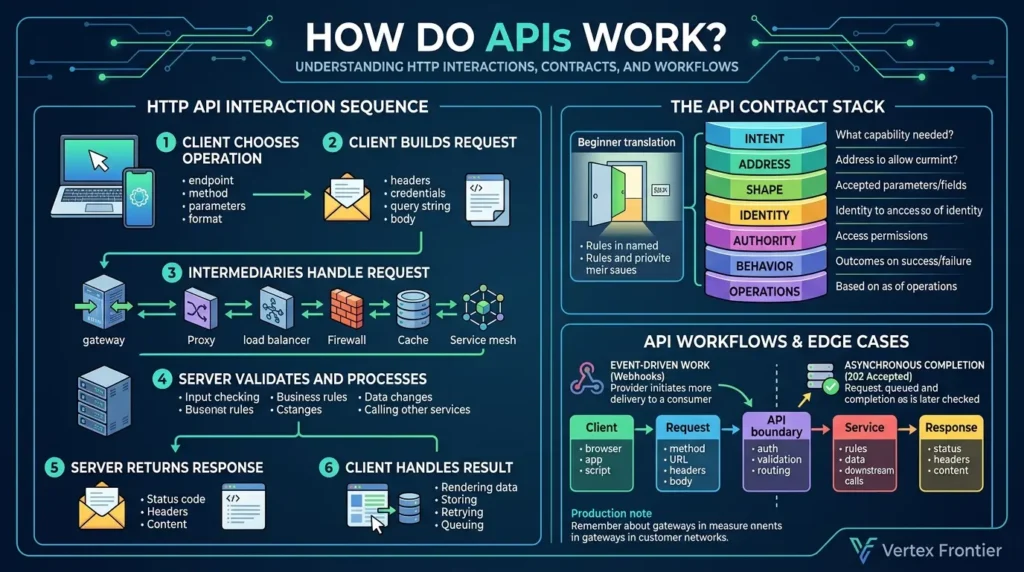
Most HTTP API interactions follow a familiar sequence:
- The client chooses an operation. It selects an endpoint, method, parameters, and representation format.
- The client builds a request. The request may contain headers, credentials, a query string, and a body.
- Intermediaries handle the request. A gateway, proxy, load balancer, firewall, cache, or service mesh may route, filter, authenticate, log, or reject it.
- The server validates and processes it. The service checks input, applies business rules, reads or changes data, and may call other services.
- The server returns a response. The response carries a status code, headers, and optional content.
- The client handles the result. It renders data, stores it, asks the user to retry, queues work, or records an operational failure.
HTTP semantics in RFC 9110 define the shared vocabulary for methods, status codes, headers, and representations. MDN’s HTTP overview is a practical companion. HTTP does not decide every application detail: the API designer still chooses resource names, schemas, authentication, authorization, pagination, rate limits, versioning, and error format.
The API Contract Stack
A useful way to understand an API is to inspect it as a stack rather than as a URL. This article calls the model the API Contract Stack:
- Intent: What capability or resource does the caller need?
- Address: Where is the operation exposed, and which method selects it?
- Shape: Which parameters, headers, media types, and body fields are accepted?
- Identity: How does the service recognize the calling application, user, or workload?
- Authority: Which objects, fields, and actions may that identity access?
- Behavior: What happens on success, validation failure, timeout, duplicate request, or asynchronous completion?
- Operations: How are limits, pagination, retries, versions, logging, and deprecation handled?
The first three layers explain why a request can be syntactically correct but still invalid. The identity and authority layers explain why a valid token can still receive 403 Forbidden. The behavior and operations layers explain why a working integration can still fail under load or during a provider migration.
API Concepts & Production Context
Click any topic to expand or collapseBeginner Translation: Doorway with Rules
An API is fundamentally a doorway with defined rules governing how software applications interact.
Technical Precision: Beyond the URL
The API contract covers syntax, semantics, security protocols, and failure behavior—not merely the target endpoint URL.
Production Note: Gateways & Proxies
Gateways and proxies are part of the real execution path. A request that works locally may encounter different timeouts, header policies, TLS inspection rules, or rate quotas within a customer’s production network.
Browser-to-backend, service-to-service, and event flows
An API call does not always begin with a browser, and not every useful interaction ends with an immediate response.
For event-driven work, the provider later initiates a new delivery to a consumer webhook. That is a different direction of initiation.
HTTP is stateless at its protocol core, although cookies, sessions, and application tokens can create stateful behavior around it. A service may also accept a request with 202 Accepted, place work on a queue, and expose a later status check. “The server responded” does not always mean “the business operation has finished.”
What is an API endpoint?
An API endpoint is a network-accessible location where a service exposes an operation or resource. In an HTTP API, it is commonly understood as a URL path combined with an HTTP method.
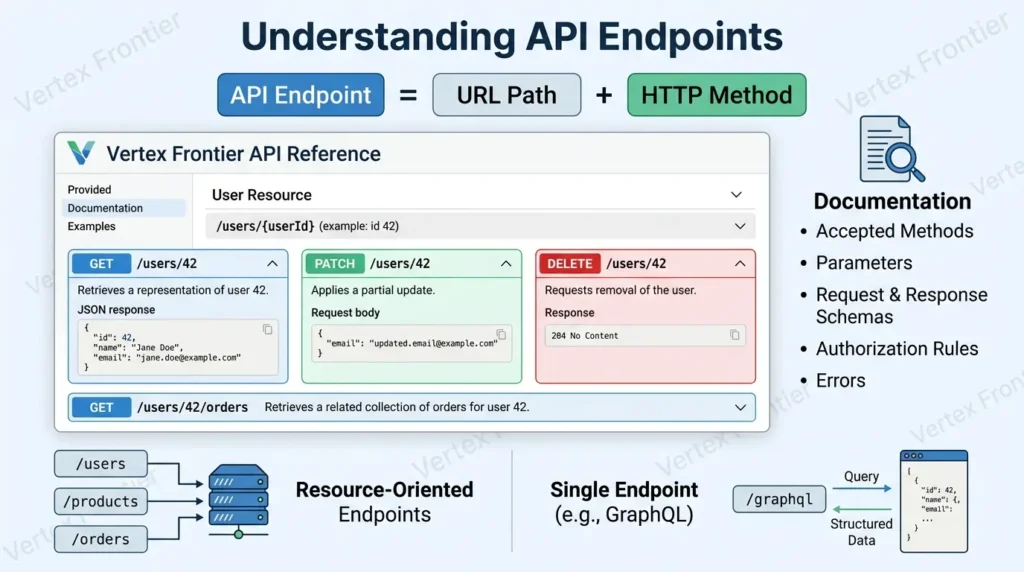
For example, these operations may target the same resource family:
GET /users/42retrieves a representation.PATCH /users/42applies a partial update if the API supports it.DELETE /users/42requests removal of the current representation.GET /users/42/ordersretrieves a related collection.
The path alone is not enough. GET /users/42 and DELETE /users/42 have different meanings, permissions, side effects, and response contracts. Documentation must define accepted methods, parameters, request and response schemas, authorization rules, and errors.
Some API styles expose many resource-oriented endpoints. Other deployments use a single endpoint for many operations. GraphQL commonly appears this way, but the GraphQL specification defines a query language and execution system, not a universal URL layout or transport.
What Is an API Gateway?
An API gateway is an intermediary entry point between clients and one or more backend services. An API is the broader contract that defines how software can request data or capabilities; a gateway is a layer in the request path that can apply shared policies before forwarding traffic to an API service. A gateway may expose one public base address while routing different paths or operations to different services.
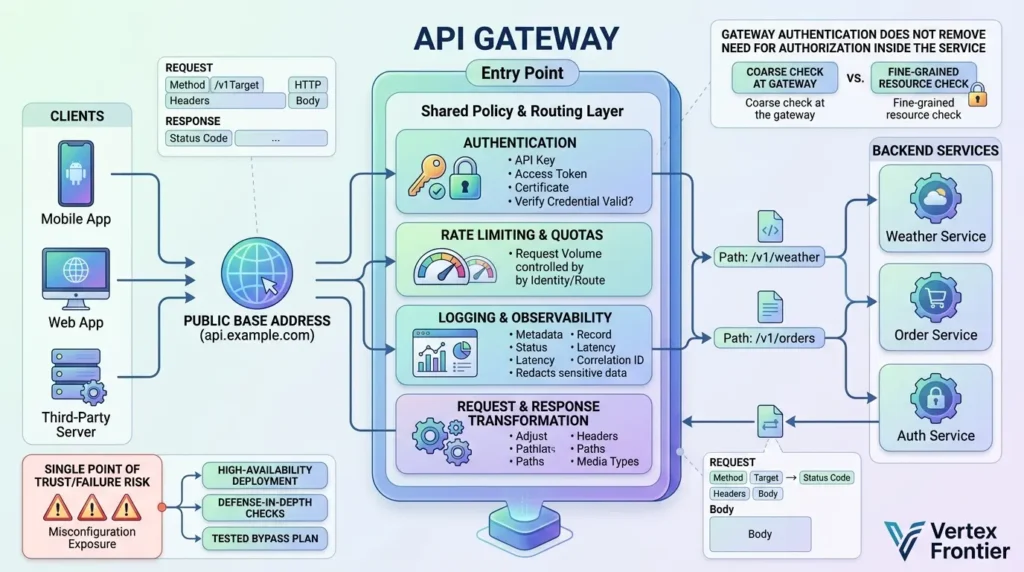
Common gateway responsibilities include:
- Authentication at the edge: validate an API key, access token, certificate, or other credential before a request reaches a service, when the deployment assigns that responsibility to the gateway.
- Routing: send a request to the appropriate service, version, region, or upstream target.
- Rate limiting and quotas: control request volume by a policy-defined identity, account, client, route, or other bucket.
- Logging and observability: record useful request metadata, status, latency, correlation identifiers, and upstream outcomes while redacting credentials and sensitive data.
- Request and response transformation: adapt headers, paths, media types, or representations when the integration contract requires it.
Gateway authentication does not remove the need for authorization inside the service. The gateway may establish that a credential is valid or apply a coarse access policy, but the service still needs to decide whether that caller may access a particular tenant, object, field, or action. A valid token at the gateway is not blanket permission for every downstream operation.
A gateway can also become a single point of trust and, depending on its design, a single point of failure or policy drift. A misconfiguration can expose multiple services, a gateway outage can affect many routes, and sensitive logs or transformations can widen the blast radius.
High-availability deployment, narrowly scoped credentials, defense-in-depth checks, clear ownership, and a tested bypass or recovery plan are practical safeguards; the right design depends on the architecture and threat model.
Request anatomy: method, target, headers, and body
Here is a provider-neutral illustrative request. The domain is deliberately fictional; it is not a live service.
HTTP request:
GET /v1/weather?city=London HTTP/1.1
Host: api.example.com
Accept: application/json
Authorization: Bearer YOUR_ACCESS_TOKGETis the HTTP method. It asks for a current representation under the API’s contract./v1/weatheris the path. The v1 is a provider-chosen versioning convention, not a requirement of HTTP.city=Londonis a query parameter. Query parameters often filter, sort, search, or paginate a request.Hostidentifies the destination in HTTP/1.1-style presentation. Modern HTTP versions can use different wire framing while preserving HTTP semantics.Accepttells the server which response media type the client prefers.Authorizationcarries an illustrative bearer token. Never publish a real secret in an article, repository, screenshot, URL, or client-side bundle.
A write request may include a body:
HTTP request with JSON body:
POST /v1/orders HTTP/1.1
Host: api.example.com
Content-Type: application/json
Authorization: Bearer YOUR_ACCESS_TOKEN
{
"product_id": "prod_123",
"quantity": 2
}
The body is data, not automatically a command. The API contract determines whether the fields are required, what types they have, and which side effects can result.
Response anatomy: status, headers, and representation
A successful response might look like this:
HTTP response:
HTTP/1.1 200 OK
Content-Type: application/json
{
"city": "London",
"temperature_c": 14,
"condition": "cloudy"
}
The status code tells the client how the server interpreted the request. Common meanings include:
201 Created: the request succeeded and created a resource; aLocationheader may identify it.200 OK: the request succeeded.202 Accepted: the request was accepted for processing, but the work may not be complete.204 No Content: the operation succeeded without a response body.400 Bad Request: the request appears invalid; validation details are API-specific.401 Unauthorized: valid authentication credentials are missing or not accepted for the target resource.403 Forbidden: the server understood the request but refuses to authorize it.404 Not Found: no current representation is available for the target resource. Some APIs also use it to avoid revealing a protected resource’s existence.409 Conflict: the request conflicts with the current resource state.429 Too Many Requests: the client sent too many requests in a given period. RFC 6585 defines this status;Retry-Aftermay be present but is not guaranteed.500 Internal Server Errorand503 Service Unavailable: the server could not fulfill the request; the latter commonly signals temporary inability.
The Problem Details standard in RFC 9457 offers an optional machine-readable error format, commonly serialized as application/problem+json. A good error gives the client safe, stable fields such as a problem type, status, validation location, and correlation identifier without disclosing secrets or internal stack traces.
What are the different types of APIs?
“API type” is ambiguous. A public API and a REST API are not competing labels. One describes access; the other describes a technical approach. Classify APIs on separate axes.
Types by access and audience
| Access or audience type | Who uses it? | Typical purpose |
|---|---|---|
| Public or open | External developers or customers, subject to the provider’s terms and controls. | Publish data, extend a product, or enable third-party integrations. |
| Private or internal | Teams and services inside an organization. | Connect internal applications, data, and workflows. |
| Partner | Approved external organizations. | Support a controlled business relationship with narrower access. |
| Composite | A client, gateway, or orchestration layer combines several services. | Coordinate a workflow or reduce client round trips. |
“Open API” can also mean the OpenAPI specification in a technical conversation, so check the context. A public API may still require registration, keys, quotas, attribution, or payment. “Public” does not mean unrestricted.
Types by architecture or protocol
| Style or pattern | Core idea | Often useful when |
|---|---|---|
| REST-like HTTP | Resources and representations use HTTP methods and status semantics. | Clients need broad compatibility and conventional operations. |
| GraphQL | Clients select fields through a schema-defined query language and execution model. | Different clients need different views of related data. |
| SOAP | An extensible XML messaging framework with an envelope and processing model. | Existing enterprise contracts and formal message processing matter. |
| RPC or gRPC | Clients call server-defined methods, often through generated stubs and Protocol Buffers. | Controlled service-to-service calls, typed contracts, and streaming are priorities. |
| WebSocket | A long-lived connection supports two-way communication. | Interactive, low-latency updates are central to the product. |
| Event or webhook | A producer emits an event and a consumer reacts asynchronously. | Polling would be wasteful or too slow. |
A private API can be REST-like, GraphQL-based, or gRPC-based. A public API can use any of those approaches. A partner service can preserve a SOAP contract. A composite API can orchestrate several protocols. The axes overlap; they do not replace one another.
REST vs GraphQL vs SOAP vs gRPC: which should you choose?
There is no universal winner. Choose based on clients, data shape, compatibility, governance, network path, and operational maturity, not a slogan about speed.
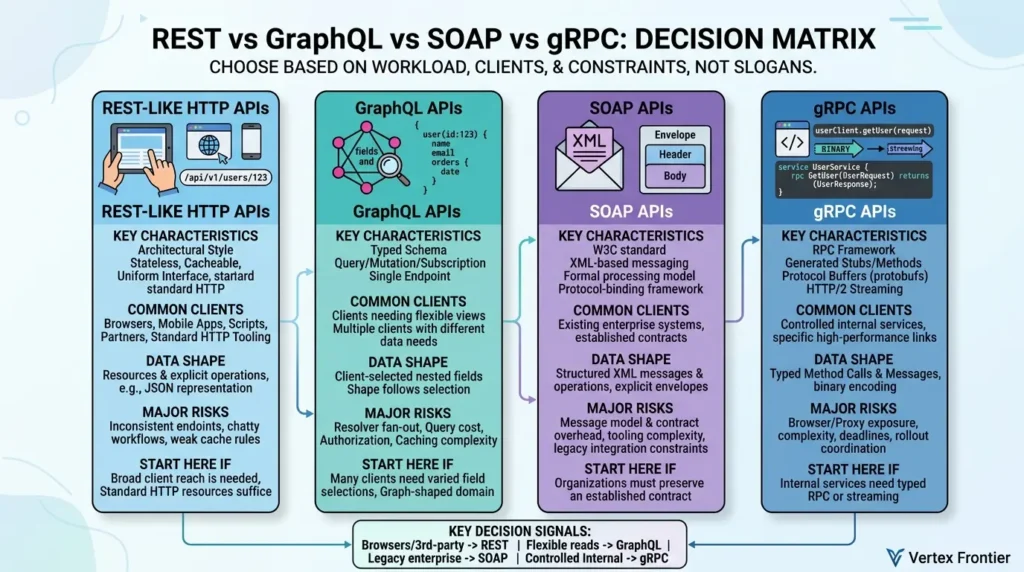
REST-like HTTP APIs
REST is an architectural style, not a protocol and not a synonym for “JSON over HTTP.” Roy Fielding’s REST dissertation describes constraints including client-server separation, stateless interaction, cache constraints, a uniform interface, and a layered system. Its uniform interface includes resource identification, manipulation through representations, self-descriptive messages, and hypermedia controls.
Many products called REST APIs implement a useful subset of those constraints. Calling them “REST-like HTTP APIs” is often more precise than claiming full conformance. REST-like designs are a strong default when browsers, mobile apps, scripts, partners, and ordinary HTTP tooling must all interoperate.
The trade-off is that endpoint design can become inconsistent, resource relationships can require several requests, and cacheability depends on the contract and intermediaries. HTTP semantics give you a foundation; they do not automatically give you a coherent API.
GraphQL APIs
GraphQL defines a typed schema and execution semantics. A query selects fields, a mutation expresses a write, and a subscription expresses a subscription operation. The result is shaped by the selection and can include top-level data and errors.
GraphQL is attractive when multiple clients need different nested views of related data, or when a graph-shaped domain benefits from a shared schema. It can reduce client-side over-fetching in some designs, but it does not eliminate server complexity. Resolvers still need authorization, query-cost limits, batching, caching, timeouts, and downstream failure handling.
The GraphQL language specification does not mandate HTTP, JSON, one endpoint, a particular database, or a programming language. Those are common deployment choices. In a community discussion about a first-party GraphQL project, one experienced developer described selective fields as less compelling when the frontend’s data needs were already controlled and warned that aggregation can wait on a slow downstream dependency. That is a project observation, not proof that GraphQL is generally slower.
SOAP APIs
W3C SOAP 1.2 defines an extensible XML-based messaging framework for structured information in distributed environments. Its message has an envelope, an optional header, and a mandatory body, with a processing model and protocol-binding framework.
SOAP is not simply “REST with XML,” and it is not inherently secure or insecure. It can remain the right choice when an organization must preserve an established contract, formal message processing, or interoperability with existing enterprise systems. Its cost is the weight of the message model, tooling, and legacy integration constraints when a simpler HTTP contract would suffice.
gRPC APIs
gRPC’s official introduction describes an RPC framework in which generated client stubs call server-defined methods. Protocol Buffers commonly provide the interface definition and message format; gRPC also supports streaming and uses an HTTP/2-based transport in its standard model.
That makes gRPC appealing for controlled service-to-service communication, strongly typed contracts, and streaming. It can be less convenient for direct browser use, public partner access, or networks with restrictive proxies unless an additional gateway or compatible browser transport is introduced. Do not say gRPC is always faster: performance depends on payloads, codecs, network behavior, deadlines, intermediaries, and workload.
A workload-based decision matrix
| Question | REST-like HTTP | GraphQL | SOAP | gRPC |
|---|---|---|---|---|
| Client diversity? | Broad browser, mobile, script, and partner fit. | Useful when clients need varied field selections. | Often driven by existing enterprise contracts. | Best fit is usually controlled clients. |
| Data shape? | Resource representations and explicit operations. | Client-selected fields and related data. | Structured XML messages and operations. | Typed method calls and messages. |
| Main risk to plan for | Inconsistent resources, chatty workflows, or weak cache rules. | Resolver fan-out, query cost, authorization, and cache complexity. | Message and contract overhead. | Browser/proxy exposure and deployment complexity. |
| Start here if… | Standard HTTP resources are enough. | Many clients need different nested views. | A proven SOAP contract must remain compatible. | Internal services need typed RPC or streaming. |
Contrarian insight: One request is not automatically better than several. A composite GraphQL or gateway request can wait for its slowest dependency, while separate calls may let a user see partial results sooner. The right question is not “Which protocol has fewer requests?” but “Which failure and rendering behavior does this workload need?”
For AI systems, the same principle applies to tool calls and service boundaries. Vertex Frontier’s Google Agent Development Kit guide explains how tools connect agent behavior to external services, while its LlamaIndex vs LangChain comparison discusses connectors, endpoints, schemas, authentication, and failure boundaries.
API Style Decision Matrix
Use the following as a set of starting points, not universal verdicts. The workload, client constraints, testing evidence, operational ownership, and governance requirements can change the choice.
| Signal / question | Likely starting point | Why | Watch-outs |
|---|---|---|---|
| Do clients include browsers or third parties? | Start with a REST-like HTTP API as a candidate. | HTTP tooling, explicit resources, and broad client reach can reduce integration friction. | CORS, authentication exposure, versioning, pagination, and partner compatibility still require deliberate design. |
| Do clients need flexible nested reads? | Start with GraphQL as a candidate. | A typed query model can let clients request related fields in a shape suited to their screen or workflow. | Query cost, resolver fan-out, authorization, caching, schema evolution, and abuse controls need testing. |
| Are the calls controlled service-to-service interactions with typed contracts? | Start with gRPC as a candidate. | A schema-driven RPC contract and generated types can fit an environment where both sides are controlled. | Browser and proxy compatibility, deadlines, observability, rollout coordination, and language/runtime support matter. |
| Is there an existing enterprise XML contract? | Start by evaluating SOAP compatibility. | Preserving a documented contract can be less disruptive than replacing it solely for stylistic reasons. | Schema governance, tooling, security policy, message overhead, and migration ownership remain part of the decision. |
| Does the workload require real-time two-way interaction? | Start by evaluating WebSockets or another documented real-time transport. | A persistent channel can support server and client messages without treating every update as an independent request. | Reconnects, authentication refresh, ordering, backpressure, presence, proxies, and horizontal scaling need explicit behavior. |
| Is the requirement asynchronous event notification? | Start by evaluating webhooks or a documented event broker pattern. | The producer can notify a consumer when an event occurs instead of requiring continuous polling. | Signatures, replay, duplicate delivery, ordering, retries, acknowledgement time, and dead-letter handling must be specified. |
How to use this matrix:
- identify the client, interaction, and delivery constraints;
- choose one starting point and write down the assumptions it relies on;
- validate the candidate with representative workload tests, failure-path tests, and the team’s security and governance requirements before committing.
Documented Real-World API Examples and Integration Patterns
The most useful examples show a complete flow: who initiates the call, what crosses the boundary, what comes back, and what can fail. The Stripe, GitHub, Jotform, and Vertex Frontier examples below document technical mechanisms and integration flows.
They are not all commercial case studies with reported financial results or performance metrics, so they should not be read as complete case studies or as evidence of a business outcome. Where a provider documents a rule, the rule is labeled as provider-specific; where a Vertex Frontier page documents a workflow, the article uses it to illustrate the mechanism rather than to claim revenue, adoption, or benchmark results.
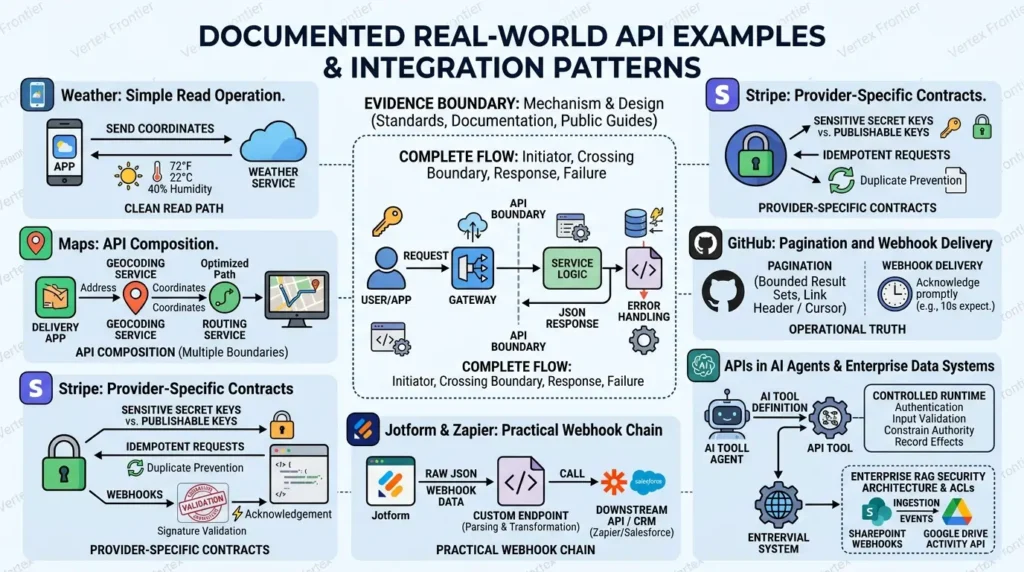
Evidence boundary for these examples
This article draws on standards, official documentation, and public Vertex Frontier guides to explain mechanisms and design considerations. It does not claim a benchmark, a controlled performance comparison, or a business outcome for the examples; those conclusions would require named workloads, test conditions, and independently reviewable results.
Weather: a simple read operation
A weather app may send a city or coordinates to a weather service, receive structured conditions, and render them for a user. The app does not need to know how sensors, forecasts, storage, or data cleaning work behind the service.
This is a clean read path: a client requests a representation, the service validates input, and the app handles a response. It is also a good first API exercise because it can be read-only and small.
Maps and geocoding: API composition
A delivery application may first send an address to a geocoding service, receive coordinates, then send those coordinates to a routing service. One user action crosses multiple API boundaries, each with different credentials, quotas, latency, and failure behavior.
That is API composition. A map displayed on a screen may be the visible result of several calls rather than one “maps API” request. Composite designs must decide which failures are fatal, which results can be cached, and whether a partial result is useful.
Stripe: keys, idempotency, and webhooks as provider-specific contracts
Stripe’s documentation is a concrete example of why payment integrations need more than a create-payment request. Its API-key documentation distinguishes publishable keys from sensitive secret and restricted keys. That is Stripe’s credential model, not a universal rule that every API key can be placed in browser code.
Stripe also documents idempotent requests: a client-generated key can let a retry recover the same operation result instead of creating a second effect, subject to Stripe’s parameter matching and retention behavior. The important lesson is not “all APIs work like Stripe.” It is that the provider must define key scope, retention, concurrency handling, and replay behavior.
Stripe’s webhook documentation adds another production boundary: verify the signature over the raw request body, acknowledge promptly, and process event work safely. Stripe documents retries, possible duplicate deliveries, and no universal guarantee of event ordering. Those details are why a webhook is a small event-processing system, not merely a POST handler.
No business-outcome metric is claimed here. The public documentation establishes the integration behavior and the design lesson: payment APIs make credentials, duplicate prevention, and asynchronous events explicit.
GitHub: pagination and webhook delivery
GitHub’s REST API documents pagination with bounded result sets and navigational URLs in the Link response header. Clients should follow the provider’s next-page link or cursor rather than inventing a URL pattern. This matters when collections change while a client is traversing them.
GitHub also documents handling webhook deliveries, including signature validation and prompt successful acknowledgement. Its delivery guidance includes a ten-second response expectation for the receiver. That timing is a GitHub rule, not a universal webhook standard.
The case illustrates an operational truth: the endpoint contract includes response headers, signatures, time expectations, and delivery behavior. Reading only the request body is not enough.
Jotform and Zapier: a practical webhook chain
Vertex Frontier’s Jotform-to-Zapier tutorial documents a practical flow involving a custom endpoint, raw JSON, webhook data, and a downstream API or CRM. It is a useful non-theoretical example because the integration moves from an event source through parsing and transformation into another service.
The public guide documents the mechanics, not a universal performance or revenue outcome. The transferable lesson is that API integration often means translating one contract into another: field names, authentication, error handling, and retries must be reconciled at the boundary.
APIs in AI agents and enterprise data systems
An AI agent can use an API as a tool, but the tool definition does not remove the need for a controlled runtime. The runtime still has to authenticate, validate inputs, constrain authority, and record side effects. For browser-facing agent tools, read WebMCP Explained: How Websites Can Expose Tools To AI Agents. For permission boundaries and OAuth, see MCP Security in Production.
In enterprise retrieval systems, APIs and webhooks can carry ingestion events, activity changes, and permission updates. Vertex Frontier’s Enterprise RAG Security Architecture & ACLs discusses SharePoint webhooks and the Google Drive Activity API in an event-driven access-control context. Its RAG data preprocessing guide provides a complementary view of ingestion and data contracts.
Again, these pages document architectures and mechanisms, not a fabricated business case study. The point is that an API boundary remains an API boundary whether the caller is a browser, a payment service, a data pipeline, or an AI agent.
How to use an API for the first time
The safest beginner workflow is documentation-first, not trial-and-error. You do not need to understand every internal service before making a read-only call, but you do need to understand the provider’s contract.
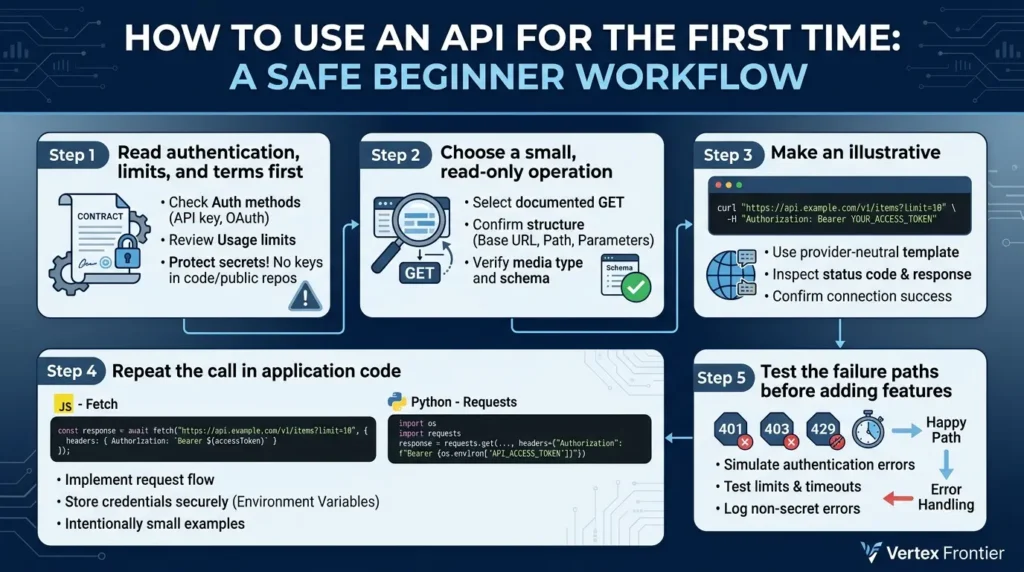
Step 1: Read authentication, limits, and terms first
Find out whether the provider requires an API key, OAuth access token, signed request, mutual TLS certificate, or another mechanism. Identify where the credential belongs and whether it is restricted by environment, scope, IP, audience, or account.
Read the usage limits and terms before writing a loop. A “public” endpoint may still have quotas or attribution requirements. Never put a secret key in a public repository, browser bundle, screenshot, URL, or log.
Step 2: Choose a small, read-only operation
Start with a documented GET that returns a small response. Confirm:
- The base URL and environment.
- The path and method.
- Required query parameters and headers.
- Authentication placement.
- Response media type and schema.
- Status codes and error shapes.
- Pagination and rate-limit behavior.
Step 3: Make an illustrative request
This provider-neutral cURL command is a template, not a live request:
cURL
curl "https://api.example.com/v1/items?limit=10" \
-H "Accept: application/json" \
  -H "Authorization: Bearer YOUR_ACCESS_TOKEN"
Replace the URL, query parameters, and authentication mechanism only according to the official provider documentation. A successful HTTP connection proves very little by itself; inspect the schema and status code.
Step 4: Repeat the call in application code
The following JavaScript example assumes that accessToken was obtained through an appropriate, already-implemented flow. It is illustrative and does not implement authentication.
JavaScript — fetch:
const response = await fetch("https://api.example.com/v1/items?limit=10", {
  headers: {
    Accept: "application/json",
    Authorization: `Bearer ${accessToken}`
  }
});
if (!response.ok) {
  throw new Error(`API request failed: ${response.status}`);
}
const data = await response.json();
console.log(data);
For a server-side Python client, keep the credential in the environment rather than source code:
Python — requests:
import os
import requests
response = requests.get(
"https://api.example.com/v1/items",
params={"limit": 10},
headers={
"Accept": "application/json",
"Authorization": f"Bearer {os.environ['API_ACCESS_TOKEN']}",
},
timeout=10,
)
response.raise_for_status()
print(response.json())
A production client also needs redaction, bounded retries, pagination, timeout policy, structured logging, and provider-specific error handling. The snippets are intentionally small so you can see the request shape; they are not complete integration frameworks.
Step 5: Test the failure paths before adding features
Remove the credential and confirm the API returns its documented authentication error. Change a required parameter. Use an unknown identifier. Send too many requests only within the provider’s permitted test process. Record the response body, status, request identifier, and relevant headers without logging secrets.
Then test a timeout or simulated upstream failure in a safe environment. Your client should distinguish an invalid request from a temporary service problem and from an unknown outcome after a network interruption.
API authentication vs authorization
These terms answer different questions:
- Authentication: Who or what is making the request?
- Authorization: What may that caller do?
A credential can be valid while the requested object or operation is forbidden. A user may be authenticated but unable to read another customer’s record. A service account may be authorized to read invoices but not refund them.
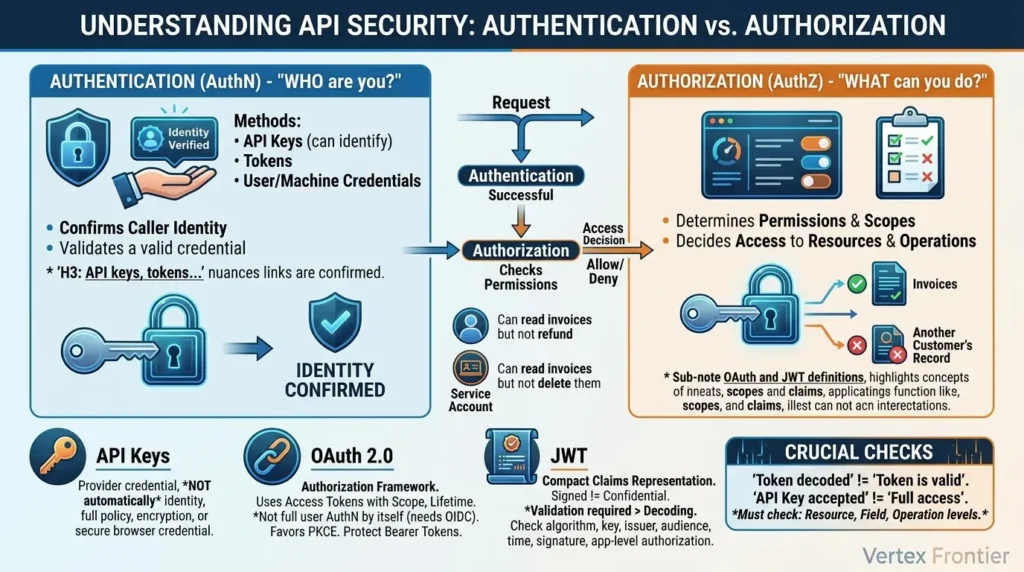
API keys, tokens, OAuth, and JWT are not synonyms
An API key is a provider-defined credential that may identify or authorize an application or caller. It is not automatically proof of a human user’s identity, a complete authorization policy, encryption, or a secure browser credential.
OAuth 2.0 is an authorization framework. It lets a client obtain an access token with a scope, lifetime, and other attributes through an authorization server. OAuth is not, by itself, a complete end-user authentication protocol; an application that needs identity needs an appropriate identity layer such as OpenID Connect.
Current OAuth security guidance in RFC 9700 favors authorization code flows with PKCE where applicable and does not treat the implicit grant as the default for new deployments. Bearer-token guidance matters because whoever possesses a bearer token can use it. Protect transport with TLS, avoid placing tokens in URLs, limit lifetime and scope, and prevent unnecessary logging or exposure.
A JWT is a compact claims representation that may be signed or encrypted. A signed JWT is not necessarily confidential: its claims may be readable. Validation requires more than decoding. The service must enforce an allowed algorithm and trusted key, then check relevant issuer, audience, time claims, signature or integrity, and application-level authorization.
For a deeper treatment of OAuth boundaries for service and agent identities, see Vertex Frontier’s NHI/IAM blueprint and agentic AI security guide.
What breaks in production?
The first successful request is the easy part. Community discussions repeatedly surface a more uncomfortable pattern: integration behavior is larger than the endpoint contract. Proxies, unclear errors, quotas, retries, downstream calls, and compatibility rules often decide whether an integration remains usable.
These are practitioner-informed patterns, not prevalence statistics. Reddit and YouTube discussions are useful for finding failure modes, but standards and provider documentation remain the authority for technical behavior.
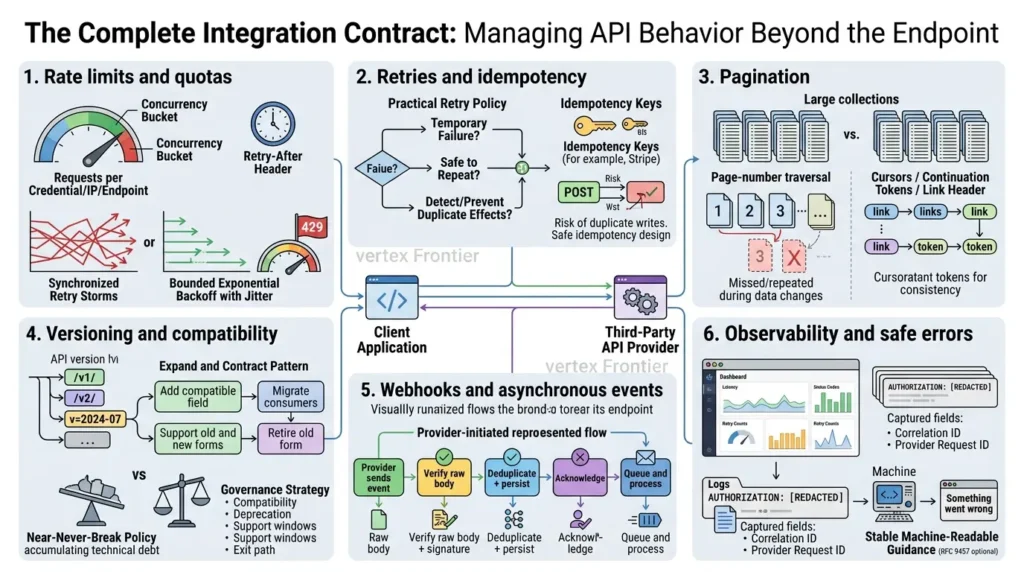
Rate limits and quotas
A provider may limit requests per credential, account, IP address, endpoint, resource, or concurrency bucket. 429 signals that too many requests were sent in a period, but it does not define the provider’s counting algorithm or reset policy. A Retry-After header may be supplied.
Read the provider’s documented limits. Avoid synchronized retry storms. If backoff with jitter is recommended, use bounded exponential backoff and stop after a policy-defined number of attempts. For a paid third-party API, a queue or centralized limiter may be useful when several workers must share one budget; whether it belongs in-process or in a separate service depends on deployment topology and consistency needs.
Retries and idempotency
Retries can turn a transient network problem into a successful user action. They can also duplicate a write. RFC 9110 defines safe and idempotent method semantics, but an HTTP method name is not a substitute for understanding the application’s side effects.
A practical retry policy answers three questions:
- Which failures are likely temporary?
- Which operations can be repeated safely?
- How will the client detect or prevent duplicate effects?
A timeout does not prove the server did not process the request. Retry POST only when the API supplies an idempotency design or equivalent protection. Stripe’s idempotency keys are one documented provider implementation; another provider may use a different key scope, retention period, or replay policy.
Pagination
Large collections are usually bounded. Pagination may use page numbers, cursors, continuation tokens, or links in response headers. GitHub’s documented Link header is a good example of why a client should follow the provider’s next-page URL rather than constructing one from assumptions.
Pagination also has a consistency problem. If records are inserted or deleted while a client walks a collection, page-number traversal can miss or repeat items unless the provider defines a snapshot or cursor behavior. Treat ordering, termination, duplicate handling, and changing data as part of the contract.
Versioning and compatibility
Providers can version through URL paths, headers, media types, account defaults, schemas, or generated service definitions. No single mechanism is required by HTTP, REST, GraphQL, SOAP, or gRPC.
A version number also does not tell you what is compatible. Read the provider’s changelog and migration rules, test fields your integration actually uses, and inventory consumers before removing a version. The expand-and-contract pattern, add a compatible field, support old and new forms, migrate consumers, then retire the old form, can reduce migration shock when it fits the domain.
A community account of a very old codebase offers a useful counterpoint: a near-never-break policy can preserve old behavior while accumulating technical debt and increasing friction for new users. “Never break clients” is not a complete governance strategy. Define compatibility, deprecation, support windows, and an exit path.
Webhooks and asynchronous events
A webhook is a provider-initiated HTTP request to a consumer URL when an event occurs. The flow is inverted: instead of polling the provider, your system receives a delivery.
A safe webhook path is:
- Receive the raw body and relevant headers.
- Verify the provider’s signature before trusting the payload.
- Enforce size, timestamp, and replay rules where documented.
- Persist an event identifier or idempotency record.
- Acknowledge promptly when the provider expects a quick response.
- Queue slow business work.
- Process, observe, and retry safely.
Do not assume exactly-once delivery or event ordering unless the provider documents those guarantees. GitHub and Stripe provide concrete, provider-specific guidance. Vertex Frontier’s Jotform and Zapier webhook guide shows the application side of custom endpoints and JSON transformation.
Observability and safe errors
A useful client or API should record enough to diagnose a failure without exposing secrets or sensitive personal data. Depending on the system, capture an endpoint name, status, latency, retry count, correlation ID, and provider request ID. Redact authorization headers and sensitive payload fields.
Return stable machine-readable guidance to your own callers. “Something went wrong” is not a contract. At the same time, verbose error details can expose information. The balanced approach is safe client detail plus protected server-side diagnostics, with authorization and threat-model decisions made explicitly. RFC 9457 is an optional structure, not a requirement.
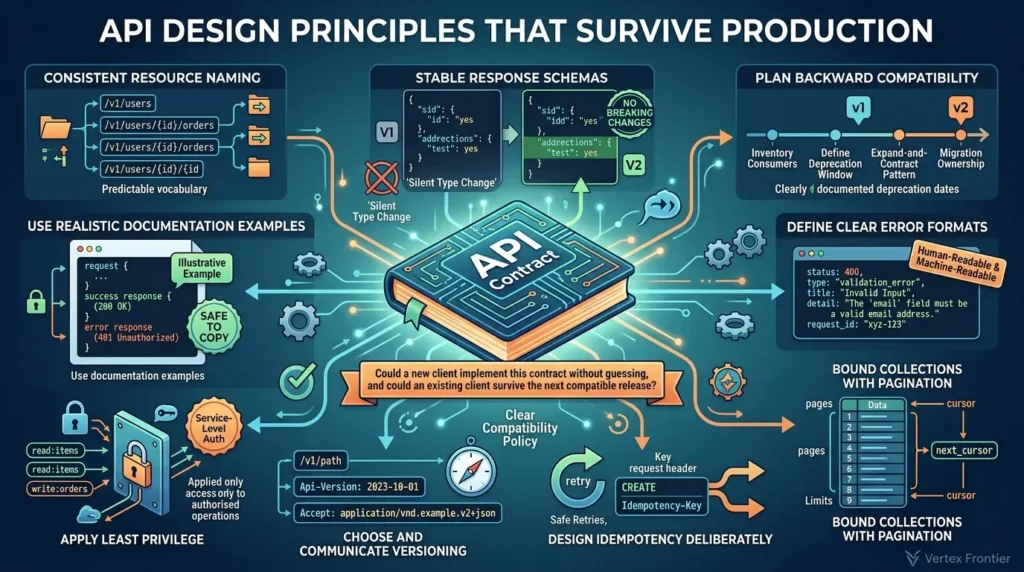
API Design Principles That Survive Production
These are practical design principles rather than absolute rules. A team may make a different choice for a documented reason, but the choice should be visible in the contract and tested with real consumers.
- Use consistent resource naming. Choose a predictable vocabulary for collections, individual resources, relationships, and actions. Consistency lowers the amount of special-case client code and makes documentation easier to scan.
- Keep stable response schemas. Prefer additive, clearly documented changes when possible. Do not silently change a field’s type, meaning, nullability, or nesting because a client may depend on that shape.
- Plan backward compatibility. Inventory consumers, define deprecation and support windows, and test the fields and status codes that clients actually use. The expand-and-contract pattern can help when it fits the domain, but it is not a substitute for migration ownership.
- Define clear error formats. Use standard HTTP semantics and stable machine-readable fields for error type, validation location, correlation information, or retry guidance. Keep human detail useful but do not make clients parse prose as a permanent contract.
- Bound collections with pagination. Document ordering, page or cursor parameters, termination, limits, and what happens when records change during traversal. Clients should follow documented continuation links or cursors rather than guessing URLs.
- Design idempotency deliberately. Safe and idempotent HTTP method semantics help, but business operations still need their own duplicate-handling rules. For retryable writes, document an idempotency key or another way to detect repeated intent.
- Choose and communicate versioning. A path, header, media type, schema, account default, or generated definition can carry version information. The mechanism matters less than a clear compatibility policy, migration path, and deprecation process.
- Apply least privilege. Give credentials and scopes only the access required for the operation, then enforce object-, field-, tenant-, and function-level authorization in the owning service. Authentication at a gateway or proxy is not enough by itself.
- Use realistic documentation examples. Show representative success and failure payloads, optional and required fields, pagination, authentication boundaries, and asynchronous behavior with placeholders rather than fake production claims. Examples should be safe to copy and clearly marked when illustrative.
A useful review question is: Could a new client implement this contract without guessing, and could an existing client survive the next compatible release? If the answer is no, improve the contract or document the limitation before adding more endpoints.
Copyable API Contract Template
Illustrative API contract template — not an executable specification:
purpose: "Describe the capability and intended consumers"
base_url: "https://api.example.com/v1"
version: "v1"
authentication:
  scheme: "Bearer"
  credential: "YOUR_TOKEN"
  scopes: ["replace-with-required-scope"]
endpoints:
  - name: "List items"
    method: "GET"
    path: "/v1/items"
    request:
      headers: {Accept: "application/json"}
      query: {limit: "optional", cursor: "optional"}
    response:
      success: {status: 200, body: "ItemPage"}
    errors: [400, 401, 403, 429, 500]
  - name: "Create item"
    method: "POST"
    path: "/v1/items"
    request:
      headers: {Content-Type: "application/json", Idempotency-Key: "YOUR_IDEMPOTENCY_KEY"}
      body: "CreateItemRequest"
    response:
      success: {status: 201, body: "Item"}
    errors: [400, 401, 403, 409, 429, 500]
errors:
  shape: {type: "string", title: "string", detail: "safe client detail", request_id: "string"}
  retry_guidance: "Document which failures may be retried and under what conditions"
pagination:
  style: "cursor or page; choose one and document it"
  fields: {limit: "bounded integer", cursor: "opaque continuation value"}
  ordering: "Document stable ordering and collection-change behavior"
rate_limits:
  policy: "Provider-defined; document scope, headers, and response behavior"
  exceeded_response: "429 with documented retry guidance"
idempotency:
  supported_for: ["Document retryable write operations"]
  key: "YOUR_IDEMPOTENCY_KEY"
  replay_behavior: "Document duplicate, mismatch, expiry, and concurrency handling"
webhooks:
  events: ["event.name"]
  callback: "https://client.example.com/webhooks/provider"
  verification: "Document signature, raw-body, replay, retry, and acknowledgement rules"
deprecation:
  policy: "Document notice period, support window, replacement, and migration path"
observability:
  request_id: "Document correlation header or identifier"
  logs: "Redact tokens and sensitive payload fields"
  metrics: ["status", "latency", "rate-limit events", "retry outcomes"]
security_notes:
  minimum: "Use TLS, least privilege, input validation, and resource-level authorization"
  secrets: "Do not place YOUR_TOKEN in source control, URLs, browser bundles, or logs"
This template is a checklist and starting point, not a replacement for the OpenAPI Specification or a provider’s official documentation. Replace each placeholder with behavior that is documented, tested, and owned by the team; do not treat the illustrative statuses, names, or values as a universal API contract.
API security checklist
The OWASP API Security Top 10 highlights risks including broken object-level, function-level, and property-level authorization; broken authentication; unrestricted resource consumption; sensitive business-flow abuse; SSRF; security misconfiguration; inventory failures; and unsafe consumption of APIs.
A practical review should ask:
- Is sensitive traffic protected with correctly validated TLS?
- Are credentials kept out of source code, URLs, logs, screenshots, and browser bundles?
- Are authentication and authorization checked separately?
- Is object-level authorization enforced for every resource identifier?
- Are fields minimized and inputs validated?
- Are expensive operations protected by quotas, limits, or approval steps?
- Are webhook signatures verified over the exact raw body where required?
- Are tokens restricted by scope, audience, lifetime, and environment?
- Are old versions and undocumented endpoints inventoried and retired deliberately?
- Can the team detect unusual access, failures, replay, and resource consumption?
CORS is not API security
CORS guidance from MDN explains how a server tells browsers which other origins may read a response. Browsers can send an OPTIONS preflight for certain cross-origin methods and headers, and credentialed requests require compatible response headers.
CORS is a browser-enforced read-control mechanism. It is not authentication, authorization, CSRF protection, a firewall, or a defense against non-browser clients. A browser CORS error does not prove that the server rejected the request, and a successful CORS response does not prove that the endpoint is secure.
Common API mistakes and how to avoid them
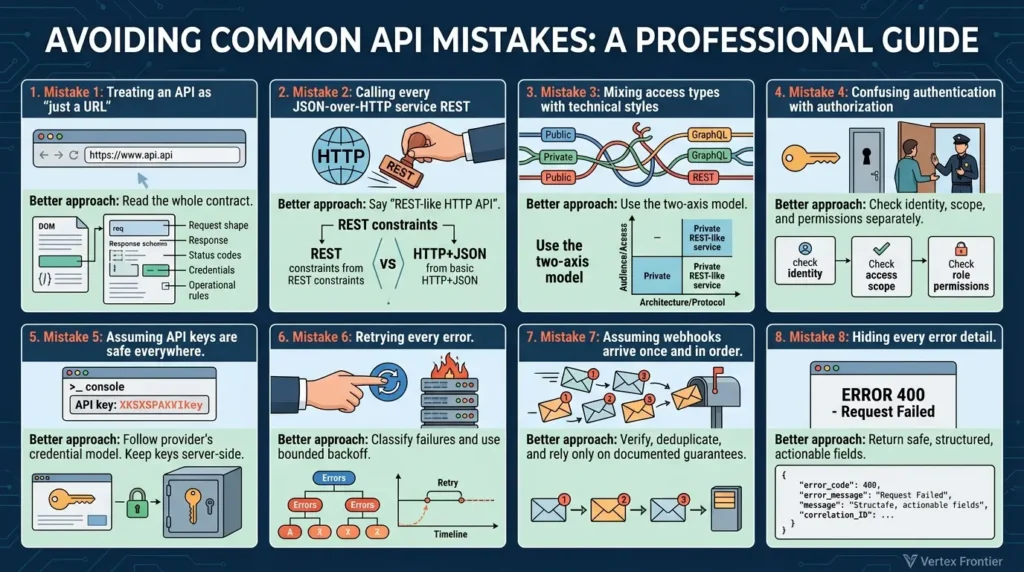
Mistake 1: Treating an API as “just a URL”
Why it fails: A URL says little about methods, schema, permissions, errors, limits, or compatibility.
Better approach: Read the whole contract. Record the request shape, response schema, status codes, credentials, and operational rules before coding.
Mistake 2: Calling every JSON-over-HTTP service REST
Why it fails: REST is an architectural style with constraints. JSON is a representation format, and HTTP is a protocol.
Better approach: Say “REST-like HTTP API” when full REST conformance is not established. The service can still be useful and well-designed.
Mistake 3: Mixing access types with technical styles
Why it fails: Public/private/partner describes audience or access. REST/GraphQL/SOAP/gRPC describes architecture or protocol.
Better approach: Use the two-axis model. “Private REST-like service” and “public GraphQL API” are both coherent descriptions.
Mistake 4: Confusing authentication with authorization
Why it fails: A valid credential does not grant access to every object, field, or action.
Better approach: Check identity, scope, tenant, object ownership, field policy, and function permission separately.
Mistake 5: Assuming API keys are safe everywhere
Why it fails: Key privileges and exposure rules are provider-specific. A key accepted by a browser does not imply that all keys are safe there.
Better approach: Follow the provider’s credential model and keep sensitive keys server-side.
Mistake 6: Retrying every error
Why it fails: A retry can amplify an outage or repeat a side effect after an uncertain timeout.
Better approach: Classify failures, respect provider guidance, use bounded backoff, and add idempotency before retrying unsafe operations.
Mistake 7: Assuming webhooks arrive once and in order
Why it fails: Providers may retry, duplicate, delay, or reorder deliveries.
Better approach: Verify, deduplicate, acknowledge promptly, queue work, and rely only on documented ordering guarantees.
Mistake 8: Hiding every error detail
Why it fails: Generic 400 responses make legitimate integration failures hard to diagnose, while over-detailed errors can leak sensitive information.
Better approach: Return safe, structured, actionable fields; keep sensitive diagnostics in protected logs; include a correlation identifier when useful.
Before and after: from a demo call to a production integration
The biggest transformation is not switching protocols. It is changing what you consider part of the API.
| Before: happy-path thinking | After: production-path thinking |
|---|---|
| “I have a URL and a key.” | I know the method, schema, credential placement, scope, and environment. |
| “A 200 means it worked.” | I validate fields, pagination, warnings, status semantics, and business completion. |
| “Retry until it succeeds.” | I classify transient failures and protect side effects with idempotency. |
| “The webhook is a POST route.” | I verify signatures, deduplicate, acknowledge, queue, and observe deliveries. |
| “The current version works.” | I track versions, deprecations, consumer dependencies, and migration tests. |
| “Logs can contain whatever helps debugging.” | Logs are useful, redacted, access-controlled, and correlated without leaking tokens or sensitive data. |
This is the Happy Path → Production Path framework: first learn the request and response, then deliberately add the failure and governance layers. It keeps the beginner explanation approachable without pretending that a demo is a finished system.
For a concrete walkthrough of that same transformation in code, going from a single @app.get("/health") route to a small API with typed Pydantic models, CRUD operations, dependency injection, error handling, and tests, see our guide to building a tested REST API with Python and FastAPI.
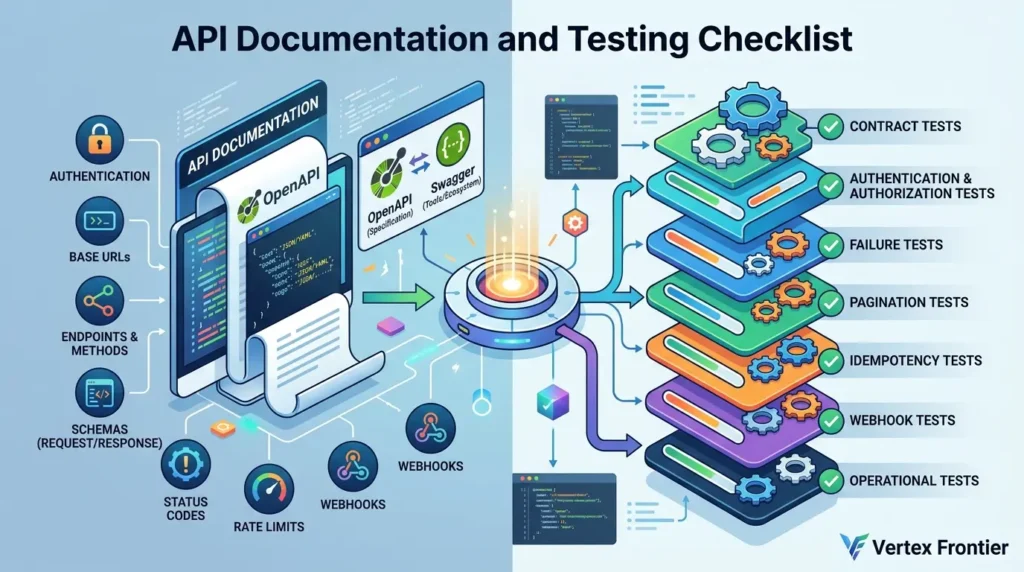
API documentation and testing checklist
Good API documentation is an executable conversation between the provider and the integrator. Before building, look for:
- Authentication and credential-storage guidance.
- Base URLs, environments, and version policy.
- Endpoint and method references.
- Request and response schemas.
- Required fields, optional fields, and data types.
- Status codes and structured error examples.
- Rate limits, pagination, timeout, and retry guidance.
- Webhook signing, retries, event identifiers, and ordering rules.
- Deprecation notices and migration instructions.
- A sandbox, test account, or safe fixture workflow.
What is OpenAPI, and how is it different from Swagger?
OpenAPI is a machine-readable description of an HTTP API. An OpenAPI document can describe paths and operations, parameters, request and response schemas, authentication requirements, and other parts of the contract in a format that tools can parse. The OpenAPI Specification is the formal specification; it is documentation about an API, not the API itself. The API is the running interface and its behavior. An OpenAPI document can be incomplete, outdated, or inconsistent with that running interface.
Swagger is the older name associated with the specification and remains a common name for tools and products that work with OpenAPI documents. In current usage, “OpenAPI” usually refers to the specification, while “Swagger” often refers to an ecosystem of tooling or to older documents. Check the tool’s supported OpenAPI version rather than assuming that every Swagger-branded feature supports every specification feature.
OpenAPI can support human-readable documentation, request and response validation, mock or sandbox workflows, contract tests, and client or server code generation. These uses improve consistency when the description is reviewed and kept in sync with the implementation. Generated code and tests do not prove that an API is correct or secure; they reproduce the contract that was described, so a stale specification can automate the wrong assumptions.
A practical test plan has several layers:
- Contract tests: confirm methods, schemas, required fields, and status codes.
- Authentication tests: expired, missing, wrong-audience, and insufficient-scope credentials.
- Authorization tests: another tenant’s object, restricted field, and forbidden function.
- Failure tests: invalid input, 404, 409, 429, timeout, and temporary upstream failure.
- Pagination tests: empty pages, final page, changing collections, and duplicate prevention.
- Idempotency tests: repeat the same write with the same key and with a changed payload.
- Webhook tests: invalid signature, duplicate event, replay, slow processing, and malformed payload.
- Operational tests: timeouts, retry bounds, redaction, correlation IDs, and alerting.
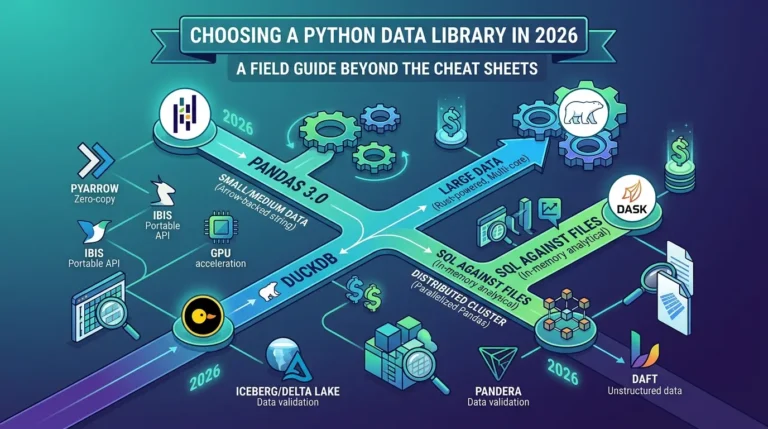
Vertex Frontier readers working with APIs for data can also connect this workflow to the guide on choosing Python data libraries, especially when an API returns a large collection that needs validation, pagination, and transformation.
API Glossary for Beginners
Endpoint
A specific address and operation where an API exposes a resource or capability.
Payload
The data carried in a request or response, often in the body but sometimes described more broadly by an integration.
Header
Metadata sent with an HTTP request or response, such as media type, authorization, caching, or correlation information.
Query Parameter
A key-value item in the target’s query string, often used for filtering, sorting, searching, or pagination.
Schema
A description of data structure, including fields, types, required values, and constraints.
Token
A credential or bearer value that a service may validate to identify a caller or grant scoped access.
Scope
A permission boundary that limits what a token or credential is intended to access or do.
Webhook
A provider-initiated HTTP delivery to a consumer URL when an event occurs.
Rate Limit
A provider or application policy that bounds request volume for a defined identity, resource, route, period, or concurrency bucket.
Idempotency
A property or application design in which repeating the same intended request does not create an unintended additional effect.
API Gateway
An intermediary layer that can authenticate, route, limit, observe, and transform traffic before it reaches backend services.
Conclusion: an API is a boundary you can reason about
The most useful answer to “what is an API?” is not merely “a way for applications to talk.” An API is a contracted boundary: one component requests a capability, another component applies rules and returns a result, and both sides depend on documented behavior.
Once that boundary is clear, the rest becomes easier to organize. You can separate access scope from technical style, distinguish authentication from authorization, understand why retries need idempotency, treat webhooks as event systems, and choose REST-like HTTP, GraphQL, SOAP, gRPC, WebSockets, or events according to the workload.
Start small. Read the documentation. Make a safe request. Test the failure paths. Then build the production path deliberately.
Frequently asked questions about APIs
What does API stand for?
API stands for application programming interface. It is an interface and contract that lets software components interact through defined operations, inputs, outputs, permissions, and behavioral rules.
Is an API the same as a website?
No. A website is primarily designed for people using a browser; an API is designed for software clients. A website may call APIs behind the scenes, but the two interfaces have different consumers and contracts.
Is an API the same as a database?
No. A database stores and queries data. An API exposes selected operations or representations and may use a database internally. Direct database access and API access have different boundaries and controls.
What is the difference between an API and a REST API?
API is the broad category. REST is an architectural style with constraints that can be used to design an API. Not every API uses HTTP, and not every HTTP API fully follows REST’s constraints.
What is an API key?
An API key is a provider-defined credential used to identify or authorize an application or caller. Its format, permissions, and exposure rules depend on the provider. It is not automatically a complete user-authentication system.
What is an API call?
An API call is an interaction in which a client sends a request to an API and receives a response, or receives an asynchronous result later. An HTTP request often includes a method, URL, headers, parameters, and sometimes a body.
Are APIs only used on the web?
No. Web APIs are common, but APIs also exist in operating systems, programming libraries, databases, message brokers, and software-development frameworks.
What is the safest way to learn APIs?
Start with a small read-only endpoint in official documentation. Learn the request and response structure, inspect status codes, keep credentials out of source code, and add timeout, error, rate-limit, pagination, and retry handling before building a larger integration.
What is an API gateway?
An API gateway is an intermediary entry point between clients and one or more backend services. It can route requests and apply shared policies such as authentication or rate limiting, but the owning service still needs to enforce resource-level authorization.

Was this article helpful?



[…] MCP does use authorization, it’s HTTP-specific, and it’s built on a real OAuth 2.1 profile, not an ad hoc scheme. The MCP authorization specification states that authorization is optional at […]
[…] store. Kafka tracks records and consumer offsets. The sink tracks what it has committed, and an external API may have already acted on an event before the consumer crashes. Each layer can be healthy while the […]
[…] you are new to API design, you may want to begin with Vertex Frontier’s guide to what an API is and how APIs work. If you already understand HTTP and JSON, you can start building immediately. By the end, you will […]
[…] you’re on the other side, building the API that others will ingest from, our guide to building a tested REST API with Python and FastAPI […]