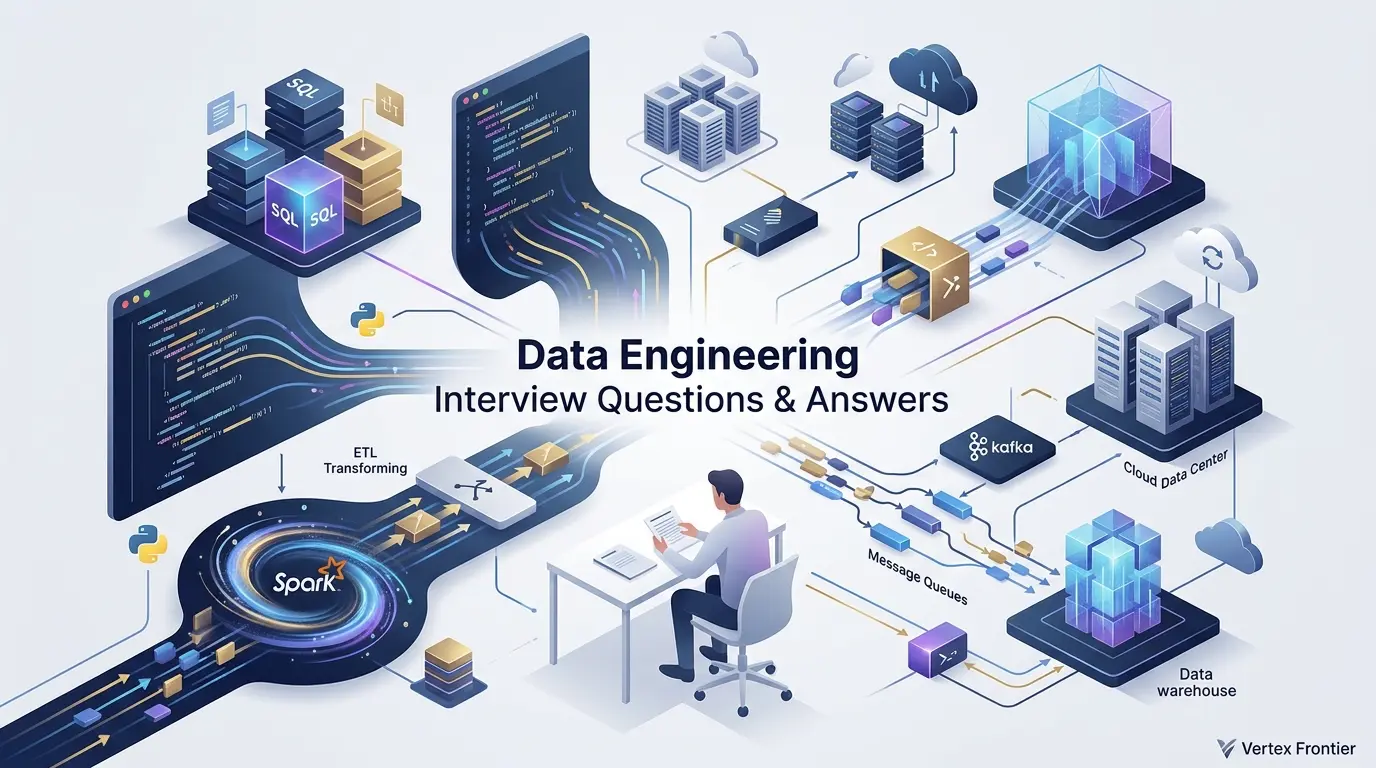

A data engineering interview is rarely a test of whether you can recite the definition of ETL. The difficult part is showing what happens after the happy path breaks.
What happens when a batch runs twice? When a CDC event arrives late? When two records have the same timestamp? When a Spark job works on 2 GB but fails on 2 TB? When a manager asks for “real time” without defining latency, correctness, or cost?
That is what separates a memorized answer from an engineering answer.
This guide is built for entry-level, mid-level, senior, staff, analytics, platform, streaming, and cloud-focused candidates. It combines the questions that appear repeatedly in public preparation material with the production reasoning that many short interview lists leave out.
The interview loop varies by company, role, location, and stack. Treat the guide as a map, not a promise that every employer will ask the same questions.
| Your target role | Start with | Do not skip |
|---|---|---|
| Junior or career switcher | SQL, Python, grain, ETL/ELT, and one end-to-end project. | Explaining what you personally built and tested. |
| Analytics or warehouse | SQL, dimensional modeling, incremental loads, and quality tests. | NULLs, duplicate joins, SCD history, and metric definitions. |
| Platform or batch | Pipeline reliability, orchestration, backfills, and observability. | Idempotency, recovery, cost, and ownership. |
| Streaming or CDC | Kafka, event time, ordering, deduplication, and replay. | Late data, deletes, schema changes, and sink semantics. |
| Senior or staff | System design, incidents, migrations, influence, and trade-offs. | Business impact, risk, alternatives, and what you would change. |
Key Takeaways
Click any topic to expand or collapseClarify data fundamentals before tools.
Strong answers clarify the data grain, assumptions, failure modes, and success criteria before proposing tools.
Senior interviews test system-level trade-offs.
SQL and Python are common screening foundations, but senior interviews usually test reliability, cost, scale, ownership, and trade-offs.
Exactly-once delivery requires external coordination.
Exactly-once delivery is not a universal end-to-end guarantee; external sinks usually need coordination or idempotent writes.
Idempotency requires explicit engineering design.
A retry is not automatically safe. Idempotency comes from deterministic boundaries, write keys, publication strategy, and reconciliation.
Prepare coding and reasoning tracks in parallel.
Prepare two tracks: timed coding practice and spoken production reasoning.
Your Data Engineering Interview Checklist
Use this as a quick readiness check before you book a mock interview. Tick the items you can explain without reading notes; leave the others for targeted practice.
How to use this data engineering interview guide
Do not try to memorize every answer word for word. Instead, use each question as a five-minute rehearsal:
- Give a direct answer in two or three sentences.
- State one assumption or ask one clarifying question.
- Explain the implementation or design choice.
- Name an edge case or failure mode.
- Finish with a trade-off and a likely follow-up.
This approach is more useful than collecting another list of definitions. The public search landscape is already crowded with numbered question banks from sites such as DataCamp, DataVidhya, Coursera, and GeeksforGeeks. The information gap is not simply more questions. It is better calibration: what the interviewer is testing, what a weak answer misses, and how the answer changes at different levels.
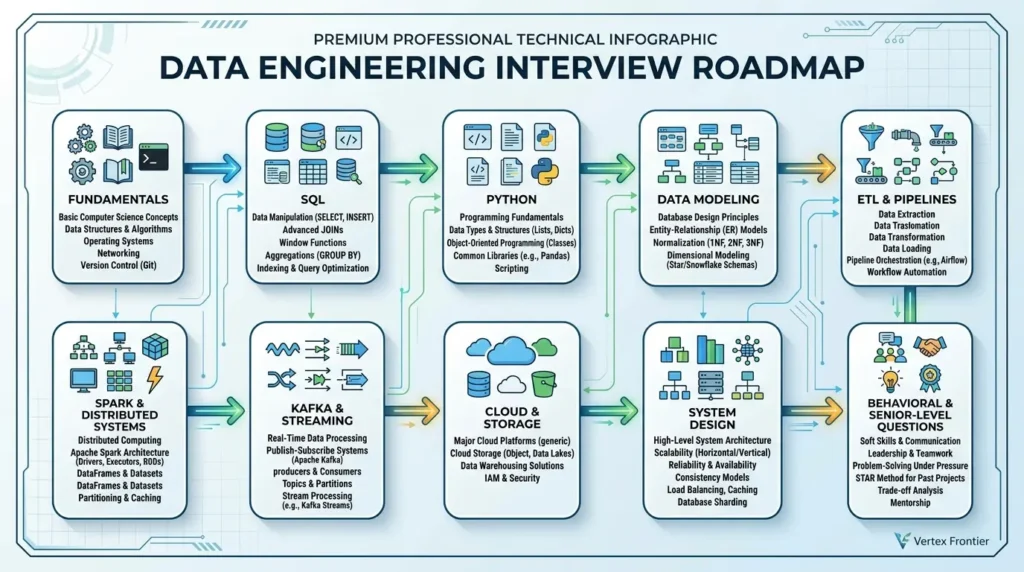
What does a data engineering interview usually include?
There is no universal interview loop, but publicly described preparation guides and practitioner discussions commonly group interviews into several stages. A junior candidate may see more SQL and coding. A senior candidate may still face a timed SQL screen, then spend more time defending architecture, incident decisions, cost, and stakeholder trade-offs.
| Stage | What it tests | Typical follow-up |
|---|---|---|
| Recruiter or HR | Motivation, communication, role fit, and truthful scope. | Why this role? What did you personally own? |
| SQL or coding screen | Query reasoning, edge cases, complexity, and implementation discipline. | What changes at 10 billion rows? |
| Pipeline design | Ingestion, transformations, retries, backfills, data quality, and recovery. | How do you rerun one day without duplicates? |
| System design | Scale, latency, storage, availability, cost, security, and trade-offs. | What is your consistency and recovery model? |
| Behavioral or project deep dive | Ownership, judgment, conflict, incidents, and influence. | What failed, and what would you change? |
The practical lesson: prepare for the question behind the question. “How do you load data?” may actually be testing whether you understand ownership, replay, schema changes, monitoring, and business correctness.
A simple framework for answering technical questions
Use the DICE framework for concept, design, and troubleshooting questions:
- D — Define: Give the short, accurate definition.
- I — Identify assumptions: State the engine, volume, latency, data grain, or correctness requirement.
- C — Choose: Explain the design or implementation and why it fits.
- E — Examine failure: Cover retries, duplicates, late data, security, cost, and validation.
For SQL questions, add a sixth step: test the result against ties, NULLs, duplicate keys, and an empty input.
For behavioral questions, use STAR+R: Situation, Task, Action, Result, and Reflection. The reflection is where seniority often shows. Explain what you learned, what you changed, or what you would do differently now.
Batch or streaming? Use the requirement, not the trend
When an interviewer asks you to design a pipeline, this matrix keeps the answer grounded in requirements rather than product preference.
| Requirement signal | Likely direction | Question you must ask |
|---|---|---|
| Freshness is measured in hours or once per day | Batch or micro-batch may be simpler. | What is the real freshness SLA and who consumes it? |
| Users need results within seconds or minutes | Streaming or frequent incremental processing may fit. | What is acceptable during late, duplicated, or missing events? |
| Events can arrive late or out of order | Use event-time logic, correction windows, and replay. | Can the metric be revised after publication? |
| The source is a daily export or API | Batch ingestion with checkpoints and backfills. | How do we detect a partial or repeated extract? |
| The team has limited operational capacity | Prefer the simplest design that meets the SLA. | Who owns on-call, replay, state, and cost? |
Copy-and-Use Answer Template
Before an interview, fill this template for three projects and five design prompts. It turns vague preparation into evidence you can speak about.
- Consumer: Who used the data and what decision did it support?
- Contract: What was the grain, schema, freshness target, and ownership?
- Choice: Which design did you choose, and what alternative did you reject?
- Correctness: How did you handle duplicates, late data, NULLs, retries, or schema changes?
- Operations: What did you monitor, and how did recovery or backfill work?
- Trade-off: What did the design cost in latency, complexity, money, or portability?
- Reflection: What would you change with another month or twice the scale?
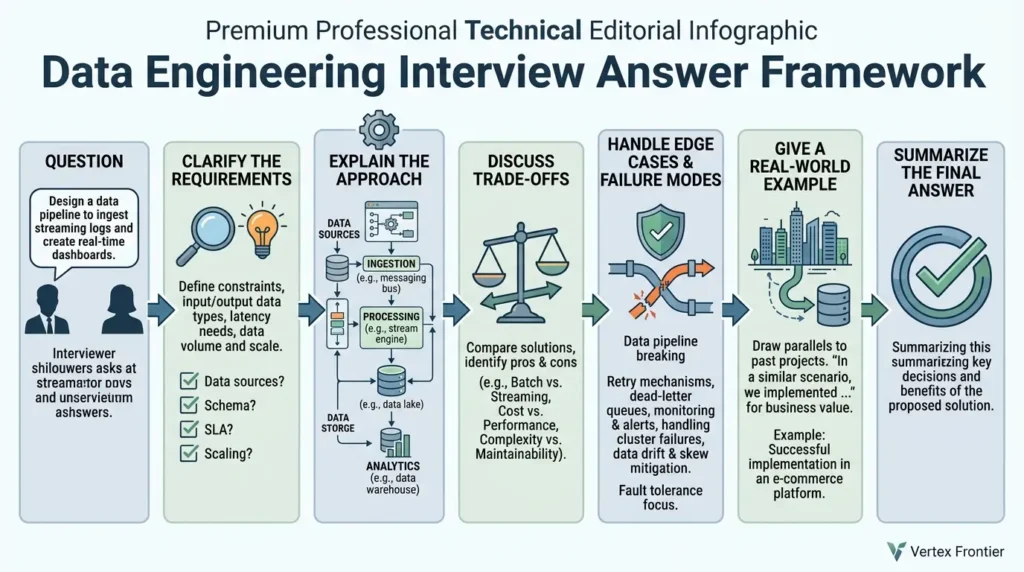
Score your answer before the real interview
Give yourself zero, one, or two points for each line. A score below eight means the answer probably needs another rehearsal; it does not mean the project was weak.
| Signal | 0 points | 2 points |
|---|---|---|
| Clarity | Starts with tools and context is unclear. | States consumer, goal, and constraints early. |
| Correctness | Happy path only. | Covers duplicates, late data, failures, and validation. |
| Trade-offs | Claims one tool is best. | Compares cost, latency, reliability, and complexity. |
| Ownership | Uses “we” without personal contribution. | Names decisions, tests, incidents, and personal scope. |
| Reflection | Ends at deployment. | Explains what changed or what would improve next. |
Data engineering fundamentals interview questions
1. What is data engineering?
Strong answer: Data engineering is the discipline of building and operating systems that collect, transform, store, govern, and serve data for analytics, applications, and machine learning. It includes more than moving rows: the engineer must make data sufficiently correct, discoverable, secure, timely, and maintainable for its consumers.
Avoid saying that data engineering is only ETL. Modern systems may include batch pipelines, streaming, CDC, lakehouse tables, warehouses, orchestration, metadata, quality checks, and serving layers.
Follow-up: How would you define “good data”? A useful answer names dimensions such as freshness, completeness, validity, uniqueness, consistency, and fitness for the consumer’s decision.
2. What is the difference between ETL and ELT?
ETL transforms data before loading the target. ELT loads raw or lightly processed data first and performs transformations in the target platform. Neither is automatically better.
Choose based on source load, target compute, privacy, governance, latency, replay needs, portability, and cost. For example, sensitive fields may need tokenization before they leave the source, while raw event data may be landed for replay and transformed in a scalable warehouse.
The AWS ETL versus ELT comparison is useful background, but broad statements such as “ELT is always faster” are too strong without workload and platform conditions.
3. What is the difference between a data lake, warehouse, and lakehouse?
A data lake usually emphasizes flexible storage of raw or semi-structured data, often on object storage. A data warehouse emphasizes governed, structured analytical workloads with managed compute and SQL access. A lakehouse attempts to combine low-cost, open storage with stronger table semantics, transactions, schema management, and multi-engine access.
The important interview move is to describe the boundary. A table format such as Apache Iceberg does not replace object storage, a query engine, a catalog, or access control. Vertex Frontier’s Apache Iceberg guide explains this distinction through snapshots, metadata, schema evolution, and physical layout.
4. What is batch processing versus stream processing?
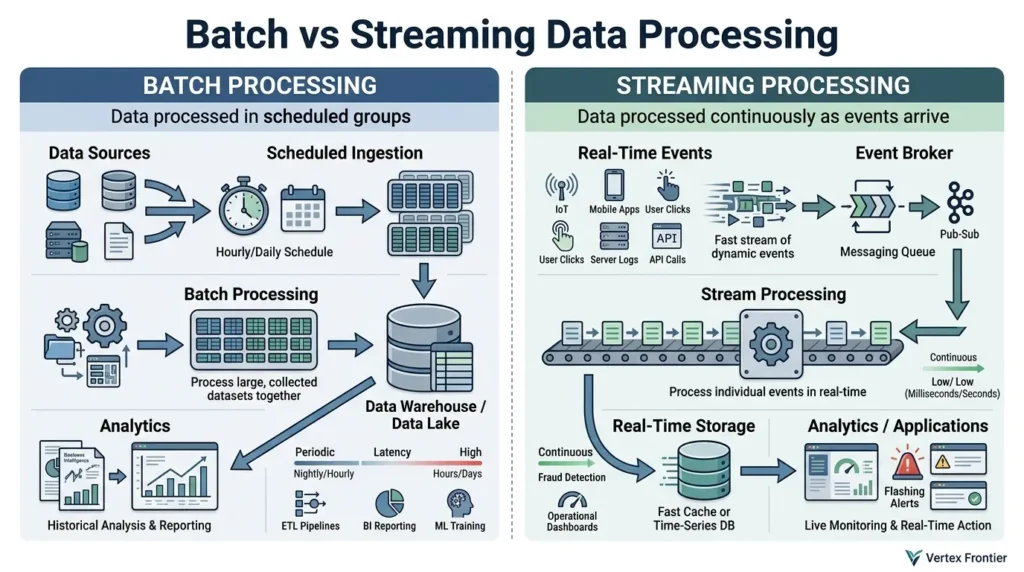
Batch processing handles bounded data at scheduled or triggered intervals. Stream processing handles continuously arriving events, often with state, event time, watermarks, and replay behavior.
Do not select streaming merely because it sounds modern. Ask what latency the consumer needs, whether events can arrive late or out of order, how much state is required, and whether the team can operate the additional complexity. A five-minute micro-batch may satisfy the real requirement with less operational risk than a fully continuous design.
5. What is OLTP versus OLAP?
OLTP systems support transactional application workloads: many small reads and writes, concurrency, constraints, and predictable point lookups. OLAP systems support analytical scans, joins, aggregations, and historical queries across larger data volumes.
A common mistake is treating OLAP as “the database for big data” and OLTP as “the small database.” Workload shape, consistency, access pattern, and schema design matter more than a simple size label.
SQL interview questions for data engineers
SQL is often the fastest way for an interviewer to see how you reason. Start by stating the grain of each table. If you skip that step, a technically valid query can still produce a wrong business result.
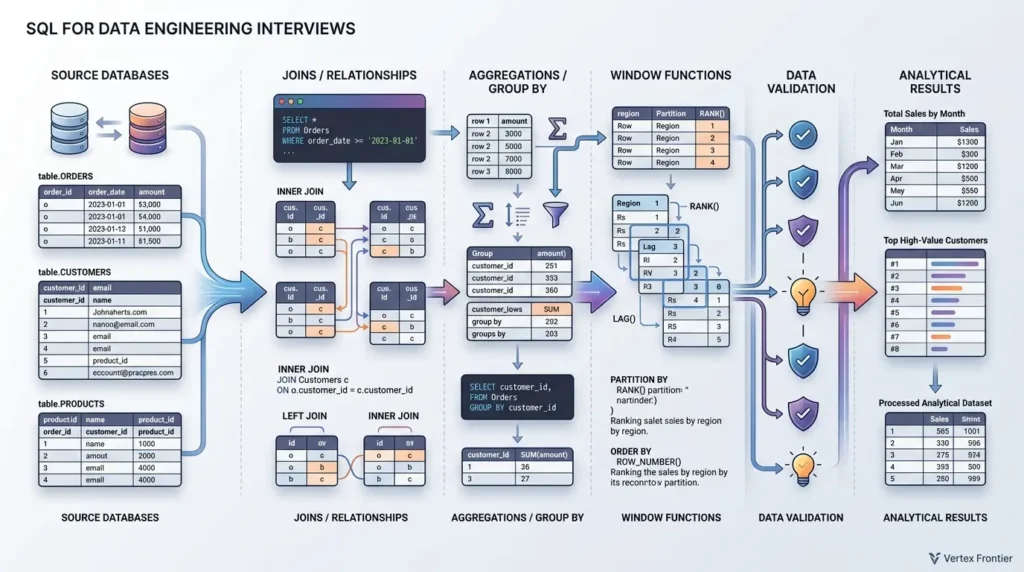
6. How do you find the second-highest salary?
First clarify whether “second-highest” means the second distinct salary or the second row after sorting. For the second distinct value, a window function is explicit:
PostgreSQL SQL — second distinct salary:
SELECT employee_id, salary
FROM (
    SELECT
        employee_id,
        salary,
        DENSE_RANK() OVER (ORDER BY salary DESC) AS salary_rank
    FROM employees
    WHERE salary IS NOT NULL
) ranked
WHERE salary_rank = 2;
DENSE_RANK() treats tied salaries as one rank. ROW_NUMBER() would answer a different question. RANK() can leave gaps after ties. The correct choice depends on the wording.
7. What is the difference between ROW_NUMBER, RANK, and DENSE_RANK?
ROW_NUMBER() gives every row a unique sequence. RANK() gives peers the same rank and leaves gaps after a tie. DENSE_RANK() gives peers the same rank without gaps.
A strong answer mentions deterministic ordering. If two rows tie on the visible sort column, add a stable tie-breaker when the business rule requires one. Also state the dialect: window syntax and NULL ordering can vary.
8. How do you remove duplicate records?
First define a duplicate. Is it the same event ID, the same business key, or identical payload? Then choose the survivor rule: latest ingestion time, source version, event sequence, or a trusted update timestamp.
PostgreSQL SQL — keep the newest row per business key:
WITH ranked AS (
SELECT
        t.*,
        ROW_NUMBER() OVER (
            PARTITION BY customer_id, order_id
            ORDER BY source_version DESC, ingested_at DESC
        ) AS rn
    FROM staging_orders AS t
)
SELECT *
FROM ranked
WHERE rn = 1;
Do not use ingestion time as the only ordering key if source events can arrive late. In CDC systems, ordering and tombstones require careful design. Vertex Frontier’s ClickHouse ReplacingMergeTree guide explores why duplicates can persist even when a table appears to have a deduplication mechanism.
9. What is the difference between COUNT(*) and COUNT(column)?
In PostgreSQL, COUNT(*) counts input rows, while COUNT(column) counts non-NULL values. COUNT(DISTINCT column) counts distinct non-NULL values. The same-looking query can therefore produce different results when missing values exist.
The PostgreSQL aggregate and expression documentation should be the reference for PostgreSQL-specific behavior. Do not generalize every SQL detail to every warehouse.
10. How do you find customers who placed no orders?
Use an anti-join or NOT EXISTS, and be careful with nullable subqueries. A clear PostgreSQL pattern is:
PostgreSQL SQL — anti-join:
SELECT c.customer_id
FROM customers AS c
WHERE NOT EXISTS (
    SELECT 1
    FROM orders AS o
    WHERE o.customer_id = c.customer_id
);
Mention why NOT EXISTS is often easier to reason about than NOT IN when NULLs can enter the subquery. Then test customers with zero orders, multiple orders, and a NULL foreign key.
11. How would you calculate a rolling seven-day metric?
Clarify whether the window is based on calendar dates or rows. A seven-row window is not necessarily seven days if some days have no records. A robust design often creates a date spine, joins daily aggregates to it, and applies a date-based window appropriate for the target engine.
This is an excellent follow-up question because it tests grain, missing dates, time zones, and window-frame semantics, not just syntax. PostgreSQL’s window-function documentation explains why frame definitions matter, especially for functions such as last_value.
SQL checklist before you submit an answer:
- What is the grain of the input and output?
- What happens with NULLs?
- Are ties deterministic?
- Are time zones and missing dates handled?
- Will the join multiply rows?
- What changes at production scale?
SQL Edge-Case Review
Before you call a query complete, run this review. It catches the small details that often turn a correct-looking query into a wrong business answer.
Python and coding interview questions
12. Why are generators useful in data engineering?
A generator yields values lazily instead of materializing the complete result in memory. That makes it useful for streaming a large file, paginating through an API, or processing records in bounded chunks.
The trade-off is that a generator is generally single-pass. If you need to iterate twice, you may need to recreate it or materialize its values. The official Python yield documentation is the right reference for language behavior.
Python — bounded line processing:
def non_empty_lines(path):
with open(path, encoding="utf-8") as handle:
        for line in handle:
            value = line.strip()
            if value:
                yield value
for record in non_empty_lines("events.log"):
process(record)
13. What is the difference between is and == in Python?
is checks object identity. == checks equality according to the objects’ comparison behavior. Use == for ordinary value comparison and reserve is for identity checks such as value is None.
This question is small but useful. It shows whether a candidate understands Python’s object model rather than relying on behavior that may appear to work for interned values.
14. How would you process a file that is larger than memory?
Stream it line by line or in chunks, select only required columns, avoid building an unbounded list, write intermediate results incrementally, and measure the memory behavior. If the transformation requires global state, such as an exact global sort, explain how you would use external sorting, partitioning, or a distributed engine instead.
The answer should distinguish a local Python task from a distributed data-processing problem. A generator solves memory pressure for sequential processing; it does not make a global join or sort cheap.
15. What is the GIL, and does it prevent Python parallelism?
The safest answer is conditional. In CPython, the Global Interpreter Lock affects execution of Python bytecode in threads, but threads can still overlap I/O and native extensions may release the lock. Processes provide separate interpreters and can help with CPU-bound work, but they add serialization and memory-transfer costs.
The Python multiprocessing documentation also makes platform and version boundaries important. Do not say “Python cannot do parallelism.” Say which workload and execution model you mean.
16. How do you make an API ingestion job reliable?
Use pagination with a stable cursor or watermark, persist progress, handle rate limits and transient errors, validate the response schema, write raw responses or an immutable landing layer where policy allows, and make the destination write idempotent. Do not advance the checkpoint until the corresponding data is durably committed.
Then discuss backfills. Can the job replay a time range? Can it recover from a partial page? What happens if the API returns the same object twice?
If you’re on the other side, building the API that others will ingest from, our guide to building a tested REST API with Python and FastAPI covers the provider side of this contract: bounded pagination, predictable error shapes, idempotency-friendly routes, and tests that exercise the failure paths a consumer will rely on.
Data modeling interview questions
17. What is the grain of a fact table?
The grain is the precise meaning of one row. Examples include one row per order line, one row per account per day, or one row per sensor reading.
Declare the grain before choosing measures. Mixing order-level and line-level facts creates double counting. This is why the Microsoft star-schema guidance emphasizes clear fact and dimension roles, although its recommendations should not be treated as a universal optimizer guarantee for every warehouse.
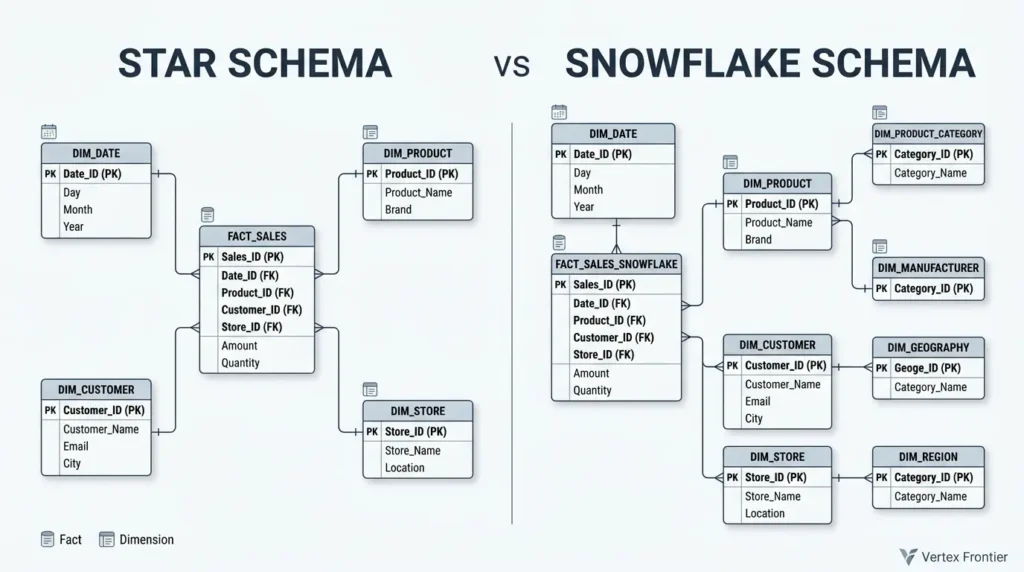
18. Star schema versus snowflake schema?
A star schema keeps dimensions relatively denormalized around a fact table, usually making analytical queries easier to understand and often reducing joins. A snowflake schema normalizes parts of the dimensions, which can reduce repetition but may add joins and complexity.
There is no automatic winner. Choose based on query patterns, governance, update behavior, semantic clarity, storage cost, and the capabilities of the target engine.
19. What is a slowly changing dimension?
A slowly changing dimension is a strategy for handling changes to descriptive attributes. Type 1 overwrites the old value. Type 2 preserves history using versions, effective dates, or a current-row indicator. Other patterns exist.
The best answer explains which business questions the model must support. If the question is “what is the customer’s current region?” Type 1 may be enough. If it is “what region did the customer belong to when the sale occurred?” you need a point-in-time rule.
20. How do you handle late-arriving data?
First define whether the late item changes a historical fact, a dimension lookup, a real-time dashboard, or a financial report. Then choose a policy: update the affected partition, use a correction event, maintain a late-data window, or recompute a bounded range.
A strong answer includes a reconciliation process. Late data is not only a streaming problem; it appears in batch exports, CDC snapshots, dimension updates, and backfills.
ETL, pipeline, and reliability questions
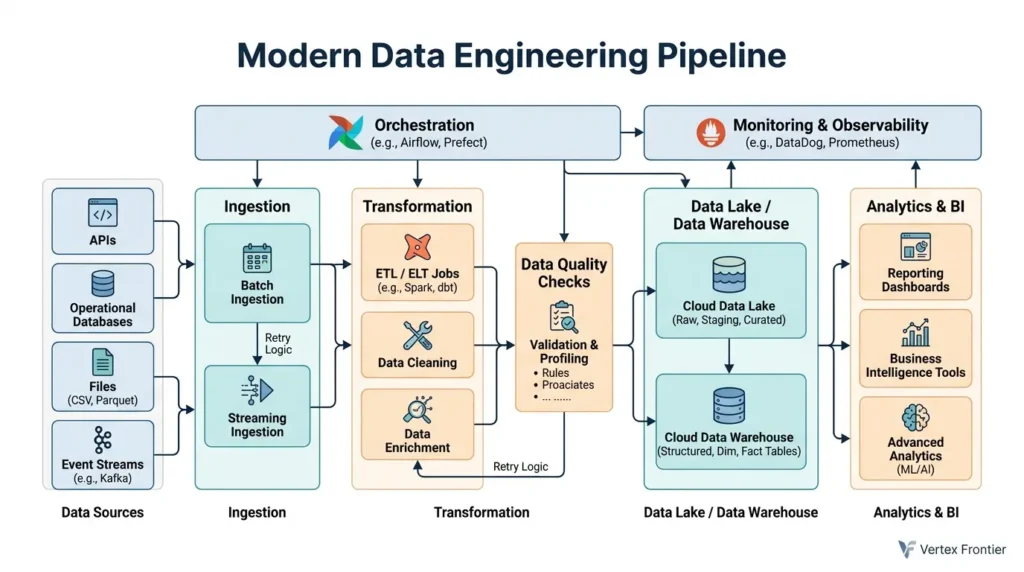
21. What makes a pipeline idempotent?
A pipeline is idempotent when rerunning the same logical input produces the intended final state rather than multiplying side effects. That usually requires a deterministic input boundary, a stable business or event key, an atomic or replaceable publication strategy, and a reconciliation path.
For example, a daily partition can be rebuilt into a temporary location and published only after validation. An incremental target can use a merge key and source version. Neither approach is universal; the answer must match the storage and consumer model.
22. How do you design safe retries?
Separate transient failure from permanent data failure. Retry network timeouts with bounded exponential backoff and jitter, but do not blindly retry validation errors. Make the write safe to repeat, record attempt and run metadata, and alert when retries exceed a meaningful threshold.
The critical question is: what side effect happened before the failure? If the job wrote half a file set or sent an external notification, the retry needs a cleanup, deduplication, or compensation strategy.
23. How do you backfill one month of data without breaking production?
Start with a dry run and a written scope. Confirm source availability, schema versions, dependencies, target partitions, expected volume, and downstream consumers. Run the backfill in an isolated or throttled path, validate counts and business checks, publish atomically where possible, and reconcile with the existing output.
A backfill is not “run the job with an older date.” It is a controlled change to historical state. Include a rollback or correction plan and communicate whether consumers will see revised results.
24. What is a data contract?
A data contract is an explicit agreement between a producer and consumers about schema, meaning, ownership, quality expectations, compatibility, and change handling. It is stronger than a file with column names.
A useful contract answers: who owns the field, what does NULL mean, what is the unit, what freshness is expected, which changes are backward-compatible, and where incidents are reported?
25. How do you monitor a data pipeline?
Monitor both system health and data health. System signals include task duration, retries, queue time, CPU, memory, lag, and failure rate. Data signals include freshness, volume, completeness, uniqueness, validity, distribution changes, and referential integrity.
Add lineage and run metadata so an alert can answer: what failed, which dataset is affected, which upstream change caused it, and whether the consumer received stale or partial data? OpenLineage provides an open metadata standard, but it is not by itself a complete observability or data-quality platform.
Before and after: a weak pipeline answer
Before: “I would schedule an Airflow job to read the source, transform it, and load the warehouse. I would add retries and monitoring.”
After: “I would define the input interval and target grain first. The job would land the source extract with a run ID, validate the schema, transform into a staging table, merge by the business key and source version, and publish only after row-count and quality checks pass. The checkpoint advances after commit. A replay of the same interval should converge to the same target state, and a reconciliation query compares source totals with published totals.”
The second answer is longer, but every extra sentence demonstrates an engineering decision.
Spark and distributed-systems interview questions
26. What are driver, executor, job, stage, and task in Spark?
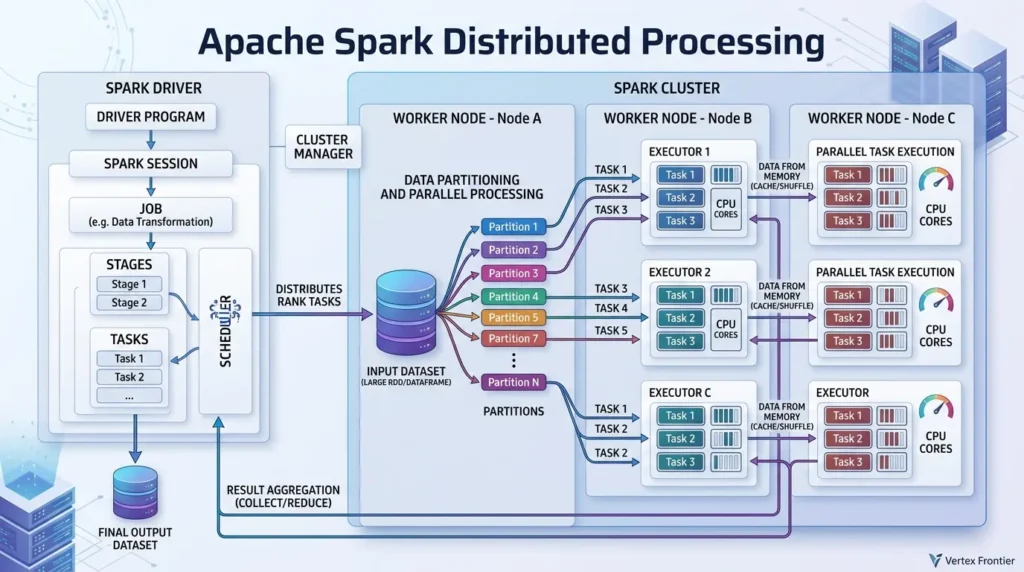
The driver coordinates the application and builds the execution plan. Executors run tasks and hold data or intermediate state. An action triggers a job. Spark divides work into stages around boundaries such as shuffles, and tasks execute work for partitions.
Exact behavior depends on the Spark API, release, and deployment mode. Use the Spark RDD programming guide and Spark SQL performance-tuning documentation for current details.
27. What causes a shuffle, and why is it expensive?
A shuffle moves data across partitions so records can be grouped or joined by a new key. It can create network traffic, disk I/O, serialization overhead, and skew problems.
Do not answer “avoid all shuffles.” Many correct aggregations and joins require them. Instead, identify whether the key is skewed, whether a broadcast join is safe, whether input files are badly sized, whether columns can be pruned, and what measurement proves the change helped.
28. Why is collect() dangerous?
collect() brings all results to the driver. It can be safe for a deliberately small result, but dangerous when the result size is not bounded. A production answer should explain how to inspect a sample, write distributed output, aggregate before collecting, or use a bounded limit.
29. How do you debug a slow Spark job?
Start with evidence: Spark UI stages, input sizes, task duration distribution, shuffle read/write, spill, skew, executor memory, file counts, and query plan. Then test one hypothesis at a time.
Common causes include a skewed join key, excessive small files, unbounded projection, a poor join strategy, repeated scans, unnecessary caching, or a Python boundary that adds serialization overhead. “Increase the cluster” is not a diagnosis.
Kafka, streaming, and CDC interview questions
30. What is a Kafka partition?
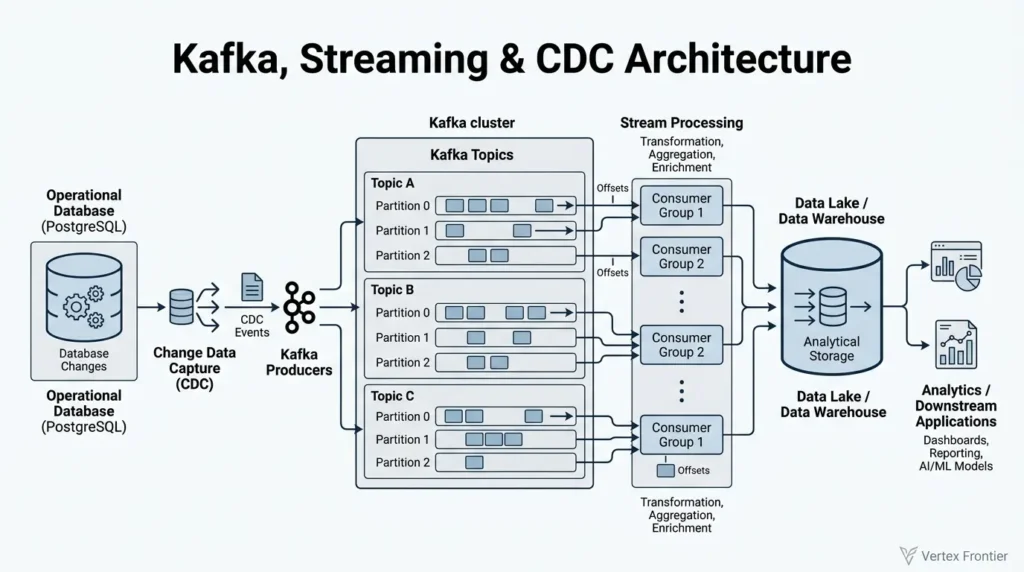
A partition is an ordered log within a topic. Ordering is guaranteed within a partition, not automatically across all partitions. Producers choose a partition through a key or partitioning strategy, and consumers in a group divide partitions among themselves.
This leads to the most important design question: what must be ordered? If all events for an account must be processed in order, the partitioning key must preserve that requirement, and the system must tolerate hot keys.
31. What are at-most-once, at-least-once, and exactly-once semantics?
At-most-once may lose messages but avoids redelivery. At-least-once may redeliver messages, so consumers need idempotency or deduplication. Exactly-once processing can be achieved within specific boundaries and configurations, but it is not a universal end-to-end guarantee.
Confluent’s delivery-semantics documentation distinguishes Kafka processing guarantees and explains why external systems require additional coordination. In an interview, state the boundary: Kafka-to-Kafka, Kafka-to-database, or Kafka-to-an-external API.
32. How do you handle late and out-of-order events?
Use event time rather than only processing time when the business metric depends on when the event occurred. Define a lateness policy, watermark or correction window, state-retention period, and behavior for events that arrive after the window.
Then explain replay. Can the system recompute the affected window? Are aggregates reversible? How are duplicates identified? What does the dashboard show while the result is provisional?
33. What is CDC, and what can go wrong?
Change data capture records inserts, updates, and deletes from a source system and delivers those changes downstream. Log-based CDC may depend on source log retention, replication configuration, privileges, snapshots, connector offsets, transaction ordering, schema evolution, and sink merge behavior.
A snapshot-to-stream handoff must be checked for overlap and gaps. “Read the timestamp column every five minutes” is a polling strategy, not a complete CDC design.
For production examples, see Vertex Frontier’s guides to Postgres CDC failure handling, MySQL CDC to Apache Doris, and CDC tool trade-offs for ClickHouse. These are useful because they focus on ordering, failover, schema changes, retries, and duplicates, not only initial setup.
34. How do you deduplicate a stream?
Define the event identity first. It may be an event ID, source transaction plus row key, or a composite of entity ID and source version. Store enough state to recognize duplicates within the required retention window, and decide what happens when an older event arrives after a newer one.
A deduplication key without an ordering or version rule can silently keep the wrong record. A tombstone must not be treated as an ordinary update if it represents deletion.
Cloud, storage, and platform questions
35. How would you choose between a warehouse and a lakehouse?
Start with workload and operating constraints: query patterns, data types, open-engine requirements, concurrency, governance, cost model, portability, recovery, and team expertise. Then map those needs to a platform.
Do not begin with “I prefer Snowflake” or “Databricks is better.” A senior answer begins with requirements and names the dependency that could change the decision.
Open table formats illustrate the point. Apache Iceberg’s evolution documentation describes schema and partition evolution, but availability still depends on the engine, catalog, runtime, and table-format version. Similar qualification applies to Delta Lake and Apache Hudi.
36. What is the role of object storage in a data platform?
Object storage provides durable, scalable file storage, but it does not automatically provide a database’s table state, transaction protocol, schema registry, query engine, or governance model. Those boundaries must be designed.
A good answer covers file format, partitioning, compaction, metadata, access control, retention, and the risks of relying on directory listings as a table definition.
37. How do you include security in a pipeline design?
Name controls instead of making vague claims. Use least-privilege identities, secret management, encryption in transit and at rest where configured, network boundaries, masking or tokenization for sensitive fields, retention rules, audit logs, and a clear ownership model.
The design should also explain residual risk. “The warehouse is secure” is not an answer. Which role can read raw PII? Where are credentials stored? Can analysts export data? How are deleted records propagated? What happens in a breach?
Behavioral and senior data engineer interview questions
38. Tell me about a data pipeline you owned.
Use STAR+R, but spend most of your time on personal ownership and decisions. Explain the business need, the original constraints, the design, the validation, the incident or trade-off, the result, and what you changed afterward.
Avoid listing tools as the story. “We used Kafka, Spark, and Snowflake” does not show judgment. “We chose a five-minute micro-batch because the consumer needed freshness under ten minutes and the team could operate it more reliably than a continuous stateful job” does.
39. Tell me about a production incident.
A strong answer includes detection, impact, containment, diagnosis, communication, recovery, and prevention. Do not claim that monitoring prevented an incident if it only detected it afterward.
Senior candidates should explain how they protected customers and data correctness while investigating. Mention the runbook, rollback or replay decision, and the permanent change that reduced recurrence.
40. Tell me about a disagreement with a stakeholder.
Frame the disagreement around requirements and evidence, not personality. Explain what each person optimized for, how you made the trade-off visible, and how you aligned on a decision.
A useful data-engineering example might involve a stakeholder asking for real-time data when the real business need was a ten-minute freshness SLA. The answer should show that you questioned the requirement without dismissing it.
Project Story Template
Prepare two versions of this story: a 60-second version for an initial screen and a three-minute version for a hiring-manager deep dive. Keep the verbs specific and separate your contribution from the team’s work.
Situation: What business or technical problem existed?
Task: What were you responsible for, and what constraints mattered?
Action: What decisions did you make, what did you test, and what trade-off did you accept?
Result: What changed, and how did you measure it? If you have no measured outcome, say so.
Reflection: What failed, what did you learn, and what would you change at twice the scale?
41. What would you do if you inherited a fragile pipeline?
Do not rewrite everything immediately. First establish ownership, consumers, failure history, data contracts, current SLAs, costs, and the blast radius of changes. Add observability and a safe validation path, then improve the highest-risk failure mode.
This answer shows operational maturity. The best architecture is not useful if no one can detect when it is wrong.
System design question: design a reliable event pipeline
A common prompt is: “Design a platform that ingests clickstream events and serves daily analytics plus near-real-time dashboards.”
Use this sequence:
- Clarify consumers: dashboard, finance, experimentation, alerts, or machine learning?
- Define event contract: event ID, entity key, event time, schema version, producer ownership, and privacy classification.
- Choose ingestion: batch, streaming, or a hybrid based on the freshness requirement.
- Preserve raw data: retain an immutable or replayable landing layer where policy and cost allow.
- Process correctly: partition by an appropriate key, handle late data, deduplicate, and define replay behavior.
- Publish modeled data: state the grain, dimensions, metrics, and point-in-time rules.
- Add quality and observability: freshness, volume, completeness, validity, lag, lineage, and alert routing.
- Protect the system: least privilege, secrets, PII handling, retention, and auditability.
- Plan recovery: replay, backfill, dead-letter handling, checkpoint recovery, and reconciliation.
- Discuss cost: storage retention, compute frequency, small files, state size, and operational burden.
Pipeline Design Canvas
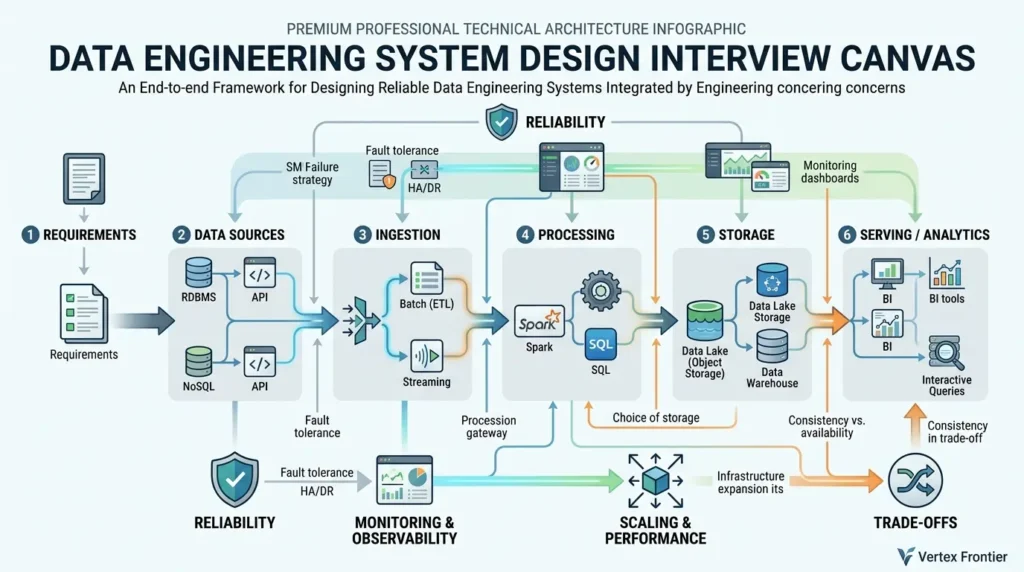
Fill this canvas during practice. If you cannot fill a field, that is usually the follow-up question you should ask the interviewer.
| Consumers | Who uses the output and what decision does it support? |
| Freshness SLA | How fresh must the data be, and what happens when it is late? |
| Expected volume | Rows or events per day, peak rate, retention, and growth. |
| Data grain | What does one output row or event represent? |
| Batch or streaming | Which requirement makes this choice necessary? |
| Partitioning key | How will reads, writes, ordering, and hot keys behave? |
| Deduplication key | How will retries, duplicates, updates, and deletes converge? |
| Quality checks | Which freshness, volume, validity, and reconciliation checks run? |
| Replay and backfill | Can one interval be safely recomputed and republished? |
| Security controls | Who can read raw data, and how are secrets and PII handled? |
| Recovery plan | What is the failure boundary, rollback path, and owner? |
The contrarian insight is simple: “real time” is not a design requirement until someone defines the acceptable delay and what correctness means during that delay. Asking that question can be more impressive than naming another streaming product.
Common mistakes candidates make
Mistake 1: Giving tool-first answers
Starting with “I would use Kafka and Spark” hides the requirements. Start with latency, ordering, volume, state, replay, and consumers. Then choose tools.
Mistake 2: Ignoring grain
Most SQL and modeling errors are easier to prevent by naming the row grain before writing the query. If a join multiplies records, no amount of formatting will rescue the metric.
Mistake 3: Treating retries as reliability
Retries can create duplicates, partial writes, and inconsistent external side effects. Explain the failure boundary and the convergence strategy.
Mistake 4: Saying “exactly once” without a boundary
Say exactly once where, under which configuration, and with what sink coordination. Otherwise say at-least-once plus idempotent processing.
Mistake 5: Overclaiming production experience
If you built a classroom project, call it a project. Explain what you measured and what you did not test. Credibility is stronger when the scope is honest.
Mistake 6: Memorizing cloud services instead of capabilities
Know the capability first: object storage, stream transport, orchestration, warehouse compute, catalog, quality, lineage, and identity. Then map it to AWS, Azure, or GCP.
Mistake 7: Forgetting to ask questions
At the end of a design prompt, ask about data residency, latency, retention, consumer correctness, cost limits, and operational ownership. Clarifying questions are part of the answer.
A seven-day preparation plan
- Day 1: Review SQL joins, aggregation, NULL behavior, windows, deduplication, and date logic. Solve two timed problems.
- Day 2: Practice Python generators, dictionaries, chunking, parsing, pagination, and tests. Explain time and space complexity aloud.
- Day 3: Design a warehouse model. State grain, keys, facts, dimensions, history policy, and late-arriving data behavior.
- Day 4: Design a batch pipeline. Cover idempotency, retries, checkpoints, backfills, contracts, quality, and reconciliation.
- Day 5: Review Spark, Kafka, streaming, and CDC. Focus on shuffle, skew, partitioning, ordering, replay, watermarks, and sink behavior.
- Day 6: Rehearse two system-design prompts and three STAR+R stories. Record yourself and remove tool-name filler.
- Day 7: Run a mock loop: one SQL problem, one Python problem, one design prompt, and one incident story. Write down every assumption you forgot to state.
30-Minute Mock Interview
Run this exercise without notes. The goal is not to finish everything perfectly; it is to practice switching between precise implementation and spoken engineering judgment.
| Time | Exercise | What to review afterward |
|---|---|---|
| 0–10 minutes | Solve one SQL problem involving a join, window, or deduplication. | Grain, NULLs, ties, empty input, and dialect. |
| 10–15 minutes | Implement a small Python parsing or chunking task. | Complexity, malformed input, memory, and tests. |
| 15–25 minutes | Design a pipeline for clickstream or CDC data. | SLA, ordering, replay, quality, security, and cost. |
| 25–30 minutes | Tell one incident or stakeholder-conflict story. | Ownership, result, reflection, and what changed afterward. |
Final interview checklist
Before the interview, confirm that you can:
- explain a pipeline without hiding behind product names;
- state the grain of every important table;
- handle duplicates, NULLs, ties, late data, and empty inputs;
- describe a replay and backfill path;
- distinguish event time from processing time;
- qualify exactly-once and security claims;
- show how you measure quality and freshness;
- discuss cost and operational ownership;
- explain one incident and one disagreement honestly;
- ask clarifying questions before committing to architecture.
Final thought
The strongest data engineering interview answer is rarely the one with the longest tool list. It is the one that makes the system’s assumptions visible.
Define the grain. State the SLA. Explain what happens on retry. Decide how late data is corrected. Show how you know the output is right. Name the cost and security trade-offs. Then be honest about what you have actually built.
That is the difference between answering a question and demonstrating engineering judgment.
Frequently asked questions
Are SQL questions always included in data engineering interviews?
SQL is a commonly reported screening skill, but interview loops vary by employer, role family, seniority, and stack. Prepare SQL while also checking the job description and asking the recruiter what the loop includes.
What should a junior data engineer study first?
Start with SQL joins, aggregation, NULLs, window functions, basic Python, data modeling grain, ETL versus ELT, and simple pipeline reliability. Then practice explaining a small project honestly.
Do senior data engineers still need to practice coding?
Often, yes. A senior candidate may still face a timed SQL or Python screen, while the later rounds place more weight on architecture, cost, reliability, incidents, influence, and technical judgment.
Is Kafka exactly-once processing guaranteed?
Exactly-once behavior depends on the processing boundary and configuration. Kafka-to-Kafka workflows can use transactions, but external database or API sinks require additional coordination, atomic offset handling, or idempotent writes.
How should I answer a pipeline-design question?
Clarify consumers and SLAs, define the event or table grain, choose batch or streaming, explain storage and processing, then cover idempotency, late data, schema changes, quality, observability, security, recovery, and cost.
What is the best way to prepare for a data engineering system-design interview?
Practice capability-first designs. For each prompt, write requirements, data contracts, architecture, failure modes, quality signals, recovery steps, security controls, and cost drivers. Then explain the design aloud in ten minutes.
Should I mention tools I have not used?
Mention adjacent concepts honestly, but do not imply production experience you do not have. Explain what you understand, what you have tested, and what you would verify in the target environment.
📋 Article Timeline & History
Successfully updated on September 17, 2026 with the latest details.
This article was originally published on September 15, 2026.

Was this article helpful?