
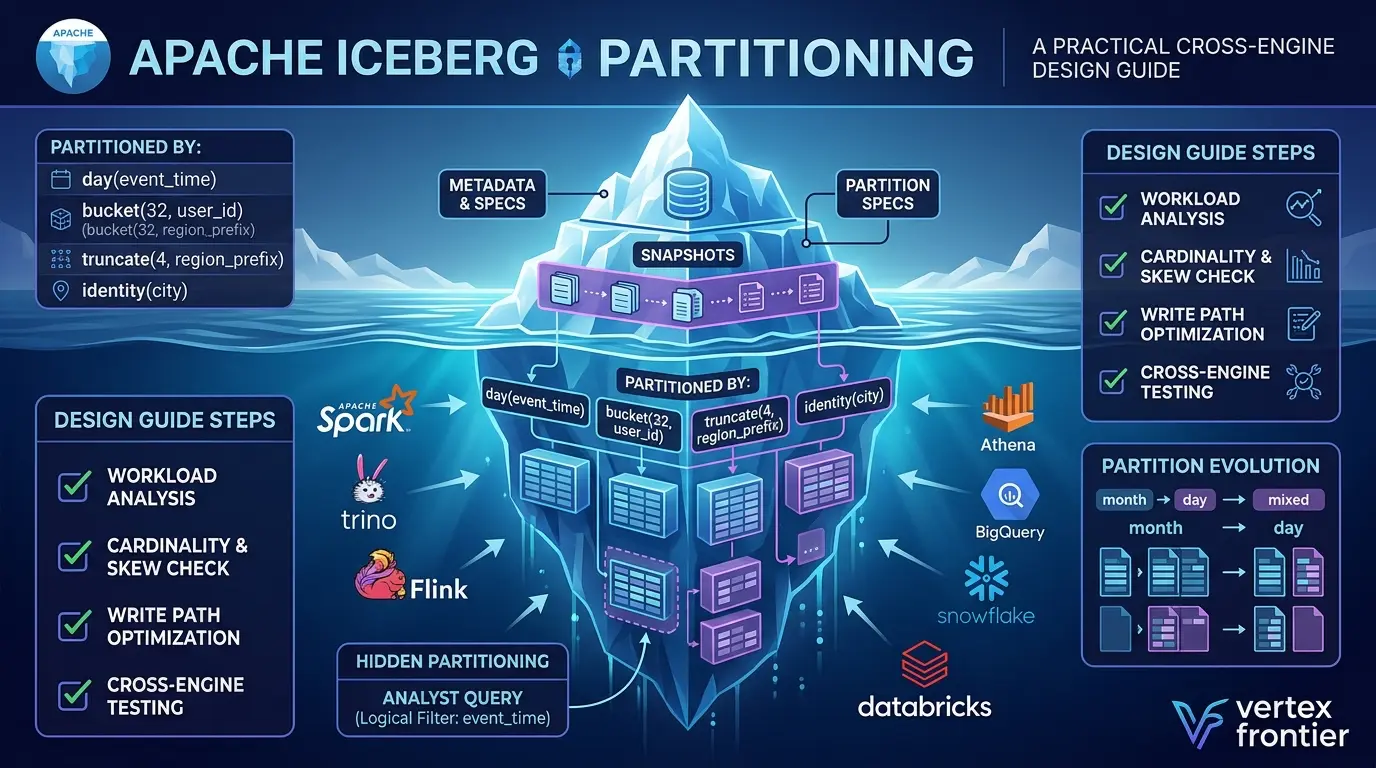

Partitioning is often introduced as a read-performance feature. That description is incomplete.
In Apache Iceberg, a partition decision also shapes how files are created, how metadata grows, how streaming writes behave, how compaction works, and how safely a table can evolve. A layout that looks efficient in a small test can become a write bottleneck, a small-file factory, or a cross-engine compatibility problem at scale.
The difficult question is not “Which partition transform is available?” It is:
Which partition contract matches this workload, this write pattern, this catalog, and the engines that must read the table?
This guide develops a practical way to answer that question. It covers hidden partitioning, transform selection, pruning, small files, skew, partition evolution, overwrite semantics, and engine-specific boundaries. The goal is not to promote one universal layout. There is no universal layout.
The short version
Click any topic to expand or collapsePartition Strategy
Choose partitions from real filter predicates and retention rules, not from column popularity.
Hidden Partitioning
Use hidden partitioning so readers filter logical columns rather than maintaining derived partition columns.
Scan Paths & Pruning
Do not confuse partition pruning with the complete scan path. File metrics, row-group statistics, sort order, and manifests still matter.
Partition Evolution
Partition evolution changes the write contract. Old files keep their original spec, so mixed layouts are normal after an evolution.
Design Validation
Validate a design with files per partition, file-size distribution, manifest count, planning time, bytes scanned, and correctness—not with one successful CREATE TABLE statement.
Engine Compatibility
Iceberg format support does not guarantee identical support in Spark, Trino, Flink, Athena, BigQuery, Snowflake, or Databricks.
What Is Apache Iceberg Partitioning?
Apache Iceberg partitioning is the process of applying a transform to one or more table columns and storing the resulting partition values in Iceberg metadata. The transform can preserve a value, derive a time unit, hash a value into a bucket, or truncate it to a bounded representation.
A partition spec is not simply a directory convention such as event_date=2026-09-26. In the Iceberg specification, a partition field identifies a source column, a transform, a partition-field ID, and a name. Data files written under a spec carry partition values that can be used during scan planning.
That distinction matters because a table may have several specs over its lifetime. A file written under the old spec does not suddenly acquire the meaning of the current spec. Its manifest records the spec that produced it, and readers plan it using that historical context.
Hidden partitioning in plain language
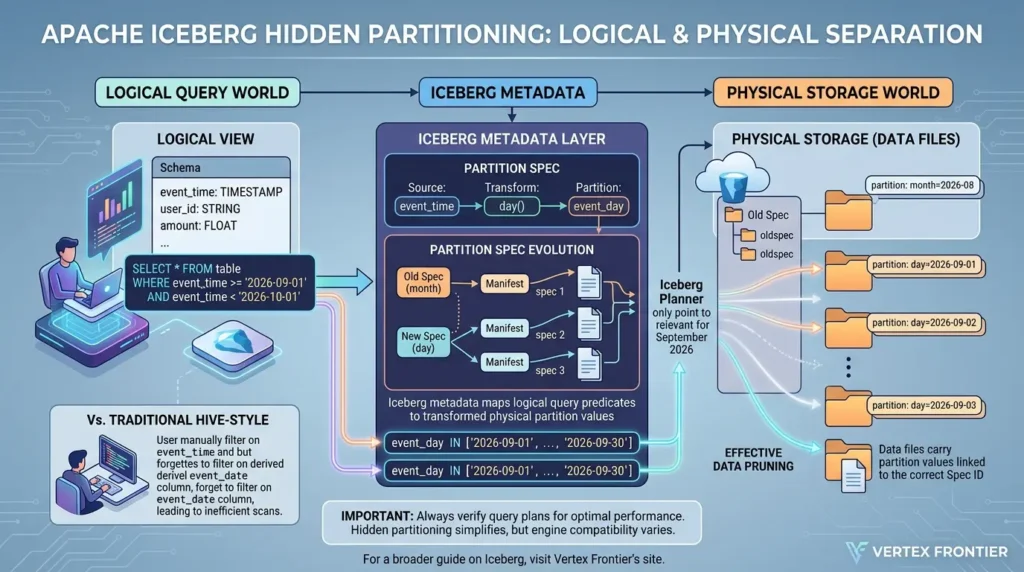
Iceberg’s hidden partitioning means that users normally query the source column instead of a manually maintained derived column. If a table is partitioned by day(event_time), a reader can filter event_time and Iceberg can project that logical predicate onto the partition transform when the engine and transform support the operation.
The word “hidden” does not mean that partition metadata disappears. It means the physical organization is separated from the logical query contract.
That separation avoids a common Hive-style failure mode: a query filters the real timestamp column but forgets to filter the derived event_date column. With Iceberg, the table can keep the source column as the user-facing contract while the writer and planner manage the transformed value.
Important boundary: hidden partitioning can simplify query behavior, but it does not guarantee that every predicate, function, connector, or engine version will produce equally effective pruning. Always inspect the actual query plan and scan metrics.
If you want a broader explanation of Iceberg’s table format, snapshots, metadata, and schema evolution, see Vertex Frontier’s Apache Iceberg guide. This article stays focused on the partitioning contract.
The Partition Contract: A Better Way to Make the Decision
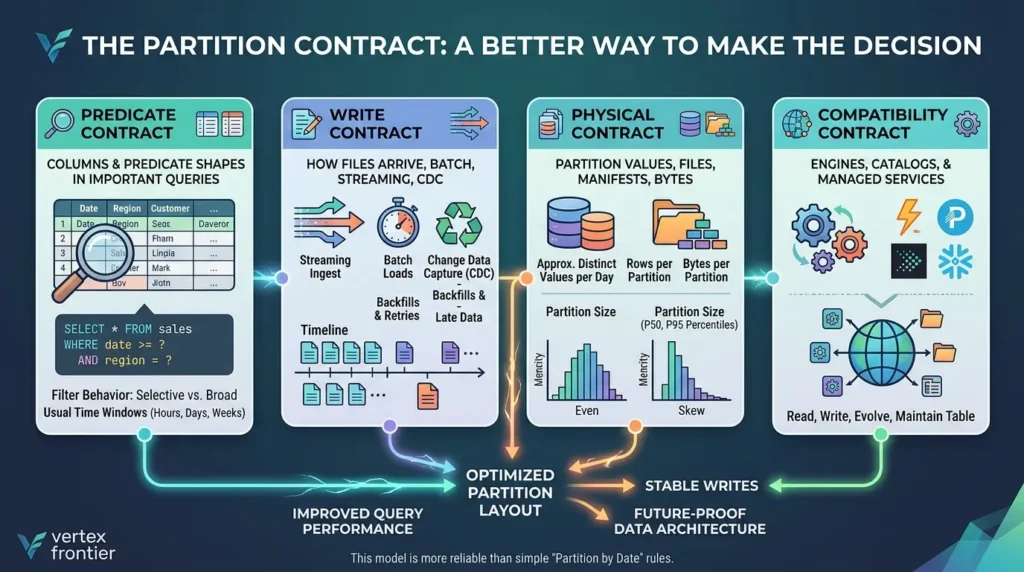
A useful partition design has four parts:
- Predicate contract: which columns and predicate shapes appear in important queries?
- Write contract: how do files arrive, batch, streaming, CDC, backfills, retries, and late data?
- Physical contract: how many partition values, files, manifests, and bytes should the table create?
- Compatibility contract: which engines, catalogs, and managed services must read, write, evolve, or maintain the table?
This model is more reliable than rules such as “partition by date” or “use buckets for joins.” Those rules may be useful starting points, but they omit the write and compatibility costs.
Step 1: Start with the workload, not the schema
List the highest-value queries and record:
- The columns used in equality, range, and
INpredicates. - The usual time window: hours, days, weeks, or months.
- Whether filters are selective or broad.
- Whether users filter one tenant, region, customer, or device at a time.
- Whether joins repeatedly use the same key.
- Whether data arrives in order or through late and replayed events.
- Whether retention deletes data by time boundary.
A column that is frequently selected is not necessarily a good partition column. Partitioning is driven mainly by filtering and write behavior, not by the presence of a column in the SELECT list.
Step 2: Estimate cardinality and skew
Partitioning by a high-cardinality identifier can create a large number of tiny partitions. Partitioning by a low-cardinality status field may leave each partition too broad to prune much data. A bucket can cap the number of groups, but it can also concentrate a popular key or create more write coordination than expected.
Measure the distribution instead of guessing:
- Approximate distinct values per day or ingestion window.
- Rows per candidate partition value.
- Bytes per candidate partition value.
- The 50th, 95th, and 99th percentile of partition size.
- The number of writers touching the same partition.
- The number and size of files created per commit.
Step 3: Check the write path
A partition that is perfect for reads can be painful for writes. Streaming jobs may touch many partitions in one micro-batch. A backfill may create a large number of small files. A retry may rewrite an existing partition, and a dynamic overwrite may affect a larger scope after the partition spec changes.
This is why partitioning should be treated as a contract between readers, writers, maintenance jobs, and catalogs, not as a folder layout chosen by one dashboard query.
Iceberg Partition Transforms Explained
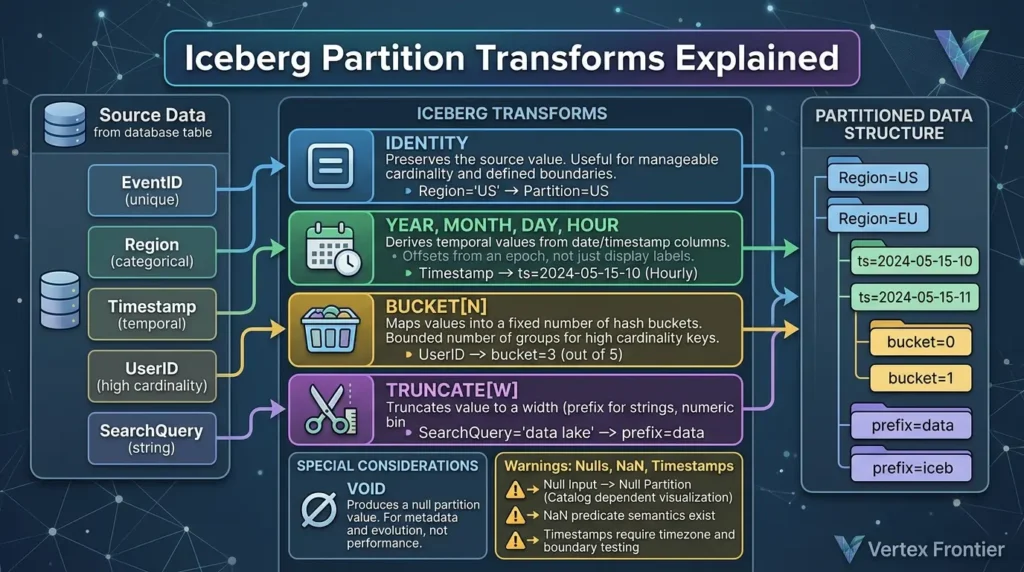
Iceberg’s core transforms are documented in the official partitioning documentation and the format specification. Their meanings are precise, and some are easy to misread.
identity
identity preserves the source value. It is attractive when the filter column has manageable cardinality and the values define useful operational boundaries.
Good candidates may include a region code, a bounded source system, or another categorical dimension with enough rows per value. It is risky for unique IDs, URLs, event IDs, or other values that produce a partition for nearly every row.
year, month, day, and hour
These transforms derive temporal values from date or timestamp columns. They are useful when queries and retention policies follow time boundaries.
A subtle but important detail: Iceberg’s transform values are not necessarily the human-facing calendar labels people expect. In the format specification, year and month are represented as offsets from an epoch, and hour is an offset from the epoch rather than simply 0 through 23. The query engine and metadata layer handle the relationship; do not build an article example that assumes the stored value is always a display label.
Use the finest time grain that the workload justifies. An hourly transform may help a table with narrow hourly lookups, but it can create many small partitions when the arrival rate is low or the table is updated frequently.
bucket[N]
bucket[N] maps values into a fixed number of hash buckets. Iceberg defines the hash behavior and serialization rules; it is not a license to substitute an engine’s unrelated hash function.
Buckets can be useful when:
- The source key has high cardinality.
- Equality filters are common.
- You need a bounded number of groups rather than one partition per key.
- The resulting data distribution is reasonably even.
Buckets are not a guarantee that a query filtering one key will read only one physical file. Multiple files can share a bucket, and the scan still depends on manifests, file statistics, residual filters, and connector behavior.
truncate[W]
truncate[W] bounds a value by truncating it to a width. For strings, that can resemble a prefix. For numeric values, the specification defines numeric binning rules; it should not be explained as “take the first W digits.” Negative values also deserve explicit testing because numeric truncation is not the same operation as string slicing.
Truncate is useful when the beginning or bounded range of a value is meaningful, but it can create skew if many values share the same prefix or numeric range.
void
void produces a null partition value and is mainly a metadata and evolution tool rather than a normal user-facing strategy. Do not present it as a performance transform.
Nulls, NaN, and timestamps deserve a warning
The current Iceberg transform rules state that null inputs produce null partition values. That does not mean every catalog writes the same visible directory representation for nulls.
bucket and truncate do not accept every primitive type. In particular, the current specification excludes floating-point types from those transforms. NaN predicate semantics exist in Iceberg expressions, but universal claims about NaN partition encoding or pruning should not be made without a tested engine and catalog combination.
Timestamp behavior also depends on the logical type, time-zone interpretation, engine, and connector. If a table receives events from multiple time zones, test boundary values around midnight and daylight-saving transitions before using hour-level partitioning.
A Workload-to-Transform Decision Matrix
The table below is a design aid, not a universal benchmark. The “right” transform depends on the distribution and the engines involved.
| Workload signal | Candidate | Why it may fit | Main risk |
|---|---|---|---|
| Time-window filters and time-based retention | day or month | Aligns physical groups with common predicates and lifecycle boundaries. | Too fine a grain can create small files and too many touched partitions. |
| Very narrow time lookups with high arrival volume | hour | Can reduce the time range considered by the planner. | Time-zone boundaries, late data, and low-volume hours can multiply files. |
| Equality filters on high-cardinality keys | bucket[N] | Bounds the number of groups while preserving a deterministic transform. | Skew, poor N selection, and engine-specific write/read support. |
| Range or prefix-oriented access | truncate[W] | Groups related values into bounded ranges or prefixes. | Prefix or numeric skew can create an uneven layout. |
| Small bounded categorical domain | identity | Readable grouping and direct predicate alignment. | Cardinality can grow silently as new values appear. |
A practical rule is to choose the coarsest transform that still removes a meaningful amount of irrelevant data, then validate whether the resulting files are large and balanced enough for the write path.
A 15-Minute Partition Design Worksheet
Before writing DDL, fill in this compact worksheet. It forces the design conversation to start with evidence rather than a familiar column name.
| Question | Write down | Decision signal |
|---|---|---|
| Which queries matter most? | Top filter columns, predicate types, time windows, and business-critical query families. | Prefer fields used in selective predicates, not fields merely returned by SELECT. |
| How many values exist? | Distinct values and rows/bytes per value for a representative period. | High cardinality makes identity risky; low cardinality may prune too little. |
| Is the distribution balanced? | Median, p95, and p99 rows or bytes per candidate value/bucket. | A large p99-to-median gap is a skew warning. |
| How does data arrive? | Batch, streaming, CDC, backfill, retry, late data, and writer concurrency. | Many touched partitions per commit increase file and commit pressure. |
| What does retention require? | Deletion and archival boundaries: hour, day, month, tenant, or legal hold. | Time transforms often fit retention, but only if the file distribution remains healthy. |
| Which engines own the contract? | Readers, writers, catalog, Iceberg version, and managed-service mode. | The narrowest supported path can become the practical design limit. |
The worksheet does not produce an automatic answer. That is intentional. It creates the evidence needed to defend a choice and exposes assumptions that should be tested before production.
Partition Pruning Is Only the First Filter
A query can pass through several layers before data reaches the execution engine:
- Partition projection: use the logical predicate to reject partition groups that cannot contain matching rows.
- Manifest filtering: use partition values and file-level metadata to reduce candidate files.
- File metrics: use lower and upper bounds, null counts, and record counts where available.
- Columnar pruning: use Parquet or ORC row-group and page statistics.
- Residual filtering: evaluate the remaining predicate against rows that survive earlier checks.
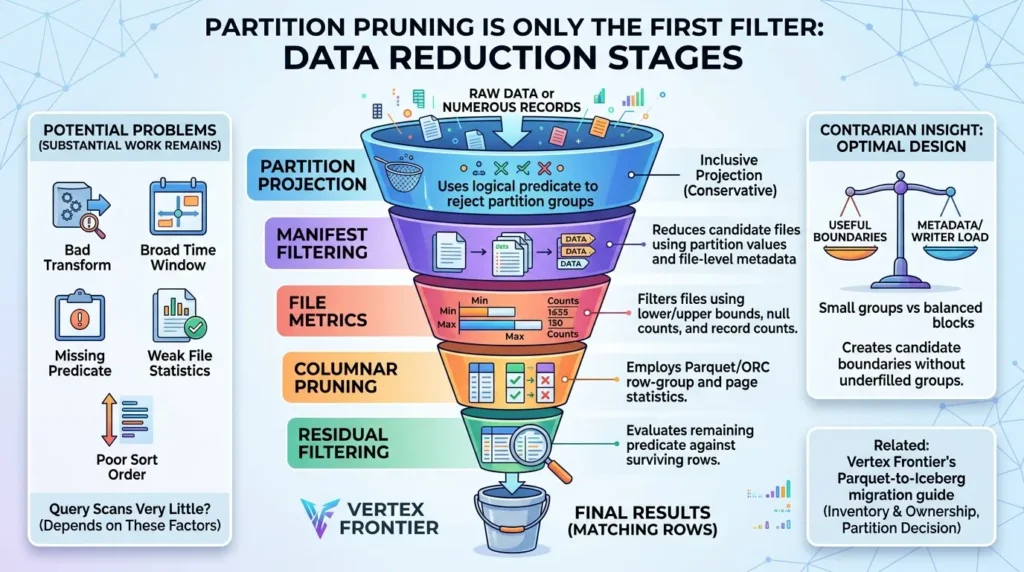
Iceberg’s specification describes inclusive projection as conservative. If a row could match the predicate, its file should not be incorrectly discarded by the projection. The result can still include files that contain no matching row; later filters remove them.
That is why “the table is partitioned” does not automatically mean “the query scans very little.” A badly chosen transform, broad time window, missing predicate, weak file statistics, or poor sort order can leave substantial work after partition pruning.
Contrarian insight: the best partition design is not necessarily the one with the smallest number of partitions. It is the one that creates useful candidate boundaries without making the writer and metadata layer pay for thousands of underfilled groups.
For a related discussion of why open table formats still need operational controls, see Vertex Frontier’s Parquet-to-Iceberg migration guide. The migration article covers inventory and ownership; this article adds the partition decision and post-change measurement layer.
Partition Evolution: Metadata Change, Operational Consequence
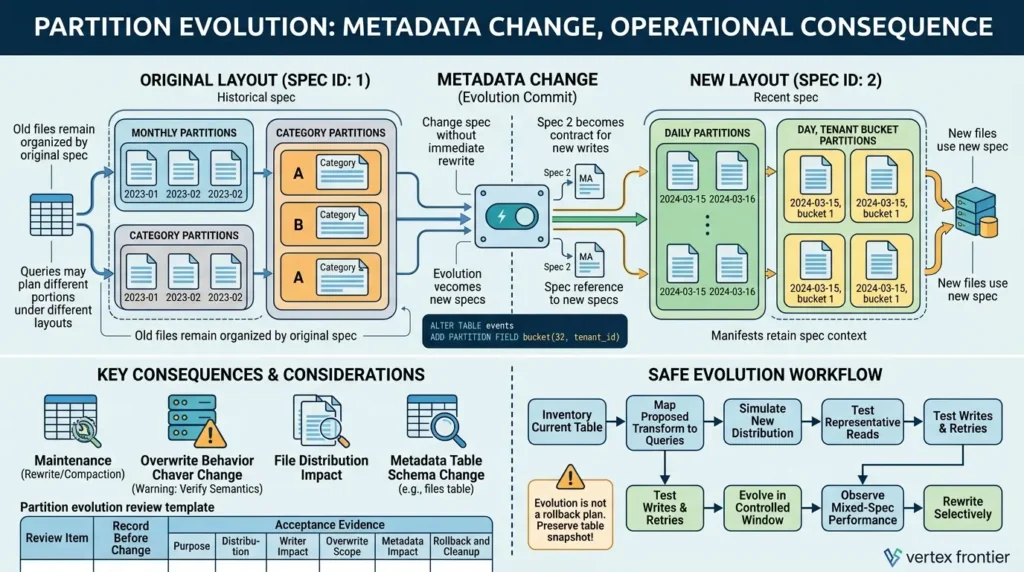
Iceberg supports changing a partition spec without immediately rewriting every historical data file. This is one of its strongest design features, but “metadata-only” should not be read as “free” or “invisible.”
After evolution:
- Old files remain organized according to their original spec.
- New files use the new spec.
- Manifests retain the spec context for the files they describe.
- A query may plan different portions of the table under different layouts.
- Maintenance, overwrite behavior, and file distribution may change.
The current spec is primarily the contract for new writes. Historical manifests must be interpreted using the spec that wrote them.
When evolution is useful
Evolution can help when:
- A monthly layout is too coarse for the current workload.
- A daily layout is creating too many tiny files and needs to become coarser.
- A high-cardinality identity field should be replaced with a bucket.
- The query workload has changed over time.
- A retention policy now follows a different time boundary.
When evolution does not solve the whole problem
Changing the spec does not automatically rewrite old data into the new physical layout. Historical files may still be large, small, skewed, or poorly sorted. If queries continue to read a large historical range, the table may need a targeted rewrite or compaction strategy.
Evolution can also change the scope of partition-aware writes. A dynamic overwrite that was safe under one layout may affect a different set of partition values under another. Verify overwrite semantics for the exact engine and Iceberg version before deploying a spec change.
A safe evolution workflow
- Inventory the current table. Record the active spec, historical specs, file counts, file sizes, manifest counts, and partition distributions.
- Map the proposed transform to real queries. Name the predicates it is intended to improve.
- Simulate the new distribution. Estimate how many values, files, and writers it will create.
- Test representative reads. Include narrow filters, broad filters, nulls, late records, and historical ranges.
- Test writes and retries. Include append, overwrite, backfill, and failed-commit recovery behavior.
- Evolve in a controlled window. Record the resulting spec ID and commit metadata.
- Observe mixed-spec performance. Compare planning time, bytes scanned, file counts, and query latency before and after.
- Rewrite selectively. Compact or rewrite only where the evidence shows that old files are still the bottleneck.
Partition evolution review template
Before approving a spec change, complete the following review. It turns “we should partition by hour now” into a change with an owner, a test boundary, and a measurable stop condition.
| Review item | Record before the change | Acceptance evidence |
|---|---|---|
| Purpose | Which query or retention problem is the new field intended to address? | A named query family and a baseline metric. |
| Distribution | Expected cardinality, skew, null rate, and files per value. | A representative profile, including p95 and p99 values. |
| Writer impact | How many partitions can one batch, stream, retry, or backfill touch? | A bounded test under production-like concurrency. |
| Overwrite scope | Does the writer use append, dynamic overwrite, predicate overwrite, MERGE, or a connector-specific mode? | A retry and late-data test showing the exact partitions replaced. |
| Metadata impact | Current and future spec IDs, manifests, metadata tables, and monitoring queries affected. | Monitoring still runs, or its schema change is documented and deployed. |
| Rollback and cleanup | Snapshot, retention window, rewrite plan, and cleanup owner. | A tested stop/rollback procedure with no premature file deletion. |
In Spark, adding or removing a partition field is a metadata operation, but the official Spark DDL documentation warns that dynamic overwrite behavior changes with the partitioning. It also warns that dropping a partition field changes the schema of metadata tables such as files. Treat monitoring SQL as part of the change, not as an afterthought.
Spark SQL — evolution example; validate the target catalog and version:
ALTER TABLE prod.db.events
ADD PARTITION FIELD bucket(32, tenant_id) AS tenant_bucket;
-- Removing a field changes the layout for new writes.
-- Review dynamic overwrite and metadata-table consumers first.Before changing a production spec, preserve the table snapshot and record the exact spec, commit, writer version, and validation results. A metadata change can be reversible in principle, but the write and maintenance activity that follows may make the operational state harder to reconstruct.
Small Files, Skew, and Compaction
Many partitioning failures show up first as a file problem.
Small files
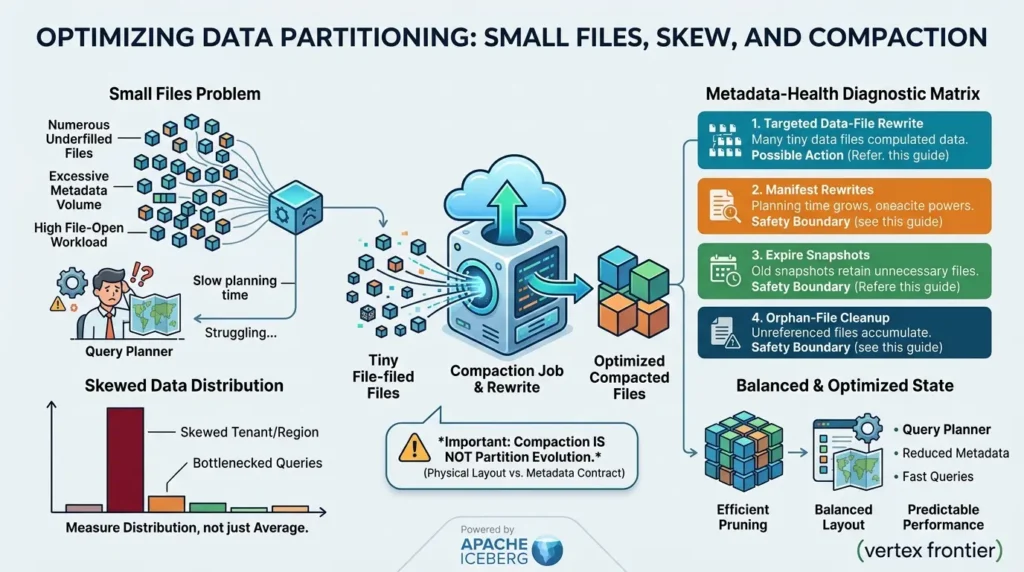
Overly fine partitions, frequent micro-batches, concurrent writers, and backfills can create many underfilled files. Small files increase file-open work and metadata volume, and they may limit the benefit of partition pruning because the planner still has to reason about a large file set.
Do not solve small files by blindly making partitions coarser. First identify the cause:
- Is the writer distributing data across too many partition values?
- Are commits too frequent?
- Are retries creating additional files?
- Is a fanout writer producing one file per partition in a way that matches the workload?
- Is a compaction job rewriting files too aggressively or not at all?
Skew
Skew occurs when one partition or bucket receives far more records than the others. A single hot tenant, region, device, or key can dominate a supposedly balanced layout.
Measure the distribution, not just the average. A healthy average can hide a 99th-percentile partition that is several orders of magnitude larger than the median.
Compaction is not partition evolution
Compaction or rewrite changes the physical file layout. Partition evolution changes the metadata contract for new writes. They can be used together, but they solve different problems.
A good maintenance plan states:
- Which partition or spec is eligible.
- Which files are selected.
- Whether deletes are rewritten.
- How concurrent writers are handled.
- What snapshot and retention rules apply.
- How the result is validated.
The official Iceberg maintenance documentation should be treated as the starting point for current procedures, because exact commands vary by engine and catalog.
Metadata-health diagnostic matrix
Partition design should be reviewed together with metadata health. The Iceberg maintenance guide distinguishes snapshot expiration, orphan-file cleanup, data-file rewrites, and manifest rewrites. They are related, but they are not interchangeable fixes.
| Observed symptom | Inspect first | Possible action | Safety boundary |
|---|---|---|---|
| Many tiny data files | files metadata table, file-size distribution, writer batch size. | Targeted data-file rewrite or writer adjustment. | Do not assume coarsening partitions is the only fix. |
| Planning time grows after frequent commits | Manifest count, manifest size, commit frequency, and filter alignment. | Rewrite manifests or reduce commit fragmentation where supported. | Measure planning time before and after; do not infer from file count alone. |
| Old snapshots retain unnecessary files | Snapshot history, rollback requirements, and reader lag. | Expire snapshots according to the retention contract. | Expiration removes time-travel/rollback availability for expired snapshots. |
| Unreferenced files accumulate | Failed jobs, active writers, path identity, and retention intervals. | Run orphan-file cleanup only after ownership and age checks. | The official guide warns that an unsafe retention interval can delete files still needed by an in-progress write. |
Engine and Catalog Boundaries
The Iceberg format defines a common table model, but the operational surface is not identical everywhere. The following matrix is intentionally cautious.
| Engine/service | What to verify | Why it matters | Primary reference |
|---|---|---|---|
| Spark | DDL transform syntax, distribution, fanout, overwrite mode, and Iceberg library version. | Write and overwrite behavior can change the operational impact of a spec. | Spark DDL |
| Trino | Partitioning array syntax, connector properties, metadata tables, and maintenance procedures. | Trino SQL is not a drop-in copy of Spark SQL. | Trino Iceberg connector |
| Flink | Connector version, write mode, overwrite semantics, and transformed-table support. | Streaming and dynamic overwrite behavior requires a pinned test, especially with late data. | Flink DDL |
| Athena | Athena engine version, Glue catalog behavior, supported transforms, and optimization commands. | A format feature may have a narrower managed-service surface. | Athena Iceberg tables |
| BigQuery | Managed versus external model, supported time partition columns, and current evolution limitations. | The table model and catalog ownership can change the answer. | Google Cloud Iceberg tables |
| Snowflake | Catalog mode, table ownership, supported evolution path, and external-writer behavior. | Snowflake-managed and externally managed Iceberg tables are not interchangeable operationally. | Snowflake partition evolution |
| Databricks | Managed versus foreign Iceberg, runtime version, write support, and transform limitations. | “Databricks supports Iceberg” is too broad to be a useful compatibility statement. | Databricks Iceberg docs |
The safe practice is to label every example with its dialect and assumptions. A Spark SQL example should say Spark SQL. An Athena statement should identify Athena. A catalog boundary should name the catalog, not just the cloud provider.
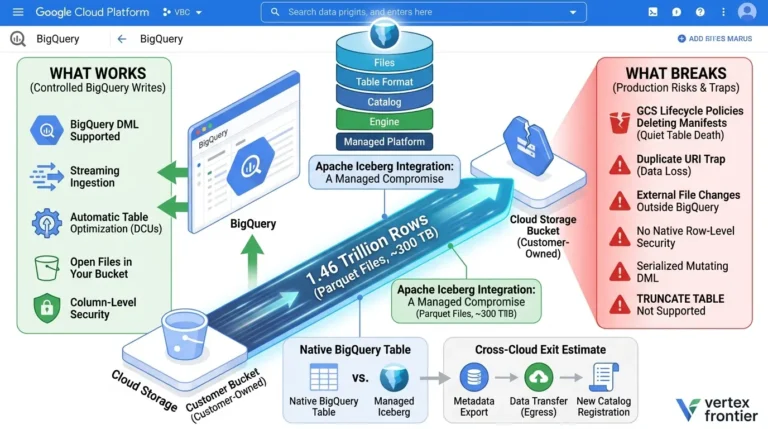
This distinction is especially important for BigQuery. Vertex Frontier’s Apache Iceberg on BigQuery field guide already covers managed-table models, storage ownership, limitations, and migration risks. Link to it for BigQuery-specific details instead of repeating the whole platform guide here.
Dialect-Labeled Examples
The following examples are deliberately short and illustrative. Validate the exact syntax against the engine and catalog version before production use.
Spark SQL — illustrative partition spec:
CREATE TABLE prod.events (
  event_id   string,
  event_time timestamp,
  tenant_id  string,
  payload    string
) USING iceberg
PARTITIONED BY (days(event_time), bucket(32, tenant_id)
Trino — illustrative table definition:
CREATE TABLE lake.events (
  event_id varchar,
  event_time timestamp(6),
  tenant_id varchar,
  payload varchar
)
WITH (
  format = 'PARQUET',
  partitioning = ARRAY['day(event_time)', 'bucket(32, tenant_id)']
);
These snippets are not interchangeable. Their syntax, supported transforms, catalog configuration, and write behavior depend on the environment. A production article should never imply that copying a DDL block across engines is a compatibility test.
Before-and-After Design Review
Before: a layout chosen from intuition
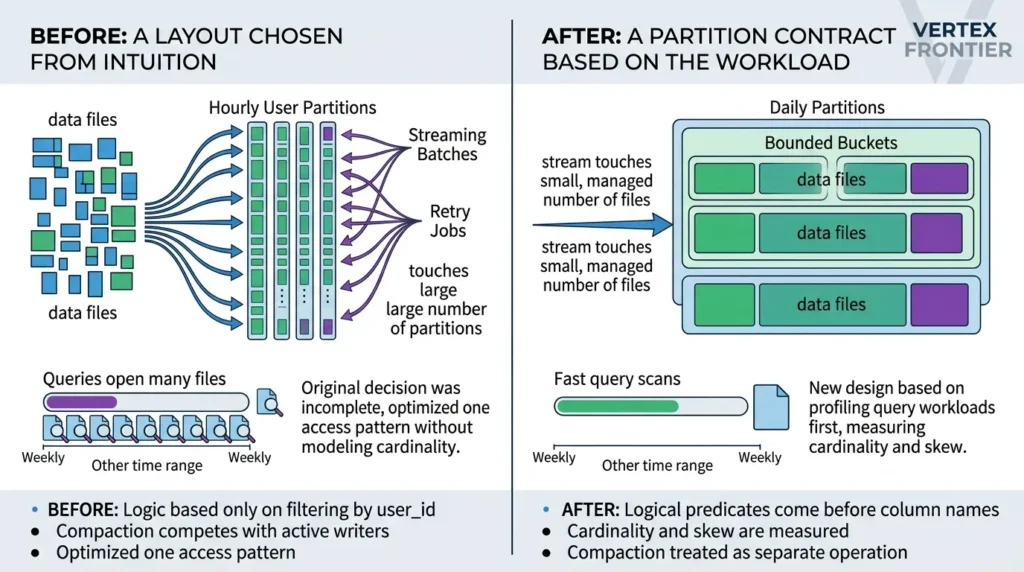
A team receives clickstream events and creates hourly partitions on user_id because analysts often filter by user. The table starts small. Queries for one user appear fast.
Over time:
- The user population grows rapidly.
- Most hourly user partitions contain only a few files.
- Streaming batches touch a large number of partitions.
- Retry jobs create additional files in old partitions.
- Queries over a week still open a large number of files.
- Compaction competes with active writers.
The original decision was not irrational. It was incomplete. It optimized one access pattern without modeling cardinality, write fan-out, and retention.
After: a partition contract based on the workload
The team profiles the queries and finds that most workloads filter a time range first, then optionally filter a tenant or region. It chooses a coarser time transform and a bounded bucket for a stable high-cardinality key. It then measures file distribution, manifest growth, and query scans before and after evolution.
The important change is not a magic transform. It is the decision process:
- Logical predicates come before column names.
- Cardinality and skew are measured.
- Writers are part of the design.
- Evolution is paired with validation.
- Compaction is treated as a separate physical operation.
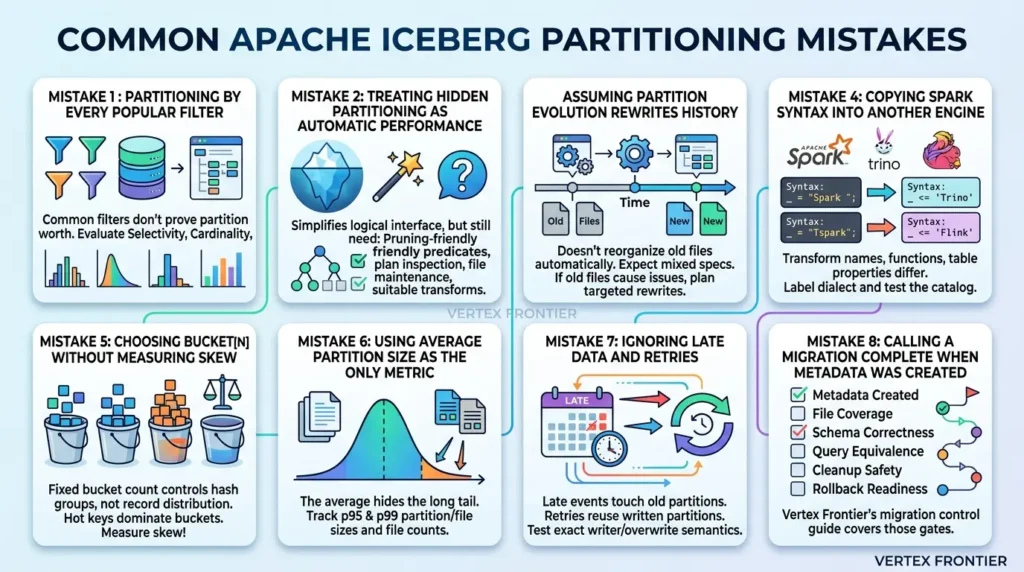
Common Apache Iceberg Partitioning Mistakes
Mistake 1: Partitioning by every popular filter
A column being common in WHERE clauses does not prove that it should be a partition field. Combine selectivity with cardinality, distribution, write fan-out, and retention.
Mistake 2: Treating hidden partitioning as automatic performance
Hidden partitioning simplifies the logical interface. It does not remove the need to write pruning-friendly predicates, inspect plans, maintain files, or choose a suitable transform.
Mistake 3: Assuming partition evolution rewrites history
It does not automatically reorganize old files. Mixed specs are expected. If historical files are the bottleneck, plan a targeted rewrite and validate the result.
Mistake 4: Copying Spark syntax into another engine
Transform names, function forms, table properties, metadata tables, and maintenance procedures differ. Label the dialect and test the catalog.
Mistake 5: Choosing bucket[N] without measuring skew
A fixed bucket count controls the number of hash groups, not the distribution of records. A hot key can still dominate a bucket.
Mistake 6: Using average partition size as the only metric
The average hides the long tail. Track p95 and p99 partition sizes, file sizes, and file counts.
Mistake 7: Ignoring late data and retries
A late event can touch an old partition. A retry can re-enter a previously written partition. Test the exact writer and overwrite semantics before treating the table as safe.
Mistake 8: Calling a migration complete when metadata was created
A successful migration command does not prove file coverage, schema correctness, partition correctness, query equivalence, cleanup safety, or rollback readiness. Vertex Frontier’s migration control guide covers those gates in detail.
The Measurement Checklist
Before and after a partition change, capture the same workload and compare:
- Bytes scanned.
- Number of candidate files.
- Number of manifests read.
- Planning time.
- End-to-end latency.
- Files per partition.
- Median, p95, and p99 file size.
- Median, p95, and p99 partition size.
- Number of partitions touched by a write.
- Commit duration and retry rate.
- Results for nulls, late events, and historical data.
Do not claim that one transform is faster without specifying the workload, data distribution, engine, version, catalog, storage, and measurement method. A result from one table is evidence for that table, not a universal benchmark.
Go / Hold / Rollback scorecard
Use this scorecard after the test run. It is more useful than a single “query became faster” result because partition changes can improve reads while damaging writes, metadata, or correctness.
| Gate | Go | Hold | Rollback trigger |
|---|---|---|---|
| Read behavior | Representative queries return correct results and meet the agreed scan/latency target. | Results are correct but scan or planning behavior is inconclusive. | Missing rows, duplicate rows, or unexplained result differences. |
| Write behavior | Append, retry, backfill, and late-data tests complete within the operating envelope. | Commit duration, touched partitions, or file counts need more observation. | A retry overwrites an unintended scope or produces correctness risk. |
| File health | File-size distribution and partition skew remain within the table’s documented envelope. | The table needs targeted compaction or a longer observation window. | A sustained small-file or hot-partition pattern threatens operations. |
| Compatibility | All required readers and writers pass the pinned compatibility tests. | One engine or catalog path remains untested. | A required reader cannot interpret or safely write the evolved table. |
| Recovery | Snapshot, rollback, retention, and cleanup ownership are documented. | The change is technically sound but the operational runbook is incomplete. | Evidence is missing, cleanup has run prematurely, or ownership is unclear. |
The scorecard is a decision aid, not a substitute for engine documentation or a formal change-management process. Its purpose is to make “not yet proven” visible before a partition change becomes a production incident.
Do not promote a new partition spec because the table was created successfully. Promote it only after representative reads, writes, retries, late data, maintenance, and cross-engine reads produce acceptable results.
A Practical Partitioning Playbook
Use this sequence for a new table or an existing table that needs redesign:
- Write down the top queries. Include filters, time windows, joins, and retention behavior.
- Profile candidate columns. Measure cardinality, skew, null rates, and daily volume.
- Model the write path. Include batch, streaming, CDC, backfill, retry, and compaction behavior.
- Select the least complex transform that fits. Avoid extra partition fields without evidence.
- Confirm engine and catalog support. Pin versions and distinguish managed from external models.
- Create a representative test table. Include ordinary values, nulls, boundary timestamps, skewed keys, and late records.
- Measure reads and writes. Capture scan, planning, file, manifest, and commit metrics.
- Evolve gradually. Record spec IDs, snapshots, writer versions, and validation evidence.
- Rewrite only where necessary. Metadata evolution and physical compaction solve different problems.
- Document the contract. Future teams should know why the transform exists and which assumptions must remain true.
Final Decision Rule
A good Apache Iceberg partition design earns its place in production by balancing three things:
- It removes enough irrelevant data from important reads.
- It creates files and metadata that the write and maintenance paths can handle.
- It remains understandable and supported across the engines and catalogs that matter.
If a design wins only one of those tests, it is not finished.
The most durable approach is to document the partition contract, measure the workload, evolve with evidence, and treat every managed service as a specific implementation rather than a generic “Iceberg-compatible” label. That is how partitioning becomes an engineering decision instead of a folder naming exercise.
FAQ: Apache Iceberg Partitioning
What is the best partition transform in Apache Iceberg?
What does hidden partitioning mean in Iceberg?
Can Iceberg partition evolution avoid rewriting data?
Is partition pruning the same as file pruning?
Should I use day or hour partitioning for timestamps?
Does Iceberg partitioning work the same in Spark, Trino, Athena, and Flink?
Can partition evolution change what a dynamic overwrite replaces?

Was this article helpful?




[…] For a practical decision framework on which transform to use, when to use hidden partitioning, and how to validate the layout before going to production, see our companion guide: Apache Iceberg Partitioning: A Practical Design Guide. […]
[…] The migration-era warning remains valuable when framed correctly: a large historical table designed without a usable partition column may have to be rebuilt rather than repaired through partition evolution. Choose the column from actual query predicates, retention rules, and data arrival behavior, not from the column that looks most familiar in the schema. For a structured framework that walks through predicate contracts, write contracts, physical contracts, and compatibility contracts before you commit to a spec, see Apache Iceberg Partitioning: A Practical Design Guide. […]