


A data warehouse interview is rarely a vocabulary test. The interviewer wants to see how you reason about grain, data quality, cost, failure recovery, query behavior, and business meaning.
You may be asked to define a star schema. Then the conversation moves quickly: What is the grain? What happens when a customer changes address? How do you stop a retry from duplicating revenue? Why is the query slow? How do you prove that yesterday’s load is complete?
This guide gives you 45 data warehouse interview questions and answers organized around that progression. Each answer follows the same practical pattern:
- What it tests
- Strong answer
- Example or trade-off
- Likely follow-up
- Common mistake
The examples are deliberately engine-aware. Partitioning in BigQuery is not the same mechanism as clustering in Snowflake, a Redshift sort key, or a PostgreSQL index. Name the dialect and the workload before claiming that one design is universally faster.
Key takeaways
Click any topic to expand or collapseStart modeling with the business process
Start modeling answers with the business process and the grain of one row.
Explain trade-offs instead of declaring winners
Explain trade-offs instead of declaring star schema, ELT, CDC, or partitioning an automatic winner.
Discuss production requirements
For production scenarios, discuss idempotency, retries, backfills, observability, and reconciliation.
Label SQL by dialect
A correct PostgreSQL answer may not transfer to BigQuery, Snowflake, Redshift, or Spark SQL.
Verify business data completeness
A green pipeline run is not proof that the business data is complete or correct.
How to use this interview guide
Use the questions in three passes. First, answer the fundamentals aloud in 30–60 seconds. Second, add one example and one limitation. Third, practice the scenario questions with a whiteboard or a small dataset.
A strong interview answer usually has this shape:
- Define the concept in one sentence.
- State the decision or assumption that matters.
- Give a concrete example.
- Name a trade-off or failure mode.
- Ask which engine, scale, latency target, and business process the interviewer has in mind.
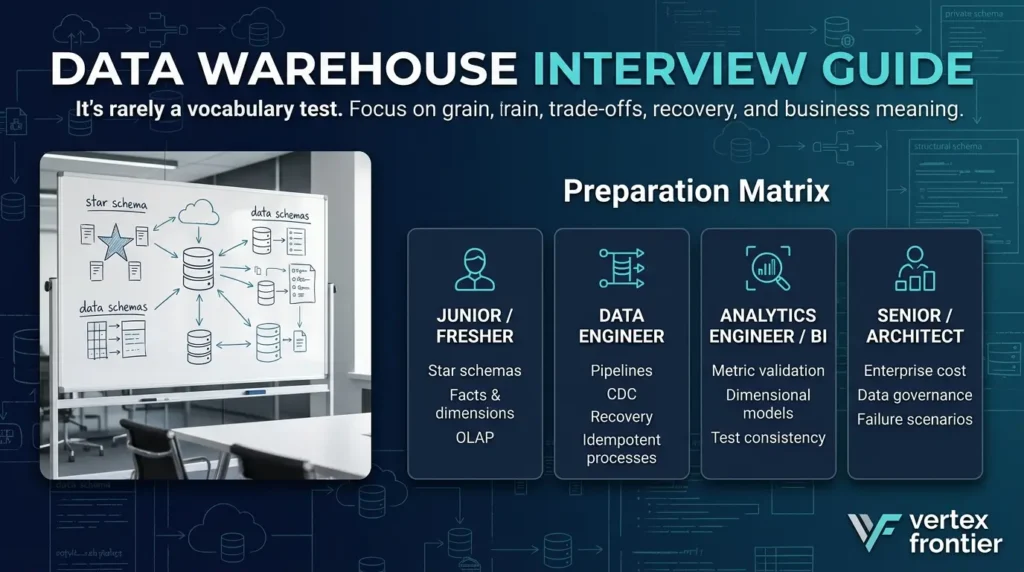
A practical preparation matrix
Do not spend equal time on every question. Use this matrix to match preparation depth to the role you are targeting.
| Target role | Must answer quickly | Must explain with an example | Proof of seniority |
|---|---|---|---|
| Junior / fresher | OLTP/OLAP, facts, dimensions, grain, joins, aggregations | A simple star schema and a deduplication query | Can state assumptions and validate a result |
| Data engineer | Incremental loads, CDC, idempotency, SCDs, query diagnosis | A failed-load recovery plan and a grain-safe model | Explains retries, backfills, monitoring, and trade-offs |
| Analytics engineer / BI | Metric definitions, dimensional models, tests, semantic consistency | A metric discrepancy investigation | Connects SQL behavior to stakeholder decisions |
| Senior / architect | Architecture boundaries, cost, governance, failure modes | A warehouse-from-scratch design under constraints | Makes decisions explicit and names what the design does not guarantee |
The matrix is a prioritization tool, not a claim about what every employer asks. Interview formats vary by company, team, seniority, and stack.
For deeper pipeline preparation, pair this guide with VertexFrontier’s ETL interview questions for data engineers and its broader data engineering interview questions and answers.
Reusable answer card
When you practice, write each answer on one card using the structure below. It prevents polished definitions from hiding weak operational reasoning.
- Definition: What is the concept in one sentence?
- Decision: When would you use it, and what assumption controls the choice?
- Example: What business process, table grain, or query makes it concrete?
- Failure mode: How could it produce wrong data, unexpected cost, or poor performance?
- Follow-up: Which engine, version, scale, or SLA would change the answer?
Use the same card for grain, SCDs, CDC, partitioning, data quality, and architecture. Consistency makes gaps visible during revision.
Core data warehouse interview questions
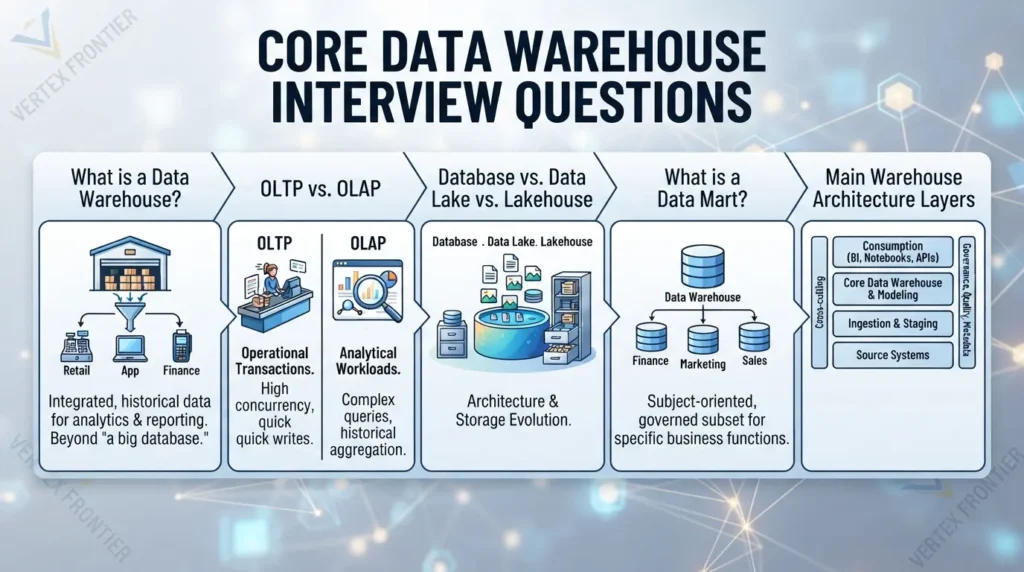
1. What is a data warehouse?
What it tests: Whether you can explain purpose, not just repeat a definition.
Strong answer: A data warehouse is a system that stores integrated, historical data for analytics and reporting. It is designed around analytical workloads: scanning, joining, aggregating, and comparing data over time, rather than handling the short, highly concurrent transactions of an operational application.
A warehouse is also a modeling and governance layer. It gives analysts agreed definitions for metrics such as orders, revenue, active users, and churn.
Example or trade-off: A retail warehouse may combine orders from an application database, refunds from a payment system, and advertising spend from an external platform. The difficult part is not copying the tables. It is defining which order state, currency, time zone, and customer identity the business trusts.
Likely follow-up: How is a warehouse different from a data lake or lakehouse?
Common mistake: Saying that a warehouse is simply “a big database.” Storage technology matters, but workload, modeling, history, governance, and analytical access patterns matter too.
2. What is the difference between OLTP and OLAP?
What it tests: Whether you understand workload design.
Strong answer: OLTP systems support operational transactions such as creating an order or updating an account. They usually prioritize short transactions, consistency, and many concurrent writes. OLAP systems support analysis, where queries often scan and aggregate many rows across historical periods.
Example or trade-off: An order service should not run a month-long customer cohort query on its primary database. The query may compete with application traffic and its schema is usually optimized for transactions, not broad analysis.
Likely follow-up: Can one modern platform support both workloads?
Common mistake: Treating OLTP as “normalized” and OLAP as “denormalized” in every case. Modeling is related to workload, but the labels are not complete architectural rules.
3. What is the difference between a database, a data warehouse, a data lake, and a lakehouse?
What it tests: Architecture vocabulary and boundaries.
Strong answer: A database is a broad term for managed data storage and access. A warehouse is optimized and governed for analytics. A data lake commonly stores large volumes of raw or semi-structured data in object storage with flexible schemas. A lakehouse combines lake-style storage with table formats, metadata, and analytical management features.
The right choice depends on workload, governance, latency, skills, storage format, query engines, and operational constraints.
Example or trade-off: A team may land raw events in object storage, transform reliable business entities into warehouse tables, and retain curated lakehouse tables for data science. These layers can coexist; they are not mutually exclusive boxes.
Likely follow-up: Which system becomes the source of truth?
Common mistake: Assuming “lakehouse” automatically replaces a warehouse. The answer must name consumers, contracts, access controls, and operational ownership.
4. What is a data mart?
What it tests: Whether you can connect enterprise structure with user needs.
Strong answer: A data mart is a subject-oriented analytical layer for a business function such as finance, marketing, or sales. It may be built from a central warehouse or organized as a governed model within it.
Example or trade-off: A finance mart can expose approved revenue and cost measures without forcing every finance user to understand raw ingestion tables. A mart should not create a second definition of revenue that contradicts the enterprise model.
Likely follow-up: How do you avoid isolated data marts becoming silos?
Common mistake: Defining a mart only by its physical database. The important properties are scope, ownership, semantic consistency, and intended consumers.
5. What are the main layers in a warehouse architecture?
What it tests: System thinking.
Strong answer: A common pattern includes source systems, ingestion, raw or landing storage, staging, modeled warehouse tables, marts or semantic models, and consumption through BI, notebooks, APIs, or reverse ETL. Governance, quality, metadata, orchestration, and observability cut across every layer.
Example or trade-off: Keeping raw data can improve replay and investigation, but it increases storage, privacy, retention, and access-control responsibilities.
Likely follow-up: Which layer owns business logic?
Common mistake: Presenting bronze/silver/gold as a universal standard. It is a useful naming pattern in some lakehouse programs, not a guarantee of correct architecture.
Dimensional modeling interview questions
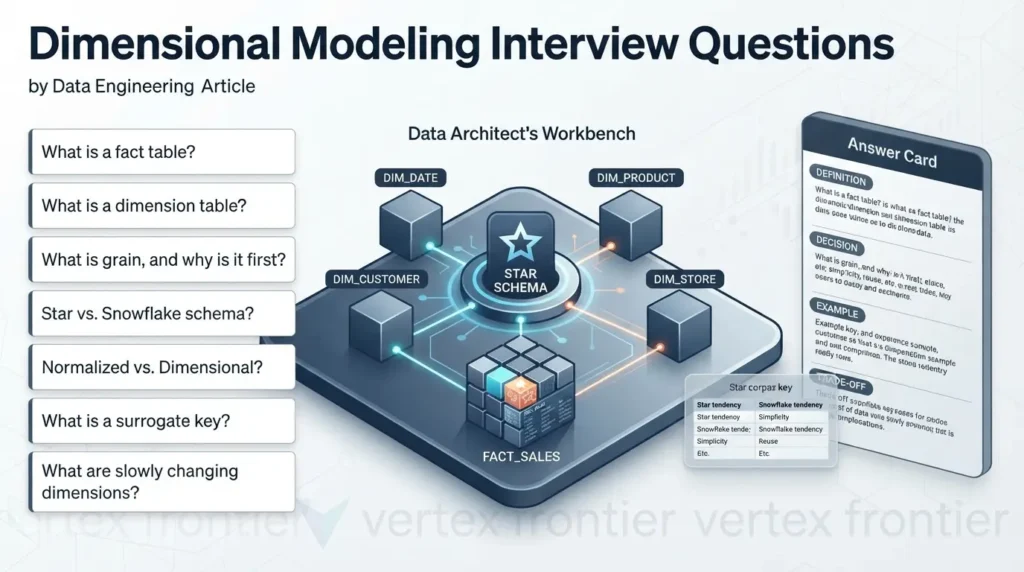
6. What is a fact table?
What it tests: Whether you understand measurable business events.
Strong answer: A fact table records events or states at a defined grain and usually contains foreign keys to dimensions plus numeric measures. Examples include an order line, a payment, a shipment event, or a daily account balance.
Example or trade-off: An order-line fact can store quantity, unit price, discount, and extended amount. It should not quietly mix order-level totals with line-level measures unless the grain is explicit.
Likely follow-up: Are all facts additive?
Common mistake: Assuming every numeric column can be summed. Revenue may be additive across products and time, while a ratio or account balance may require a different aggregation rule.
7. What is a dimension table?
What it tests: Whether you can describe descriptive context.
Strong answer: A dimension table stores descriptive attributes used to filter, group, and label facts. Customer, product, date, location, and employee are common examples.
A dimension may be relatively wide and may preserve history through slowly changing dimension techniques.
Example or trade-off: A customer dimension can contain segment, region, and account status. If customer region changes, the team must decide whether historical orders should retain the old region or be restated under the new one.
Likely follow-up: What is a conformed dimension?
Common mistake: Calling every lookup table a dimension without explaining how it relates to a business process and fact grain.
8. What is grain, and why is it the first modeling decision?
What it tests: The most important dimensional-modeling habit.
Strong answer: Grain states what one row represents. For example: “one row per order line,” “one row per daily account balance,” or “one row per shipment event.” You choose the grain before selecting dimensions and measures because every join and aggregation depends on it.
Microsoft’s star-schema guidance and AWS’s dimensional-modeling guidance for Amazon Redshift both emphasize business process and grain as foundations of the model.
Example or trade-off: If a table is at order-line grain and you join it to a promotion table with multiple matching rows, revenue can multiply. The fix is not to add DISTINCT blindly. First define the relationship and reduce the many-side data to the intended grain.
Likely follow-up: How would order grain differ from order-line grain?
Common mistake: Choosing the grain after drawing the schema.
9. What is a star schema?
What it tests: Practical dimensional design.
Strong answer: A star schema places a central fact table near denormalized dimension tables. The structure is easy for analytical users to understand and often reduces the number of joins required for common reporting queries.
Example or trade-off: A sales fact may connect to date, product, customer, and store dimensions. Denormalized attributes can make BI queries simpler, but dimensions may contain repeated values and require stronger update and history practices.
Likely follow-up: Is a star schema always faster than a snowflake schema?
Common mistake: Answering “yes.” Performance depends on the engine, physical design, data distribution, query shape, and workload.
10. What is a snowflake schema?
What it tests: Whether you understand normalized dimensions.
Strong answer: A snowflake schema normalizes some dimension attributes into related tables. For example, a product dimension may connect to brand and category tables.
Example or trade-off: Snowflaking can reduce repeated attributes and clarify shared hierarchies. It can also add joins and make self-service analysis harder.
Likely follow-up: When would you choose it?
Common mistake: Treating snowflake as bad design. It is a trade-off, not a failure state.
11. Star schema versus snowflake schema: how would you decide?
What it tests: Decision quality under constraints.
Strong answer: I would compare query simplicity, dimension size, hierarchy reuse, update behavior, governance, BI-tool behavior, and engine performance under representative workloads. I would start with a clear grain and test the queries that matter rather than choosing from a diagram alone.
| Decision factor | Star tendency | Snowflake tendency |
|---|---|---|
| Self-service simplicity | Usually simpler | More relationships to understand |
| Repeated attributes | More repetition | More normalization |
| Hierarchy reuse | Often embedded | Often explicit |
| Final answer | Workload- and engine-dependent; validate with representative queries | |
Likely follow-up: How would you measure the choice?
Common mistake: Using a universal rule instead of a workload and governance explanation.
12. What is the difference between normalized and dimensional modeling?
What it tests: Whether you can connect operational integrity with analytics usability.
Strong answer: Normalized models reduce redundancy and are useful for transactional consistency. Dimensional models organize data around business processes, facts, dimensions, and analytical access patterns. A warehouse may use both: normalized staging for integration and dimensional marts for consumption.
Example or trade-off: A normalized customer model may split address, account, and status entities across tables. A customer dimension may present the attributes together to make reporting and historical analysis easier.
Likely follow-up: Does dimensional modeling mean denormalize everything?
Common mistake: Treating 3NF and star schema as competing religions. They solve different problems.
13. What is a surrogate key, and why use one?
What it tests: Historical identity and warehouse design.
Strong answer: A surrogate key is a warehouse-generated identifier that represents a dimension row. It can separate warehouse identity from a source-system key and allow multiple historical versions of the same business entity.
Example or trade-off: Customer C-100 may have one dimension row for its old region and another for its new region. The fact joins to the correct historical dimension key.
Likely follow-up: When would a natural key still be useful?
Common mistake: Claiming that surrogate keys automatically solve duplicate or late-arriving data. They help identify versions; pipeline logic still needs to resolve source identity and timing.
14. What are slowly changing dimensions?
What it tests: History management.
Strong answer: Slowly changing dimensions are techniques for handling changes to descriptive attributes. Type 1 overwrites the old value. Type 2 creates a new versioned row. Type 3 keeps limited prior state in another column. Kimball’s SCD reference describes additional patterns, but implementation details vary by platform.
Example or trade-off: Type 1 is appropriate when only the current value matters. Type 2 is useful when reports must reflect the customer’s region at the time of the sale.
Likely follow-up: How do you handle a late-arriving dimension?
Common mistake: Writing one MERGE statement as if it were portable across all warehouses.
15. What is the difference between a Type 1 and Type 2 SCD?
What it tests: Choosing history semantics.
Strong answer: Type 1 updates the existing dimension row and loses the old value. Type 2 inserts a new row with version metadata such as effective dates or a current indicator, preserving historical states.
Example or trade-off: Correcting a spelling error may be Type 1. A customer changing legal entity or sales territory may require Type 2 if historical reporting must preserve the old context.
Likely follow-up: What if the source does not provide an update timestamp?
Common mistake: Assuming Type 2 is always better. It adds rows, joins, testing, and interpretation costs.
ETL, ELT, and reliability questions
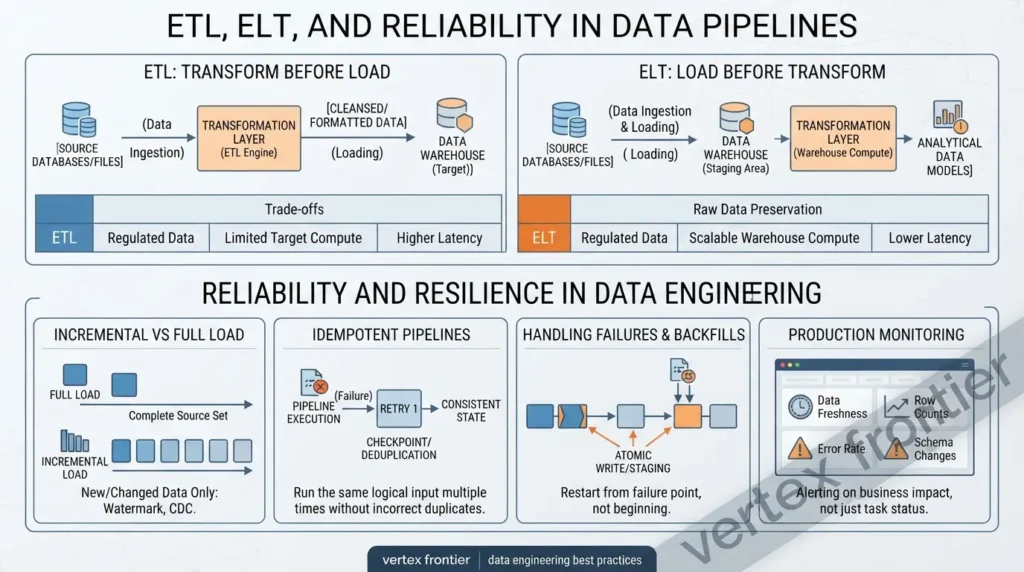
16. What is ETL versus ELT?
What it tests: Pipeline architecture and trade-offs.
Strong answer: ETL transforms data before loading it into the target. ELT loads data first and transforms it in the target platform. Modern systems can support both patterns, and some pipelines combine them.
Microsoft’s Fabric Data Factory overview documents ETL, ELT, and combined approaches rather than presenting one universal winner.
Example or trade-off: ELT can preserve raw data and use warehouse compute for transformations. ETL may be useful when sensitive fields must be filtered before landing or when the target has limited transformation capability.
Likely follow-up: Which one would you choose for a regulated source?
Common mistake: Saying “cloud means ELT.” Discuss data exposure, replay, latency, compute, governance, and source/target capabilities.
17. What is a full load versus an incremental load?
What it tests: Volume and change-processing strategy.
Strong answer: A full load processes the complete source set. An incremental load processes only new or changed data, using a reliable watermark, CDC stream, change timestamp, monotonically increasing key, or another method.
Example or trade-off: Full loads are simple but may become expensive and slow. Incremental loads reduce work but require handling late changes, deletes, corrections, missed windows, and replay.
Likely follow-up: How do you validate an incremental load?
Common mistake: Treating updated_at as reliable without checking time zones, backdated corrections, clock skew, and updates that do not change the timestamp.
18. What makes a pipeline idempotent?
What it tests: Safe retries and production maturity.
Strong answer: An idempotent pipeline can run the same logical input more than once without producing incorrect duplicates or inconsistent results. It usually requires stable business keys, checkpoints, deduplication, deterministic transformations, controlled merge semantics, and a clear definition of the processing interval.
Example or trade-off: Instead of blindly appending a daily file on retry, record the file identity and processing status, load into a staging area, validate counts, and publish the result once the batch is accepted.
Likely follow-up: Is idempotency the same as exactly-once processing?
Common mistake: Claiming exactly-once without specifying source, transport, sink, checkpoint, failure boundary, and duplicate assumptions.
19. How do you handle a failed ETL job halfway through a load?
What it tests: Recovery design.
Strong answer: I first identify the failed stage and the affected interval. Then I check whether writes were atomic, which records or files were committed, and whether the next retry can safely reprocess them. I would use staging, batch identifiers, reconciliation counts, and idempotent publication rather than simply rerunning production writes.
Example or trade-off: A partial fact load may require removing or replacing one batch, not truncating the whole table. The correct action depends on transaction and table semantics.
Likely follow-up: What would you log?
Common mistake: Saying “restart from the last step” without proving that the last step is safe to repeat.
20. What is CDC?
What it tests: Change data capture boundaries.
Strong answer: Change data capture identifies inserts, updates, and deletes from a source so downstream systems can process changes instead of repeatedly scanning the entire source. CDC may be log-based, trigger-based, timestamp-based, or implemented through platform-specific features.
Example or trade-off: AWS DMS CDC documentation makes clear that CDC behavior includes prerequisites and latency considerations; it should not be described as automatically real-time or complete.
Likely follow-up: How do you handle deletes and ordering?
Common mistake: Calling CDC an audit log or promising permanent retention without checking the connector and retention policy.
21. How do you handle duplicate files or events?
What it tests: Reliability under replay.
Strong answer: I define the event or file identity, persist ingestion metadata, deduplicate at the appropriate grain, and separate arrival identity from business identity. I also preserve enough metadata to explain why a record was accepted, ignored, or replaced.
Example or trade-off: Two files can contain the same business events but have different filenames. File-name deduplication alone is not enough if the source can resend data under a new name.
Likely follow-up: What if events arrive out of order?
Common mistake: Using DISTINCT as a general data-quality strategy. It can hide legitimate repeated events.
22. How do you design a backfill?
What it tests: Controlled historical processing.
Strong answer: I define the affected time range, source snapshot, target grain, dependencies, expected volume, write strategy, validation checks, and rollback or correction plan. I isolate the backfill from normal incremental processing or make their interaction explicit.
Example or trade-off: A backfill may write a new batch version and publish it after reconciliation. Directly overwriting production rows makes it difficult to distinguish corrected history from a partial run.
Likely follow-up: How do you prevent the backfill from double-counting data?
Common mistake: Treating a backfill as a long regular run without special observability and capacity planning.
23. What should you monitor in a production warehouse pipeline?
What it tests: Operational completeness.
Strong answer: I monitor schedule and duration, source freshness, row counts, nulls, duplicates, referential integrity, accepted business ranges, schema changes, late data, error rates, data volume, cost, and downstream availability. I alert on business impact, not only task status.
Example or trade-off: A successful job that loads zero rows can be more dangerous than a failed job because it may publish an apparently valid but incomplete dataset.
Likely follow-up: Which checks are hard failures and which are warnings?
Common mistake: Monitoring only whether the scheduler reports green.
SQL and analytical interview questions
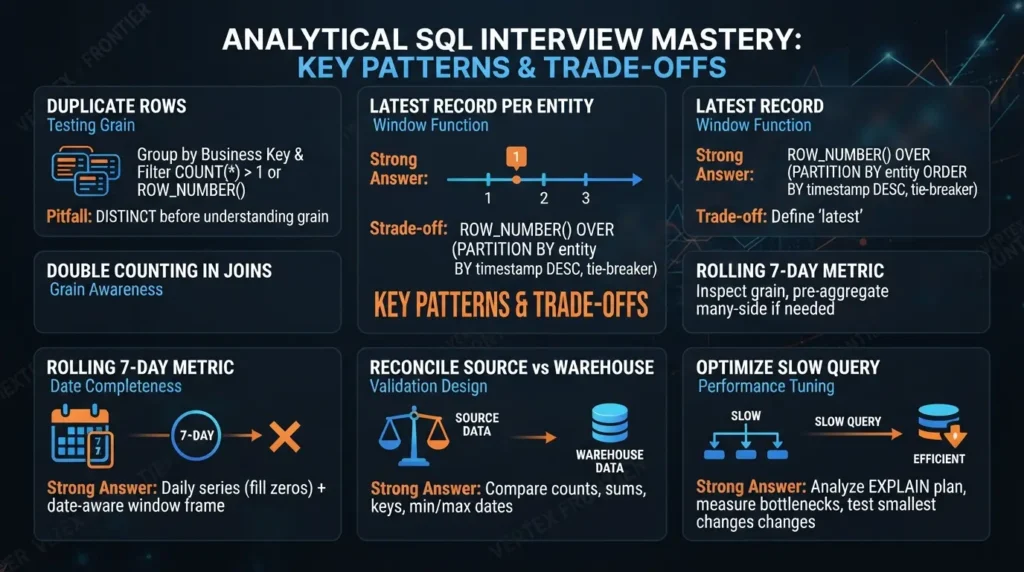
24. How do you find duplicate rows?
What it tests: Grain and window-function discipline.
Strong answer: First define what “duplicate” means. Then group by the business key and filter groups with a count greater than one, or use ROW_NUMBER() to inspect repeated records while retaining the reason for the selected row.
Portable SQL pattern — validate in your dialect:
SELECT customer_id, order_id, COUNT(*) AS row_count
FROM fact_orders
GROUP BY customer_id, order_id
HAVING COUNT(*) > 1;
Example or trade-off: Duplicate business keys may indicate replay, a many-to-many join, or a legitimate repeated event. Removing them without understanding the grain can destroy data.
Likely follow-up: How would you keep the latest record?
Common mistake: Using DISTINCT before understanding why rows multiply.
25. How do you return the latest record for each entity?
What it tests: Window functions and deterministic ordering.
Strong answer: Use ROW_NUMBER() partitioned by the entity key and ordered by the business timestamp plus a deterministic tie-breaker. The tie-breaker matters when two records have the same timestamp.
SQL pattern — adapt the date and identifier types:
WITH ranked AS (
SELECT
    customer_id,
    status,
    updated_at,
    ingestion_id,
    ROW_NUMBER() OVER (
      PARTITION BY customer_id
      ORDER BY updated_at DESC, ingestion_id DESC
    ) AS rn
  FROM customer_updates
)
SELECT customer_id, status, updated_at
FROM ranked
WHERE rn = 1;
Example or trade-off: “Latest” could mean latest source update, latest ingestion, or latest effective business state. Name which one you mean.
Likely follow-up: What if updates arrive late?
Common mistake: Ordering only by timestamp when ties are possible.
26. How do joins create double counting?
What it tests: Grain awareness.
Strong answer: Double counting happens when one row on the left matches multiple rows on the right, multiplying measures before aggregation. I inspect the grain on both sides, pre-aggregate the many-side table when appropriate, and reconcile totals before and after the join.
Example or trade-off: Joining order-line revenue to a customer-tags table with three tags per customer creates three copies of each line unless the tag relationship is reduced or modeled separately.
Likely follow-up: Would SUM(DISTINCT amount) fix it?
Common mistake: Using a distinct aggregate that removes legitimate equal-valued transactions.
27. How would you calculate a rolling seven-day metric?
What it tests: Window frames and date completeness.
Strong answer: I first create a daily-grain series, including zero-activity dates when the metric requires them. Then I apply a date-aware or row-aware window appropriate to the SQL dialect and define whether the current day is included.
Example or trade-off: Seven rows are not necessarily seven calendar days if dates are missing. Time zones and late-arriving events also affect the result.
Likely follow-up: How would you validate the boundary dates?
Common mistake: Applying a seven-row window to sparse data and calling it seven days.
28. How do you reconcile source and warehouse totals?
What it tests: Validation design.
Strong answer: I compare counts, sums, distinct business keys, min/max timestamps, null rates, and status distributions at the same grain and time boundary. I investigate expected exclusions, time-zone differences, deletes, late records, and transformation rules before labeling it a mismatch.
Example or trade-off: A source count may include canceled test orders that the warehouse intentionally excludes. Reconciliation must compare like with like.
Likely follow-up: What thresholds would you use?
Common mistake: Expecting every metric to match exactly without documenting the transformation contract.
29. What is a window function, and when do you use one?
What it tests: Analytical SQL.
Strong answer: A window function calculates across related rows without collapsing them into one row per group. It is useful for ranking, latest-row selection, running totals, lag/lead comparisons, and period-over-period analysis.
Example or trade-off: LAG() can compare an account’s current balance with its previous balance while retaining one row per account-date.
Likely follow-up: How is it different from GROUP BY?
Common mistake: Ignoring the partition, order, or frame definition.
30. How do you optimize a slow warehouse query?
What it tests: Diagnosis before tuning.
Strong answer: I start with the execution plan or query profile and measure bytes or rows processed, scan volume, join cardinality, filter selectivity, spill or shuffle behavior, concurrency, and data layout. Then I test the smallest change that addresses the observed bottleneck.
PostgreSQL’s EXPLAIN documentation is a useful reminder that planner cost is not a universal time measurement; other engines expose different plans and metrics.
Example or trade-off: A smaller projection, earlier filter, better join grain, partition predicate, clustering choice, or pre-aggregation may help. Adding a physical structure without a workload hypothesis can increase maintenance and cost.
Likely follow-up: What information do you need before recommending a fix?
Common mistake: Saying “add an index” without naming the engine. Warehouses may use partitions, clustering, sort keys, distribution, micro-partition metadata, caching, or other mechanisms.
Performance, cloud, and platform questions
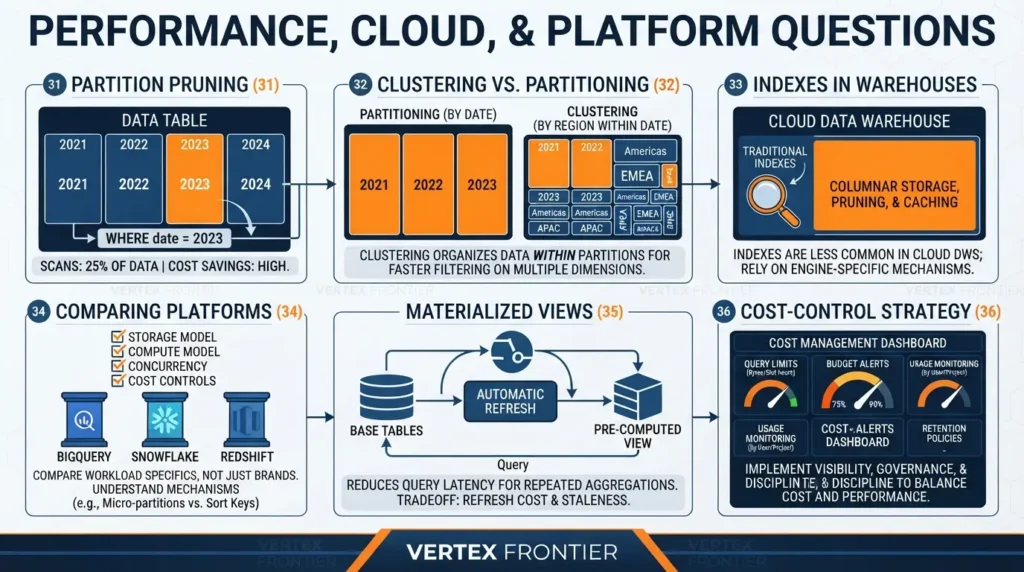
31. What is partition pruning?
What it tests: Physical design and cost awareness.
Strong answer: Partition pruning means the engine reads only relevant partitions instead of scanning the entire table, when the query filter aligns with the partitioning scheme and the engine can use it.
For example, BigQuery partitioned tables can reduce scanned data when queries filter the partitioning column. The actual benefit depends on table design and query predicates.
Example or trade-off: Partitioning by event date can help time-bounded reports. It may be unhelpful if most queries scan all dates or if the chosen key does not match access patterns.
Likely follow-up: Does partitioning always reduce cost?
Common mistake: Presenting partitioning as an automatic performance win.
32. What is clustering, and how is it different from partitioning?
What it tests: Engine-specific physical concepts.
Strong answer: Partitioning separates data into larger logical ranges or units. Clustering organizes data within those units according to selected columns so the engine can skip irrelevant blocks or metadata ranges. The exact behavior differs by platform.
BigQuery clustering documentation and Snowflake’s micro-partition documentation describe different implementations and caveats.
Example or trade-off: A date partition plus customer clustering may help queries constrained by both date and customer. A different workload may need product or tenant locality instead.
Likely follow-up: How do you choose the columns?
Common mistake: Saying that clustering, indexes, sort keys, and micro-partitions are interchangeable.
33. What is an index, and are indexes useful in a warehouse?
What it tests: Avoiding platform-generalized advice.
Strong answer: An index is an access structure that can help a database locate rows without scanning the whole table. Its usefulness depends on the engine, table size, selectivity, write pattern, optimizer, and workload. Some analytical platforms use different physical mechanisms rather than traditional indexes.
Example or trade-off: PostgreSQL may benefit from a B-tree index for a selective lookup, while a cloud warehouse may rely more on columnar storage, partitioning, clustering, sorting, pruning, or caching.
Likely follow-up: What would you inspect before adding one?
Common mistake: Saying indexes are always useless, or always the first fix.
34. How would you compare BigQuery, Snowflake, and Redshift in an interview?
What it tests: Decision framing rather than brand memorization.
Strong answer: I would compare the specific workload: storage and compute model, ingestion paths, concurrency, governance, data layout, SQL features, operational skills, networking, cost controls, and downstream tools. I would avoid declaring a winner without workload and measurement.
Example or trade-off: BigQuery’s partitioning and clustering, Snowflake’s micro-partition metadata and clustering behavior, and Redshift’s sort-key design are not the same. The interview answer should name the relevant mechanism and documentation.
Likely follow-up: Which would you choose for a multi-tenant event workload?
Common mistake: Repeating a generic product comparison without asking about latency, volume, concurrency, region, and budget.
35. What is a materialized view?
What it tests: Precomputation and freshness trade-offs.
Strong answer: A materialized view stores the result of a query or an engine-managed representation so future queries may avoid repeating all computation. The refresh behavior, supported query shapes, optimizer use, and freshness guarantees are platform-specific.
Example or trade-off: Precomputing daily aggregates can reduce repeated work, but it introduces refresh cost, staleness, invalidation, and another object to monitor.
Likely follow-up: When is a table better?
Common mistake: Claiming that materialized views automatically make every query faster.
36. What does a data warehouse cost-control strategy include?
What it tests: Production ownership.
Strong answer: It includes workload visibility, bytes or compute consumed, query limits where appropriate, partition and pruning discipline, incremental transformations, retention policies, concurrency management, ownership tags, and alerts for anomalies. The exact controls depend on the provider.
Example or trade-off: A query that scans a large history every hour may be cheaper and simpler after a verified incremental model, but only if late data and corrections remain covered.
Likely follow-up: How do you avoid optimizing cost at the expense of correctness?
Common mistake: Treating a lower bill as success if freshness, completeness, or analyst productivity deteriorates.
Data quality, governance, and security questions
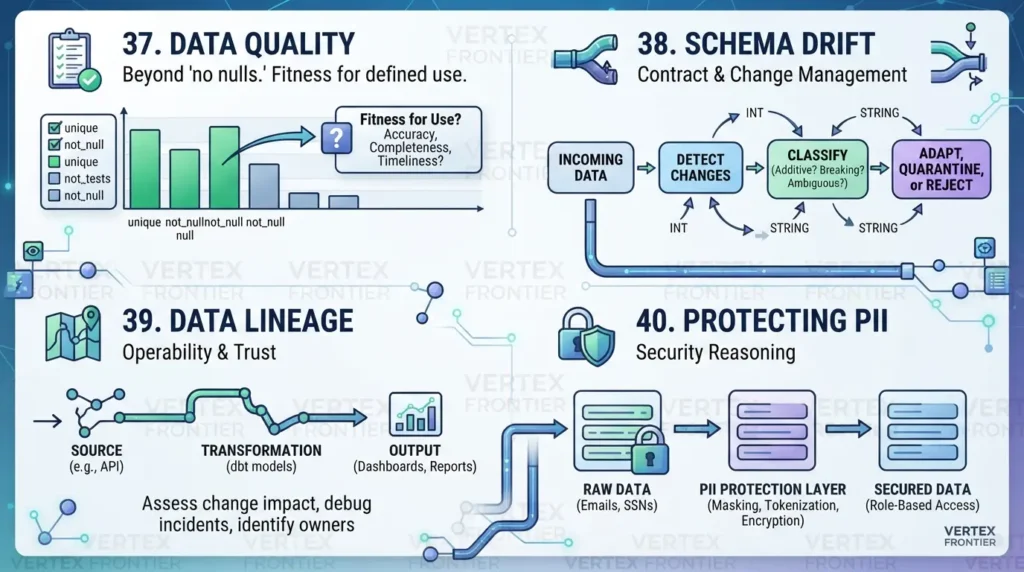
37. What is data quality?
What it tests: Whether you can move beyond “no nulls.”
Strong answer: Data quality is fitness for a defined use. It can include accuracy, completeness, validity, uniqueness, consistency, timeliness, and integrity. The right checks come from the data contract and business risk.
Example or trade-off: A not_null test may catch missing IDs, but it cannot prove that revenue is complete, currencies are correct, or events arrived within the reporting SLA.
dbt’s data-test documentation describes tests as assertions such as unique, not_null, accepted values, and relationships. Passing them does not prove that every business rule is satisfied.
Likely follow-up: Which test would you add first?
Common mistake: Treating a tool’s green test count as a full quality score.
38. How do you handle schema drift?
What it tests: Contract and change management.
Strong answer: I classify changes as additive, breaking, or ambiguous; detect them before publication; document ownership; test downstream models; and define whether to quarantine, adapt, or reject the change. For semi-structured data, I also monitor field presence, type changes, and unexpected nesting.
Example or trade-off: An additive nullable field may be safe for some consumers but still require catalog and contract updates. A renamed field can silently produce nulls if the pipeline accepts it without validation.
Likely follow-up: How do you coordinate a breaking change?
Common mistake: Letting the warehouse infer a new schema and assuming downstream logic will adapt safely.
39. What is data lineage, and why does it matter?
What it tests: Operability and trust.
Strong answer: Lineage describes how data moves from sources through transformations to outputs. It helps teams assess change impact, explain metrics, debug incidents, support audits, and identify owners.
Example or trade-off: If the finance revenue metric changes, lineage should show which source fields, models, tests, dashboards, and downstream exports may be affected.
Likely follow-up: Is column lineage always accurate?
Common mistake: Treating a catalog entry as proof that ownership, freshness, and business definitions are current.
40. How would you protect PII in a warehouse?
What it tests: Security reasoning.
Strong answer: I begin by classifying sensitive fields and defining who needs which access. Controls may include minimization, tokenization or masking, role-based access, row- or column-level policies, separate restricted datasets, encryption, audit logs, retention rules, and controlled extracts.
BigQuery’s row-level security documentation and column-level security documentation show why permissions and feature limitations must be named rather than generalized across providers.
Example or trade-off: Analysts may need customer segments but not raw email addresses. A masked or tokenized field can support analysis while reducing exposure, but access and re-identification risks still need review.
Likely follow-up: How do you audit access?
Common mistake: Saying “the cloud provider makes it secure by default.” Security is a configured control system, not a product adjective.
Scenario and system-design interview questions
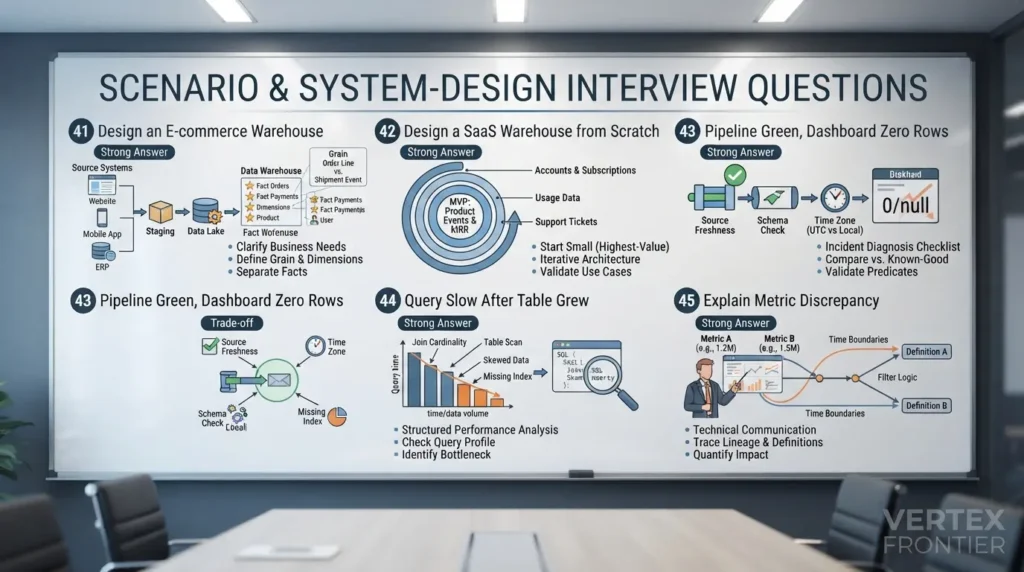
41. Design a warehouse for an e-commerce business.
What it tests: Requirements, grain, and evolution.
Strong answer: I would clarify business questions, source systems, order lifecycle, currency, time zone, refunds, cancellations, inventory, latency, retention, and users. Then I would define business processes and grains: order line, payment event, shipment event, and daily inventory snapshot may need separate facts. I would identify conformed dimensions such as date, product, customer, and store, then define ingestion, quality checks, orchestration, and access controls.
Example or trade-off: One giant orders table may look convenient but can mix order, payment, shipment, and line-item grains. Separate facts can preserve meaning and prevent accidental multiplication.
Likely follow-up: How would you model returns?
Common mistake: Starting with tools before requirements and grain.
42. Design a warehouse from scratch for a SaaS product.
What it tests: Iterative architecture.
Strong answer: I would start with the highest-value decisions: product events, accounts, users, subscriptions, invoices, and support interactions. I would define event identity and contracts, land raw data for replay, build a small trusted model, add observability and ownership, and expand through validated use cases.
Example or trade-off: A minimal first release may prioritize daily product and revenue reporting rather than building every future domain. The model should still preserve identifiers and timestamps needed for later history.
Likely follow-up: How would you handle multi-tenant access?
Common mistake: Designing every table before validating the first decision the warehouse must support.
43. A pipeline is green, but the dashboard shows zero rows. What do you do?
What it tests: Incident diagnosis.
Strong answer: I check source freshness, extraction windows, credentials, incremental predicates, schema changes, filters, partition boundaries, staging counts, rejected records, downstream joins, and dashboard cache or semantic-model behavior. I compare the run with the previous known-good interval and communicate impact before changing data.
Example or trade-off: A successful query can return zero rows because the date predicate uses UTC while the business uses local time. The green status says the code ran, not that the expected business population arrived.
Likely follow-up: What evidence would make you stop the pipeline?
Common mistake: Rerunning immediately and potentially making the diagnosis harder.
44. A query became slow after the table grew. How do you respond?
What it tests: Structured performance analysis.
Strong answer: I capture the query profile before and after the change, compare rows and bytes processed, check data distribution and join cardinality, inspect filters and pruning, review concurrency, and identify the first changed condition. Then I test a targeted change against representative queries.
Example or trade-off: The problem may be a many-to-many join, a lost partition predicate, skew, a stale statistic, a changed data type, or a workload-concurrency issue—not simply “more rows.”
Likely follow-up: How do you prove the fix is safe?
Common mistake: Benchmarking one query in isolation and claiming a universal improvement.
45. How would you explain a warehouse metric discrepancy to a stakeholder?
What it tests: Technical communication and trust.
Strong answer: I first restate both metric definitions and their time boundaries. Then I trace the source, filters, joins, status rules, currency, time zone, late data, and refresh times. I quantify the population affected where possible, document the root cause, and agree on the canonical definition and corrective action.
Example or trade-off: “Revenue” may mean booked orders, paid orders, fulfilled orders, or recognized revenue. The disagreement may be semantic rather than a SQL bug.
Likely follow-up: How do you prevent recurrence?
Common mistake: Choosing the number that looks more credible without defining the business rule.
A system-design scoring matrix
For an open-ended design question, interviewers often learn more from your reasoning than from the final diagram. Before you finish, check the design against these dimensions.
| Dimension | Question to ask yourself | Weak signal | Strong signal |
|---|---|---|---|
| Meaning | What does one row represent? | Tables are named but grain is absent | Every fact and snapshot has an explicit grain |
| Change | What happens when data arrives late or changes? | Only the happy path is described | Deletes, late data, corrections, and backfills are named |
| Trust | How do you know the result is usable? | Only task success is monitored | Freshness, completeness, reconciliation, and ownership are covered |
| Cost | What grows as volume and usage grow? | “The warehouse scales” | Storage, compute, concurrency, retention, and query shape are considered |
| Boundary | What does this design not guarantee? | Universal claims | Engine, version, workload, and permission limits are stated |
This matrix is especially useful for senior interviews because it turns “design a warehouse” into a reviewable decision process.
Three production lessons worth mentioning in an interview
These are not employer-specific “guaranteed questions.” They are evidence-backed patterns that make an answer more realistic.
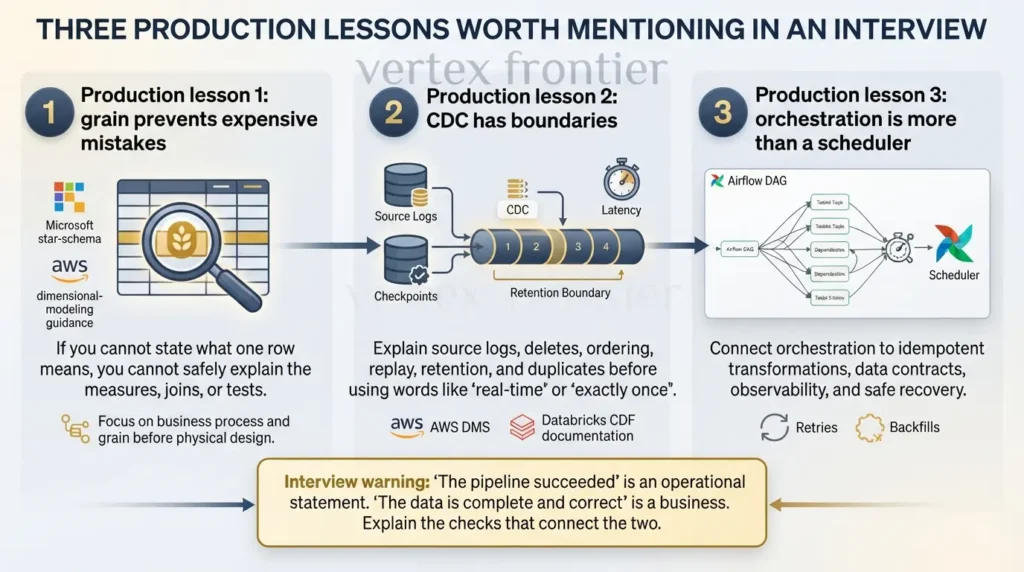
Production lesson 1: grain prevents expensive mistakes
The Microsoft star-schema guidance and the AWS dimensional-modeling material both place business process and grain before physical design. The transferable lesson is simple: if you cannot state what one row means, you cannot safely explain the measures, joins, or tests.
Production lesson 2: CDC has boundaries
AWS DMS CDC guidance documents prerequisites and latency considerations, while Databricks Change Data Feed documentation describes retention-bounded change data. In an interview, explain source logs, checkpoints, deletes, ordering, replay, retention, and duplicates before using words such as “real-time” or “exactly once.”
Production lesson 3: orchestration is more than a scheduler
An Airflow DAG represents tasks and dependencies, but scheduling, logical data intervals, retries, and backfills still need careful semantics. A mature answer connects orchestration to idempotent transformations, data contracts, observability, and safe recovery.
Common mistakes candidates make
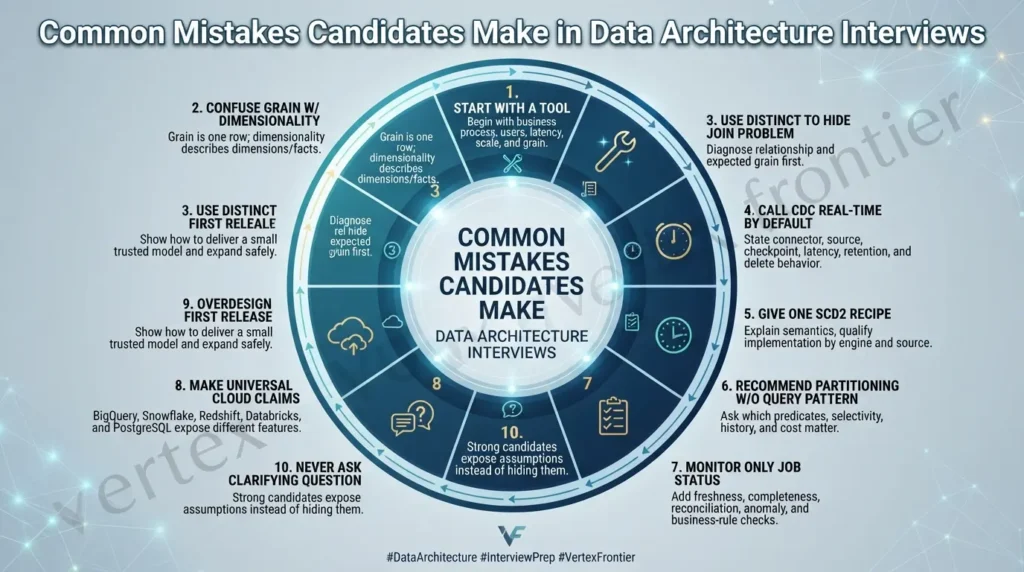
They start with a tool
Begin with the business process, users, latency, scale, and grain.
They confuse grain with dimensionality
Grain is what one row represents; dimensionality describes the number or arrangement of dimensions and facts.
They use DISTINCT to hide a join problem
Diagnose the relationship and expected grain first.
They call CDC real-time by default
State connector, source, checkpoint, latency, retention, and delete behavior.
They give one SCD2 recipe
Explain the semantics, then qualify the implementation by engine and source behavior.
They recommend partitioning without a query pattern
Ask which predicates, selectivity, history range, and cost model matter.
They monitor only job status
Add freshness, completeness, reconciliation, anomaly, and business-rule checks.
They make universal cloud claims
BigQuery, Snowflake, Redshift, Databricks, and PostgreSQL expose different features and semantics.
They overdesign the first release
Show how you would deliver a small trusted model and expand safely.
They never ask a clarifying question
Strong candidates expose assumptions instead of hiding them.
Before-and-after: turning a weak answer into a strong one
Weak answer: “I would use a star schema because it is faster, use ELT because it is modern, and partition the table for performance.”
Stronger answer: “I would first define the business process and grain. For a sales model, I might choose one row per order line and separate payment or shipment events if they have different grains. I would compare a star and a more normalized design against the BI workload. For ETL versus ELT, I would consider raw retention, sensitive fields, latency, target compute, and replay. For physical design, I would inspect the engine and query profile before choosing partitioning, clustering, sorting, or another mechanism. I would validate the result with reconciliation and representative queries.”
The stronger answer is not longer for its own sake. It reveals assumptions, decision criteria, and failure boundaries.
A compact answer framework for senior candidates
Use the GRAIN framework when a design question becomes broad:
- G — Goal: What business decision or user outcome must the data support?
- R — Row meaning: What does one row represent, and at what time?
- A — Assumptions: What are the source, latency, scale, identity, and correctness assumptions?
- I — Integrity: How will you handle duplicates, late data, deletes, retries, and quality?
- N — Navigation: How will users discover, query, govern, and monitor the result?
It is an interview framework, not a vendor methodology. Its purpose is to keep the answer anchored in meaning before tools.
Recommended study path on VertexFrontier
To build end-to-end depth before your interview, follow this curated technical roadmap:
Stage 1: The Core Foundation
Start with our flagship guide to [Data Engineering Interview Questions & Answers] for wide-angle coverage of distributed SQL, system design, and cloud architecture.
Stage 2: Pipeline Mechanics & Ingestion
Dive into [ETL Interview Questions for Data Engineers] to master idempotent pipelines, retry budgets, backfilling strategies, and CDC fundamentals.
Stage 3: Modern Table Layouts & Partitioning
Deepen your storage-layer knowledge by reading our deep dive into [Apache Iceberg partitioning]to understand hidden partitioning and file layout optimizations.
Stage 4: Lakehouse Cross-Engine Boundaries
Benchmark multi-engine patterns by comparing [Apache Iceberg on BigQuery] with [Apache Iceberg with Snowflake] to speak credibly about engine trade-offs.
Stage 5: Real-World Production War Stories
Learn what breaks in production by studying [Postgres CDC in production] and how to resolve [ClickHouse CDC duplicates].
Need to prepare for a specific niche? Browse the full [Interview Questions archive] for focused domain guides.
Does this guide cover senior or architect-level interviews?
The scenario questions are designed to help senior candidates discuss assumptions, trade-offs, failure modes, governance, cost, and operating boundaries. Add a system-design exercise using a realistic business domain for deeper practice.
Should I memorize one SQL answer for every warehouse?
MERGE, isolation, query plans, and physical design can differ across PostgreSQL, BigQuery, Snowflake, Redshift, and Spark SQL.What should I say when I do not know the platform detail?
Final checklist before the interview
- Can you state the grain of every fact you propose?
- Can you explain how a retry avoids duplicate business events?
- Can you distinguish a source update timestamp from an ingestion timestamp?
- Can you describe a reconciliation check beyond row count?
- Can you diagnose a slow query before recommending a physical change?
- Can you explain one SCD choice and its cost?
- Can you state how deletes, late data, and backfills work?
- Can you name the SQL dialect you are using?
- Can you explain what a green pipeline status does not prove?
- Can you ask the interviewer a useful clarifying question?
Conclusion
The strongest answers to data warehouse interview questions are not the ones with the most buzzwords. They are the ones that preserve meaning under pressure: clear grain, explicit assumptions, defensible trade-offs, safe retries, measurable quality, and platform-aware performance reasoning.
Practice each answer in layers. Give the definition. Add the example. Name the failure mode. Then ask which workload and engine the interviewer has in mind. That habit turns a memorized answer into an engineering conversation.
FAQs: Data Warehouse Interview Questions
What are the most important data warehouse interview topics?
Prioritize grain, facts and dimensions, star versus snowflake, SCDs, ETL/ELT, incremental loading, idempotency, CDC, SQL joins and windows, data quality, performance diagnosis, cloud-platform differences, and warehouse design scenarios.
Are these data warehouse interview questions suitable for freshers?
Yes. Start with the core definitions, OLTP versus OLAP, facts, dimensions, grain, schemas, and basic SQL. Then practice one production follow-up for each concept so your answers show more than memorization.
What SQL should a data engineer know for a warehouse interview?
Be comfortable with joins, aggregation, CASE, common table expressions, window functions, latest-row selection, deduplication, date logic, null handling, reconciliation, and query-plan reasoning. Practice with a named dialect when syntax differs.
Is star schema better than snowflake schema?
Neither is universally better. Compare query simplicity, hierarchy reuse, dimension maintenance, BI behavior, governance, and measured performance for the workload and engine.
Is ETL or ELT better?
It depends on where transformations should run, how raw data is retained, whether sensitive fields must be filtered before landing, the target platform, latency, governance, replay needs, and cost. A strong answer explains those criteria.
What is the best way to answer a data warehouse design question?
Clarify the business goals first. Define the process and grain, identify sources and history requirements, choose facts and dimensions, explain ingestion and quality checks, address failure recovery and governance, then discuss physical design and scale.
How should I prepare for cloud data warehouse questions?
Learn the concepts first, then compare the documented behavior of the specific platform named in the interview. Review storage and compute, partitioning or clustering, concurrency, security, cost controls, orchestration, and observability.
Does this guide cover senior or architect-level interviews?
The scenario questions are designed to help senior candidates discuss assumptions, trade-offs, failure modes, governance, cost, and operating boundaries. Add a system-design exercise using a realistic business domain for deeper practice.
Should I memorize one SQL answer for every warehouse?
No. Memorize the analytical idea, then verify the syntax and semantics for the named dialect. Window functions, date handling, MERGE, isolation, query plans, and physical design can differ across PostgreSQL, BigQuery, Snowflake, Redshift, and Spark SQL.
What should I say when I do not know the platform detail?
State the portable principle, identify the missing platform assumption, and explain how you would verify it. For example: “I would inspect the engine’s documented partitioning and query-profile behavior before promising a cost or performance effect.” That is stronger than guessing a vendor-specific feature.

Was this article helpful?




[…] pipeline mechanics to how the warehouse itself is modeled and queried, see our companion guide to 45 Data Warehouse Interview Questions and Answers covering facts, dimensions, SCDs, and grain-safe […]
[…] Related interview preparation: If you are preparing to explain partition pruning, clustering differences, and table layout trade-offs in cloud warehouses, see our dedicated guide to Data Warehouse Interview Questions and Answers. […]
[…] in technical interviews? We cover real-world deduplication and data consistency scenarios in our Data Warehouse Interview Questions […]