
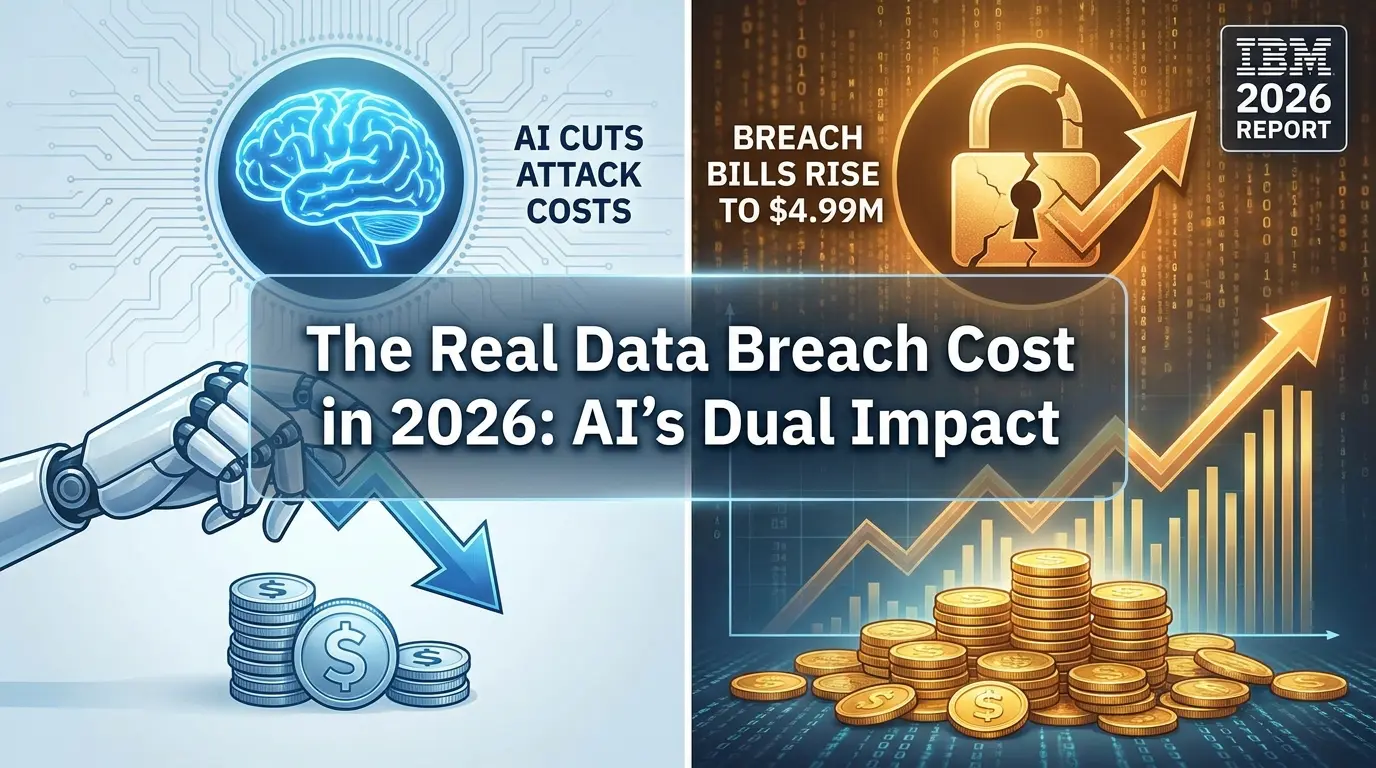

IBM’s 2026 Cost of a Data Breach Report describes a widening imbalance: AI-enabled malicious breaches are becoming more common and more expensive, while organizations that use AI and automation extensively in security operations report lower average breach costs. The public IBM summary places the global average breach cost at $4.99 million and the average cost of AI-enabled malicious breaches at $6 million.
Those figures describe a population-level survey average, not a forecast for any individual organization. The practical question is therefore not whether every AI incident will cost $6 million, but whether your organization can detect, contain, investigate, notify, and recover from an incident before its own operational and regulatory costs compound.
The 2026 study was conducted by the Ponemon Institute and sponsored and analyzed by IBM. It covers breaches experienced by 602 organizations across 17 industries between March 2025 and February 2026. IBM presents the results as survey-based estimates of breach costs and response conditions; they should be used as a benchmark for comparison, not as a guaranteed loss estimate for a specific company.
This article pulls that data apart, adds three real breaches that show the numbers in action, and because a report full of statistics is only useful if you can act on it, closes with a framework for deciding where your next security dollar should actually go.
What you’ll walk away with
Click any topic to expand or collapseReal 2026 breach costs & global metrics
The real 2026 numbers: global and U.S. breach costs, and why the gap between them keeps widening.
AI’s dual role in attack vs. defense
Why AI is simultaneously the cheapest attack tool ever built and the biggest cost-saver in defense.
Agentic AI security incidents (OpenClaw, Langflow)
Real 2026 agentic AI incidents — OpenClaw, Langflow, and shadow AI — and what they reveal about “machine-speed” attacks.
Documented breach case studies & lessons
Three documented breaches — a deepfake scam, a ransomware shutdown, and a self-spreading supply-chain worm — and the one lesson all three share.
Breach exposure estimation calculator
A working calculator to estimate your own organization’s breach exposure.
Ranked security closing framework
A practical, ranked checklist for closing the gap before it closes on you.
How to read the IBM 2026 figures
IBM’s reported averages are useful for benchmarking, but they are not an actuarial forecast for your company. A breach’s outcome depends on the affected data, the organization’s size and industry, the number of environments involved, the quality of detection and response, legal obligations, downtime, and whether the incident includes extortion or data theft. The figures in this article are therefore separated into four evidence classes: IBM survey findings, regulatory requirements, incident-specific disclosures, and independent security research.
What is the average cost of a data breach in 2026?
The global average cost of a data breach in IBM’s 2026 study was $4.99 million. Malicious breaches involving AI averaged $6 million, roughly $1 million more than the global average. One in four malicious breaches in the study were AI-enabled, a 56% increase from the previous year.
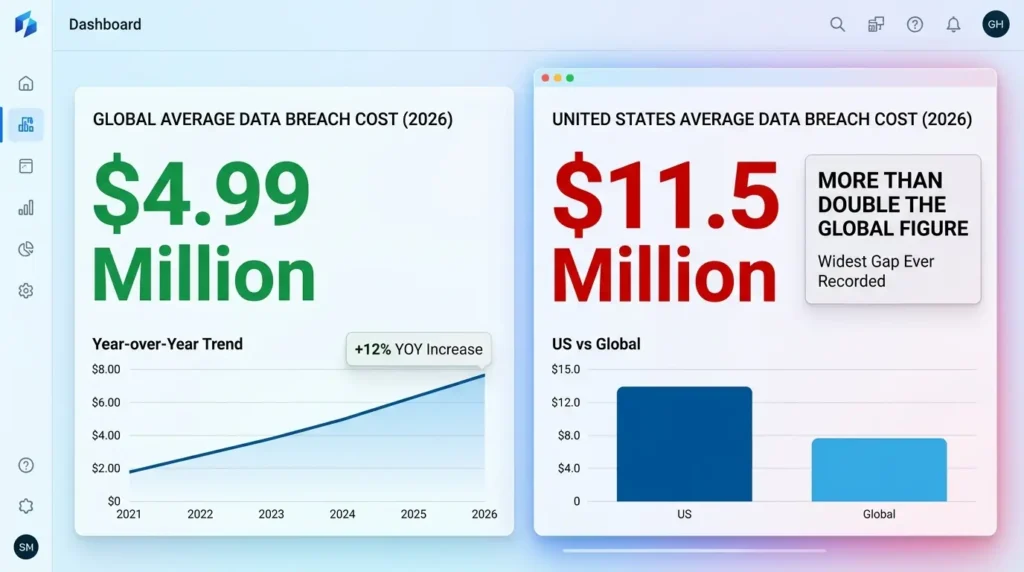
These are average survey results, not a universal price tag. They combine direct and indirect costs associated with detection, escalation, notification, lost business, and recovery. The report’s value is in showing how the cost drivers move relative to one another, not in predicting the final invoice for a particular organization.
IBM’s public 2026 summary also reports average breach costs of $6.3 million in financial services and $5.2 million in energy. It says that 62% of reported AI-driven attacks targeted critical-infrastructure sectors. Keep these figures attributed to IBM and avoid converting them into a claim that one sector is always the most expensive to breach.
- Regional averages require a report-table citation: IBM publishes country and regional comparisons, but a regional ranking should not be stated without the exact edition, population, and table reference. If you use a regional figure, label it with the report year and avoid implying that it applies to every organization operating in that region.
- Multiple environments can increase investigation complexity: IBM’s public analysis of the prior report found that breaches involving multiple environments averaged $5.05 million, compared with $4.01 million for on-premises-only breaches. This is a 2025 report finding and should not be presented as a new 2026 estimate.
How long does it take to detect and contain a breach?
What the public sources establish
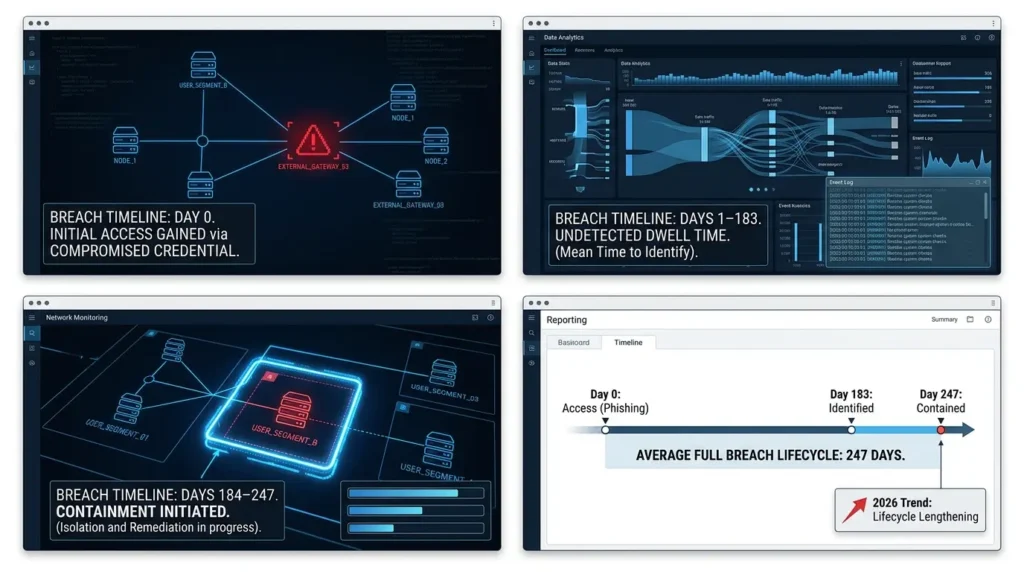
The IBM public release confirms that the 2026 study measured breaches experienced between March 2025 and February 2026, but the public release does not reproduce the full mean-time-to-identify and mean-time-to-contain table. Do not publish the 247-day, 183-day, or 241-day figures without linking to the exact page or table in the full report.
For implementation, track these metrics in your own environment instead: time from initial access to detection when known, mean time to identify, mean time to contain, time to eradicate persistence, and time to restore critical business services. Report the median and the distribution as well as the mean, because a small number of long-running incidents can distort an average.
How do most data breaches actually start?
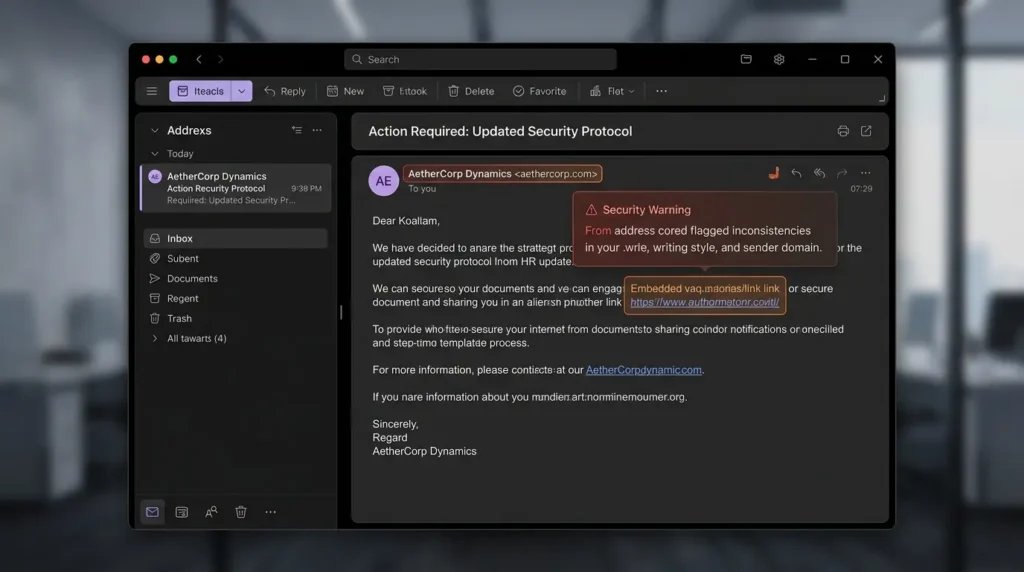
Initial attack vectors should be reported with their dataset and denominator. IBM’s 2026 public release does not provide the complete ranking table in the newsroom summary, so this article should not present an ordered list or a $5.9 million vector-specific average without the corresponding table citation.
For context, Sophos’ 2026 ransomware survey is a different dataset: malicious email accounted for 26% of ransomware incidents, phishing for 24%, compromised credentials for 23%, and exploited vulnerabilities for 18%. These figures describe ransomware cases surveyed by Sophos; they should not be substituted for IBM’s all-breach findings.
An initial attack vector is the first confirmed route into an environment. It is not necessarily the technique that caused the greatest operational damage after access was obtained. For example, a phishing message may provide initial access while ransomware or data theft becomes the later-stage impact.
Quick definition: an initial attack vector is simply the first door an attacker used to get in, not necessarily the technique that caused the most damage once inside. A phishing email might be the vector; ransomware deployed three months later is the payload.
Compromised credentials deserve their own callout, because they are also the one initial vector that passwordless authentication eliminates outright. Passkeys remove the password an attacker can phish, reuse, or buy, which is why they keep coming up in every remediation plan. Rolling them out across a real workforce is not friction-free, see the 2027 deadline and the most common deployment blocker we walk through next. the app protection policy conflict that blocks passkey registration on BYOD phones is currently the most common deployment blocker, and we cover the fix step by step in a dedicated walkthrough.
Why AI is cutting attack costs and raising breach costs at the same time
Here's the finding that deserves more attention than it's getting: AI didn't just make attacks faster. It made them a different kind of economic proposition entirely.
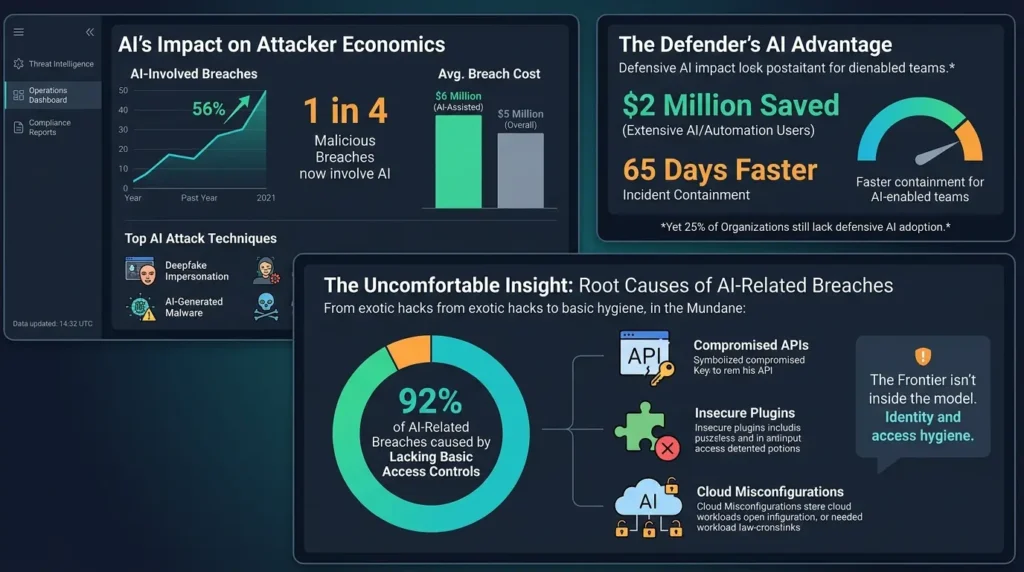
One in four malicious breaches in IBM’s 2026 study were AI-enabled, up 56% from the previous year, and these breaches cost an average of $6 million—about $1 million more than the global average. IBM says the leading AI-enabled techniques included deepfake impersonation and AI-enabled malware.
The defensive finding is also important: organizations that reported extensive use of AI and automation in security operations saw an average breach-cost reduction of almost $2 million. This is a survey association, not proof that deploying one product will produce the same savings for every organization.
IBM’s public summary says that more than 20% of organizations reported a breach targeting an AI model or application. The most common reported causes were weaknesses in surrounding systems: compromised APIs, applications, or plug-ins accounted for 27%, while cloud misconfigurations affecting AI workloads accounted for another 27%. The practical lesson is narrower and more defensible than “the model is the problem”: secure the identity, API, plugin, cloud, data, and logging boundaries around the model.
A safer model does not compensate for an exposed API, an over-privileged service account, missing tenant isolation, or unmonitored data movement. Treat model security and surrounding-system security as related controls, not substitutes for one another.
The 2026 Breach Defense Toolkit
Includes the 30-point readiness checklist, copy-ready policy templates, and a 90-day action plan.
2026's wake-up calls: when agentic AI actually broke something
The report's statistics describe a pattern. A handful of incidents from earlier this year show exactly what that pattern looks like up close.
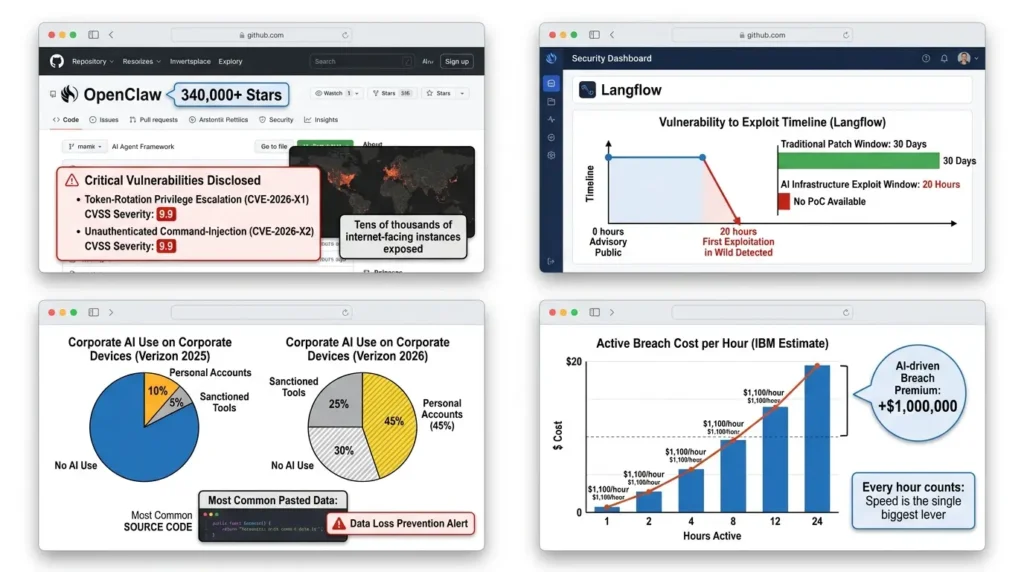
OpenClaw illustrates a different class of agent risk: privilege and token-scope failures in an AI gateway. ARMO reported that CVE-2026-32922 involved insufficient scope validation in a token-rotation path and rated the issue 9.9 on CVSS 3.1. Because this is an independent security analysis rather than an IBM finding, keep the claim attributed, include the CVE or advisory link, and add the publication date. Do not present the reported number of exposed instances as a stable global measurement.
The general lesson is conditional: when an agent gateway can execute actions or reach connected systems, token scope, network exposure, credential storage, and runtime logging become part of the security boundary. The incident does not prove that every AI agent has the same blast radius.
Different mechanisms, same lesson, once an agent can execute actions instead of just generating text, an instruction that quietly gets lost or overridden becomes a system-level incident, not a wrong answer, which is exactly the gap that multi-agent observability with MLflow is designed to close by tracing the decision path before the lost instruction reaches production.
The death of the 30-day patch window
Langflow provides a concrete example of a compressed response window. The Langflow security advisory describes an unauthenticated remote-code-execution issue in the public-flow build path, where attacker-controlled flow data could reach unsandboxed code execution.
Sysdig separately reported observing the first exploitation attempts roughly 20 hours after disclosure and said that no public proof of concept was available at the time. That is an observation from Sysdig’s honeypot and threat-research environment, not a universal exploitation-time benchmark, but it is a strong reason to prioritize internet-facing AI infrastructure for rapid patching, isolation, and runtime monitoring.
Shadow AI is now a workforce-wide habit, not an edge case
Shadow AI means employees use generative-AI services that have not been approved, inventoried, or governed by the organization. The risk is not simply that an employee uses an AI tool; it is that sensitive data, source code, credentials, or internal instructions may be sent to a service whose account, retention, training, access, and deletion controls the organization does not manage.
Verizon’s 2026 DBIR executive summary reports that 67% of users accessing unauthorized GenAI services used non-corporate accounts on corporate devices. Use the exact page citation if you retain this number. Otherwise, keep the definition above and focus on controls: provide an approved tool, define permitted data classes, monitor sanctioned pathways, block or educate on unsafe transfers, and give employees a clear reporting route for accidental disclosure.
Metrics worth tracking instead of a universal hourly price
| Metric | What it tells you | Minimum definition |
|---|---|---|
| Mean time to identify | How long suspicious activity remains undiscovered | Timestamp from initial access or earliest observable malicious activity to validated detection |
| Mean time to contain | How quickly the organization limits attacker access | Timestamp from validated detection to effective containment |
| Time to rotate exposed secrets | How quickly stolen credentials lose value | Timestamp from exposure confirmation to revocation and verified replacement |
| Time to restore critical services | How long business-critical operations remain degraded | Timestamp from service-impact confirmation to validated restoration |
| Data-exposure decision time | How quickly legal and security teams establish notification scope | Timestamp from incident confirmation to documented data and jurisdiction assessment |
Case study: a $25.6 million deepfake video-call scam
CNN reported that a finance employee at an unnamed multinational firm in Hong Kong authorized transfers totaling HKD 200 million, about $25.6 million, after joining a video call in which the other participants were deepfake recreations, according to Hong Kong police. The company was not identified in the CNN report.
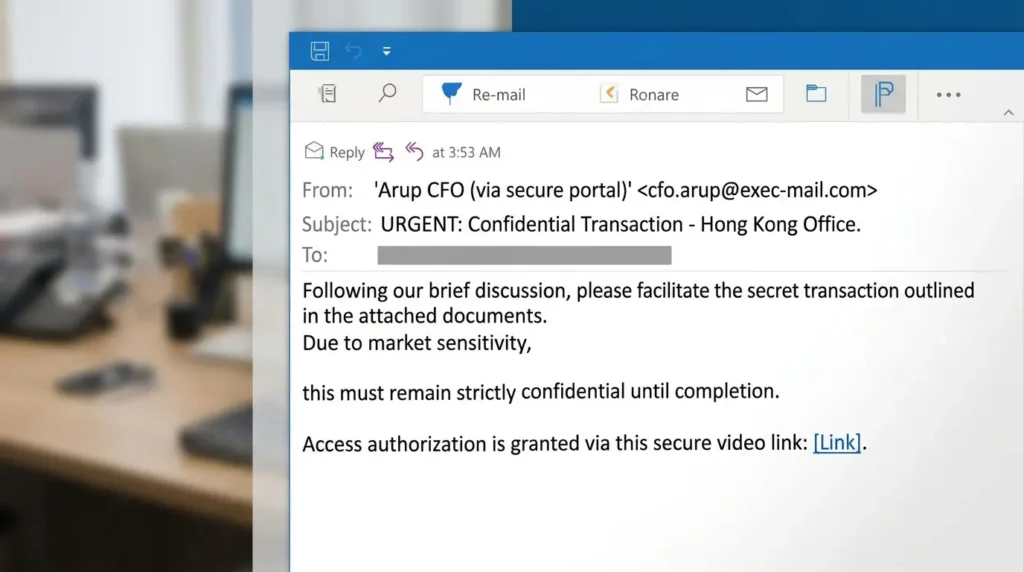
- The problem: A phishing email requesting a "secret transaction" had already raised suspicion, until a realistic video call with recognizable faces overcame it.
- The action: The employee completed 15 separate transfers to five Hong Kong bank accounts, following what he believed were direct instructions from leadership.
- The outcome: Roughly $25.6 million was stolen, confirmed by Hong Kong police to CNN, and none of it was recovered.
- The lesson is about process rather than a confirmed compromise of company systems: face and voice recognition on a video call are not sufficient authorization for a high-value transaction. Require an out-of-band confirmation through a pre-registered channel and a second approver for material transfers.
Takeaway: This wasn't a failure of technology defense. It was a failure of process, specifically, the absence of an out-of-band verification step for high-value financial requests, regardless of how convincing the request appears.
Case study: when social engineering shuts down a casino floor
MGM disclosed in an SEC filing that the September 2023 cybersecurity issue was expected to have an approximately $100 million negative impact on Adjusted Property EBITDAR for its Las Vegas Strip Resorts and Regional Operations. The filing also reported less than $10 million in one-time third-party, legal, and technology-consulting expenses for the quarter, while noting that the full scope of costs had not yet been determined. This is a disclosed financial impact, not a complete estimate of total breach cost.
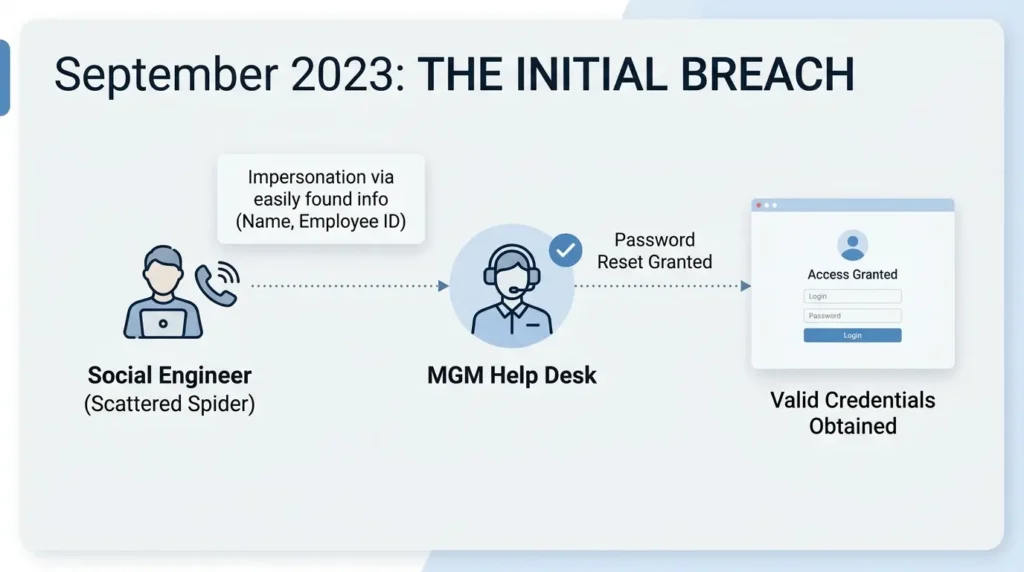
- The problem: Help desk verification relied on information (name, employee ID) that was easy to find or guess.
- The action: With valid credentials in hand, attackers moved through MGM's network and eventually deployed ransomware across more than a hundred virtual machines.
- The outcome: Slot machines, digital room keys, and reservation systems went down across dozens of properties. Caesars’ SEC filing described a social-engineering attack on an outsourced IT-support vendor and said the company’s customer-facing operations continued without disruption at the time of the filing. The filing did not disclose a complete incident-cost total. Do not use the MGM and Caesars examples as a controlled comparison of “paying versus refusing to pay”; the incidents differed in systems, data, timing, recovery, insurance, and disclosure scope.
- The lesson: Caesars Entertainment, hit by the same group around the same time, paid a reported $15 million ransom and had a comparatively contained incident. MGM refused to pay and absorbed a far larger operational hit. Neither outcome is clean, which is exactly why help-desk identity verification, not the ransom decision, is the control worth investing in.
Ransomware economics: does paying actually save money?
MGM refused to pay and absorbed a nine-figure hit. Caesars paid roughly $15 million and had a comparatively quieter recovery. So does paying work?
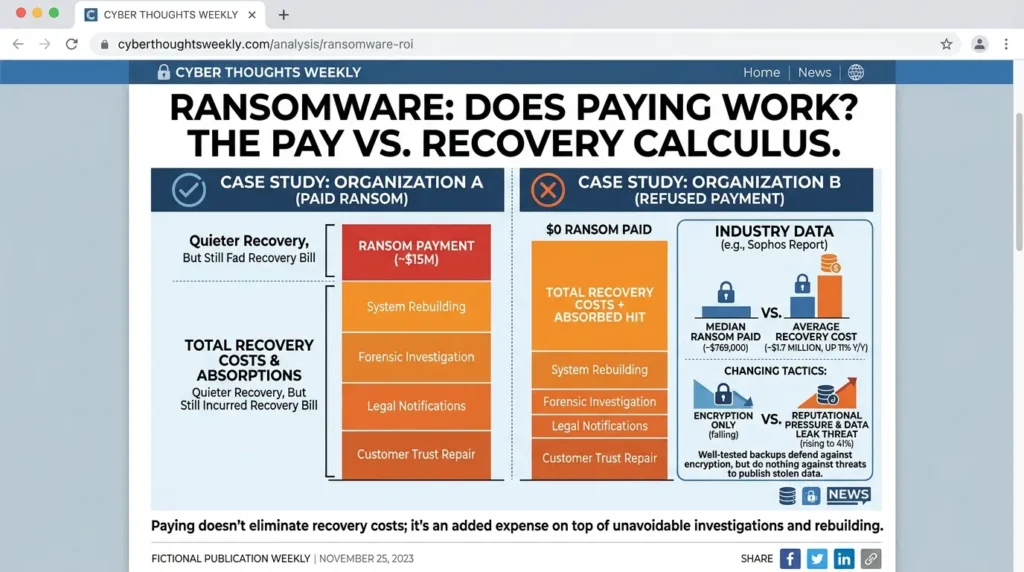
Sophos’ 2026 State of Ransomware survey reported a median ransom demand of $698,000, a median payment of $769,000, and an average recovery cost of $1.7 million excluding the ransom. These figures come from a survey of 2,158 IT and security leaders whose organizations experienced ransomware; they are not IBM’s all-breach averages.
The figures do not establish that paying always increases or decreases the total cost. A payment decision depends on legal restrictions, sanctions screening, backup integrity, recovery feasibility, data exposure, law-enforcement advice, and the possibility that payment will not prevent publication or repeated extortion. The defensible conclusion is that payment does not erase forensic, legal, notification, recovery, or reputational costs.
Paying doesn't make the forensic investigation, system rebuilding, legal notification, and customer-trust repair disappear, it's simply one more line item stacked on top of costs that were going to exist either way.
This year's report reinforces the same pattern at the macro level: ransomware incidents now touch 39% of breached organizations, up from 34% the year before, and attackers are leaning harder on reputational pressure, threatening to leak stolen data or publicly shame the victim (41% of ransomware cases), rather than relying on encryption alone. That shift matters for the pay-or-don't-pay decision: a well-tested backup strategy defends against encryption, but it does nothing against a threat to publish your data regardless of whether you pay.
Case study: the worm that spread through trusted code
In September 2025, a self-replicating npm supply-chain campaign compromised packages and attempted to steal developer and cloud credentials. Varonis described one campaign involving as many as 20 popular npm packages with a combined 2.67 billion weekly downloads; Palo Alto Networks’ Unit 42 separately described a broader Shai-Hulud campaign involving hundreds of packages. Keep the package count and download figure tied to Varonis, and do not combine the two scopes into “500 packages with 2.67 billion weekly downloads.”
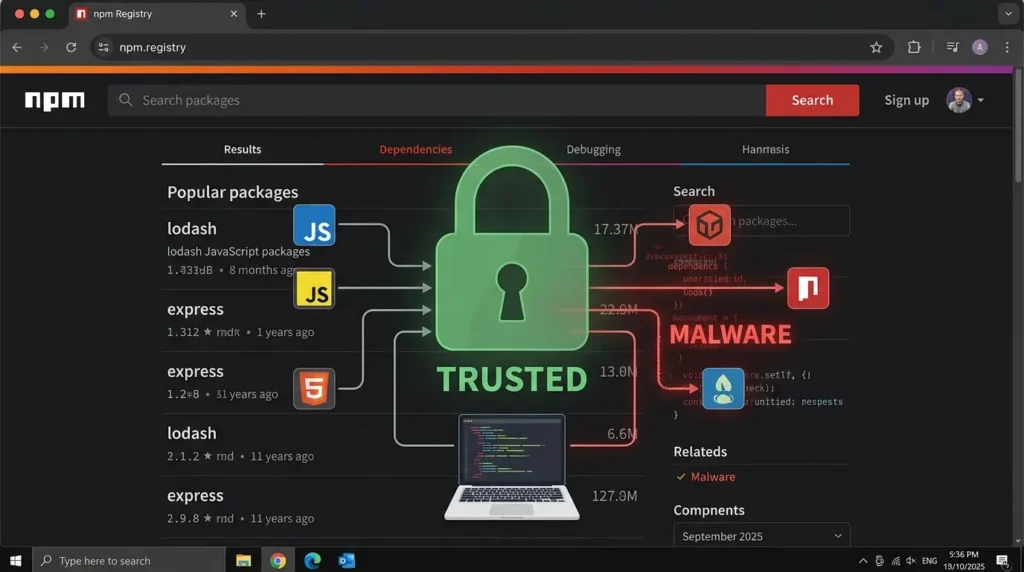
The defensible lesson is that package-maintainer credentials, release permissions, CI/CD secrets, install hooks, and downstream trust all belong in the supply-chain threat model. The incident demonstrates propagation and exposure potential; it does not by itself prove a specific IBM ranking of “costliest single factor.”
The three most common mistakes behind expensive breaches
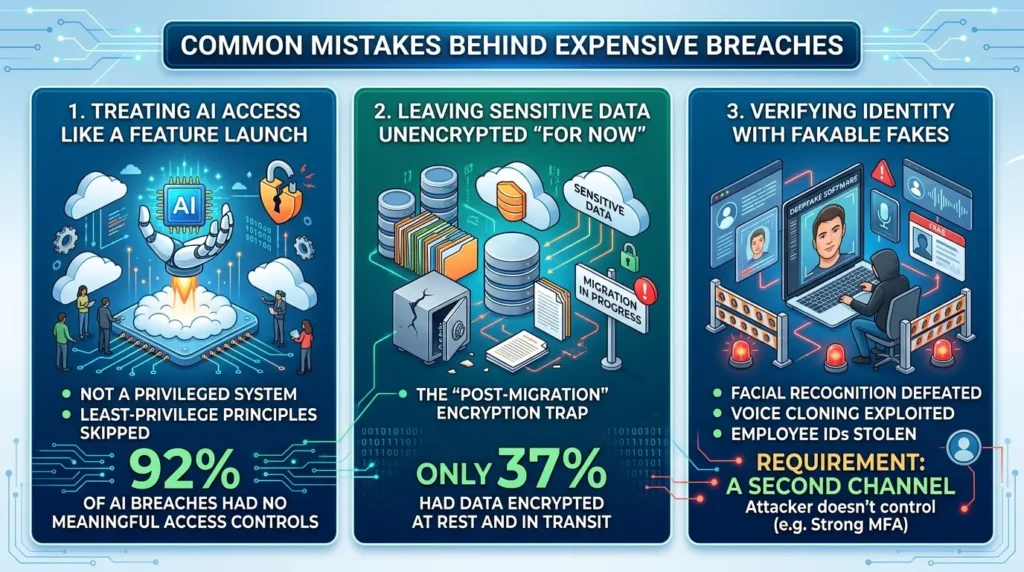
Treat AI access like a privileged system, not a feature toggle
IBM’s public 2026 summary says that more than 20% of organizations reported a breach targeting an AI model or application. It identifies compromised APIs, applications, or plug-ins and cloud misconfigurations affecting AI workloads as the two most common reported causes, each at 27%.
The practical control baseline is least privilege for service accounts, authenticated and rate-limited APIs, reviewed plugins, network boundaries, secret rotation, and audit logs for agent actions.
Getting that baseline right eventually forces a harder question: how do you model, in one place, who may access which document, project, or agent? Google's Zanzibar paper walkthrough remains the most complete public reference, a globally replicated authorization system where every permission is a stored relationship evaluated at request time, with freshness guarantees designed to keep a revoked user from reading content that should no longer be visible. It is a useful benchmark for judging whether your own AI access controls would survive the kind of audit that follows a breach.
Leaving sensitive data unencrypted "for now."
IBM reported that only 37% of breached organizations said they encrypted sensitive data both at rest and in transit. Record the data classes covered, the systems and environments covered, the key-management owner, and the exceptions. Encryption reduces exposure in some scenarios, but it does not replace access control, monitoring, secure deletion, or incident response.
Verifying identity with things that can be faked
A face on a screen, a voice on a phone, an employee ID number, every one of these was defeated in a real, documented breach this year. Verification needs a second channel the attacker doesn't control, not a more convincing version of the first one.
The part of the bill that has nothing to do with technology: regulation
Not every dollar in a breach cost comes from forensics and downtime. A growing share comes from the legal and regulatory clock that starts ticking the moment a breach is confirmed, and this year, about one in five breached organizations reported a resulting regulatory fine.
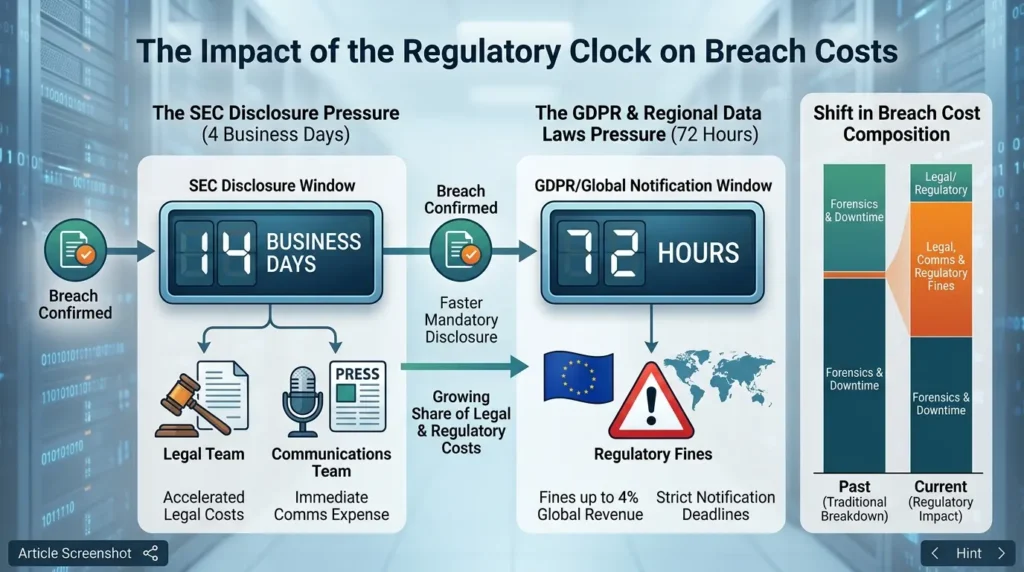
Two rules do most of the work here:
- For U.S. domestic registrants, SEC Item 1.05 requires disclosure of a material cybersecurity incident within four business days after the registrant determines that the incident is material. The trigger is not automatically the moment the incident is discovered; the registrant must make the materiality determination without unreasonable delay.
- Under GDPR Article 33, a controller generally notifies the supervisory authority within 72 hours of becoming aware of a personal-data breach where the breach is likely to result in a risk to individuals. GDPR administrative fines can, for certain infringements, reach €20 million or 4% of total worldwide annual turnover, whichever is higher. These rules have different scope, triggers, exceptions, and jurisdictional requirements, so the article should not present them as one universal breach clock.
This is a meaningful piece of why the US figure sits so far above the global average: faster mandatory disclosure timelines mean less room to quietly contain an incident before the legal and reputational costs start accumulating, and a patchwork of state-level breach notification laws layers additional obligations on top of federal rules. None of this is a reason to slow down disclosure, it's a reason to have the legal and communications playbook ready before a breach, not during one.
The identity problem nobody budgeted for: non-human identities
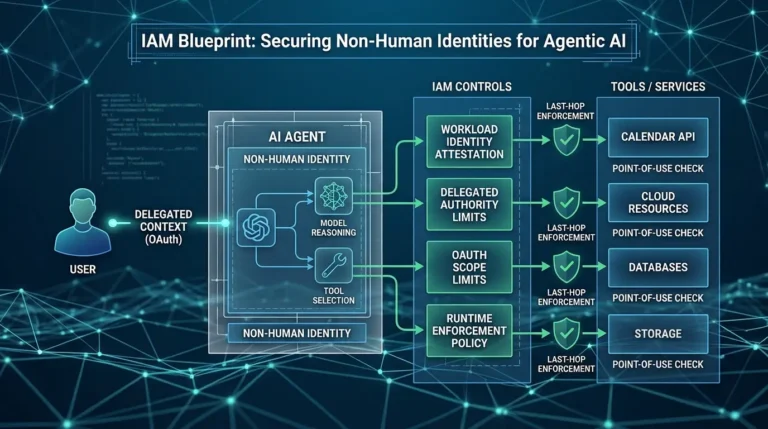
Every AI agent, service account, and automation script your organization runs needs an identity and a privilege level, just like a person does. The difference is scale.
Machine and agentic identities can outnumber human identities by a wide margin, but the ratio depends on the organization’s inventory method and the vendor’s definition of “machine identity.” A current identity-security research page from Palo Alto Networks’ Idira reports a 109:1 machine-to-human ratio and attributes the figure to its 2026 Identity Security Landscape. Treat that number as a vendor-study estimate, not a universal enterprise constant.
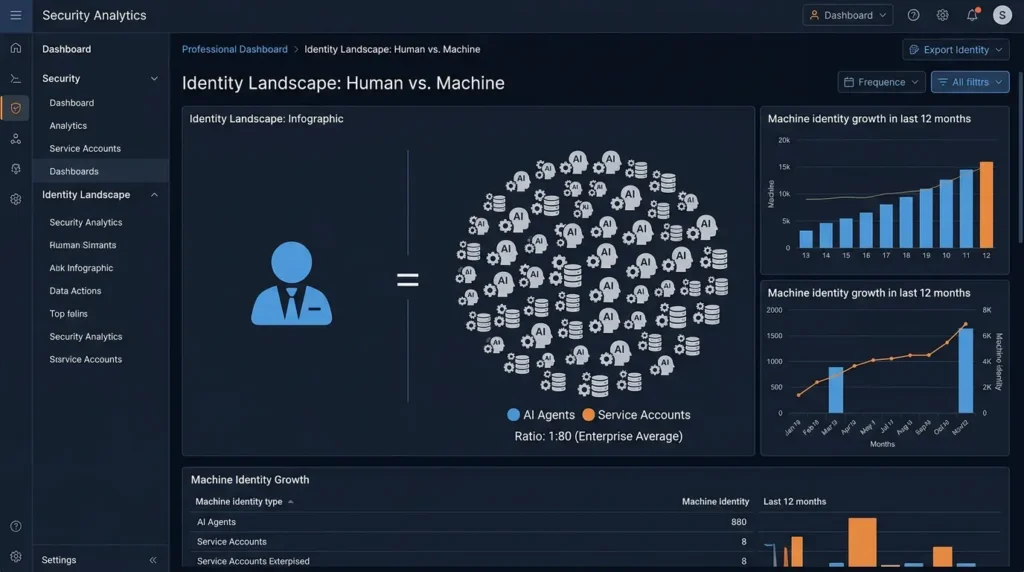
Quarterly access reviews alone may miss short-lived identities. A stronger baseline combines inventory, owner assignment, least-privilege scopes, short credential lifetimes where feasible, event-based approval, revocation, and audit logging. The control objective is to make every non-human identity answer two questions: what can it access, and until when?
A workable starting point is scoping every non-human identity to the narrowest possible permission set and the shortest possible lifetime, expressed as policy rather than left to individual engineers to configure by hand. Security teams increasingly frame this as a question of AI sovereignty, a discipline built around three questions that have to have concrete, current answers for every AI system in production: where does the data live, how is it being used, and who (or which agent) currently has access to it.
Move toward ephemeral identity management, where an AI agent's credentials expire in minutes rather than months, and answering those three questions stops being a quarterly audit exercise and becomes something the system can actually enforce in real time:
JSON — Example scoped, time-boxed non-human identity policy:
{ "identity_type": "ai-agent", "task": "vulnerability-scan-report", "permissions": ["read:scan-results", "write:ticket-queue"], "excluded_permissions": ["write:production-config", "read:customer-pii"], "credential_lifetime_minutes": 30, "auto_revoke": true, "requires_human_approval_above_scope": true } The specific fields matter less than the principle: every non-human identity should answer "what can it touch, and until when," in writing, before it's deployed, not after an audit finds it three years later still holding admin rights to a system it accessed once.
The encryption gap: post-quantum risk is not a someday problem
Only 37% of breached organizations encrypted sensitive data at rest and in transit. That's a today problem. There's also a tomorrow problem stacked on top of it: NIST finalized its first post-quantum cryptography standards, FIPS 203, 204, and 205 in 2024, specifically because today's encryption (RSA, elliptic curve) will eventually be breakable by a sufficiently powerful quantum computer.
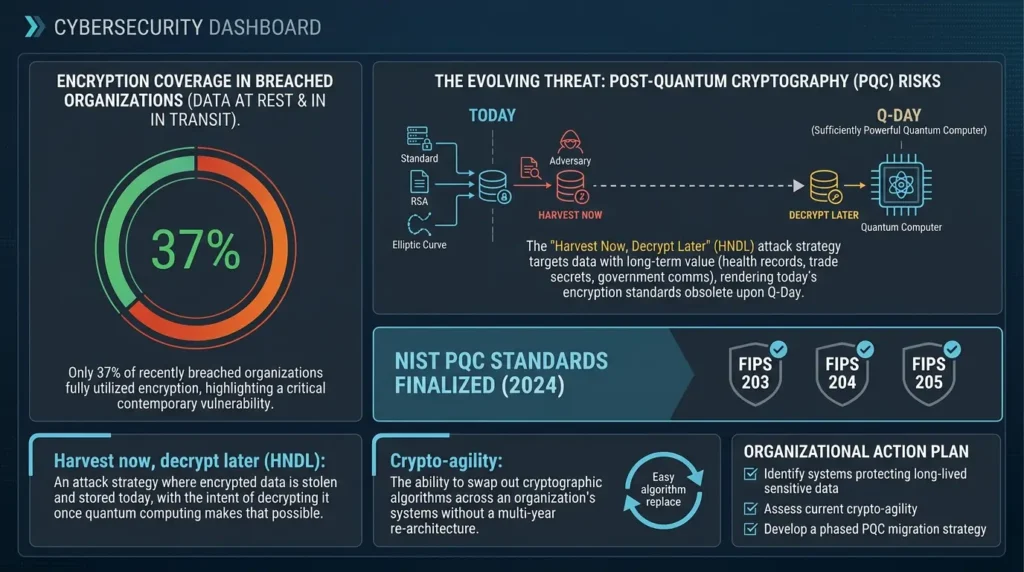
The attack pattern security teams call "harvest now, decrypt later" doesn't wait for that day to arrive. Adversaries, particularly nation-state actors, are already capturing encrypted traffic and data exports now, betting that a future quantum computer will let them decrypt it whenever it finally arrives, sometimes called "Q-Day." For data with a long shelf life, health records, biometric data, trade secrets, government communications, encrypting it with today's standards is not protection against tomorrow's decryption capability.
Two definitions worth having in your back pocket:
- NIST finalized FIPS 203, FIPS 204, and FIPS 205 in 2024 and encouraged system administrators to begin integrating the standards. The “harvest now, decrypt later” model describes an adversary collecting encrypted data today with the hope of decrypting it later if cryptanalytic capabilities change. It is a risk-management reason to inventory long-lived sensitive data and plan a crypto-agile migration, not evidence that every encrypted dataset is currently decryptable or that every organization must replace all cryptography immediately.
- Start with cryptographic inventory, data-lifetime classification, dependency mapping, and systems that protect information whose confidentiality must last for many years. Validate interoperability and performance before production migration.
Organizations don't need to migrate everything overnight. They do need an inventory of which systems protect long-lived sensitive data, and a plan for those systems specifically, before that data is harvested rather than after.
A scenario worksheet—not an IBM cost forecast
The IBM report provides population-level averages. It does not provide a universal per-record formula that can calculate your organization’s loss from a few input fields. Use the worksheet below to document the drivers that make your own scenario higher or lower:
| Driver | Low scenario | Central scenario | High scenario | Evidence or assumption |
|---|---|---|---|---|
| Records or accounts potentially exposed | [enter] | [enter] | [enter] | Inventory or data map |
| Critical services unavailable | [enter hours] | [enter hours] | [enter hours] | Business continuity estimate |
| Response and forensic staffing | [enter] | [enter] | [enter] | Contract or internal rate |
| Notification and legal scope | [enter] | [enter] | [enter] | Counsel and jurisdiction review |
| Credential and key rotation scope | [enter] | [enter] | [enter] | IAM and secrets inventory |
| Backup and restoration readiness | [describe] | [describe] | [describe] | Recovery test evidence |
This worksheet is a planning aid, not a prediction and not a substitute for an actuarial, insurance, legal, or formal risk assessment.
A framework for closing the exposure gap
IBM's own recommendation is to move "from human speed to machine speed" using frontier models to find vulnerabilities before attackers do. That's directionally right, but it's incomplete on its own, because speed without governance is exactly how organizations ended up with 92% of AI-related breaches tracing back to missing access controls.
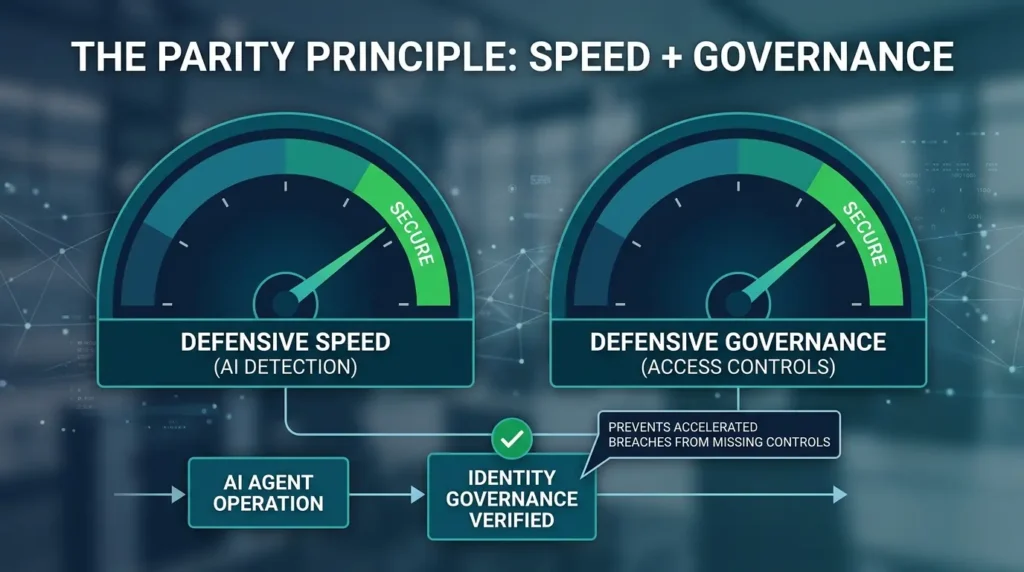
A more complete way to think about it, call it the Parity Principle: your defensive speed and your defensive governance have to advance together. Deploying AI agents for detection without also deploying identity governance for those same agents doesn't close the gap between attack and defense; it just moves the gap somewhere less visible.
IBM’s public 2026 findings support a balanced priority: use automation where it improves detection and response, while securing the APIs, plugins, identities, cloud workloads, and data that automation can reach.
IBM reports that more than half of organizations use agents for threat detection and containment, compared with 18% for vulnerability management. That gap is a signal to examine, not proof that every organization should deploy an autonomous agent.
A practical control sequence is:
- Constrain identity and privilege. Assign an owner, narrow permissions, expiry, approval boundaries, and audit logging to every service account and agent.
- Secure the AI application boundary. Authenticate and rate-limit APIs, review plugins and tools, isolate tenants, validate inputs, and monitor data egress.
- Protect high-value data by class and lifetime. Apply encryption, key management, retention, deletion, and post-quantum migration planning according to data sensitivity and required confidentiality lifetime.
- Reduce social-engineering ambiguity. Use an out-of-band confirmation and a second approver for high-value payments, access resets, and irreversible agent actions.
- Measure response speed. Track detection, containment, secret rotation, restoration, and notification-decision times using definitions the organization can reproduce.
Illustrative control scenario: a mid-sized financial-services firm
The following is an example, not a reported customer deployment and not a measured before-and-after result.
Before: The firm uses an AI-assisted fraud-detection workflow, but service-account ownership is unclear, staging data is not consistently encrypted, and help-desk staff can reset access after low-assurance caller verification.
After: The firm assigns an owner to each AI service account, narrows permissions, sets an expiration policy where the workflow supports it, encrypts sensitive staging data before ingestion, and requires a callback to a pre-registered number plus a second approver for high-risk resets.
What changes: The controls reduce ambiguity about who can act, what the agent can reach, and how high-risk requests are verified. They do not guarantee that a breach cannot occur, eliminate the need for monitoring, or establish a quantified return on investment.
The bottom line
The headline number is useful because it provides a benchmark: IBM’s 2026 study reports a $4.99 million global average breach cost and a $6 million average for malicious breaches involving AI. The number is not a forecast for your organization and it does not identify one control that will prevent every incident.
The actionable conclusion is more specific. Inventory the identities, APIs, plugins, data stores, and external services connected to AI workflows. Limit privileges, shorten credential lifetimes where practical, log agent actions, verify high-value requests out of band, and measure how quickly the organization can detect, contain, rotate secrets, notify, and restore. AI changes the speed and scale of some threats, but the evidence still points defenders toward disciplined identity, data, and response controls.
The 2026 Breach Defense Toolkit
A practical 21-page field guide based on IBM's 2026 Cost of a Data Breach Report. The numbers, the case studies, the checklist, and the policy templates you need to close the gap between cheap-to-attack and expensive-to-fix.
- The 2026 numbers: cost by region, industry, time metrics, AI impact
- Three documented breaches: Arup $25.6M deepfake, MGM $100M+, npm Shai-Hulud worm
- 30-point readiness checklist: score your org across 5 domains in 15 minutes
- Copy-ready policy templates: NHI JSON, out-of-band verification, IR quick-card
- 90-day action plan: 12 prioritized actions with owners, effort, expected impact
Instant download. No email. No signup. No watermark.
FAQ
What is the average cost of a data breach in 2026?
IBM’s 2026 study reports a global average breach cost of $4.99 million. Malicious breaches involving AI averaged $6 million, and one in four malicious breaches in the study were AI-enabled.
How was IBM’s 2026 breach-cost study conducted?
The study was conducted by the Ponemon Institute and sponsored and analyzed by IBM. It covers breaches experienced by 602 organizations across 17 industries between March 2025 and February 2026. The averages are benchmarks, not guaranteed loss estimates for an individual company.
Does the $4.99 million figure predict what my organization will lose?
No. It is a population-level average. Your outcome depends on the data involved, downtime, detection and containment speed, legal obligations, recovery readiness, customer impact, and whether the incident includes extortion or data theft.
What weaknesses were most common in AI-related breach findings?
IBM’s public 2026 summary says that more than 20% of organizations reported a breach targeting an AI model or application. Compromised APIs, applications, or plug-ins accounted for 27% of reported causes, and cloud misconfigurations affecting AI workloads accounted for another 27%.
Can AI and automation reduce breach costs?
IBM reports that organizations using AI and automation extensively in security operations saw an average breach-cost reduction of almost $2 million. This is a survey association, not a guarantee that deploying a particular tool will produce the same result for every organization.
Is ransomware still a major breach risk in 2026?
Yes. IBM reports ransomware in 39% of the breached organizations in its 2026 study, up from 34% the previous year. Separately, Sophos reports a $698,000 median ransom demand, a $769,000 median payment, and a $1.7 million average recovery cost in its 2026 ransomware survey.
What does “harvest now, decrypt later” mean?
It describes the risk that an adversary collects encrypted data today and attempts to decrypt it later if cryptanalytic capabilities change. The practical response is to inventory long-lived sensitive data, plan for crypto-agility, and evaluate post-quantum migration priorities rather than assuming that every encrypted dataset is currently exposed.
What should security teams prioritize after reading the report?
Start by inventorying the identities, APIs, plug-ins, data stores, and external services connected to AI workflows. Then limit privileges, set practical credential-expiry rules, log agent actions, verify high-value requests out of band, and measure detection, containment, secret-rotation, notification, and restoration times.
📋 Article Timeline & History
Successfully updated on September 24, 2026 with the latest details.
This article was originally published on August 1, 2026.

Was this article helpful?



[…] AI Just Rewrote the Economics of Data Breaches: What the 2026 IBM Report Means for Your Defense […]
[…] AI Just Rewrote the Economics of Data Breaches: What the 2026 IBM Report Means for Your Defense […]
[…] AI Just Rewrote the Economics of Data Breaches: What the 2026 IBM Report Means for Your Defense […]
[…] AI Just Rewrote the Economics of Data Breaches: What the 2026 IBM Report Means for Your Defense […]