
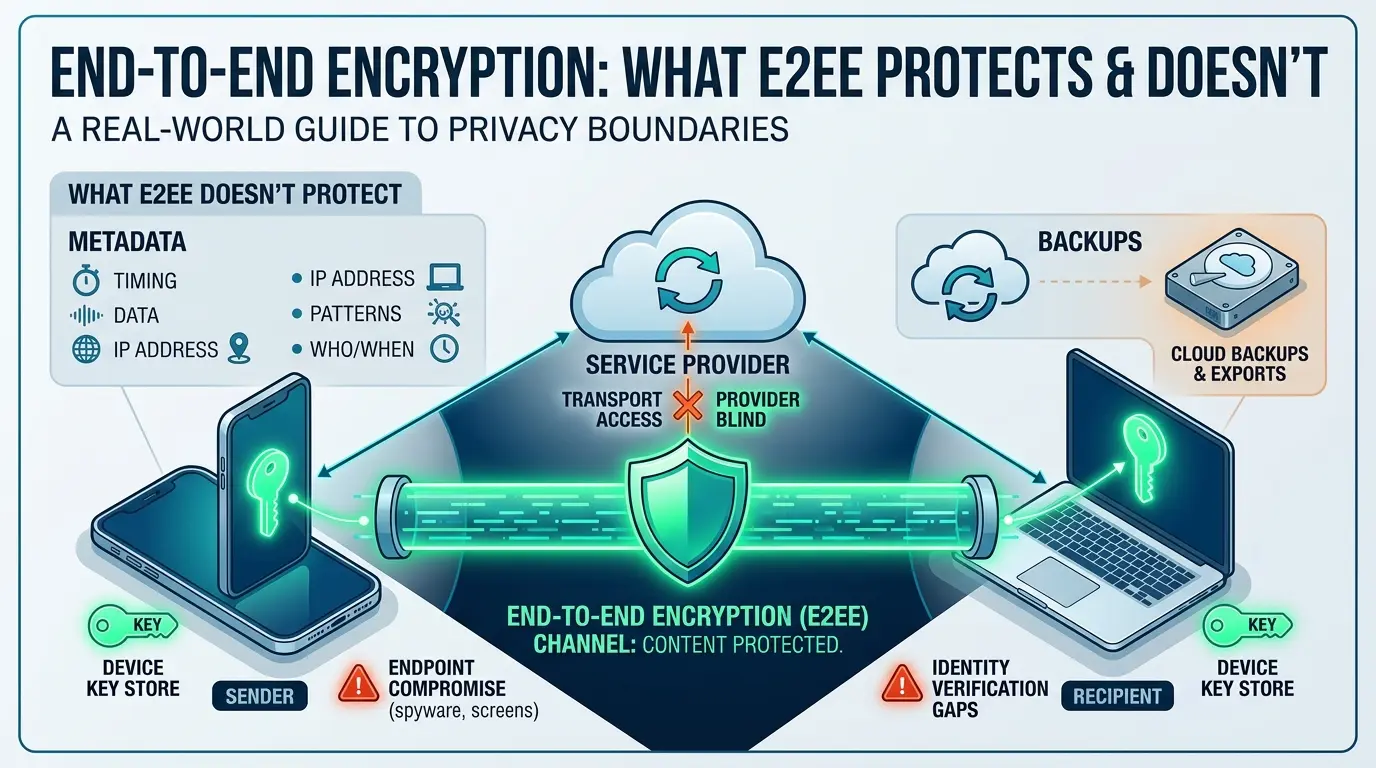

A message can be encrypted all the way to its destination and still expose more than you think.
The provider may be unable to read the text. Your cloud backup may still contain a copy. The recipient may screenshot it. A seized phone may reveal it. A phone-number account may be taken over without anyone breaking the encryption. And the service may still know when two accounts connected, even if it cannot see what they said.
That is the part most explanations leave out.
End-to-end encryption, or E2EE, is not a privacy force field. It is a protection boundary. It is designed to keep the service carrying your data from reading the protected content while that content travels between endpoints. Whether the whole conversation remains private depends on what happens before encryption, after decryption, around the encrypted message, and in every copy created along the way.
This guide explains E2EE without treating the label as a complete security review. You will learn how the cryptography works, how to tell E2EE from ordinary encryption in transit, why metadata matters, what backups change, how real products implement the idea, and how to choose the right protection for a real threat model.
Key Takeaways
Click any topic to expand or collapseE2EE coverage boundaries & unprotected vectors
E2EE protects message content between intended endpoints; it does not automatically protect metadata, cloud backups, screenshots, or compromised physical devices.
Encryption vs. Identity Authentication
Encryption and authentication solve distinct cryptographic problems: payload encryption secures payload content, while identity authentication verifies sender identity on the opposite endpoint.
Out-of-band privacy leak vectors
Critical privacy compromises occur outside the encrypted channel — via unencrypted cloud backups, secondary linked devices, OS notification previews, account recovery flows, and recipient-side data exports.
Post-Quantum, MLS & Protocol capabilities vs. Endpoint Security
Post-quantum cryptography, key transparency logs, Messaging Layer Security (MLS), and cross-platform RCS target structural protocol engineering — none substitute for baseline client endpoint security.
Usability boundaries & per-message encryption state
E2EE relies on adoption usability and state boundaries: secure key recovery mechanisms must remain user-accessible, while every individual payload requires validation against its active protected delivery state.
Security evaluation framework for E2EE products
To rigorously evaluate an E2EE platform, audit its security defaults, private key ownership models, metadata retention policies, backup encryption design, device linking protocols, delivery state indicators, and graceful failure modes.
What does end-to-end encryption mean?
The National Institute of Standards and Technology defines E2EE as communications encryption in which data is encrypted while passing through a network, while routing information remains visible. In practical terms, the sender’s device encrypts the message, the service relays ciphertext, and the recipient’s device decrypts it.
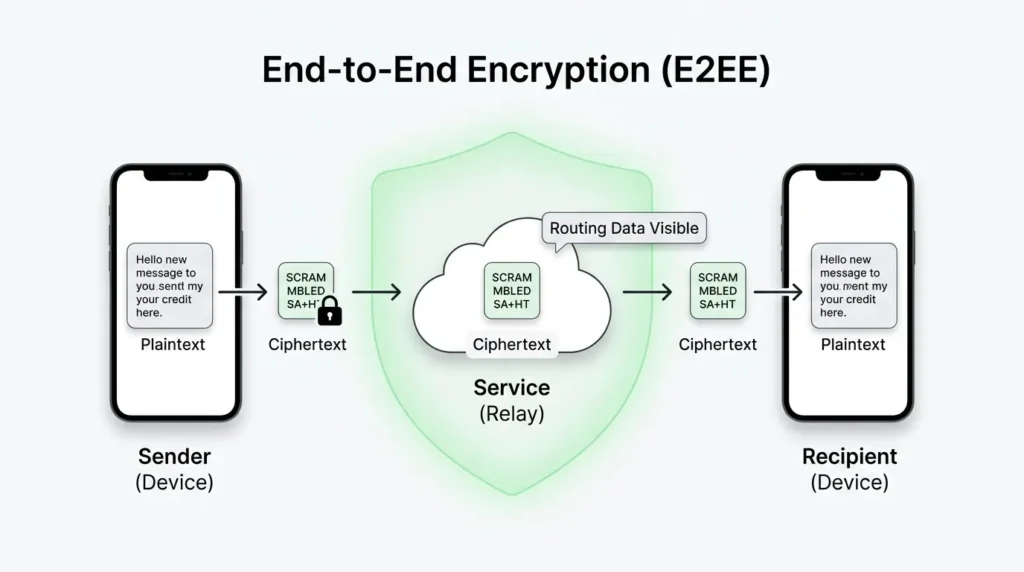
The key phrase is end to end. The protected path runs from one endpoint to another. It does not stop at the company’s server merely because the connection between your phone and that server is encrypted.
A normal encrypted connection, such as TLS, protects a browser session or app connection while it moves between your device and a service. The service usually decrypts the data after it arrives so it can process, index, store, moderate, or forward it. That protection is valuable, but it is not the same as E2EE.
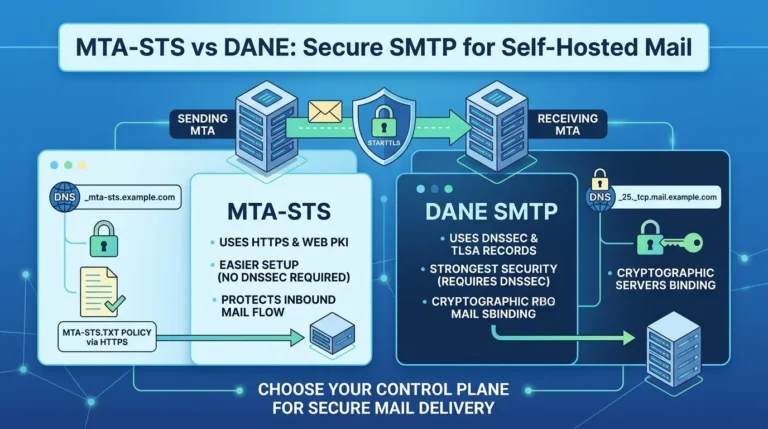
Email transport standards such as MTA-STS and DANE improve authentication and downgrade resistance between mail servers, but they still operate at the transport layer. For a practical comparison of these two SMTP security models, see MTA-STS vs DANE for self-hosted mail.
With E2EE, the service should receive an encrypted payload that it can transport but not understand. The provider may still know that two devices connected, how large a packet was, when it arrived, or which account should receive it. The message body is protected; the surrounding system may not be.
E2EE versus encryption in transit
The difference is easier to see in a simple comparison.
| Protection model | Who can usually decrypt the content? | What the service can do | Typical example |
|---|---|---|---|
| No encryption | Anyone who intercepts the traffic may read it | The provider can read and process everything | Unsecured legacy protocols |
| Encryption in transit | The user and the service | The service can read, store, scan, or forward plaintext | A standard TLS-protected web service |
| End-to-end encryption | The intended endpoints | The service can relay ciphertext but should not read the content | A properly configured E2EE chat or meeting |
| E2EE plus encrypted backup | The endpoints and whoever holds the backup key | The provider should not read the backup either | Signal Secure Backups or enabled WhatsApp E2EE backup |
The last row matters because a conversation can be E2EE in transit and then lose that protection when an app exports it to a cloud account. The Electronic Frontier Foundation’s explanation of encrypted chat backups makes the operational problem clear: a screenshot, local export, or cloud backup creates another copy that may follow different security rules from the original conversation.
E2EE protects a message between endpoints. It does not promise that every copy, system, or person around that message is equally protected.
How does E2EE work?
The cryptography is complicated, but the basic sequence is not.
First, each participant has keys. A public key can be shared. A private key stays on the device or in a protected local key store. The sender uses the recipient’s public information to establish or derive a shared secret. The message is then encrypted with keys derived from that secret.
The service can deliver the ciphertext because it does not need to know the plaintext. The recipient uses their private key material to derive the matching decryption key.
That description is simplified. Modern messengers need to handle people who are offline, messages that arrive out of order, multiple devices, changing phones, new group members, lost keys, and attackers who may compromise a device temporarily. They therefore use protocols rather than one static encryption key.
Private Email Services Compared: What Happens When Your "Zero-Access" Provider Gets a Court Order
Key exchange: agreeing without sending the secret
A key agreement protocol lets two devices create a shared secret without sending that secret across the network in readable form. Diffie-Hellman-style exchanges are a common building block. The participants exchange public values and combine them with private values held locally.
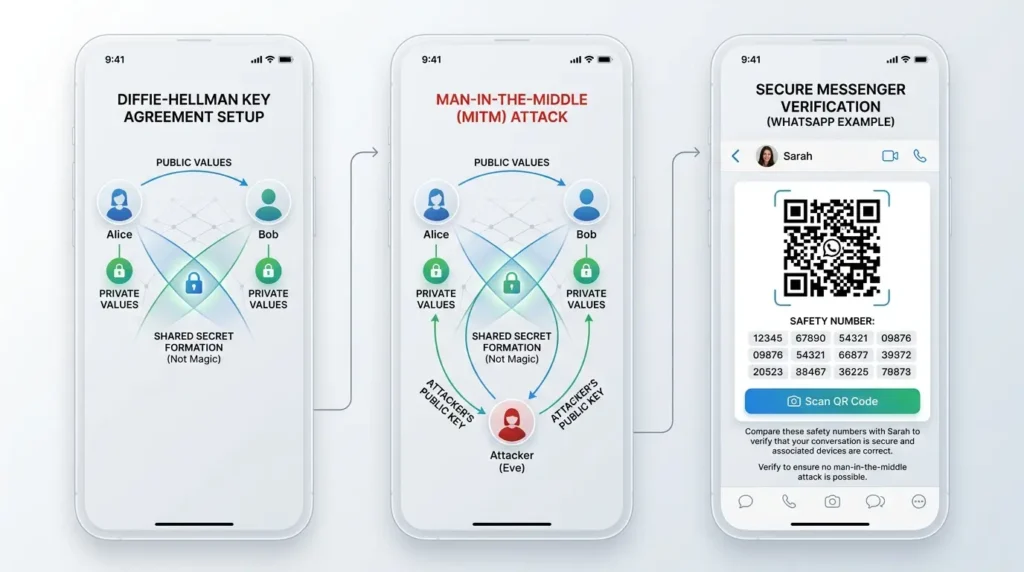
The result is not magic. If an attacker can replace public keys during setup, they may be able to impersonate one participant to the other. That is why secure messengers provide safety numbers, security codes, QR-code comparisons, certificates, or key-transparency systems. These tools help users detect a man-in-the-middle attack or an unexpected device change.
WhatsApp, for example, provides a security code for each personal chat and lets users compare a QR code or a 60-digit number. Its help documentation explains that the code is used to verify that the conversation and associated devices are the ones users expect. Verification is optional, but it matters most when the identity of the contact matters.
The Double Ratchet: why one stolen key should not unlock everything
A static key creates a dangerous failure mode. If an attacker steals it, they may be able to decrypt old messages, future messages, or both.
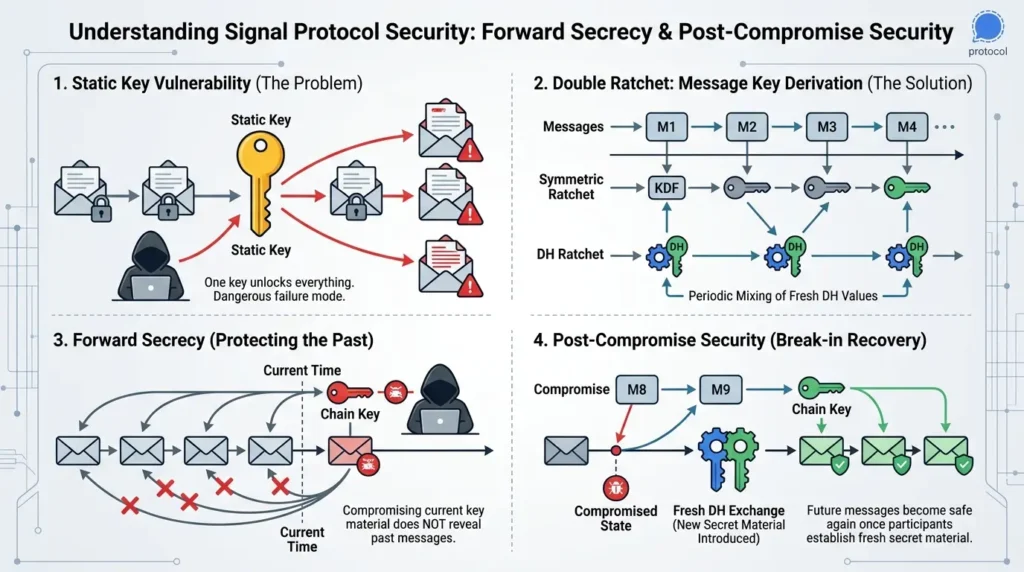
The Signal Protocol’s Double Ratchet design addresses this by deriving a new message key for each message and periodically mixing in new Diffie–Hellman values. The Signal specification describes two relevant properties: past output keys should remain protected if a later chain key is exposed, and future keys can recover after fresh secret material is introduced.
This is the technical foundation behind two ideas often discussed in secure messaging:
- Forward secrecy: compromising current key material should not automatically reveal earlier messages.
- Break-in recovery or post-compromise security: After a temporary compromise, future messages can become safe again once the participants establish fresh secret material.
Neither property protects a message that is already visible on an unlocked phone. They protect the protocol’s key history, not the human endpoint.
Authentication: encryption is not identity
Encryption answers one question: can an unauthorized party read the content?
Authentication answers another: who are you actually talking to?
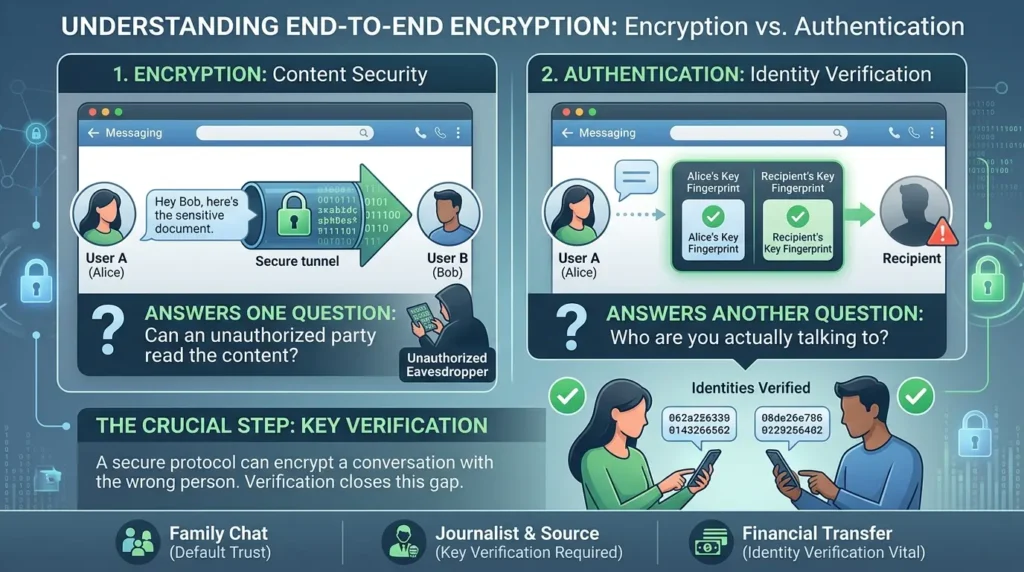
A secure protocol can encrypt a conversation with the wrong person if the user accepts a fraudulent key or connects to an impersonator. That is why a good E2EE system needs a way to verify keys, devices, or identities. The verification step may be inconvenient, but it closes a gap that encryption alone cannot close.
For ordinary family conversations, users may accept the default trust model. For a journalist communicating with a source, a company approving a financial transfer, or an activist communicating under surveillance, key verification is not a decorative feature. It is part of the security decision.
E2EE depends on key exchange, key rotation, and identity verification. “The app uses encryption” is too vague to tell you whether those pieces are present or correctly configured.
The E2EE boundary map: five places privacy can fail
Most E2EE explanations stop at the cryptographic boundary. A more useful model follows the message through its entire life cycle.
Before encryption: the capture problem
The message may be copied before the app encrypts it. A malicious keyboard, screen reader, accessibility service, clipboard monitor, spyware infection, or compromised operating system can see what you type.
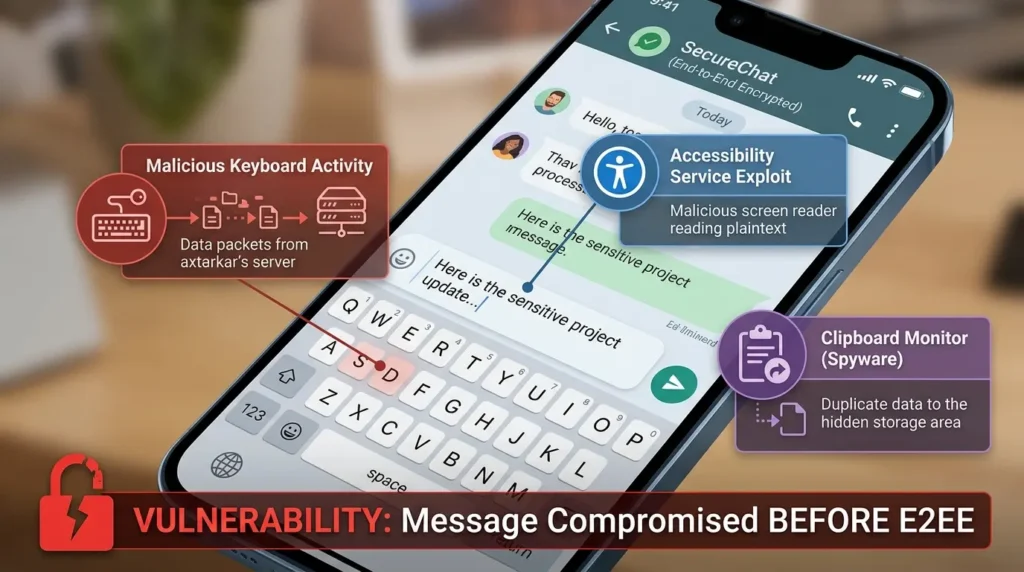
E2EE cannot protect data that never reaches the encryption function safely. If the phone is compromised, the attacker may read the message before encryption or after decryption without attacking the protocol.
During delivery: the metadata problem
The content may be encrypted while the system still exposes useful facts around it. Metadata can include account identifiers, approximate timing, message size, IP address, device information, group membership, delivery status, or patterns of communication.
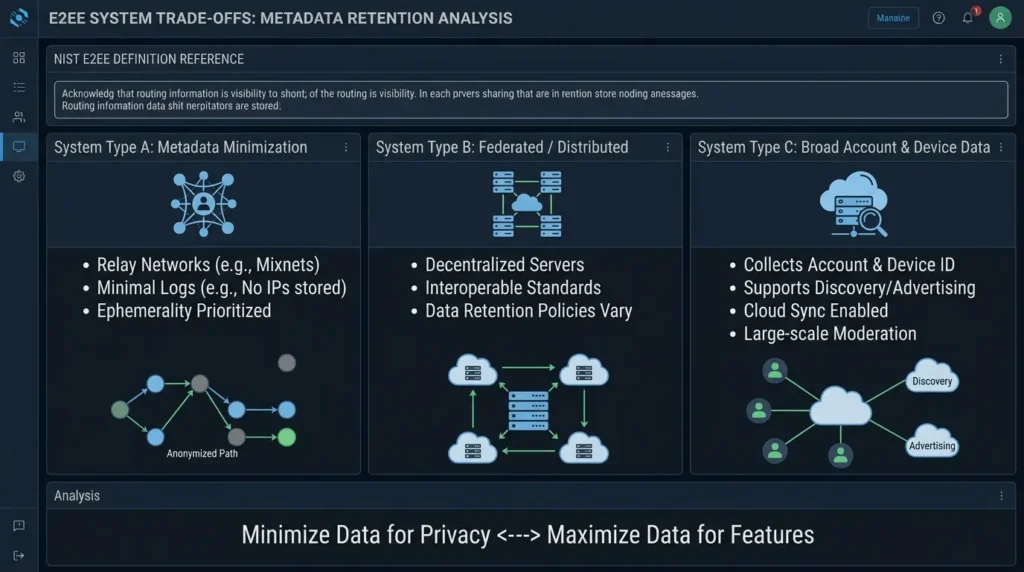
Metadata can reveal relationships. A record showing that two people communicate every morning may be useful even when the messages themselves remain unreadable. NIST’s definition explicitly notes that routing information remains visible in E2EE communications.
Different systems make different trade-offs. Some minimize what their servers retain. Some use relay networks. Some rely on federated servers. Others collect broad account and device data because they support discovery, advertising, cloud synchronization, or large-scale moderation.
After decryption: the endpoint problem
The recipient’s device must decrypt the message somewhere. At that moment, the content is readable to the recipient’s app and operating system. An unlocked phone, malicious app, screen recording, notification preview, screenshot, or forensic extraction can expose it.
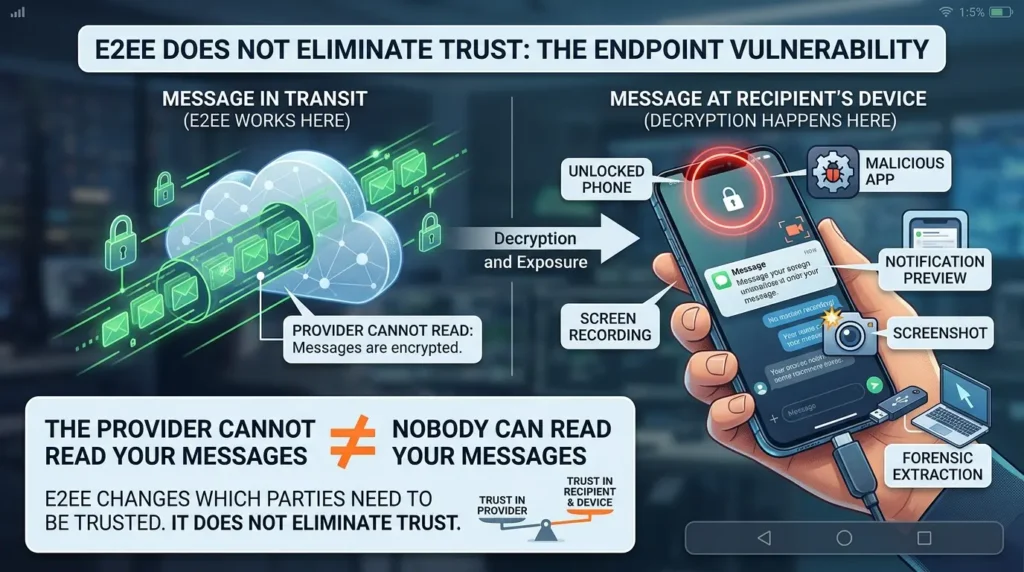
This is why “the provider cannot read your messages” is not the same as “nobody can read your messages.” E2EE changes which parties need to be trusted. It does not eliminate trust.
Copies: the backup problem
Backups are where many privacy designs become inconsistent.
A chat may be E2EE while the backup is protected only by the cloud provider’s account security. A message set to disappear may still exist inside a backup made before deletion. A participant may export the conversation to a desktop, photograph the screen, or copy the text into an email.
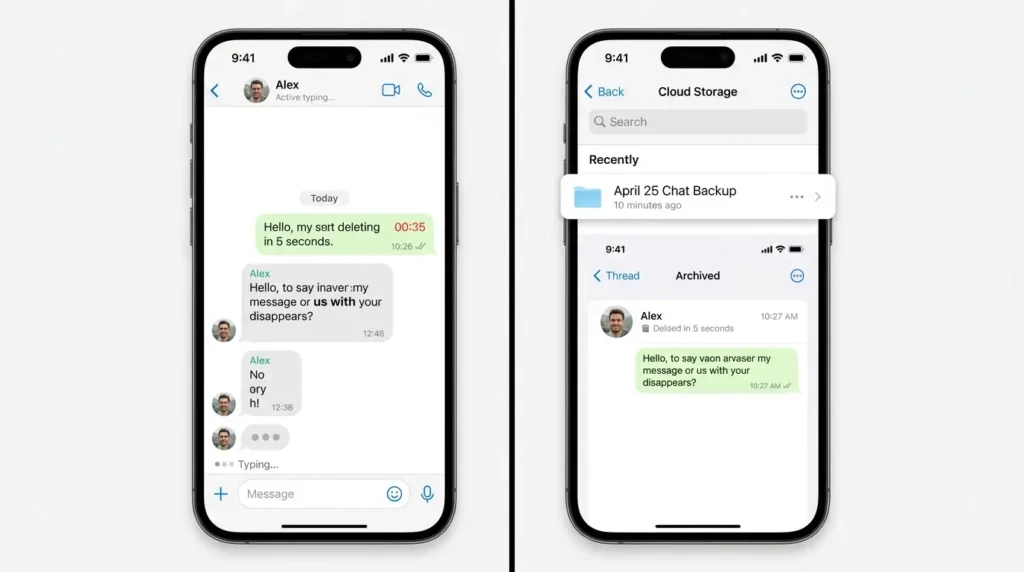
Signal historically avoided cloud chat backups, which reduced exposure but made device migration harder. In 2025, Signal announced opt-in Secure Backups. Its design uses a recovery key generated on the device; Signal says the key is not shared with its servers, and the backup remains E2EE. The feature illustrates an important trade-off: better recovery does not have to mean giving the provider a readable copy, but the user becomes responsible for protecting the recovery key.
WhatsApp took a different route. Its normal chat backups can be stored through iCloud or Google Drive, while its optional E2EE backup feature adds another encryption layer. Meta’s engineering description says that, when E2EE backup is enabled, neither WhatsApp nor the cloud provider should be able to access the backup or its encryption key.
Governance: the policy problem
Even a technically sound protocol operates inside a company, an app store, a jurisdiction, and a product policy. The provider may not be able to read plaintext content, but it may still change defaults, retain metadata, expose account information, cooperate with legal requests, or build a business around surrounding data.
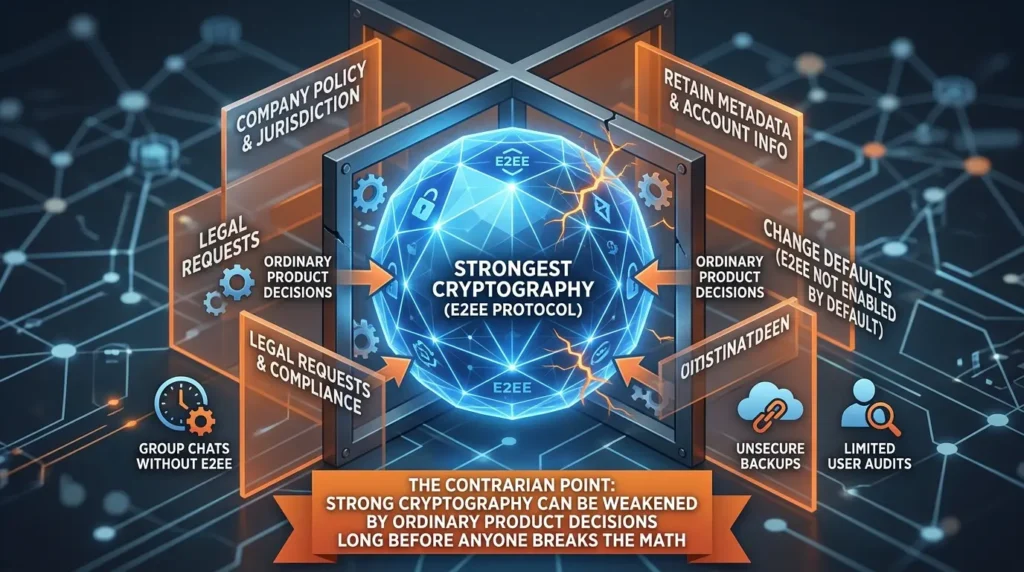
Governance also determines whether E2EE is enabled by default, whether group chats use it, whether backups preserve it, whether new devices are verified, and whether users can audit the implementation.
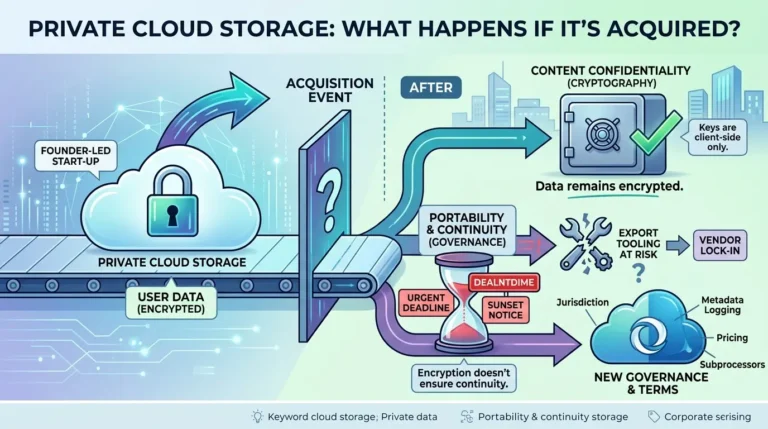
This is the contrarian point: the strongest cryptography can be weakened by ordinary product decisions long before anyone breaks the math. And the most consequential product decision of all is a change in ownership, see what actually happens when a private cloud storage provider gets acquired.
E2EE is strongest when all five layers, capture, metadata, endpoints, copies, and governance, are reviewed together.
Real-world case study: what a Signal subpoena could and could not produce
In March 2026, Signal published details of a federal grand jury subpoena from the District of Columbia. The request covered 37 phone numbers and sought account creation and last-connection information. Signal reported that seven accounts did not exist, 24 had no responsive information for the relevant period, and six produced the requested data.
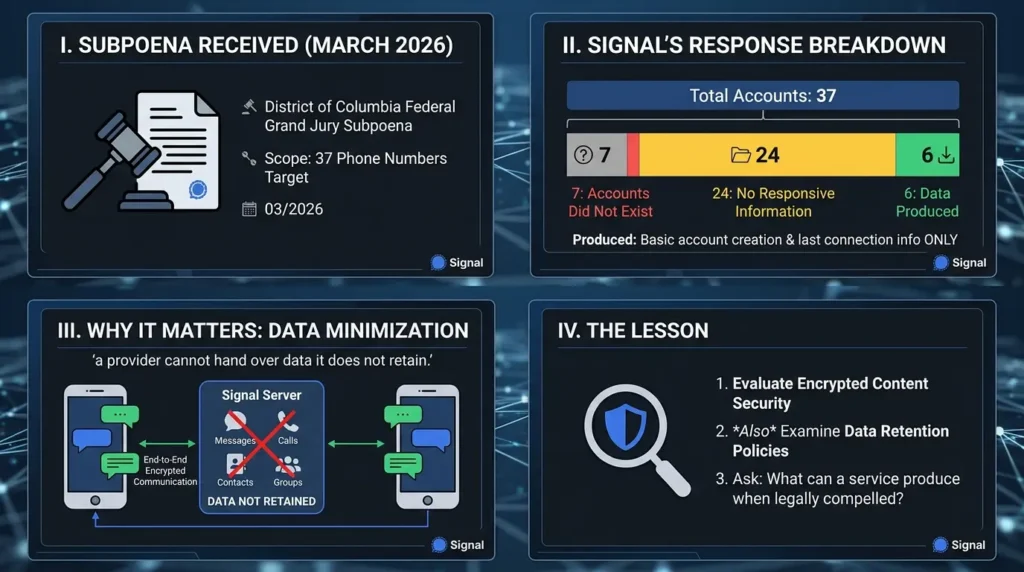
The case does not prove that Signal is invisible. It proves something narrower and more useful: a provider cannot hand over data it does not retain. The result reflects both cryptography and data minimization. Messages, calls, contacts, groups, and other categories were not available to disclose through that request because Signal says they were not held by its service.
That distinction matters. A subpoena to the provider is one threat. A warrant for an unlocked phone is another. A network observer watching timing is another. The same app can perform well against one threat and poorly against another.
Lesson: ask not only whether a service encrypts content, but also what it can produce when legally compelled.
Real-world case study: WhatsApp shows why backups matter
WhatsApp adopted the Signal Protocol for message content and later added optional E2EE backups. The product decision exposed a problem that many users miss: a secure conversation can create a less secure copy when it enters a cloud backup.
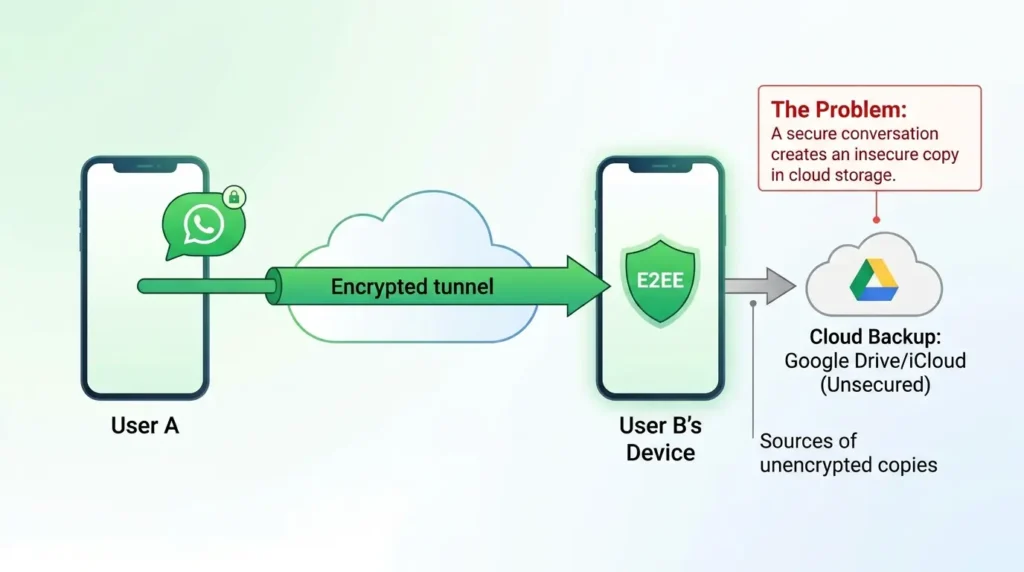
Meta’s engineering documentation describes a design in which a randomly generated backup key is protected either by a user-held password or a 64-digit key. The cloud provider stores encrypted backup data, while the key is designed to remain inaccessible to WhatsApp and the storage provider when E2EE backup is enabled.
The practical outcome is not “WhatsApp backups are unsafe.” The practical outcome is that the setting matters. A user who leaves E2EE backup disabled is making a different security choice from a user who enables it and safely stores the recovery secret.
The EFF also points out a group-chat complication: each participant may control their own backup behavior. One person can preserve a copy of a conversation even if another person uses disappearing messages or never creates backups.
Lesson: E2EE is a property of a specific data path. Check the chat, the backup, the linked device, and the export separately.
Real-world case study: Zoom shows that E2EE can reduce features
E2EE is not free from product trade-offs.
Zoom’s support documentation explains that its E2EE meeting mode derives meeting keys from participants’ machines rather than from Zoom’s servers. It also states that enabling E2EE disables or limits features such as cloud recording, live transcription, polling, streaming, and some AI features.
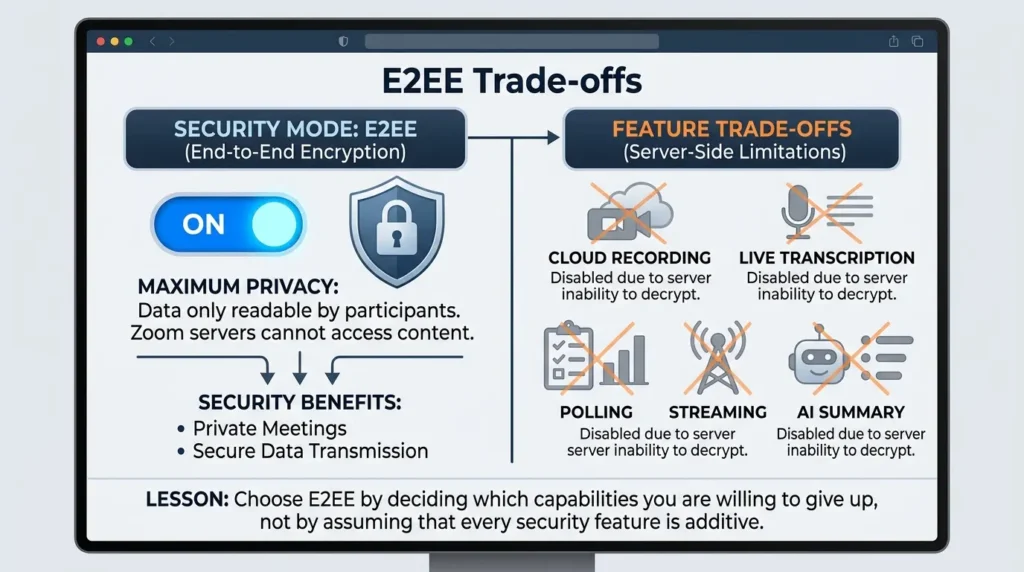
That is not a failure. It is a direct consequence of the design. If Zoom’s servers cannot decrypt the meeting, they cannot provide server-side transcription or cloud recording in the same way.
This case is useful because it corrects a common assumption: the most private mode is not always the mode with the most features. E2EE can reduce the service’s ability to search, moderate, record, summarize, recover, or inspect the content. That loss may be exactly what a high-risk user wants. It may also be unacceptable for a business that needs searchable compliance records.
Lesson: choose E2EE by deciding which capabilities you are willing to give up, not by assuming that every security feature is additive.
How to verify that E2EE is real
A privacy label is not enough. Before trusting an E2EE feature, ask these questions.
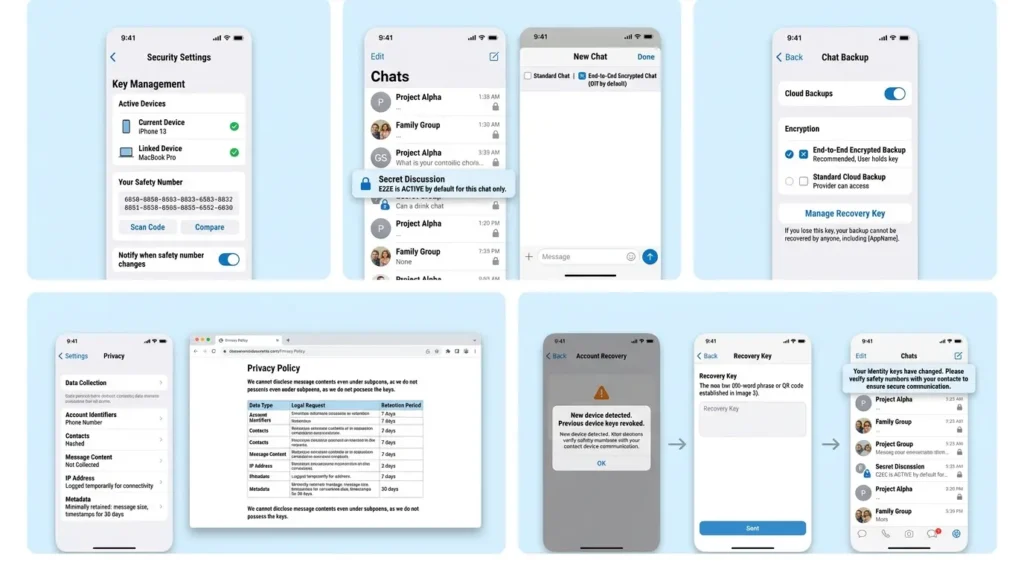
Step 1: Identify the endpoints
- Who holds the decryption keys?
- The sender and recipient?
- Every member of a group?
- A service-controlled key server?
- An administrator?
- A cloud backup provider?
If the provider can generate or recover the content keys without user-held secrets, the system may be encrypted but not fully end-to-end in the way users assume.
Step 2: Check the default
Is E2EE enabled automatically, or must the user start a special chat or turn on a setting? Does the default change for group chats, business accounts, bots, customer support, meetings, or calls?
Telegram’s Secret Chats, for example, are a reminder that “the app supports E2EE” is weaker than “the conversation is E2EE by default.”
Step 3: Inspect the backup path
- Does the app create cloud backups?
- Are they E2EE by default?
- Who holds the recovery key?
- What happens if the user forgets the password?
- Is the backup protected when a participant uses a different device?
Step 4: Verify identity and devices
- Can users compare safety numbers or security codes?
- Are new linked devices visible?
- Does the app warn users when keys change?
- Can an attacker register a second device using only control of a phone number?
Step 5: Read the metadata and retention policy
Find out what the provider collects, how long it keeps it, and what it can disclose. Look for account identifiers, contacts, IP addresses, connection dates, device lists, message size, group membership, and delivery logs.
Step 6: Test the failure mode
- What happens if the phone is lost?
- Is the account re-registered?
- A user forgets the recovery key?
- A participant takes a screenshot?
- The provider receives a subpoena?
- A server is compromised?
A system is easier to trust when its failure modes are documented rather than hidden behind a broad marketing statement.
- Confirm who holds the decryption keys.
- Check whether E2EE is the default for this exact feature.
- Review backups, exports, and linked devices.
- Verify contact identity when the stakes are high.
- Read the metadata and retention policy.
- Decide what happens if the device, number, or recovery secret is compromised.
What community research reveals: E2EE has an adoption boundary and a state boundary
Official specifications explain what a protocol can protect. Community discussions reveal what people do when that protection conflicts with recovery, device migration, work habits, or a confusing interface. Both matter.
A recurring theme in a Signal backup discussion on Reddit was not a complaint about ciphers. It was a complaint about losing a phone, missing years of conversations, and finding an empty desktop history after adding a new device. Other participants took the opposite view: a long-lived archive can turn a private conversation into a recoverable asset that might later be seized, restored, or coerced out of someone.
Neither side is simply “for” or “against” security. They are choosing different failure modes. One group fears irreversible loss. The other fears durable copies. The protocol cannot decide which loss is worse for you.
This produces an often-missed idea: an E2EE system has an adoption boundary. If recovery is too hard, users may leave the app, keep a second unprotected channel, export sensitive material manually, or disable protections they do not understand. Those workarounds can erase more privacy than the original design preserved. The EFF’s backup guidance supports the underlying principle: backups create a separate security path and need their own encryption and recovery decision.
The device is often the real unit of trust
A technically informed Reddit discussion about group E2EE raised a useful correction to the usual “Alice and Bob” story. Even when two people are talking, the cryptographic conversation may involve several endpoints: Alice’s phone, Alice’s laptop, Bob’s phone, Bob’s tablet, and perhaps a browser session.
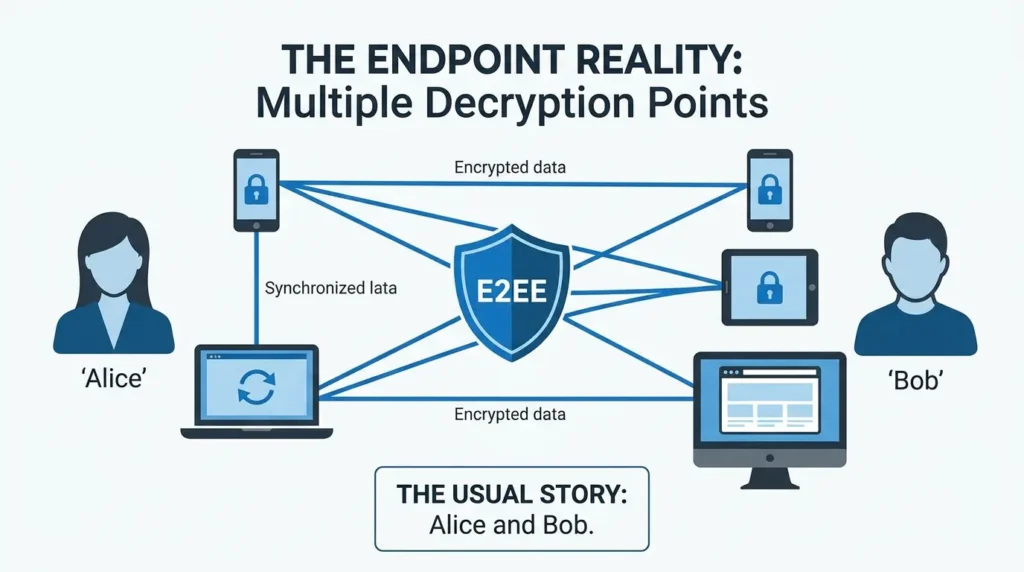
That changes the question from “Do I trust this person?” to “Which of this person’s devices can currently decrypt this conversation?” A single forgotten desktop, a shared tablet, or a linked browser profile can expand the plaintext attack surface without changing the chat’s E2EE label.
A Signal Protocol lecture makes the same conceptual point from the protocol side: key rotation can recover from exposed session state only after new secret material is exchanged. It cannot make plaintext safe on a device that continues to leak it. Post-compromise security repairs key state; it does not disinfect endpoints.
This is why linked-device review should be treated as a recurring operating habit, not a one-time setup step. When a phone is replaced, a laptop is loaned, a browser profile is shared, or an employee leaves, the right question is not merely whether the password changed. It is whether the number of decryption-capable endpoints changed.
Encryption is a live state, not a brand property
A 2026 YouTube walkthrough of the Android–iPhone RCS rollout highlighted a practical failure mode: people may see that RCS is available and assume the entire conversation is protected. But a conversation can change state. It can enter a beta path, require a supported carrier, depend on software versions, or fall back to SMS/MMS when RCS is unavailable.
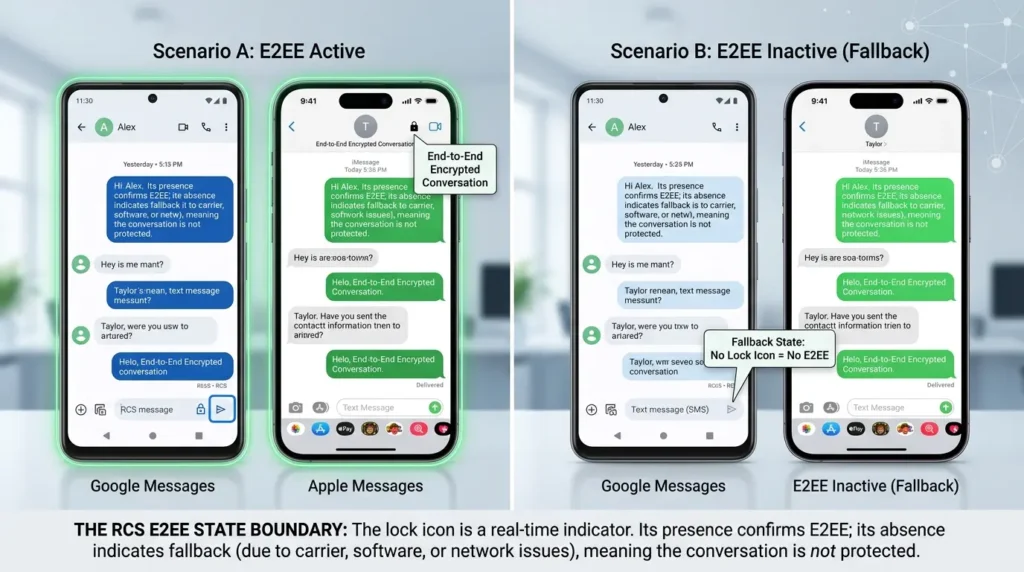
Google’s official RCS rollout notice makes this conditionality explicit: cross-platform E2EE began as a rollout in beta, requires supported devices and carriers, and uses a lock indicator to show an encrypted conversation. The video research adds the user-experience lesson: the lock icon is not decoration. It is a security-state indicator. If it is absent, the reader should not assume the message took the same protected path as the message sent five minutes earlier.
This creates the second original idea: E2EE has a state boundary. A product may support E2EE in principle while a specific message is not E2EE in practice. The state can be altered by fallback, a business integration, a bot, a new linked device, a backup setting, a carrier condition, or an app update.
The operational E2EE check: recovery, devices, and delivery
A practical privacy decision should therefore add three operating questions to the usual protocol checklist:
- Recovery: If the phone disappears tonight, where can this conversation be restored from, and who holds the key?
- Devices: How many phones, desktops, tablets, and browser sessions can decrypt this conversation right now?
- Delivery: Is this exact message using the protected mode now, or has the system fallen back, changed feature state, or crossed into an unencrypted integration?
| Operational boundary | Question to ask | Common failure mode | Useful control |
|---|---|---|---|
| Adoption | Can people use recovery and migration without unsafe workarounds? | Manual exports, second unprotected apps, or abandoned secure channels | An E2EE backup plan with a protected recovery secret |
| Devices | Which endpoints can read the conversation today? | Forgotten browser, shared tablet, old laptop, or unmanaged work device | Regular linked-device review and fast revocation |
| Delivery state | Is this exact message in the E2EE path right now? | SMS fallback, feature downgrade, unsupported carrier, or unencrypted business integration | Check the security indicator and understand fallback behavior |
E2EE can be cryptographically excellent and operationally fragile. The secure system is the one people can recover, use across devices, and verify in its current delivery state without inventing unsafe shortcuts.
The next frontier of E2EE
The basic E2EE model is now familiar: encrypt on one endpoint, decrypt on another, and keep the service in the middle from holding readable content. The next set of problems is less visible. They concern what happens when the attacker records today’s traffic for tomorrow, when a server lies about which public key belongs to an account, when a group grows from five people to five thousand, or when a message leaves a chat app and enters a cloud or email system.
These are not separate versions of the same problem. They are different engineering constraints. Treating them as one large “encryption” category is how product comparisons become misleading.
Post-quantum E2EE and the harvest-now-decrypt-later problem
A future quantum computer is not required to threaten today’s private conversations. An attacker can capture encrypted traffic now, store it, and wait. If a future machine can break the public-key mathematics used to establish the session, the attacker may be able to revisit old recordings. This scenario is usually called harvest now, decrypt later.
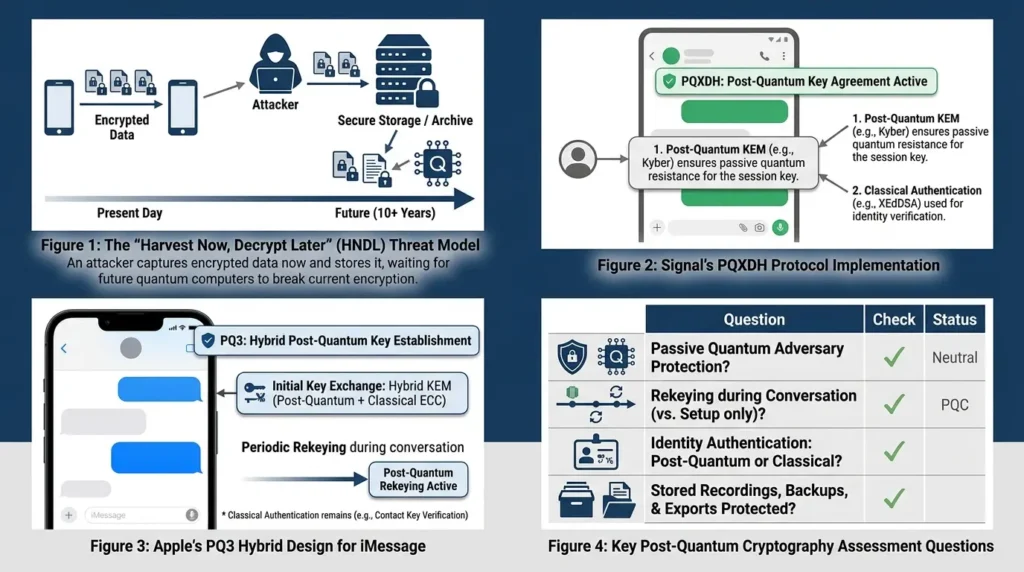
The danger is greatest when the information remains sensitive for years. A disposable conversation and a legal strategy document do not have the same confidentiality lifetime. The cryptography should match the time the data needs to remain private.
Post-quantum cryptography does not replace E2EE. It upgrades particular pieces of the E2EE protocol. A design may protect the initial key exchange against a passive quantum attacker while still using classical cryptography for identity authentication. It may also use post-quantum keys only at setup or repeatedly during a conversation.
Signal’s PQXDH specification describes a post-quantum key agreement designed for asynchronous messaging. It provides post-quantum forward secrecy for the key-establishment portion while still relying on a classical discrete-log assumption for mutual authentication in the referenced revision. That is a meaningful upgrade, but not a reason to describe every layer as quantum-proof.
Apple’s PQ3 explanation describes a different design choice for iMessage: a hybrid of classical elliptic-curve cryptography and post-quantum key encapsulation, with post-quantum material used both at initial establishment and during periodic rekeying. Apple also acknowledges that its authentication and Contact Key Verification mechanisms remain classical in important respects. The distinction is worth preserving.
The useful question is not “Does this app have post-quantum encryption?” Ask instead:
- Is the initial key exchange protected against a passive quantum adversary?
- Are new keys introduced during the conversation, or only once at setup?
- Is identity authentication also post-quantum, or still classical?
- Does the implementation protect stored recordings, backups, and exports as well?
Advanced insight: post-quantum readiness is a protocol coverage map, not a marketing badge. Two products can both advertise “quantum-resistant E2EE” while protecting different points in the message lifecycle.
Client-side scanning: the message can be inspected before encryption
Client-side scanning changes the location of inspection rather than breaking the cipher. The app or operating system examines a photo, text, link, or attachment on the user’s device before the E2EE layer turns it into ciphertext. If the content matches a rule, hash database, classifier, or legal category, the device can report or block it before the message is encrypted.
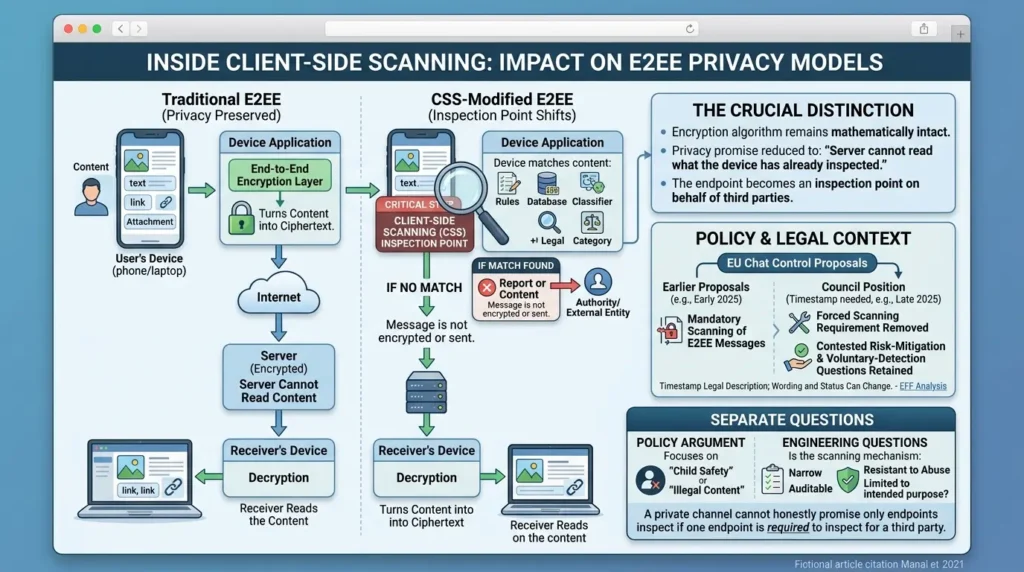
That distinction matters. The encryption algorithm may remain mathematically intact while the privacy promise is reduced to “the server cannot read what the device has already inspected.” The endpoint becomes an inspection point.
The policy debate is not theoretical. The Electronic Frontier Foundation’s analysis of the EU Chat Control process describes earlier proposals that would have required scanning, while also noting that the Council position discussed in late 2025 removed a forced requirement to scan E2EE messages but retained contested risk-mitigation and voluntary-detection questions. The status and wording of these measures can change, so an article should timestamp its legal description instead of presenting “Chat Control” as one fixed law.
The technical objection is simple: a private channel cannot honestly promise that only the endpoints can inspect the content if one endpoint is required to inspect every message on behalf of a third party. The policy argument may focus on child safety or illegal content. The engineering question is whether the scanning mechanism is narrow, auditable, resistant to abuse, and limited to the intended purpose. Those are separate questions.
Advanced insight: the most important E2EE boundary may be the moment immediately before encryption. If the device is turned into a mandatory sensor, keeping the server blind does not preserve the original privacy model.
Key transparency: reducing the need to trust a key directory
E2EE needs a way to learn which public key belongs to an account. That creates a subtle server-trust problem. A dishonest or compromised key directory could show Alice one public key for Bob and show Bob a different key for Alice. Each conversation could still be encrypted, but the users would be encrypted to different parties.
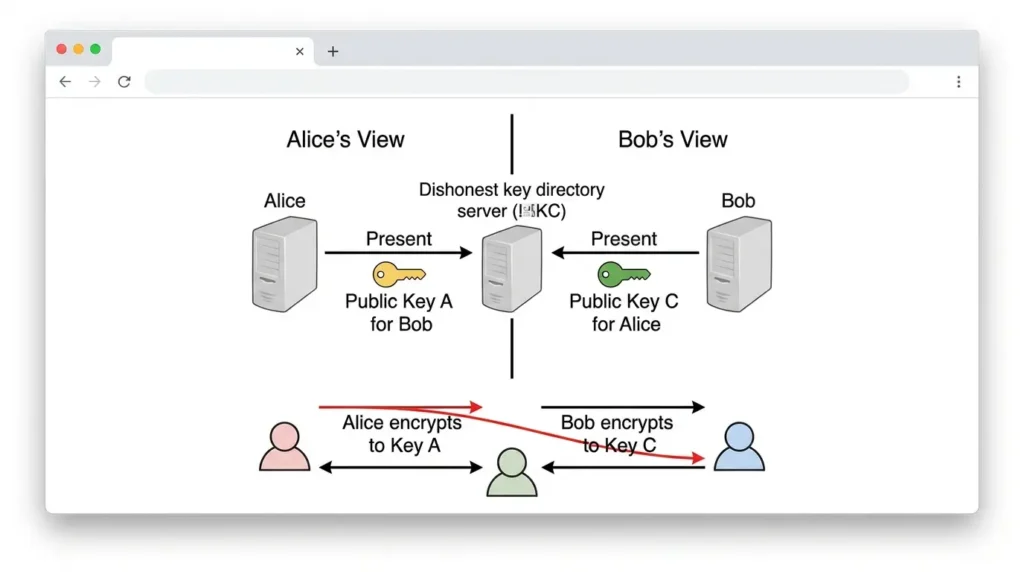
Manual safety-number or QR-code comparison helps, but it asks users to perform a security ceremony repeatedly. Key transparency automates part of that work by placing account-to-key changes in an auditable structure. Devices can check that the key they received is included in a consistent, verifiable log rather than accepting the directory’s answer without evidence.
Apple’s Contact Key Verification design describes a verifiable log-backed map and consistency proofs that help devices detect manipulated key-directory views. The same article notes that WhatsApp deployed an Auditable Key Directory using related ideas. This does not make the key directory unnecessary. It changes the trust model from “the directory is honest” to “the directory must provide evidence that its answers fit a history that can be audited.”
Key transparency also has limits. It does not prove that the user’s phone is clean. It does not tell you whether the person controlling an account is the person you expected. It does not prevent a legitimate account owner from adding a device. It is a defense against silent key substitution and split views, not a complete identity system.
Advanced insight: key transparency is the bridge between strong cryptography and normal human behavior. It tries to make the secure path the easy path without pretending that the server has disappeared.
MLS and the group-encryption scalability problem
The Double Ratchet is a useful way to explain one-to-one messaging, but groups introduce a different problem. A group has membership changes, concurrent sends, offline participants, device additions, removals, and a shared state that must remain consistent across many endpoints.
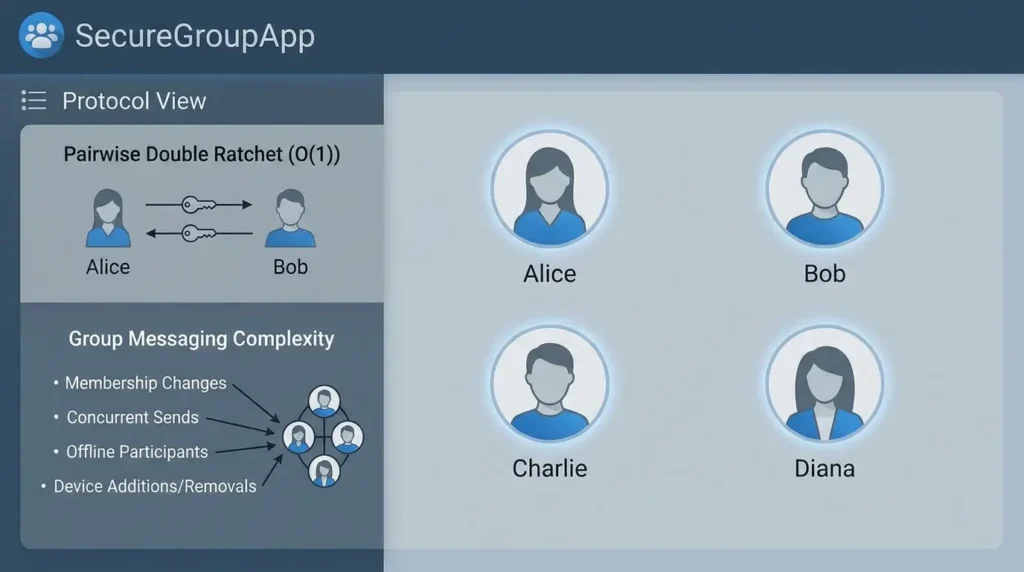
If every membership change requires a large number of separate pairwise updates, the communication and computation cost can grow quickly. The group may still be secure, but the system becomes difficult to operate at scale.
The IETF’s Messaging Layer Security standard, RFC 9420 , addresses this category of problem. Its abstract describes asynchronous group key establishment with forward secrecy and post-compromise security for groups ranging from two participants to thousands. MLS uses a tree-based group-state model so that a membership change does not require every participant to exchange a new secret with every other participant.
MLS is not a guarantee that every group-chat product is safe. Implementations still need secure identity binding, authentication, delivery infrastructure, device management, and careful handling of removed members. A protocol standard can reduce one scalability bottleneck while leaving endpoint compromise or metadata exposure untouched.
Advanced insight: group E2EE is not just “one-to-one E2EE multiplied by the number of people.” It is a state-management problem. The hard part is keeping membership, key updates, and recovery correct while people are offline and devices keep changing.
RCS, SMS, and the Android–iPhone transition
SMS is not end-to-end encrypted. It was designed for carrier delivery, not for sender-to-recipient confidentiality. RCS adds richer messaging features, but the presence of an RCS label does not by itself prove that a conversation is E2EE.
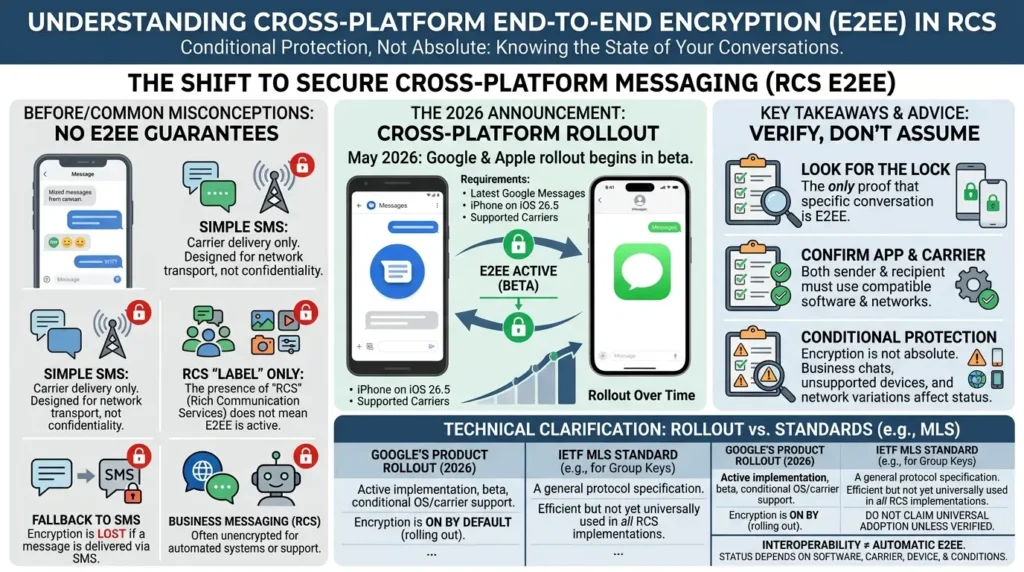
That distinction became especially confusing when Android and iPhone users exchanged messages through different platform ecosystems. Google Messages supported E2EE for certain Android-to-Android conversations, while cross-platform RCS had a different history and set of conditions.
That situation is changing. Google’s May 2026 announcement says Google and Apple began rolling out cross-platform E2EE for RCS in beta for iPhone users on iOS 26.5 with supported carriers and Android users on the latest Google Messages. Google says encryption is on by default and will roll out over time.
The correct reader advice is conditional, not absolute. Look for the lock indicator, confirm the app and carrier support the feature, and do not assume that every RCS message, including business, fallback, or unsupported-device traffic, has the same protection. A message that falls back to SMS is not E2EE.
The arrival of cross-platform E2EE also creates a standards question. Google’s 2026 announcement establishes the product rollout, while the IETF MLS standard describes a general protocol for efficient group key establishment. Do not claim that every RCS implementation is already using MLS unless the implementation documentation says so. The important point for readers is that interoperability and E2EE are no longer automatically opposing goals, but the exact feature state still depends on software, carrier, device, and rollout conditions.
E2EE outside chat: cloud storage and email
E2EE is not limited to messages. It can protect files, backups, calendars, and email, but the design becomes harder to explain because cloud services must often support search, sharing, recovery, previews, synchronization, and collaboration.
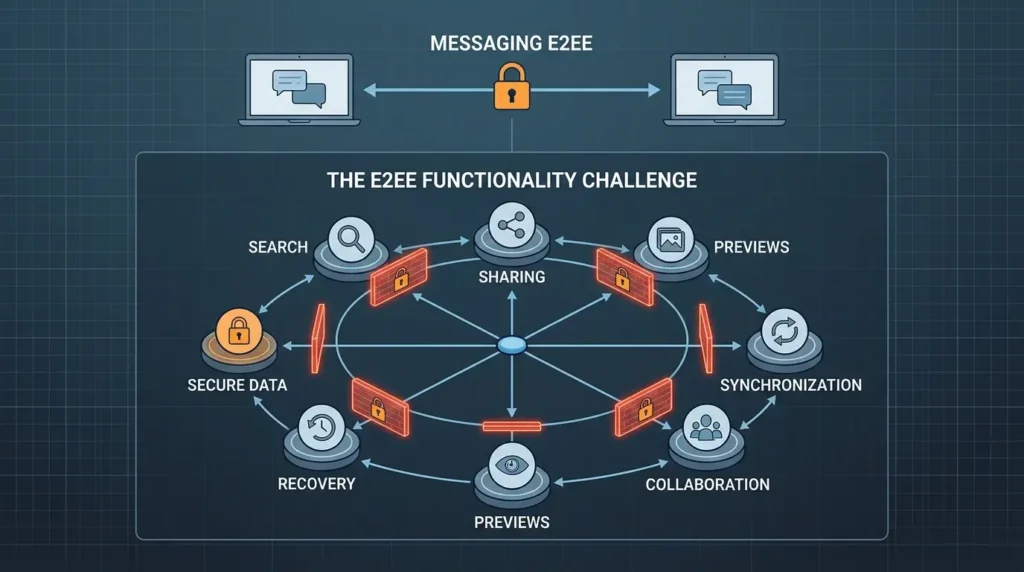
For cloud storage, the useful distinction is between standard encryption at rest and a model where trusted devices hold the keys. Apple’s iCloud security overview says Standard Data Protection keeps many encryption keys in Apple data centers so Apple can help with recovery. Advanced Data Protection changes the model for most iCloud data categories by keeping the keys on trusted devices, while some metadata and certain services remain outside that E2EE coverage.
Proton uses the term zero-access encryption for a related storage model. Its official explanation of zero-access encryption says files are encrypted on the device before being sent to Proton Drive and that Proton does not hold the key needed to read the stored file. As with any provider claim, readers should check the exact product, sharing mode, metadata, recovery process, and client implementation rather than assuming the phrase covers every feature.
Email is more difficult because it is federated. The sender and recipient may use different providers, different clients, different key stores, and different levels of support. The subject line, routing headers, recipient addresses, and delivery path may not receive the same protection as the body. A message can be encrypted for one recipient and unencrypted for another.
The IETF’s RFC 9787 guidance on end-to-end email security explains why email E2EE is difficult to make reliable: S/MIME and PGP/MIME can provide confidentiality, integrity, and authentication, but flexible standards and inconsistent mail-user-agent behavior create interoperability and usability failures. That is why a consumer chat app can make E2EE feel automatic while PGP or S/MIME often requires deliberate key management.
Advanced insight: E2EE gets harder as a service becomes more interoperable. Chat apps control both endpoints. Email, cloud sharing, and cross-platform messaging must negotiate with systems they do not control. The result is more reach, but more ways for encryption to become partial, optional, or invisible.
| Advanced layer | Problem it addresses | What it does not solve |
|---|---|---|
| PQC | Recorded ciphertext that may be decrypted by future quantum computers | Endpoint compromise, classical authentication gaps, or unencrypted backups |
| Client-side scanning | Pre-encryption inspection for policy or safety decisions | It does not preserve the original “only endpoints can inspect” model |
| Key transparency | Silent key substitution and inconsistent directory views | Proving that the account owner or device is trustworthy |
| MLS | Efficient asynchronous group key management | Bad membership policy, exposed devices, or careless implementation |
| Cloud and email E2EE | Protecting data beyond a live chat session | Interoperability, metadata, sharing links, and recovery complexity |
The future of E2EE is not one replacement algorithm. It is a collection of defenses for quantum collection, key directories, large groups, cross-platform delivery, cloud copies, and federated email.
What E2EE does not protect
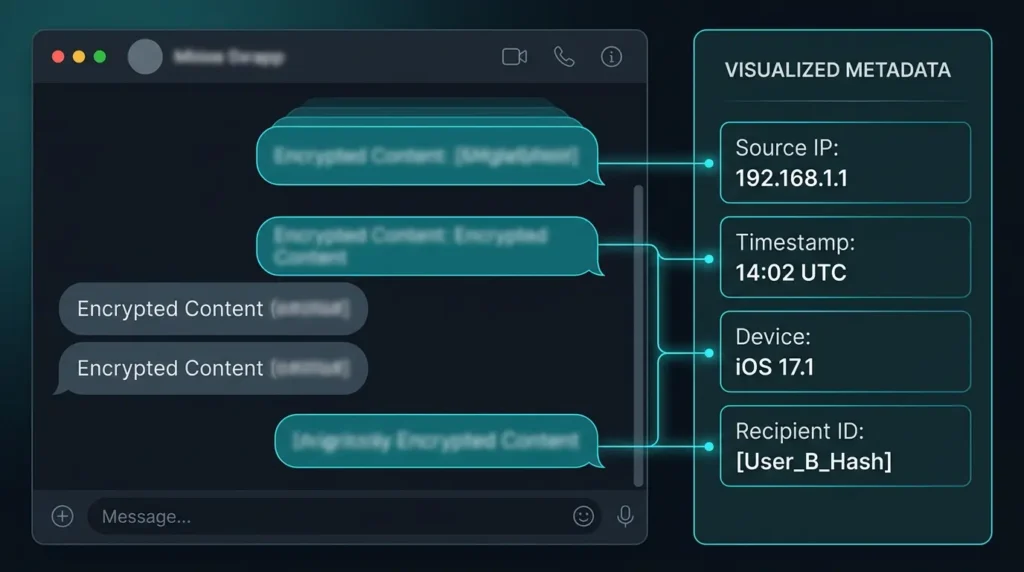
It does not hide every piece of metadata
E2EE can protect the words while leaving the pattern visible. In some systems, the service can still see account identifiers, delivery times, IP addresses, device information, group structure, or connection frequency. The exact exposure varies by implementation, but the general rule is stable: encrypted content and private metadata are different goals.
It does not protect a compromised endpoint
If spyware reads the message before encryption, E2EE has already lost the contest. If spyware reads the screen after decryption, the protocol still worked; the endpoint did not.
Use a strong device passcode, current operating-system updates, app locks where appropriate, and careful control of notifications. High-risk users should also consider whether the device itself can be trusted.
It does not protect the recipient from themselves
The recipient can forward, copy, photograph, export, or summarize the message. E2EE cannot enforce what a legitimate recipient does after receiving plaintext.
Disappearing messages can reduce retention, but they cannot erase screenshots or backups that already exist. Treat disappearing messages as a retention feature, not a guarantee of destruction.
It does not automatically authenticate the person
A secure channel to the wrong account is still the wrong channel. Verify keys or safety codes when impersonation would cause harm.
It does not solve access and recovery
Encryption can make recovery harder because the service cannot simply reset the keys for you. That is a feature for confidentiality and a cost for usability. A lost recovery key may mean permanent loss of the backup.
E2EE narrows the trusted middle. It does not remove the need to secure devices, identities, backups, and recovery secrets.
The before-and-after test
A useful way to evaluate E2EE is to compare the whole workflow before and after enabling it.
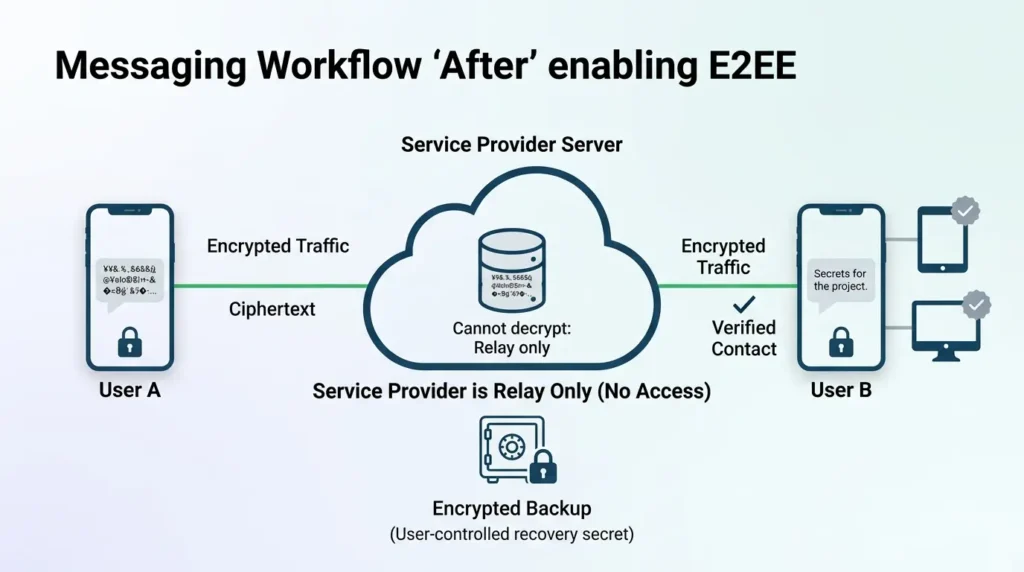
Before: A user sends a message over a service that encrypts traffic to its servers. The service decrypts and processes the content. A cloud backup stores another readable or provider-accessible copy. The recipient’s linked devices may receive it without a visible key change.
After: The sender and recipient devices encrypt and decrypt the content. The provider relays ciphertext. The user verifies the contact when needed. The backup is either disabled or separately encrypted with a user-controlled recovery secret. Linked devices are reviewed. The phone and notifications are protected.
The difference is not just mathematical. It changes who must be trusted and where a legal or technical request can reach.
Common E2EE mistakes
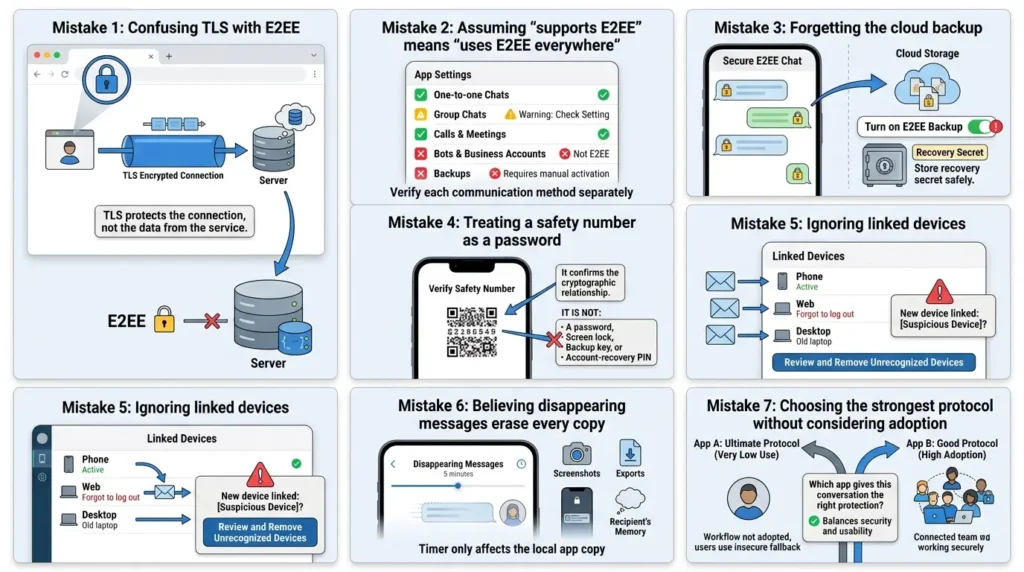
Mistake 1: Confusing TLS with E2EE
A lock icon in a browser means the connection is protected. It does not tell you whether the service can read the data once it arrives.
Mistake 2: Assuming “supports E2EE” means “uses E2EE everywhere”
Check one-to-one chats, group chats, calls, meetings, bots, business accounts, and backups separately.
Mistake 3: Forgetting the cloud backup
The original message may be protected while the backup is not. Turn on E2EE backup when the service offers it, and store the recovery secret safely.
Mistake 4: Treating a safety number as a password
A verification code helps confirm the cryptographic relationship. It is not a password, screen lock, backup key, or account-recovery PIN.
Mistake 5: Ignoring linked devices
A forgotten desktop session can keep receiving new messages. Review linked devices after changing phones, losing a laptop, or responding to a suspicious alert.
Mistake 6: Believing disappearing messages erase every copy
They may delete the app’s local copy after a timer. They cannot control screenshots, exports, backups, notification previews, or the recipient’s memory.
Mistake 7: Choosing the strongest protocol without considering adoption
A tool no one uses correctly is not a secure workflow. The right question is not “Which app wins?” It is “Which app gives this conversation the right protection without pushing people into a less secure fallback?”
When E2EE is the right choice - and when it is not enough
E2EE is a strong default for private personal conversations, confidential work, source protection, sensitive customer communications, and meetings where the service operator should not hold readable content.
It is not a substitute for identity verification, endpoint protection, data-retention policy, access control, or incident response. A company may need both E2EE and carefully designed records. A journalist may need E2EE plus source authentication and device security. A family may need E2EE plus simple recovery that people will actually use.
For organizations, ask four operational questions before deployment:
- Which conversations require provider-blind content protection?
- Which metadata must be retained for safety, billing, or compliance?
- Who controls recovery keys and linked devices?
- What features disappear when E2EE is enabled?
The answer may differ between a board meeting, a customer-support channel, a legal consultation, and an emergency response team.
| Layer | What E2EE helps with | What you still need to control |
|---|---|---|
| Content | Provider reading the message body | Endpoint security and recipient behavior |
| Metadata | Usually not fully protected by E2EE alone | Retention, routing, identifiers, timing, and IP exposure |
| Backups | Protected only if the backup has separate E2EE | Recovery keys, cloud settings, and exports |
| Identity | Does not automatically authenticate users | Safety-code checks, device verification, and account recovery |
The practical answer
End-to-end encryption is one of the most useful protections available for private digital communication. It changes the default relationship between a user and the service: the provider can carry the message without automatically becoming a reader of it.
But the protection stops at a boundary. It does not erase metadata. It does not secure a cloud backup by itself. It does not verify that the recipient is who they claim to be. It does not protect an unlocked or infected phone. It does not decide how much usability, recovery, moderation, or search you are willing to trade for confidentiality.
The right question is therefore not “Is this app encrypted?” Ask five more precise questions:
- What is protected?
- Who holds the keys?
- What metadata remains?
- Where do copies go?
- What happens when a device, account, or recovery secret fails?
If you can answer those questions, the E2EE label becomes useful. If you cannot, it is only a promise.
Frequently Asked Questions
Is E2EE the same as encryption?
No. E2EE is a specific form of encryption in which the intended endpoints control the keys needed to read the content. A service can use encryption in transit and still decrypt the data on its own servers.
Can a company read an E2EE message?
A correctly implemented E2EE service should not be able to read the protected content in transit because it does not hold the necessary decryption keys. But the company may still see metadata, receive an unprotected backup, operate a feature outside E2EE, or access content supplied by a business account or endpoint.
Does E2EE hide metadata?
Not automatically. Routing information, account identifiers, timing, device details, and connection patterns may remain visible. Some services reduce metadata collection, but E2EE and metadata privacy are separate properties.
Are E2EE backups automatically protected?
No. A chat backup may use different encryption from the conversation itself. Check whether E2EE backup is enabled, who holds the recovery key, and what happens on the other participants’ devices.
Can police read E2EE messages?
A provider may have little or no readable message content to hand over. Authorities may still obtain metadata, backups, a linked device, or the physical phone. The answer depends on the target, the provider’s retention, the device state, and the legal process.
Does E2EE protect a phone that has spyware?
No. Spyware can capture a message before encryption or after decryption. E2EE protects the transport and service boundary; it does not make an infected endpoint trustworthy.
Why do some E2EE products remove features?
Features such as cloud recording, server-side transcription, AI summaries, content search, and some moderation tools require the service to process readable content. When the service cannot decrypt the meeting or message, those features may be unavailable or redesigned.
What should I check before trusting an E2EE app?
Check the default mode, key ownership, identity verification, metadata policy, backups, linked devices, recovery model, open technical documentation, independent review, and the security of the devices involved.
📋 Article Timeline & History
Successfully updated on September 24, 2026 with the latest details.
This article was originally published on August 14, 2026.

Was this article helpful?




[…] End-to-End Encryption Explained: What E2EE Protects, and What It Doesn’t […]
[…] guarantee. Proton describes zero-access encryption for stored mailbox data, while Tuta describes end-to-end encryption across a broader set of mailbox fields. Mailfence relies on OpenPGP-based workflows, and Posteo […]
[…] None of that requires breaking your encryption. All of it can still upend your relationship with the service. This distinction, between content confidentiality and the continuity and control system wrapped around it, is the organizing idea for everything that follows. For a deeper technical breakdown of what encryption actually promises versus what it doesn’t, see Vertex Frontier’s guide to what end-to-end encryption does—and does not—protect. […]