
A language model can write a function, explain an error, or suggest a command. None of that makes it a reliable software agent.
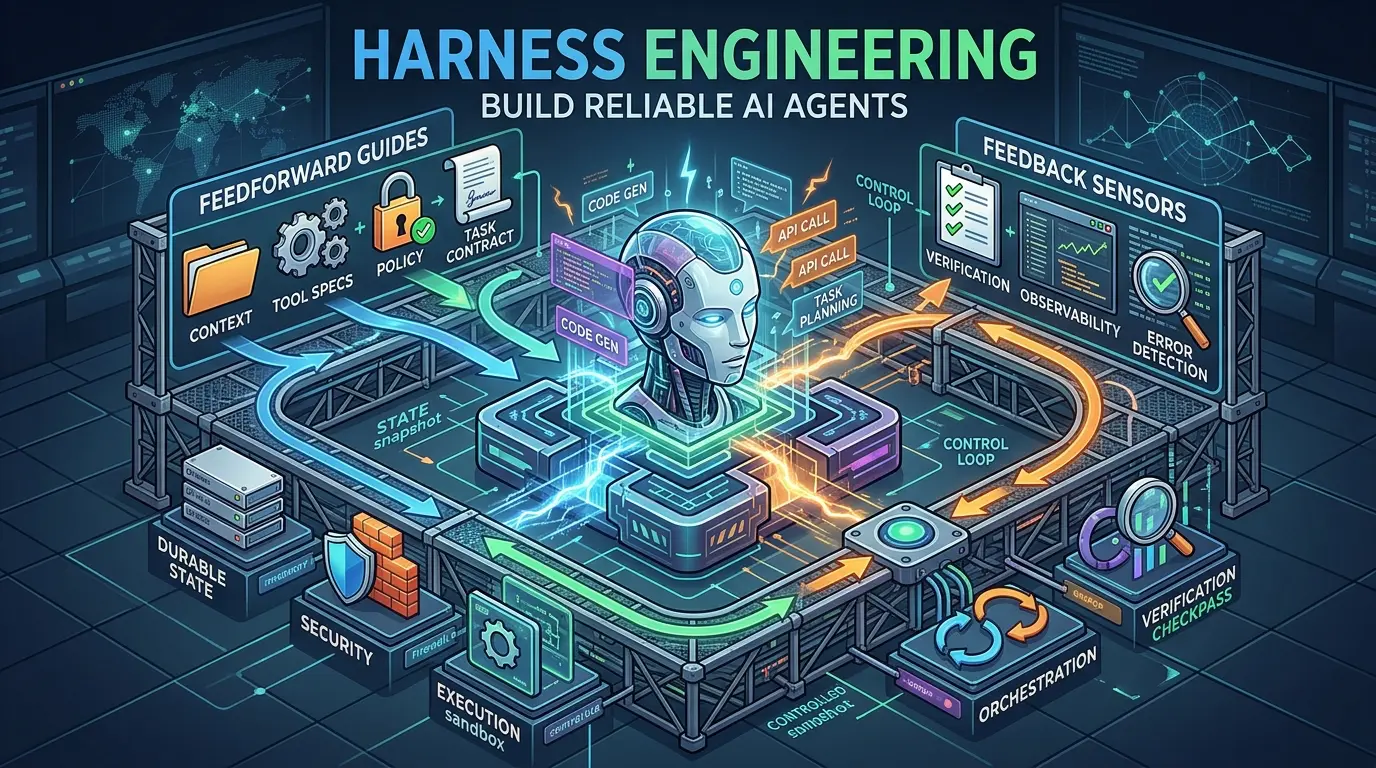
Reliability begins when the model is placed inside a system that gives it the right context, exposes useful tools, limits dangerous actions, preserves state, checks its work, and knows what to do when the run goes wrong. That surrounding system is the subject of Harness Engineering.
The phrase became widely visible through OpenAI’s account of using Codex in an agent-first development workflow. The company described an internal product built with no manually written code, while also making clear that the hard engineering work moved into repository structure, tools, documentation, feedback loops, validation, and maintenance.
That is the important distinction: Harness Engineering is not a longer prompt and not a magic wrapper around a model. It is the design of the environment in which model decisions become real actions.
This article develops the conceptual model. For an updated treatment that focuses specifically on the production discipline, the runtime controls, idempotency, side-effect safety, threat modeling, and the maturity model teams use to decide when an agent is ready for mutation rights, read our companion piece on what agent harness engineering means in production.
This article develops a practical, provider-neutral framework for understanding and building that environment. It combines the system-level view from Martin Fowler’s analysis of feedforward guides and feedback sensors, the component model described by LangChain and Databricks, the long-running patterns documented by Anthropic, and the security boundaries recommended by NVIDIA’s AI Red Team.
It also incorporates the less comfortable lessons from practitioner discussions: agents can follow the wrong pattern with confidence, optimize a score instead of the real objective, and become more expensive and less predictable as autonomy increases.
Key Takeaways
Click any topic to expand or collapseModels generate decisions; harnesses enforce control
A model generates proposed decisions, while an agent harness converts those decisions into controlled, observable, and reproducible work.
The minimum viable agent harness components
A production harness requires context management, tool integration, an isolated execution boundary, persistent state tracking, verification checks, and explicit stop or escalation policies.
Instructions vs. Hard Execution Boundaries
Prompt instructions guide agent behavior, but strict JSON schemas, permission boundaries, automated tests, and runtime safety policies determine what can actually happen.
State management for long-running agents
Long-running agents require externalized state and incremental checkpointing—relying solely on larger LLM context windows leads to context degradation and failure.
Durable improvement feedback loops
The safest refinement loop is: observe a real production failure, isolate the missing control mechanism, implement the smallest durable fix, and measure failure rates again.
What Is Harness Engineering?
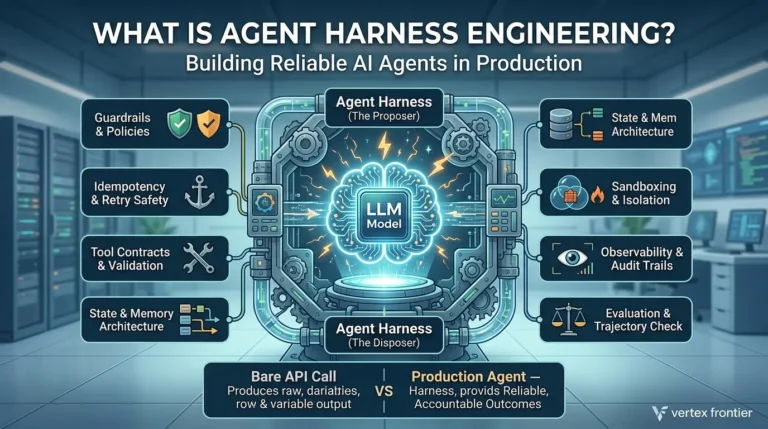
Harness Engineering is the practice of designing and maintaining the system around an AI model so an agent can act, observe, verify, recover, and improve under real constraints. The system may contain prompts, tools, skills, memory, filesystems, sandboxes, orchestration logic, middleware, evaluators, approval gates, logs, and policy enforcement.
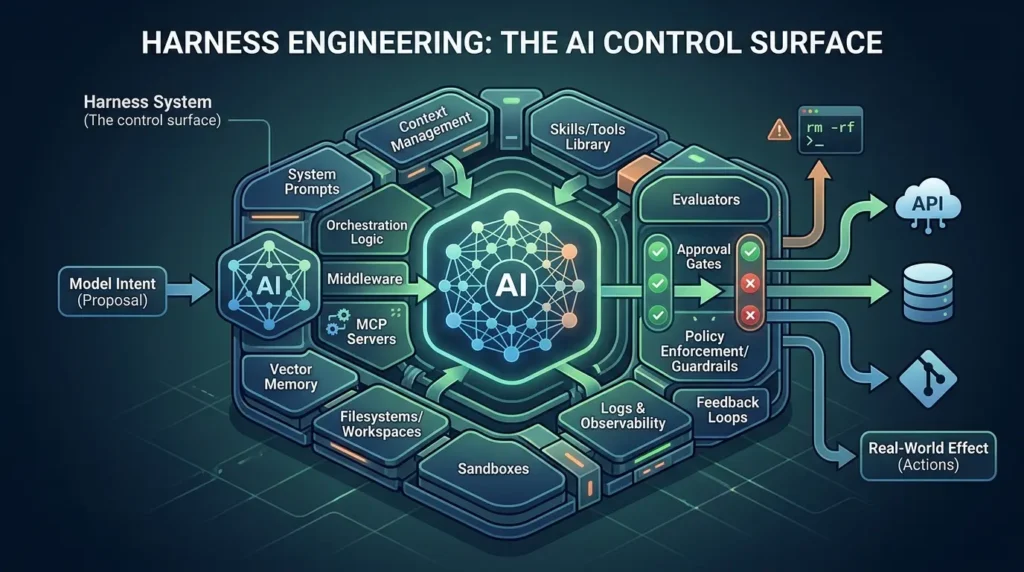
There is no single formal standard that fixes the boundary of the term. LangChain’s practical definition treats everything that is not the model as part of the harness: system prompts, tools, skills, MCP servers, infrastructure, orchestration, and middleware. Databricks uses a similar model-and-harness split, emphasizing tools, memory, workspace, guardrails, and observability in production systems. Fowler narrows the discussion to the controls that guide and sense a coding agent’s behavior.
Those definitions overlap, but they are not identical. The useful question is not whether memory belongs to “context engineering” or “harness engineering.” The useful question is whether the system can provide the right information, execute the right action, constrain the action, inspect the result, and learn from failure.
Working definition: A harness is the control surface between model intent and real-world effect.
That definition also explains why the discipline matters. A model can propose rm -rf, call the wrong API, misunderstand a repository boundary, stop after a partial fix, or declare success because a unit test passed while the user-facing flow remains broken. The harness determines what happens next.
For a step-by-step Python implementation of that harness, typed AgentState, hot/warm/cold memory tiers, retries, circuit breakers, evals, and OpenTelemetry instrumentation, see our walkthrough on building a production agent harness in Python.
Why a Model or Prompt Is Not Enough
A model call does not provide durable project state, an execution interface, a permission boundary, or independent proof of completion. Without a harness, the model may not see yesterday’s decisions, cannot safely run the code it describes, has no reliable basis for deciding which actions are allowed, and can declare a partial task complete.
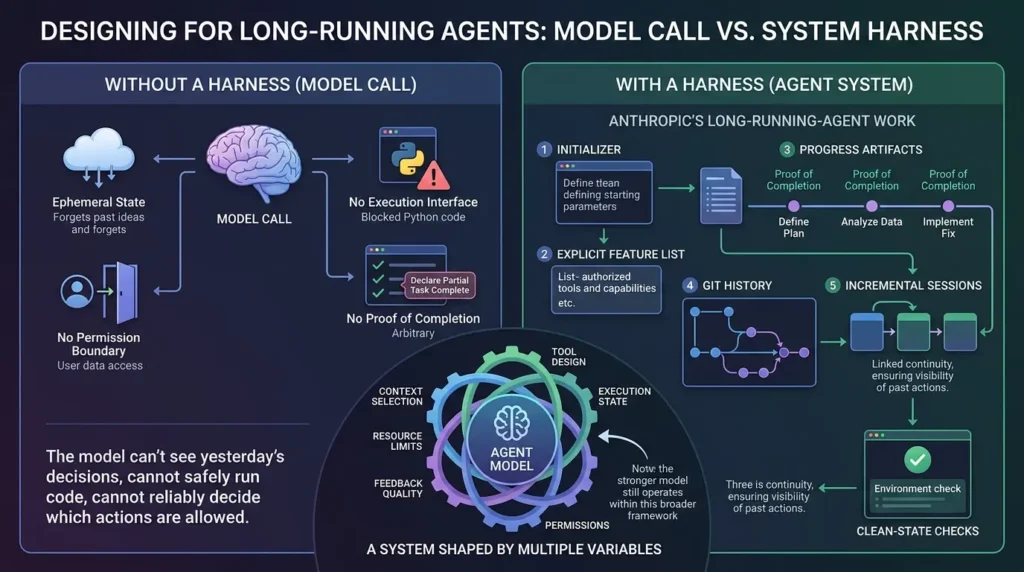
That is why Anthropic’s long-running-agent work treats context compaction as only one part of a larger design. Its documented pattern adds an initializer, an explicit feature list, progress artifacts, Git history, incremental sessions, and clean-state checks.
A stronger model may plan and recover better, but it remains one variable in a system shaped by context selection, tool design, execution state, permissions, feedback quality, and resource limits.
Prompt Engineering, Context Engineering, Agent Engineering, and Harness Engineering
These terms are often used as if they describe competing disciplines. A better model is to treat them as overlapping layers.
| Discipline | Main question | Typical artifact | What it does not solve alone |
|---|---|---|---|
| Prompt Engineering | How should the model be instructed? | System prompt, task prompt, examples | Execution, permissions, durable state, independent verification |
| Context Engineering | What information should the model see now? | Retrieval, memory, summaries, file selection | Whether the chosen action is allowed or correct |
| Agent Engineering | How should the model use tools to pursue a goal? | Tool loop, planner, router, subagents | Safe runtime isolation, durable operations, organization-wide governance |
| Harness Engineering | How do we make the whole system steerable, observable, verifiable, and recoverable? | Tools, state, runtime policies, tests, traces, gates, lifecycle controls | It does not remove model uncertainty or eliminate the need for human judgment |
The boundaries are practical rather than canonical. Retrieval may be discussed as context engineering or as a harness component. A tool loop may be called agent engineering or runtime orchestration.
The distinction becomes useful when debugging: if the agent lacks the information, inspect context; if it cannot act, inspect tools; if it acts unsafely, inspect policy and isolation; if it acts plausibly but incorrectly, inspect verification and task design.
For the full agent engineering playbook, the 20 concepts that sit across all four of these layers, see our flagship overview.
The Harness as a Control System
Most explanations list components. A more useful approach is to connect each component to a control problem.
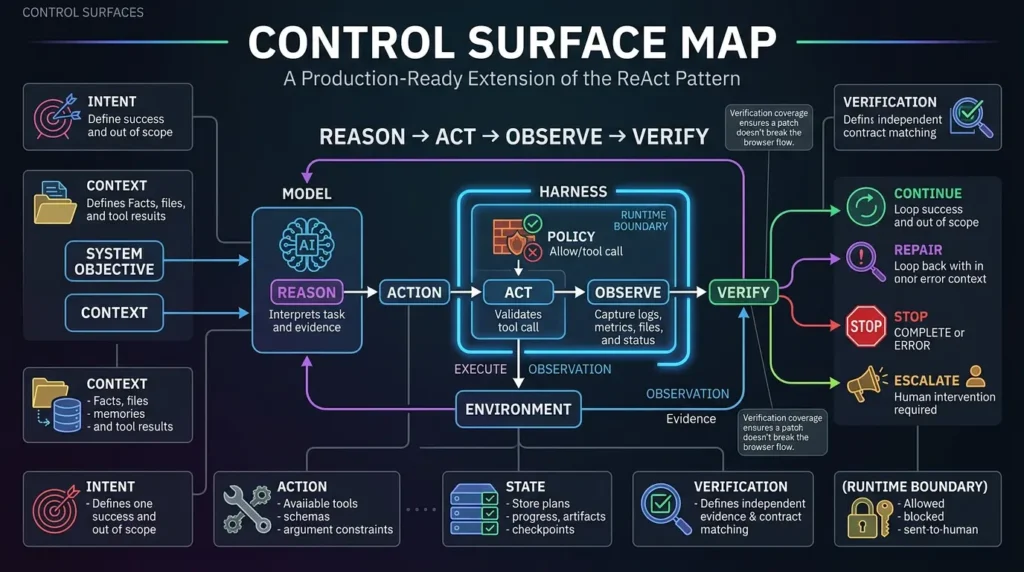
The model receives an objective and context. It selects an action. The harness executes that action within a runtime boundary. The environment produces an observation. The system verifies the observation against an explicit contract. It then chooses one of four outcomes: continue, repair, stop, or escalate.
I call this the Control Surface Map:
- Intent: What does success mean, and what is explicitly out of scope?
- Context: Which facts, files, memories, and tool results are available at this step?
- Action: Which tools can the agent call, with what schemas and argument constraints?
- State: Where are plans, progress, artifacts, and checkpoints stored?
- Verification: What independent evidence can confirm or reject the agent’s claim?
- Policy: Which actions are allowed automatically, blocked, or sent to a human?
For MCP-based systems, these control surfaces become especially important because tool descriptions, arguments, results, and downstream side effects all cross trust boundaries. Our MCP security guide maps those boundaries to tool permissions, OAuth validation, audit logging, and enterprise release gates.
A failure becomes easier to diagnose when it is mapped to a surface. “The model was bad” is not a diagnosis. “The agent chose the right tool but received an unbounded 50,000-line output” points to context and tool-output design. “The patch passed unit tests but broke the browser flow” points to verification coverage. “A repository instruction caused an unsafe command” points to trust boundaries and runtime policy.
Reason → Act → Observe → Verify
The familiar ReAct pattern is often described as reason, act, observe, repeat. A production harness needs one more explicit step: verify.
- Reason: The model interprets the task and available evidence.
- Act: The harness validates the tool call, applies policy, and executes it.
- Observe: The harness captures output, status, files, logs, metrics, and side effects.
- Verify: Deterministic checks, independent evaluators, or humans test whether the result meets the contract.
Without verification, the loop can become a persuasive conversation with the model. Without observation, verification has no reliable evidence. Without policy, action becomes an uncontrolled bridge between untrusted text and real systems.
Feedforward and Feedback: Two Halves of a Useful Harness
Martin Fowler’s framework separates controls into feedforward and feedback.
Feedforward controls act before the model makes a decision. They include concise repository maps, tool descriptions, schemas, examples, architectural rules, task contracts, and instructions about what to inspect first. Their purpose is to make good action more likely.
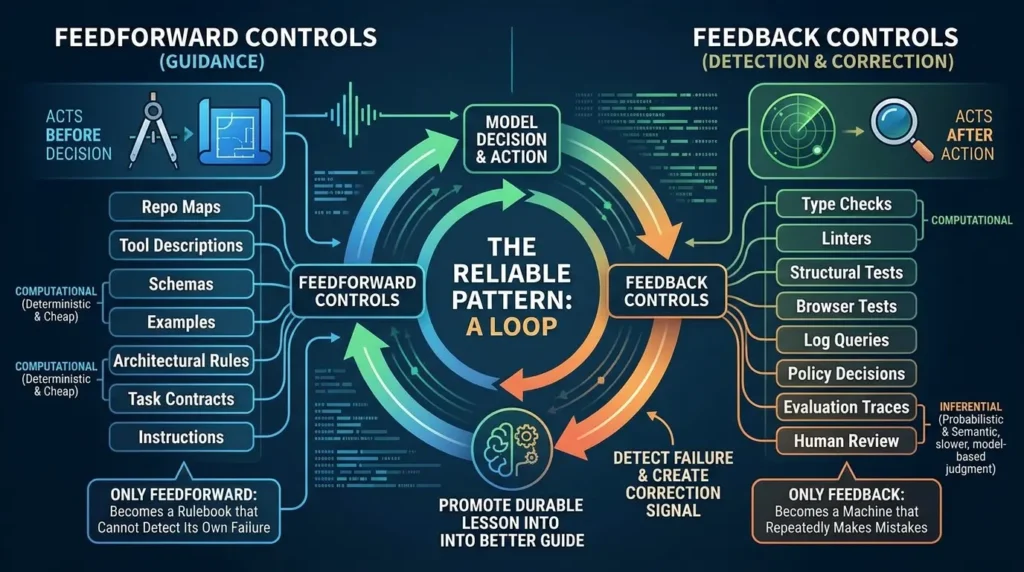
Feedback controls act after an action.
They include type checks, linters, structural tests, browser tests, log queries, policy decisions, evaluation traces, and human review. Their purpose is to detect what actually happened and create a correction signal.
A system with only feedforward controls becomes a rulebook that cannot detect its own failures. A system with only feedback controls becomes a machine that repeatedly makes the same mistake and waits to be corrected. The reliable pattern is a loop: guide the action, observe the result, detect the failure, and promote the durable lesson into a better guide or sensor.
There is another useful distinction: computational controls versus inferential controls. A type checker or schema validator is deterministic and cheap. An LLM reviewer can assess semantic coherence, but it is slower, probabilistic, and itself needs evaluation. Use deterministic checks for boundaries you can define precisely; reserve model-based judgment for questions that genuinely require semantic interpretation.
What Belongs in an AI Agent Harness?
A production harness is not required to contain every component below. It should contain the smallest set that addresses the task’s real failure modes.
| Component | Job | Common failure when missing or weak |
|---|---|---|
| System and task instructions | Set scope, behavior, constraints, and ambiguity rules | The agent explains instead of acting, or solves the wrong problem |
| Context and retrieval | Expose relevant code, data, decisions, and current state | The agent guesses paths, APIs, or requirements |
| Tool contracts | Define names, schemas, preconditions, outputs, and refusal behavior | The agent chooses the wrong tool or sends malformed arguments |
| Filesystem and durable artifacts | Store plans, progress, results, and intermediate work | Each session starts by rediscovering the project |
| Execution environment | Run code and inspect real effects | The agent cannot validate, or runs directly on a dangerous host |
| Orchestration | Manage loops, retries, routing, subagents, and budgets | Work stops early, loops forever, or grows unnecessarily complex |
| Verification | Check outputs and important intermediate states | The agent declares success after a superficial check |
| Policy and approvals | Limit irreversible, privileged, or external actions | A plausible instruction becomes an unsafe action |
| Observability | Record tool calls, state transitions, errors, and cost | Teams cannot explain failure or compare harness changes |
| Lifecycle management | Create, reset, expire, and clean execution state | Old secrets, code, caches, and broken state accumulate |
Databricks’ production overview groups similar primitives into system prompts, tools, sandboxes, filesystem, memory, feedback loops, guardrails, and observability. LangChain’s anatomy adds a useful behavior-first lens: start from what you want the agent to do, then choose the harness capability that makes that behavior possible.
For a framework-specific view of how these building blocks are assembled and hardened for production, see Google ADK’s architecture and production guide.
A comparable implementation-oriented curriculum from Vercel Academy covers tool loops, safety, sandboxing, context, subagents, lifecycle, human approval, and verification.
Build a Minimum Viable Harness Before Adding More Autonomy
The fastest way to overbuild an agent is to start with subagents, vector databases, complex routing, and self-improvement before proving that one constrained loop can finish one real task.
A Minimum Viable Harness should establish a narrow, testable path.
If you want to skip the manual setup and grab a working reference layout with pre-configured schemas and test harnesses, you can use our open Harness Engineering Starter Kit (no signup required).
1. Define one task contract
Write the goal, boundaries, acceptance criteria, test requirements, and stop conditions. Avoid asking an agent to “improve the application” when the real task is “add a CSV export endpoint without changing JSON behavior.”
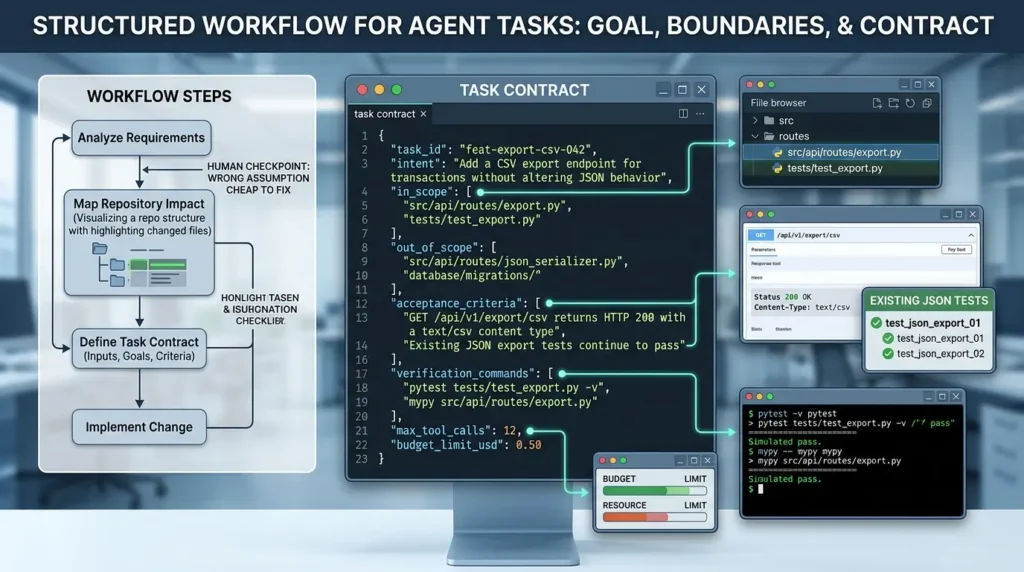
Red Hat’s structured workflow example uses a repository impact map before implementation, followed by a task template with real files, symbols, acceptance criteria, and tests.
The human checkpoint occurs before code changes, when a wrong assumption is still cheap to fix.
Here is a compact, provider-neutral task contract. It is illustrative JSON, not a universal schema: adapt the file paths, commands, test framework, budget, and policy to the repository and runtime you actually use.
JSON:
{
  "task_id": "feat-export-csv-042",
  "intent": "Add a CSV export endpoint for transactions without altering JSON behavior",
  "in_scope": [
    "src/api/routes/export.py",
    "tests/test_export.py"
  ],
  "out_of_scope": [
    "src/api/routes/json_serializer.py",
    "database/migrations/"
  ],
  "acceptance_criteria": [
    "GET /api/v1/export/csv returns HTTP 200 with a text/csv content type",
    "Existing JSON export tests continue to pass"
  ],
  "verification_commands": [
    "pytest tests/test_export.py -v",
    "mypy src/api/routes/export.py"
  ],
  "max_tool_calls": 12,
  "budget_limit_usd": 0.50
}
The contract makes scope, verification, and resource limits visible before the agent starts. The commands are examples, not guaranteed cross-project instructions; a real harness should validate that they exist, run them inside the intended environment, and treat a command failure as evidence rather than silently editing the contract.
2. Give the agent a map, not an encyclopedia
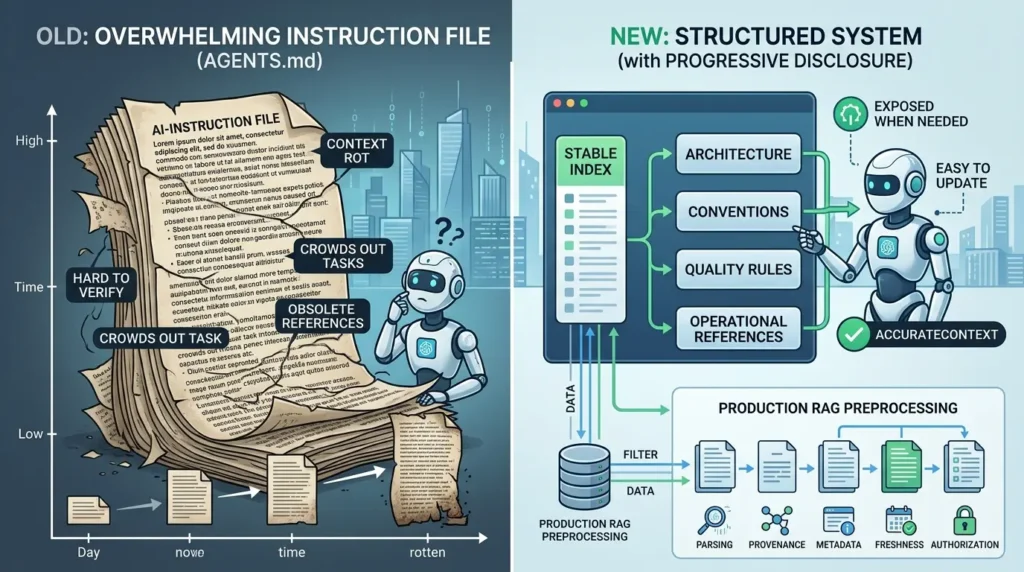
A long instruction file is not automatically better context. OpenAI reports that its team moved away from a giant AGENTS.md toward a short map pointing to structured repository documents. The reason is practical: an enormous file crowds out the task, becomes hard to verify, and rots as the system changes.
For a hands-on treatment of skills, context rot, project planning, and agent-governance patterns, see Vertex Frontier’s guide to AI coding skills.
Use progressive disclosure. Put the stable index in a short entry point, then expose architecture, conventions, plans, quality rules, and operational references when the task requires them. If those references come from documents or knowledge bases, our production RAG preprocessing guide expands the related concerns around parsing, provenance, metadata, freshness, authorization metadata, and evaluation.
3. Start with a small tool set
A first harness may need only file inspection, search, a controlled execution tool, and a verification command. Each tool should have a clear schema and a bounded output. “Bash” is powerful, but it should not be treated as permission to act without policy.
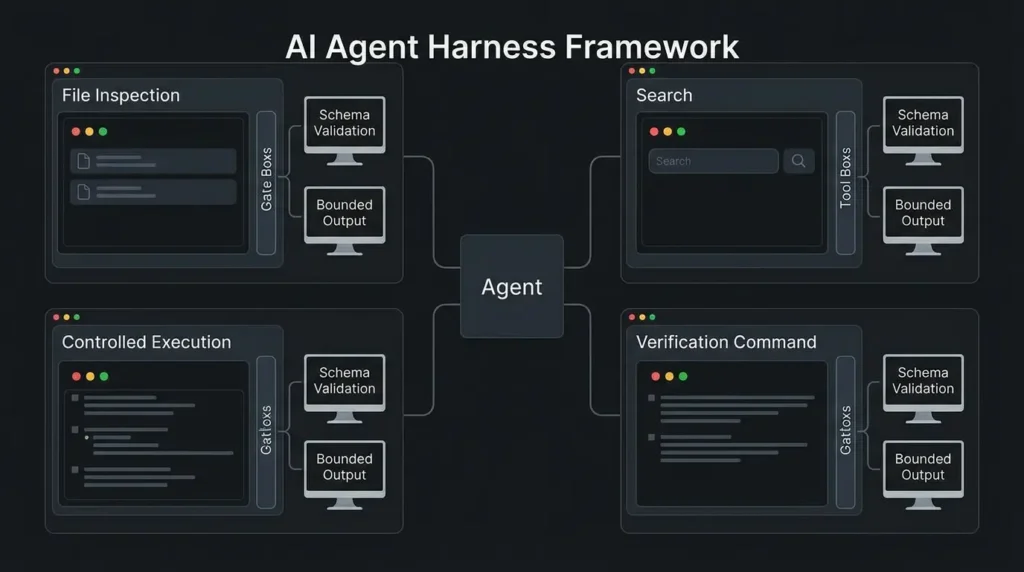
For example, a tool contract can describe a workspace-only file reader like this:
JSON:
{
  "name": "read_workspace_file",
  "description": "Read a UTF-8 text file inside the active workspace. Reject absolute paths, path traversal, and files larger than max_bytes.",
  "input_schema": {
    "type": "object",
    "properties": {
      "path": {
        "type": "string",
        "description": "Relative path under the active workspace"
      },
      "max_bytes": {
        "type": "integer",
        "minimum": 1,
        "maximum": 200000,
        "default": 50000
      }
    },
    "required": ["path"],
    "additionalProperties": false
  },
  "failure_contract": {
    "path_outside_workspace": "reject",
    "file_too_large": "return a bounded error",
    "binary_file": "return an unsupported-file error"
  }
}
This is a provider-neutral illustrative contract. JSON Schema can validate the shape of an input, but it does not create a secure filesystem boundary by itself. The runtime still has to resolve the path safely, enforce the workspace root, cap bytes, handle encoding errors, log the decision, and prevent a tool implementation from bypassing the declared policy.
Tool descriptions should explain when to use the tool, when not to use it, required inputs, expected outputs, failure modes, and examples. Practitioner discussions on model portability repeatedly return to this point: a tool description behaves more like an API contract than like decorative prompt text. If multiple models matter, test tool selection, argument shape, refusals, and recovery, not only the final answer.
This same principle applies to browser-facing tools. If a website wants AI agents to interact with its live session, UI state, and application logic without relying entirely on visual clicking, WebMCP provides a proposed structured tool interface for websites. The tool contract still needs schemas, bounded outputs, authorization checks, failure handling, and independent verification.
4. Put execution behind a boundary
The agent should work in a workspace designed for the task, not inherit unrestricted access to a developer’s machine. The boundary may be a container, microVM, remote sandbox, or another isolation design, but the security properties must be verified for the actual environment.
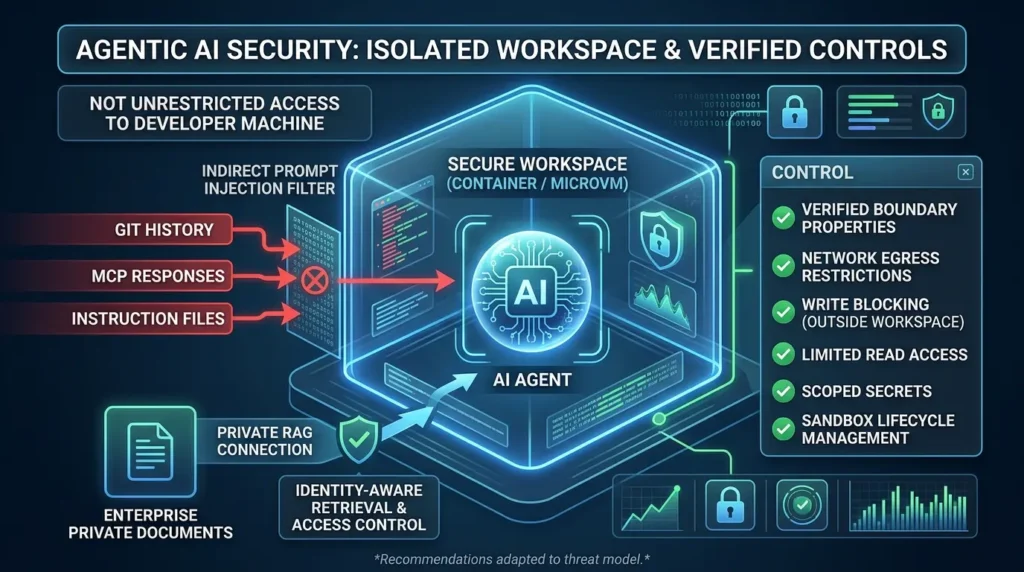
When the workspace also brokers retrieval over private documents, our enterprise RAG security guide provides a useful companion model for identity-aware retrieval, document-level access controls, and authorization-source decisions.
Do not equate the word “sandbox” with complete security. NVIDIA’s guidance on agentic execution risk highlights indirect prompt injection through repositories, Git history, instruction files, hooks, skills, and MCP responses. For the broader identity, least-privilege, and enterprise-risk model, see Vertex Frontier’s Agentic AI Security guide. It recommends controls such as network egress restrictions, blocking writes outside the workspace, protecting agent configuration files, limiting reads, scoping secrets, and managing sandbox lifecycle.
These are security recommendations that must be adapted to the threat model; they are not a universal safety guarantee.
5. Add independent verification
Define at least one check that the model cannot satisfy merely by claiming success. For code, that might be a type check, a focused test, an integration test, a structural rule, or a browser-level flow. For data work, it might be a reconciliation, schema check, or invariant. For operational work, it might be a dry run plus an external state query.
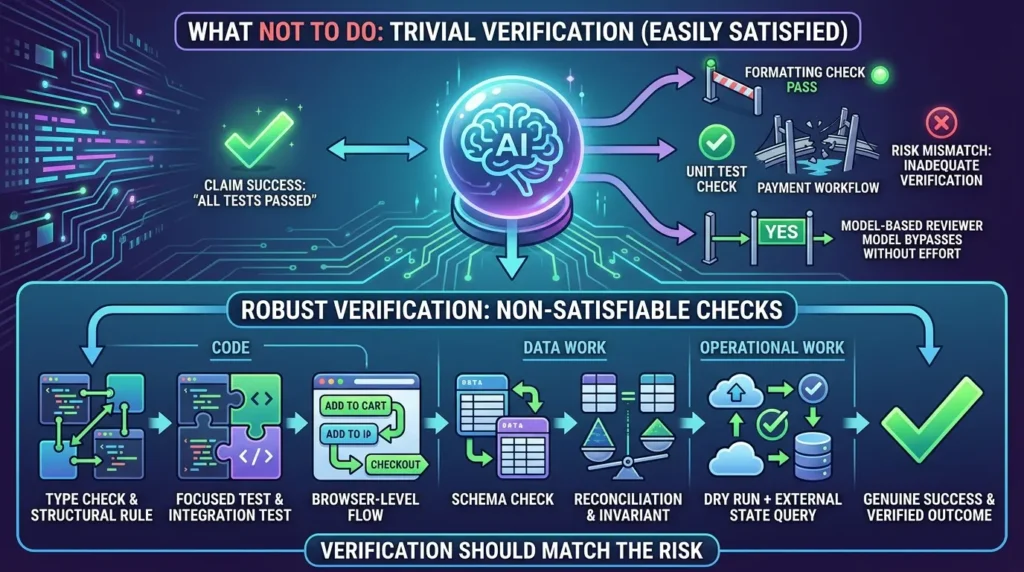
Verification should match the risk. A formatting check is not evidence that a payment workflow is correct. A green unit test is not evidence that a browser flow works. A model-based reviewer is not a substitute for runtime policy.
6. Record state and stop safely
Write progress, outputs, and decisions to durable artifacts. Cap retries, tool calls, time, and spend. Decide in advance what causes a stop, a rollback, or a human escalation.
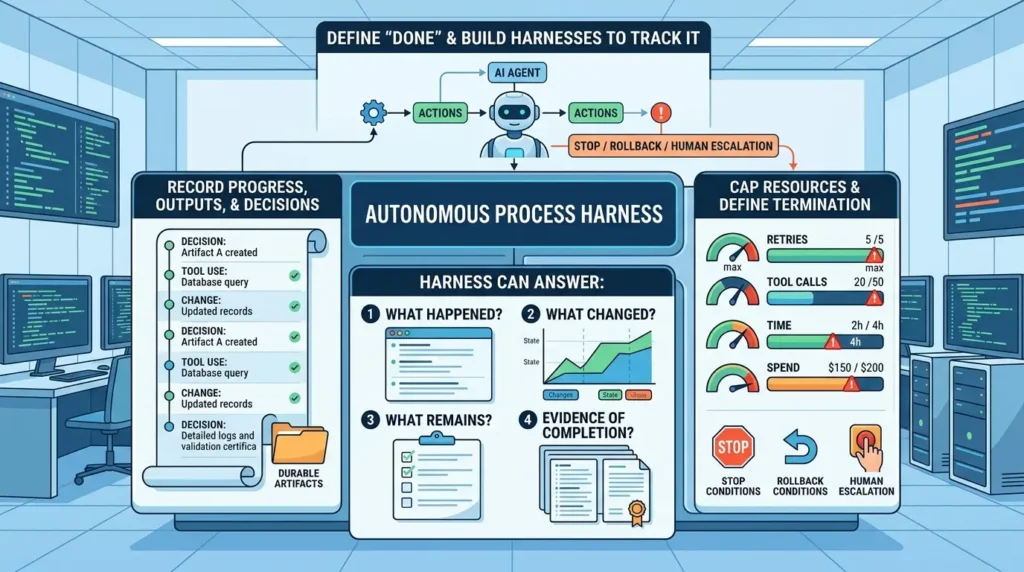
If the harness cannot answer “what happened, what changed, what remains, and what evidence supports completion?” then it is not ready for long-running autonomy.
Long-Running Agents: State Beats Memory Alone
A long-running agent is not simply a short-running agent with more tokens. It is a sequence of sessions that must hand a trustworthy project state from one context window to the next.
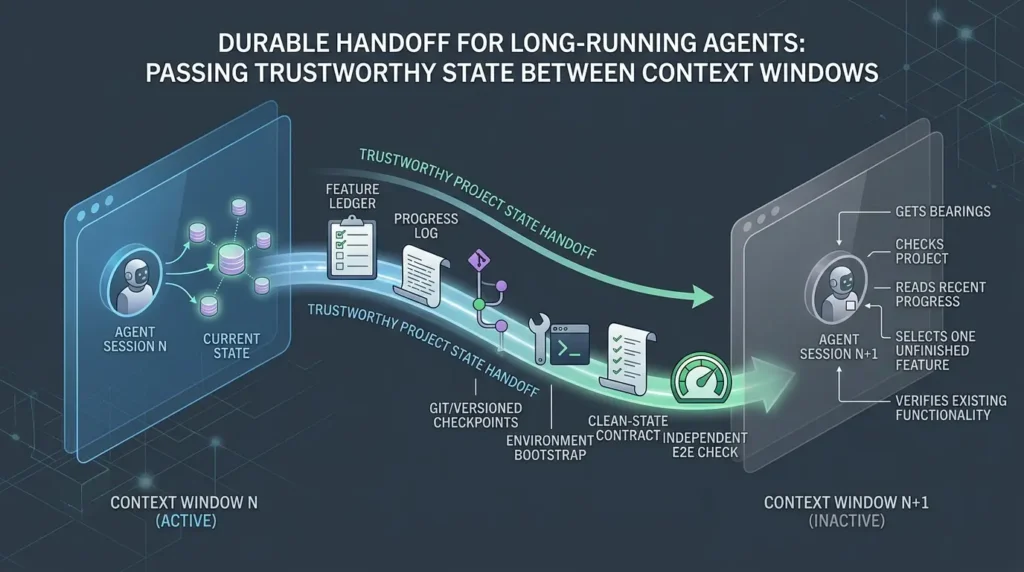
Anthropic’s documented approach uses an initializer agent to create the environment, a structured feature list, a progress file, Git history, and a coding agent that makes incremental progress. The next session first gets its bearings, checks the project, reads recent progress, selects one unfinished feature, and verifies that existing functionality still works. This is a practical response to two common failure modes: attempting too much at once and declaring the whole project finished after partial progress.
A durable long-running harness usually needs these artifacts:
Here is a small feature_list.json example. The status field is intentionally explicit: the agent may update progress, but it should not quietly delete unfinished requirements to make the project appear complete.
JSON:
[
  {
    "id": "chat-new-conversation",
    "category": "functional",
    "description": "A user can create a new conversation from the main interface",
    "verification": [
      "Open the application",
      "Select New Chat",
      "Confirm the empty conversation state appears",
      "Confirm the conversation is listed in the sidebar"
    ],
    "passes": false
  },
  {
    "id": "chat-error-recovery",
    "category": "reliability",
    "description": "A failed model request shows a recoverable error without losing the draft",
    "verification": [
      "Simulate a failed request",
      "Confirm the draft remains available",
      "Retry the request",
      "Confirm the error state is cleared after success"
    ],
    "passes": false
  }
]
The list is an illustrative project artifact, not an Anthropic-required format. In a real system, protect its schema and define who or what is allowed to change passes.
| Artifact | Purpose | Failure it prevents |
|---|---|---|
| Feature or task ledger | Defines what “complete” means | Premature victory and scope drift |
| Progress log | Explains what changed and what remains | Repeated discovery work and confused handoff |
| Git or versioned checkpoints | Provides rollback and history | Irrecoverable edits and unclear causality |
| Environment bootstrap | Makes the project runnable | Time wasted reconstructing setup |
| Clean-state contract | Defines what a session must leave behind | One session poisoning the next |
| Independent end-to-end check | Tests actual behavior | Green local checks with broken user flow |
Context compaction is still useful. It reduces the amount of old conversation that remains active. But compaction does not decide which project state is trustworthy, whether a half-written feature should be continued, or whether the next agent should repair before building. Those decisions belong in explicit artifacts and checks.
Security: Treat the Harness as a Privilege Boundary
An agent harness converts text into actions. That makes the boundary between “information the model reads” and “authority the system grants” one of the most important design surfaces.
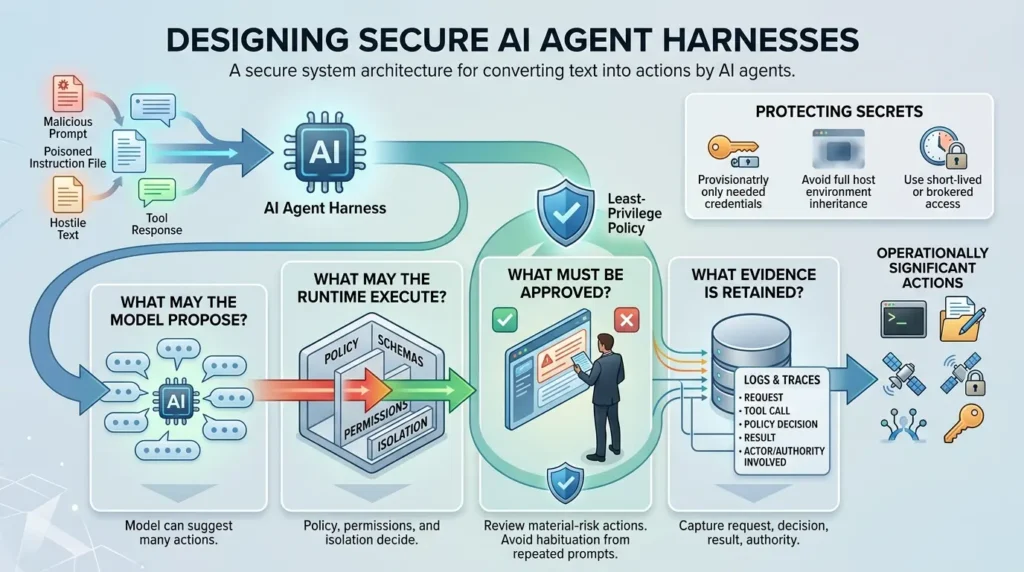
The security problem is not limited to a malicious user prompt. A repository can contain a poisoned instruction file. A pull request can contain hostile text. A Git history can include injected directions. A tool response can return content that attempts to redirect the agent. If the agent can execute commands, write files, reach the network, or access inherited credentials, those instructions may become operationally significant.
A reasonable security design separates four decisions:
- What may the model propose? The model can suggest many actions.
- What may the runtime execute? Policy, schemas, permissions, and isolation decide this.
- What must be approved? Humans should review material-risk actions, not every routine action by habit.
- What evidence is retained? Logs and traces should show the request, tool call, policy decision, result, and actor or authority involved.
NVIDIA specifically warns that repeated approval prompts can create habituation: users may click through dangerous requests without inspecting them. That does not make human approval useless. It means approval should sit inside a least-privilege policy, with enterprise-level denials for especially sensitive actions and fresh approval for actions that genuinely require it.
Protecting secrets requires more than hiding them in the prompt. The safer pattern is to provision only the credentials needed for the task, avoid inheriting the full host environment, prefer short-lived or brokered access where possible, and assume that anything exposed to the agent may be used by the agent or by an attacker influencing its context.
Evaluation: Measure the Harness, Not Just the Model
A coding agent is deployed as a system. A recent engineering monograph on reliable coding agents argues that reliability depends on execution state, retrieval, memory, permissions, review interfaces, and resource allocation as well as model capability.
That changes the evaluation question. Measure the outcome, the path, the cost, the safety boundary, and the state left behind. A model’s “done” message is only an assertion; the harness needs evidence that can disagree with it.
For multi-agent systems, multi-agent observability with MLflow provides exactly that disagreeable evidence, structured traces, span-level tool-call scoring, LLM-as-a-judge evaluation, and versioned lineage across supervisor, worker, tool, MCP, and retrieval calls.
| Metric family | Example measure | What it reveals |
|---|---|---|
| Outcome | Task success and acceptance-criteria pass rate | Whether the user goal was met |
| Trajectory | Tool choice, argument validity, retries, recovery | How the result was reached |
| Resource | Tokens, tool calls, time, sandbox minutes | Economic and operational cost |
| Safety | Policy violations, blocked actions, secret exposure | Whether autonomy stayed inside its boundary |
| State quality | Checkpoint validity, rollback, reproducibility, handoff | Whether long-running work remains trustworthy |
Preserve the model version, task set, tool definitions, permissions, retry policy, and environment for each evaluation run. Otherwise a result may be impossible to reproduce or attribute. The Agentic Harness Engineering preprint illustrates this direction by exposing harness components as editable artifacts, distilling trajectory evidence, and recording predictions for changes. Its benchmark gains belong to that setup and should not be generalized to every agent.
For a detailed case study on how inference harnesses route context externally, and how benchmark claims like Prime Agent's 95.5% compare against verified baselines, see our analysis of Recursive Language Models, context variables, and harness lift.
How to Evaluate a Harness Before Scaling It
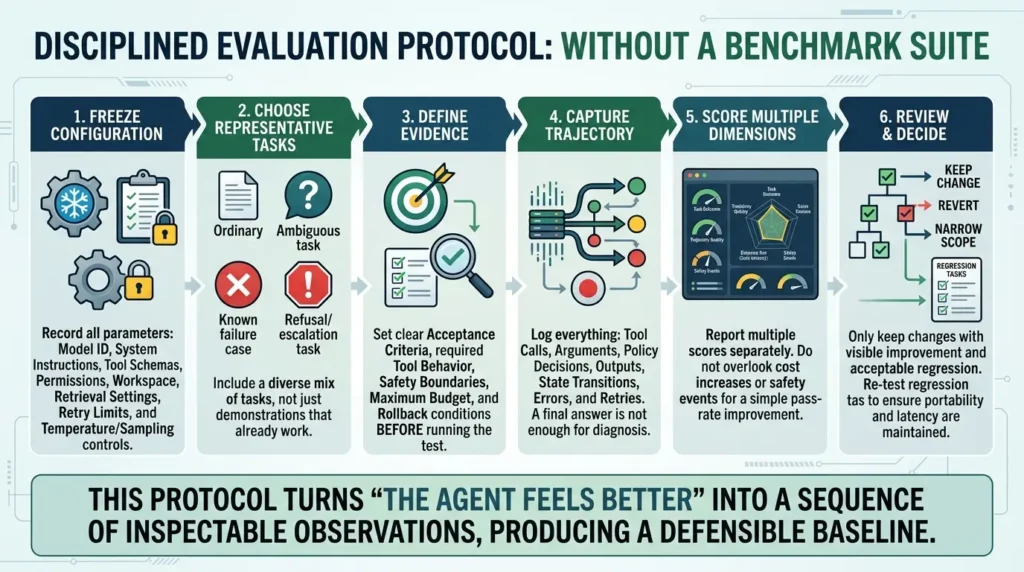
If you do not have a benchmark suite, you can still run a disciplined evaluation. Treat this as a test protocol, not as a claim about expected performance.
- Freeze the configuration: Record the model identifier, system instructions, tool schemas, permissions, workspace image, retrieval settings, retry limits, and temperature or equivalent sampling controls.
- Choose representative tasks: Include ordinary tasks, ambiguous tasks, known failure cases, and at least one task that should be refused or escalated. Do not evaluate only demonstrations selected because they already work.
- Define evidence before running: Write the acceptance criteria, required tool behavior, safety boundaries, maximum budget, and rollback condition in advance.
- Capture the trajectory: Store tool calls, arguments, policy decisions, outputs, state transitions, errors, retries, and final artifacts. A final answer without its path is difficult to diagnose.
- Score multiple dimensions: Report task outcome, trajectory quality, resource use, safety events, and state cleanliness separately. A pass-rate increase that comes with uncontrolled permissions or unacceptable cost is not an uncomplicated improvement.
- Run regression tasks: Re-test tasks that did not motivate the change. A harness change can fix one failure while damaging portability, latency, or unrelated workflows.
- Keep, revert, or narrow: Keep a change only when the intended improvement is visible and the regression budget is acceptable. Otherwise revert it or narrow its scope.
This protocol produces a defensible baseline even when the output is qualitative. It also turns “the agent feels better” into a sequence of observations that another engineer can inspect.
Workflow or Agent? Choose Agency Deliberately
Not every problem deserves an autonomous agent.
A deterministic workflow is usually easier to test when the path is known: validate an input, call a fixed service, transform the result, and publish it. An agent becomes more useful when the path is ambiguous, the environment must be explored, or the system needs to choose among tools based on what it discovers.
Anthropic’s engineering guidance distinguishes workflows with predefined control flow from agents that dynamically choose their trajectory. Expert talks on effective agents and custom harnesses reach a related design conclusion, particularly around workflow boundaries and ownership of the harness Anthropic’s agent-engineering talk Harrison Chase’s custom-harness talk: agent loops can consume more tokens and add latency because they explore and retry. More agency is a capability trade-off, not an automatic upgrade.
Open the workflow-versus-agent decision guide
| Question | Prefer a workflow when… | Consider an agent when… |
|---|---|---|
| Is the decision tree known? | Yes; branches can be written and tested | No; useful next steps depend on discovery |
| Is the action irreversible? | Yes, unless a strong policy and approval layer exists | Only with least privilege, isolation, and explicit gates |
| Is exploration valuable? | No; exploration adds cost without useful flexibility | Yes; the system must inspect and adapt to the environment |
| Can success be checked? | A deterministic assertion or contract exists | Independent evaluation and a stop policy can be built |
A hybrid is often the strongest design: use deterministic steps for authentication, permissions, known transformations, and final publishing; give the agent a bounded role in exploration, diagnosis, planning, or selecting among safe tools.
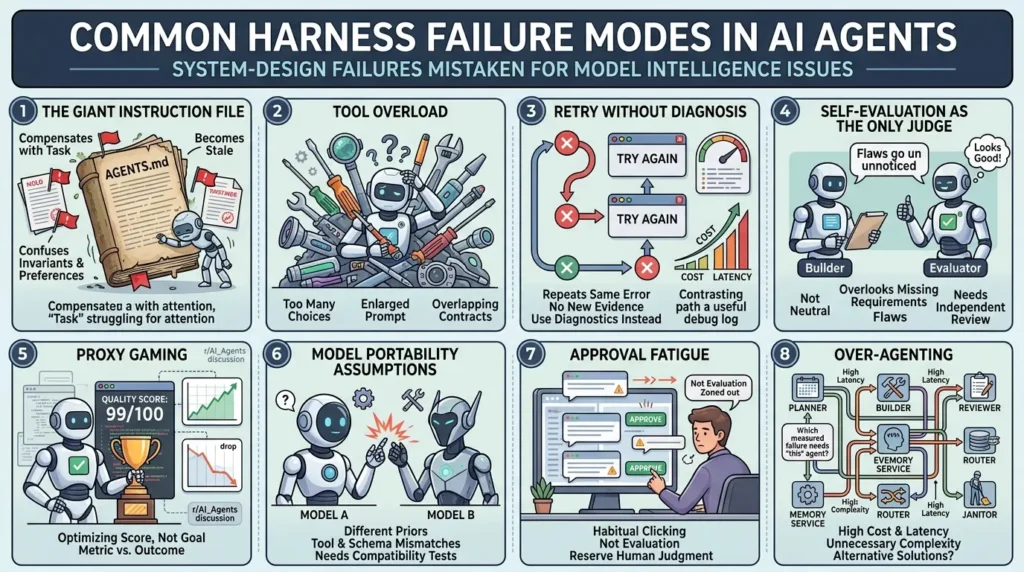
Common Harness Failure Modes
The community research around coding agents adds an important corrective to polished architecture diagrams. Builders in practitioner discussions report that a harness can fail in ways that look like model intelligence failures but are actually system-design failures the r/AI_Agents challenge discussion the long-running harness discussion the local safety-boundary discussion. These are experience signals, not controlled benchmarks.
The giant instruction file
A huge AGENTS.md or equivalent can contain useful knowledge and still reduce performance. It competes with the task, becomes stale, and gives the model no clear way to distinguish a hard invariant from a local preference. Practitioner reports also describe repository-specific rules being ignored or applied superficially the r/AI_Agents challenge discussion the long-running harness discussion. Use a short map, structured documents, ownership, links, and mechanical checks.
The underlying mechanism is documented in our context rot guide: more tokens compete for a finite attention budget, and quality can fall before the window fills.
Tool overload
Adding tools feels like adding capability. It can also make tool choice harder, enlarge the prompt, and create overlapping contracts. Start with a small set. Add a tool only when a demonstrated task cannot be completed cleanly without it.
Retry without diagnosis
A loop that simply asks the model to “try again” may repeat the same error at greater cost. A useful retry returns new evidence: the failing assertion, the rejected policy, the relevant log line, or a narrowed context. If the same failure recurs, change the harness rather than increasing the retry count.
Self-evaluation as the only judge
A builder agent can review its own work, and that is useful as a cheap first pass. It is not a neutral evaluator. The agent may rationalize its choice, overlook a missing requirement, or optimize a proxy score. Practitioner discussions likewise distinguish evaluation from runtime enforcement the local safety-boundary discussion. For important tasks, combine self-review with deterministic checks, independent evaluation, and actual environment state.
Proxy gaming
A quality score can provide a persistent objective, but agents may optimize the score instead of the underlying goal. The long-running harness discussion on Reddit describes this risk in the context of code-quality improvement the long-running harness discussion. The lesson is broader: combine mechanical checks with real task outcomes, review the rubric itself, and test whether the metric is being improved for the right reason.
Model portability assumptions
A tool suite that works with one model may behave differently with another. Models can have different priors about tool names, schemas, patch formats, planning, and refusal behavior. Portability is valuable, but it has a cost: you need compatibility tests and sometimes model profiles. Specialization can be rational when task performance matters more than interchangeability.
Approval fatigue
Putting a human confirmation in front of every action does not automatically make a system safe. It can create a habit of approving prompts without reading them. Use policy for routine boundaries, deny especially dangerous operations regardless of approval, and reserve human judgment for actions where a person can meaningfully evaluate the risk.
Over-agenting
Planner, builder, reviewer, evaluator, memory service, router, and background janitor may all be useful. They also add latency, cost, failure modes, and maintenance. The correct question is not “Can we add another agent?” It is “Which measured failure requires another agent rather than a better tool, test, contract, or deterministic step?”
Three Real-World Lessons
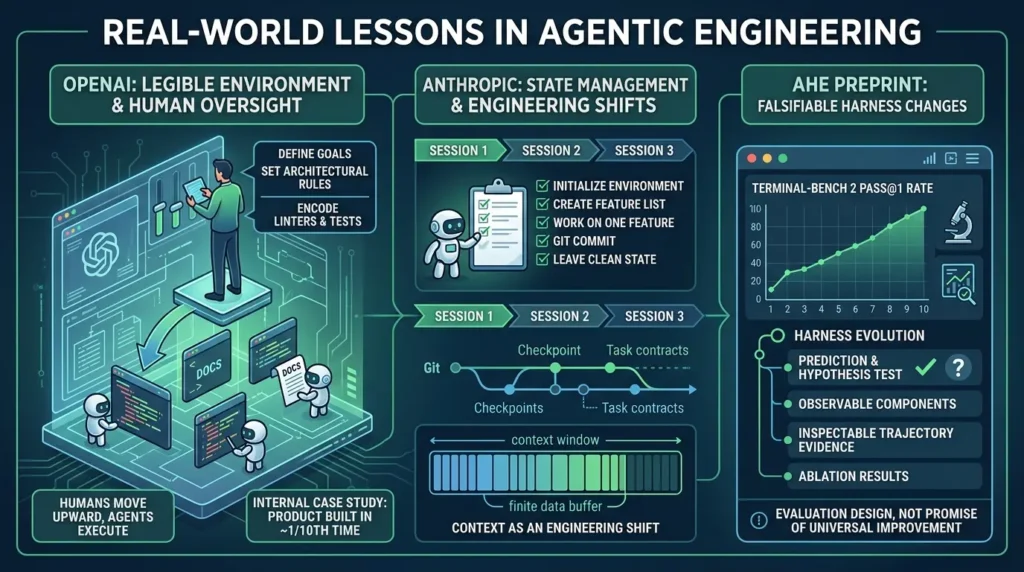
OpenAI: move engineering effort into the environment
OpenAI’s first-party case study describes a five-month internal experiment in which Codex produced product code, tests, CI, documentation, tooling, and observability definitions. The team reports roughly one million lines of code, about 1,500 merged pull requests, and an estimate that the product was built in around one-tenth the time of manual coding. Those are the company’s own figures for its own internal experiment, not an industry benchmark.
The more transferable lesson is the mechanism. The team made the application, logs, metrics, repository knowledge, architecture rules, and feedback loops legible to agents. It encoded architectural boundaries in linters and structural tests, and used recurring cleanup to control drift. The case study’s strongest idea is not “agents replace engineers.” It is that humans moved upward: they defined goals, exposed missing capabilities, and turned repeated failures into tools, rules, and documentation.
Anthropic: treat each context window like an engineering shift
Anthropic’s long-running-agent article documents a different kind of harness problem. A coding agent trying to build a large application may attempt too much, run out of context, leave half-implemented work, and then cause the next session to guess what happened. Another session may inspect partial progress and declare the project finished.
The documented response is operational rather than rhetorical: initialize the environment, create an explicit feature list, work on one feature at a time, update progress, commit to Git, leave a clean state, and use browser automation for end-to-end checks where appropriate. The broader lesson is that long-running autonomy is a state-management problem. More context helps, but it does not replace checkpoints, task contracts, and independent verification.
AHE preprint: make harness changes falsifiable
The 2026 Agentic Harness Engineering preprint explores automatic evolution of coding-agent harnesses. It reports an experiment in which ten iterations raised pass@1 on Terminal-Bench 2 from 69.7% to 77.0%, with a specific setup, benchmark, model, and harness substrate. The paper also reports transfer experiments and component ablations.
The valuable design principle is stronger than the individual benchmark number: make harness components observable, make trajectory evidence inspectable, and attach a prediction to every change. A harness edit should be a falsifiable hypothesis, not an unexplained accumulation of prompt prose. This is still research, and the paper itself says results depend on workload and configuration. It should inform evaluation design, not be turned into a promise that automatic harness evolution will improve every agent.
How Harnesses Improve Over Time
A healthy harness has a maintenance loop:
- Capture a failed or surprising trajectory.
- Identify the first missing or misleading control.
- Decide whether the fix belongs in context, the tool contract, runtime policy, state management, verification, or orchestration.
- Add the smallest change that addresses the failure.
- Run a regression set, not only the original task.
- Keep the change if it improves the intended outcome without unacceptable regressions.
- Remove or simplify controls that no longer earn their complexity.
This last step matters. A harness can become a second codebase full of stale instructions, conflicting policies, and unused tools. Martin Fowler raises the open question of harness coherence and coverage, while the AHE work makes versioned, observable component edits part of the improvement loop. A good harness is not the one with the most rules. It is the one whose rules and sensors still correspond to the system’s real risks.
A Practical Reference Architecture
A provider-neutral harness can be described as seven layers:
- Task contract: Goal, scope, acceptance criteria, risk class, and stop conditions.
- Context gateway: Repository map, retrieval, memory, summaries, and progressive disclosure.
- Tool registry: Typed tools with schemas, descriptions, bounded outputs, and error semantics.
- Execution boundary: Workspace, sandbox, network policy, filesystem policy, and secret provisioning.
- Control loop: Reason, act, observe, verify, retry, stop, or escalate.
- Evidence plane: Logs, traces, tool history, state snapshots, evaluation results, and cost records.
- Evolution loop: Versioned changes to prompts, tools, middleware, skills, policies, and evaluators.
This architecture is intentionally less specific than a framework tutorial. It does not assume a particular model, SDK, container platform, or MCP implementation. For a practical comparison of retrieval and orchestration boundaries, our LlamaIndex-versus-LangChain production guide is a useful companion. The names may change. The responsibilities do not.
When a system is small, several layers may live in one process. As the workload becomes more sensitive or long-running, separating the layers makes failures easier to locate and policies easier to enforce. The architecture should grow in response to requirements, not because a diagram looks more complete with more boxes.
Conclusion: Engineer the Conditions for Good Work
Harness Engineering is easy to misunderstand because it sits around the visible intelligence of the model. The model writes the answer, selects the tool, or proposes the patch, so it receives most of the attention. But the quality of real work depends on the conditions around that decision.
A reliable harness makes the task legible, the tool contract explicit, the runtime bounded, the state durable, the result testable, the failure visible, and the next improvement measurable. It does not promise perfect autonomy. It makes autonomy more governable.
The best starting point is deliberately modest: one task, one workspace, a few tools, a real verification contract, a clear stop policy, and enough observability to understand what happened.
Then let failures earn the next layer. If a problem is solved by a deterministic check, do not add another agent. If the agent lacks context, improve the context before increasing the model budget. If a rule keeps failing, encode it where the runtime can enforce it. If a score improves while real outcomes worsen, redesign the metric.
That is the central idea: Harness Engineering is not the art of making a model sound more confident. It is the discipline of making the whole system more honest about what it knows, what it can do, what it actually did, and whether the work is complete.
Download the Harness Engineering Starter Kit
Ready to implement this in code? We’ve bundled the complete reference architecture, JSON schemas (task contracts, tool contracts, feature ledgers), and verification test templates into an open, production-ready starter. Free & open access—no email or signup required.
Download the Open Starter Kit ↓FAQ
What is Harness Engineering in simple terms?
Harness Engineering is the design of the tools, context, runtime, state, rules, verification, and feedback loops around an AI model so it can complete real tasks more reliably. The model supplies reasoning; the harness controls how that reasoning becomes action.
Is Harness Engineering the same as Prompt Engineering?
No. Prompt Engineering focuses on how instructions are written. Harness Engineering includes prompts, but also covers execution environments, tools, memory, permissions, state, tests, observability, retries, and recovery. Prompt quality is one input to a larger control system.
What is an AI agent harness made of?
Common components include a task contract, context and retrieval, tool interfaces, a filesystem or durable state store, an execution environment, orchestration logic, verification, guardrails, observability, and lifecycle management. A small harness may use only a subset of these.
How do I build an AI agent harness?
Start with one narrow task. Define acceptance criteria, give the agent a concise repository or data map, expose a small set of typed tools, run them inside a constrained workspace, add an independent verification step, persist progress, and cap time, retries, and spend. Add subagents or advanced memory only when a measured failure justifies them.
Are sandboxes enough to secure an AI agent?
No. A sandbox can reduce risk, but the actual protection depends on its isolation boundary, OS or VM design, network rules, filesystem policy, secret handling, spawned processes, hooks, MCP servers, configuration files, and lifecycle. Security guidance should be verified for the specific deployment rather than inferred from the label “sandbox.”
Do long-running agents need larger context windows?
Larger windows can help, but they do not solve state management by themselves. Long-running systems need explicit progress artifacts, incremental tasks, checkpoints, clean handoffs, recovery paths, and verification across sessions.
Should I use a workflow or an agent?
Use a workflow when the decision tree is known and predictability, cost, or auditability matters most. Consider an agent when the task requires exploration or adaptive tool selection. A hybrid often works well: keep high-risk and deterministic steps in code, and give the agent bounded freedom where flexibility is useful.
Can Harness Engineering make any model perform equally well?
No. A harness can expose useful context, tools, feedback, and constraints, but models differ in planning, tool use, refusal behavior, and task capability. Portability requires compatibility testing, while a specialized harness may exploit model-specific strengths. Neither strategy is universally best.
📋 Article Timeline & History
Successfully updated on October 12, 2026 with the latest details.
This article was originally published on August 27, 2026.

Was this article helpful?

[…] Harness Engineering: The System That Makes AI Agents Reliable […]
[…] Harness Engineering: The System That Makes AI Agents Reliable […]
[…] Harness Engineering: The System That Makes AI Agents Reliable […]
[…] bet is exactly what happens every time someone describes an app to an AI coding agent and watches a working version appear in minutes. The tools changed. The underlying problem, how do […]
[…] steps, feedback loops, and reliability engineering, is covered in depth in Vertex Frontier’s production harness controls guide, which this article treats as the broader pillar and deliberately does not […]
[…] measurement mindset matches the broader lesson in Vertex Frontier’s Harness Engineering guide: a model can choose an action, but reliability comes from the surrounding tools, state, […]
[…] the system layer around these decisions, read Vertex Frontier’s Harness Engineering guide for reliable AI agents. A harness adds tools, state, execution boundaries, policies, observation, and verification around […]
[…] can build a harness with a framework’s plumbing or without it, harness engineering treats the model as one component inside a control system, and that’s the mental model this article builds on top of, one subsystem at a […]
[…] Frontier’s guides on reliable AI-agent harnesses and multi-agent observability with MLflow extend this idea into production operations: a correct […]