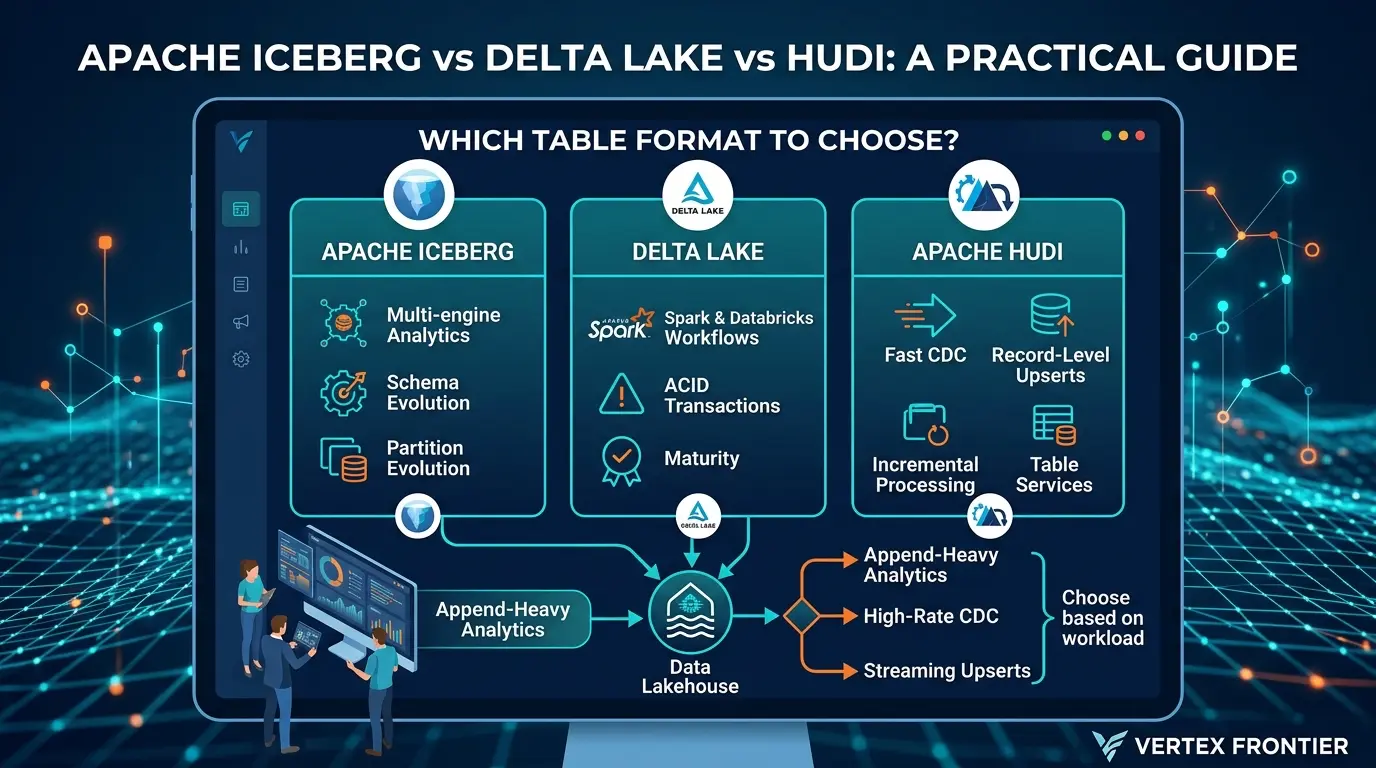

If you are comparing Apache Iceberg vs Delta Lake vs Hudi, you are probably not looking for another feature checklist. You want to know which format will behave well with your actual workload, your engines, your catalog, and the people who will operate it at 2 a.m. when a commit fails.
The honest answer is that there is no universal winner: Iceberg is a strong starting candidate for open, multi-engine analytics and tables that need schema or partition evolution. Delta Lake is a strong operational candidate for teams deeply invested in Databricks and Spark-centered workflows. Hudi deserves an early evaluation when fast record-level updates, CDC, incremental processing, and table services are central to the design.
These are workload-based hypotheses, not universal product rankings; the benchmark and compatibility checks later in this guide decide whether they hold in your environment.
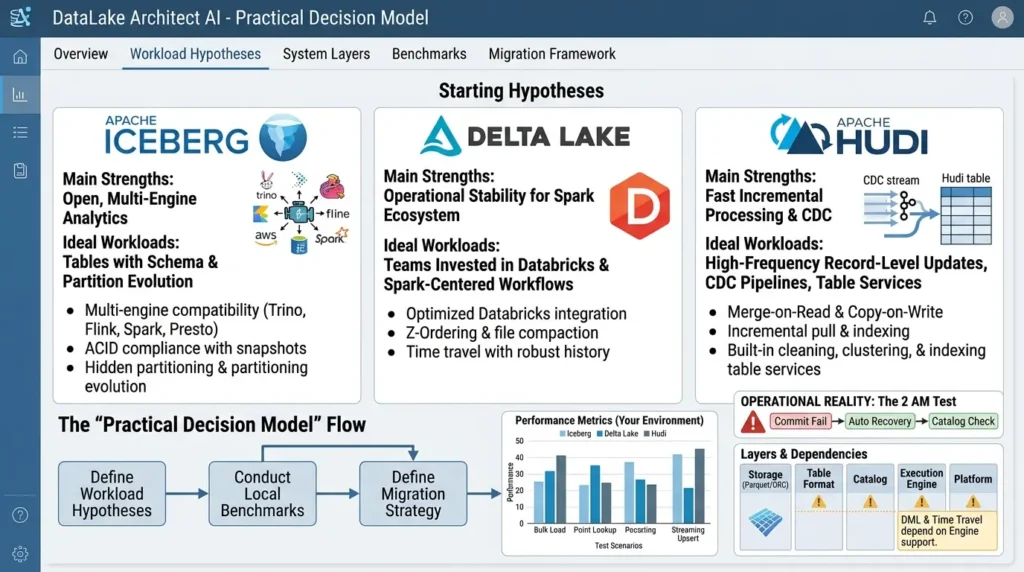
The difficult part is that the table format is only one layer of the system. A format can be open while a production feature depends on a particular engine. A table can be readable by an engine while DML, time travel, maintenance, permissions, or recovery remain incomplete. A benchmark can show one format winning because the test quietly favored its default write mode.
This guide uses a practical decision model rather than a universal ranking. It separates the table format from the storage files, catalog, execution engine, and managed platform; compares the three formats by workload and operating model; and gives you a benchmark and migration framework you can defend in a design review.
Key Takeaways
Click any topic to expand or collapseChoose format by specific workload requirements
Append-heavy analytics, Change Data Capture (CDC) pipelines, streaming upserts, and multi-engine concurrent reads lead to fundamentally different format architecture decisions.
Separate architectural layers clearly
Do not confuse a core table-format specification with query engine optimization, metastore catalog functionality, or managed cloud platform service layers.
Measure total operating cost & maintenance overhead
Data compaction, secondary indexing, snapshot retention policies, metadata growth, and disaster recovery procedures are integral parts of long-term query performance.
Maintain a production exit path & migration plan
A table format decision must document data migration paths, coexistence mechanisms, catalog ownership, and rollback strategies prior to production deployment.
Vertex Frontier Free Resource
Open Table Format Decision & Architecture Workbook
Compare Iceberg, Delta Lake, and Hudi using your actual workload, engine versions, maintenance model, benchmark evidence, and exit-path constraints.
No email required · 100% Free
The short answer: which format should you choose?
Use this as a first filter, not as the final architecture decision.
| If your dominant requirement is… | Start with… | Why | Validate before committing |
|---|---|---|---|
| Open, multi-engine analytics across Spark, Trino, Flink, and other readers | Iceberg | Its specification, catalog model, hidden partitioning, schema evolution, and partition evolution are designed for broad engine interoperability. See the Apache Iceberg documentation for the current supported concepts. | Test every required DDL, DML, time-travel, maintenance, and permission operation in your exact engine versions. |
| A Databricks-first or Spark-first platform with mature Delta workflows | Delta Lake | Delta is a natural fit when the surrounding platform, transaction-log tooling, optimization jobs, and governance already assume Delta. | Separate Delta open-format behavior from Databricks-only features and verify the readers outside that platform. |
| High-rate CDC, keyed upserts, incremental reads, and rapid ingestion | Hudi | Hudi is designed around mutable records, incremental processing, indexing, and table services. Its official FAQ describes the workload distinction clearly. | Measure ingestion latency together with compaction, indexing, query latency, and the operational burden of table services. |
| A format decision with no dominant workload or platform constraint | Run a controlled bake-off | The answer depends on operation mix, engine support, catalog ownership, file layout, and maintenance policy. | Use the benchmark protocol in this guide; do not compare vendor charts with different defaults. |
Decision rule: If you cannot name the workload, the writer, the readers, the catalog owner, and the maintenance owner, you are not ready to choose a table format. You are still choosing a platform story.
Apache Iceberg with Snowflake: Managed vs External Tables, Catalogs, Performance, and Cost
First, understand what these formats actually manage
Apache Iceberg, Delta Lake, and Apache Hudi are open table formats. They are not replacements for Parquet as a file encoding, and they are not query engines. They add a table-management layer around data files and metadata so a lake can support operations that are difficult to make reliable with a directory full of files.
The Delta Lake explanation of open table formats describes the common idea well: the data still lives in files such as Parquet, while metadata records table state, operations, and the information needed for reliable reads and writes. That layer enables features such as atomic commits, time travel, schema enforcement or evolution, and more effective data skipping.
A useful mental model has five layers:
| Layer | What it controls | Examples | Why confusing it causes bad decisions |
|---|---|---|---|
| Storage files | Physical rows, columns, encoding, compression, and file-level statistics | Parquet, ORC | A file format does not provide table commits, schema governance, or a durable snapshot history by itself. |
| Table format | Snapshots, commits, schema and partition metadata, row-level change semantics, and table maintenance model | Iceberg, Delta Lake, Hudi | A format may support a concept while your chosen engine or version exposes only part of it. |
| Catalog | Table identity, registration, namespaces, permissions, and metadata location | REST Catalog, Hive Metastore, AWS Glue, Unity Catalog, Nessie | Two teams can use the same format but have very different portability and governance outcomes. |
| Execution engine | SQL, scans, writes, merges, deletes, joins, planning, and maintenance procedures | Spark, Trino, Flink, Athena, Snowflake | “Readable” does not necessarily mean fully supported for DML, time travel, or maintenance. |
| Managed platform | Automation, optimization, governance, observability, and vendor-specific extensions | Databricks, AWS services, cloud lakehouse platforms | A platform advantage can be real without being a property of the underlying open table format. |
The practical consequence
When someone says “Delta is faster,” ask: faster in which engine, with which write mode, against which file layout, with what compaction state, and under which cache conditions? When someone says “Iceberg is open,” ask: open at the specification layer, the catalog layer, the engine layer, or the complete operating stack?
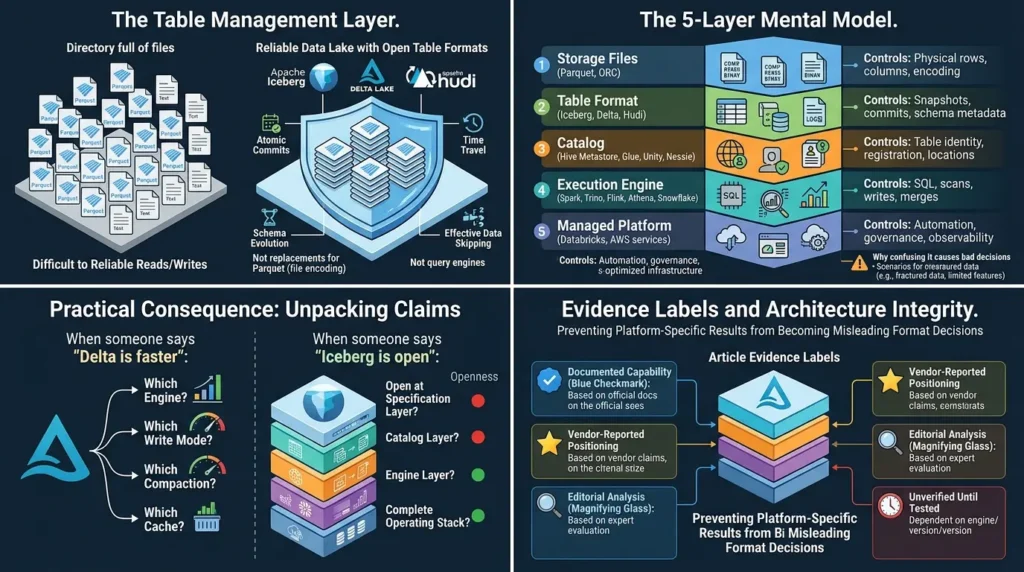
This article uses four evidence labels implicitly throughout: documented capability for claims supported by current project documentation, vendor-reported positioning for project descriptions of intended workloads, editorial analysis for the decision framework, and unverified until tested for compatibility or performance questions that depend on your exact engine and version.
That distinction is not pedantry. It is how you prevent a platform-specific result from becoming a misleading format decision.
Apache Iceberg vs Delta Lake vs Hudi: how the architectures differ
The three formats solve overlapping lakehouse problems, but they emphasize different operating models.
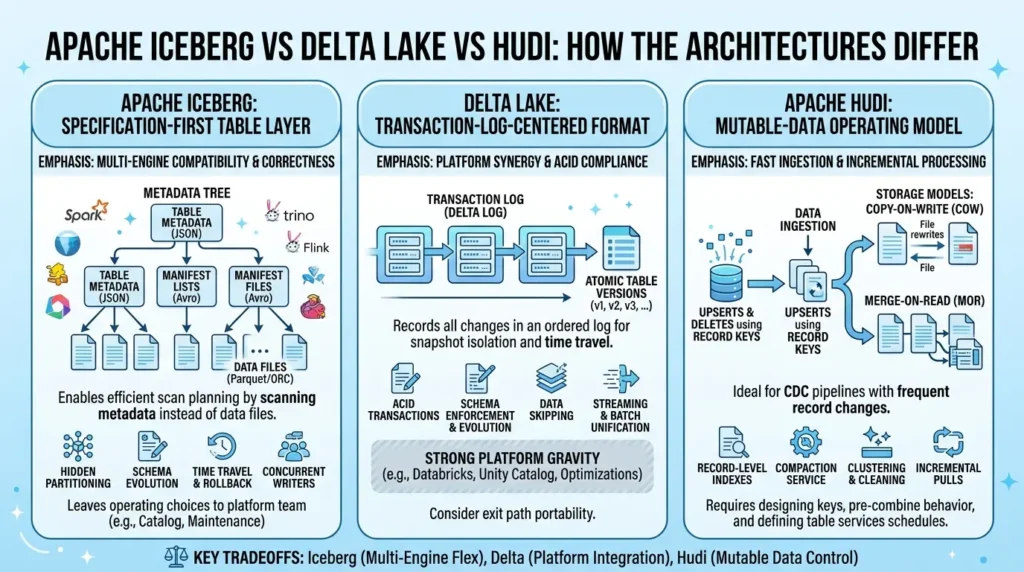
Apache Iceberg: a specification-first table layer for large analytic tables
Iceberg maintains table state through snapshots and metadata files. Its metadata tree includes JSON table metadata plus Avro manifest lists and manifest files that describe data files and their statistics. Engines can use this metadata to plan scans without opening every data file first. The Iceberg performance documentation explains how table metadata and data-file statistics support scan planning and filtering.
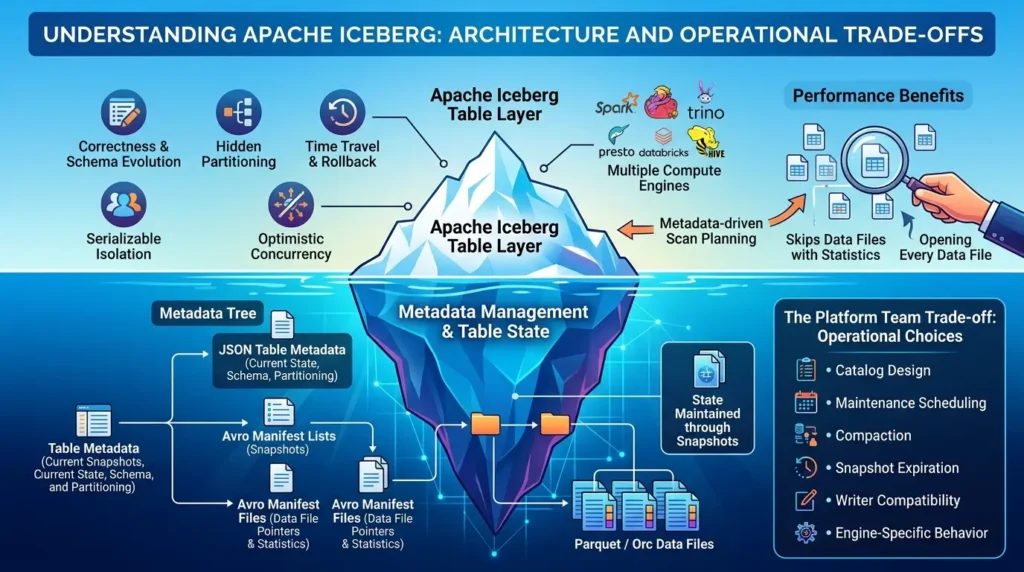
Iceberg’s design emphasizes correctness, schema evolution, hidden partitioning, partition-layout evolution, time travel, rollback, and concurrent writers. The official documentation describes serializable isolation, optimistic concurrency, and compatibility across multiple compute engines. That makes Iceberg attractive when the table must be read and operated by more than one engine over its lifetime.
The trade-off is not that Iceberg is “hard.” The trade-off is that a general-purpose, multi-engine table layer leaves more operating choices to the platform team: catalog design, writer compatibility, maintenance scheduling, compaction, snapshot expiration, and engine-specific behavior.
Delta Lake: a transaction-log-centered format with strong platform gravity
Delta Lake records table changes in a transaction log and uses that log to provide atomic table versions, time travel, schema enforcement or evolution, and data-skipping features. The Delta Lake documentation is the correct place to verify the current open-source feature surface rather than relying on a comparison article written for a different runtime version.
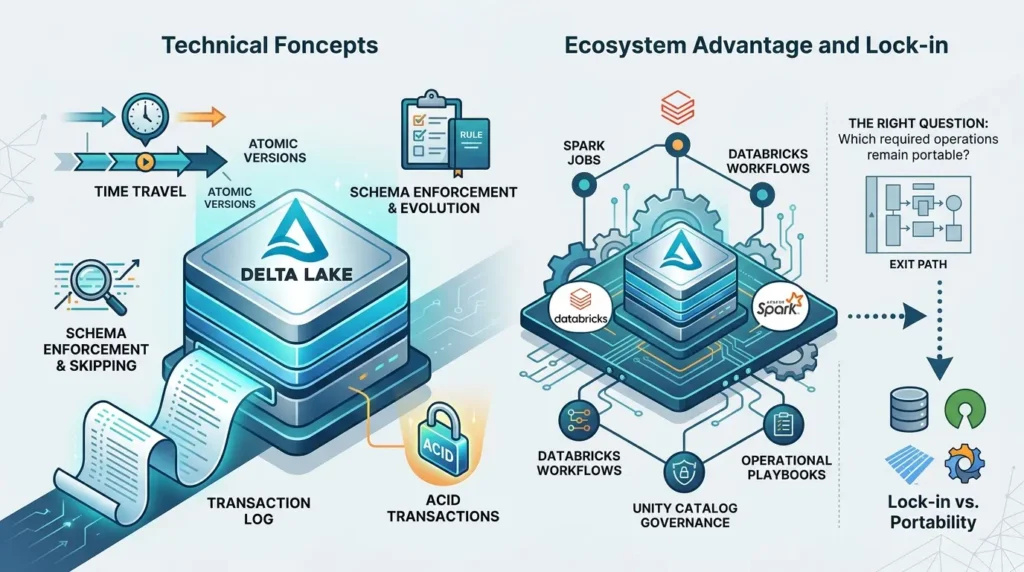
Delta’s practical strength is often its surrounding platform. If a team already runs Spark jobs, Databricks workflows, Delta-specific optimization, Unity Catalog governance, and operational playbooks, choosing Delta may reduce the number of new systems it has to learn and operate.
The current Delta Lake documentation describes ACID transactions, streaming and batch unification, time travel, upserts, deletes, and a connector ecosystem; the separate Delta update and delete guide and concurrency-control documentation are better sources for operation-level verification than a generic comparison table.
That advantage can also create lock-in pressure. The right question is not “Is Delta open?” It is “Which required operations remain portable when this table leaves the platform that made them convenient?” A Delta-centered architecture may still be the correct answer; it simply deserves an explicit exit-path decision.
Apache Hudi: a mutable-data operating model
Hudi was designed around fast ingestion, record-level upserts, deletes, incremental reads, indexing, and table services. Its official FAQ distinguishes Hudi’s mutable, CDC-oriented design from Iceberg’s scan-oriented analytic heritage and documents Hudi’s use of record keys, indexes, copy-on-write and merge-on-read storage, compaction, clustering, cleaning, and archival.
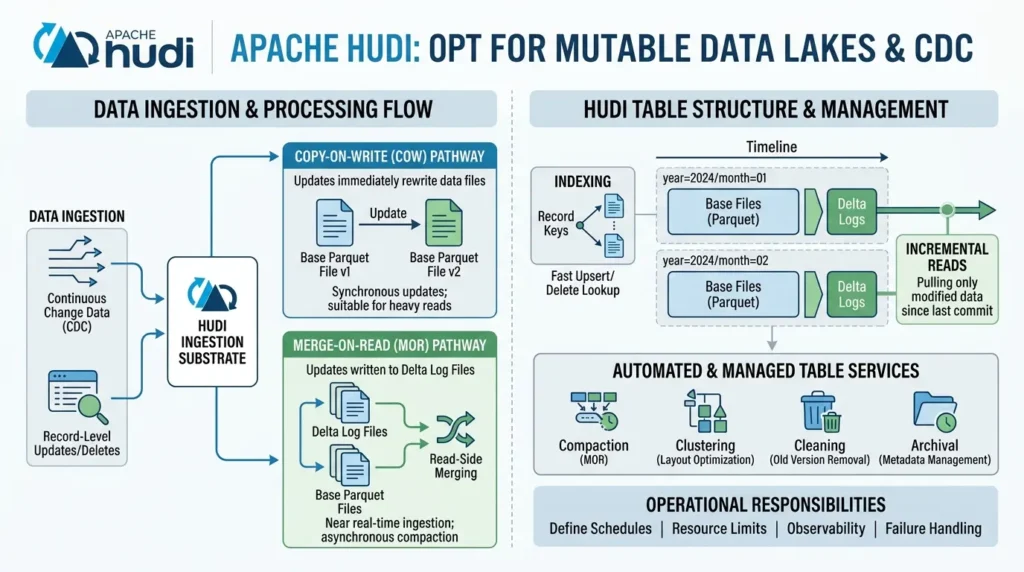
This is why Hudi is a strong candidate to test for a pipeline that repeatedly changes existing records rather than appending immutable events. The Hudi documentation describes record keys, incremental processing, indexes, and table services as central parts of its model. That is useful for CDC and deduplication, but it means the team must be comfortable designing keys, pre-combine behavior, ordering, deletes, and table services.
Hudi’s advantage is also its responsibility. Built-in services do not make maintenance disappear; they make it part of the table’s operating model. You still need to define schedules, resource limits, failure handling, observability, and ownership.
The comparison that matters: workload before features
The phrase “Iceberg vs Delta Lake vs Hudi performance” sounds like one question. It is actually several questions:
- How quickly can new data become queryable?
- How expensive are keyed updates and deletes?
- Does the workload need incremental reads rather than repeated full scans?
- What happens when the table receives a burst of updates to old partitions?
- How much write amplification is acceptable?
- Who pays the compaction and indexing cost?
- How many engines must read the result?
Workload decision matrix
| Workload pattern | Iceberg | Delta Lake | Hudi | Questions to test |
|---|---|---|---|---|
| Append-heavy event analytics | Strong fit when multiple engines and evolving partitions matter. | Strong fit in a Delta/Spark-centered platform. | Works, but Hudi’s mutable-data features may exceed what the workload needs. | How many readers? What is the retention and scan pattern? |
| High-rate CDC and keyed upserts | Possible, but validate delete-file behavior, reader cost, and compaction policy. | Strong in Spark/Databricks workflows; validate merge cost and runtime features. | Natural fit when record keys, indexes, incremental reads, and table services are central. | What is the update rate? Are keys stable? What is the latency target? |
| Streaming ingestion with frequent mutations | Validate small-file growth, delete-file planning, and asynchronous maintenance. | Validate streaming checkpointing, merge patterns, and optimization ownership. | Often attractive because incremental processing and table services are first-class concerns. | Can maintenance keep up without stealing resources from ingestion? |
| Multi-engine BI and ad hoc analytics | Often the first candidate; verify catalog and operation support across every engine. | Works when readers support Delta consistently; check portability requirements. | Works when readers understand the table and its snapshot/merge-on-read behavior. | Can every reader perform the operations, not just scan the files? |
| Data products with changing partition strategy | Strong fit where partition evolution and hidden partitioning reduce long-term rewrite pressure. | Validate the platform’s partitioning and clustering features separately from Delta itself. | Validate partition layout, clustering strategy, and the effect on old data. | Will today’s layout still serve next year’s queries? |
A practical workload test before you choose
Copy-on-Write vs Merge-on-Read: the trade-off behind many “performance” claims
Copy-on-Write rewrites affected data files when records change. That usually makes reads simpler because the latest table state is already materialized, but it can make writes expensive when a small logical change touches large files.
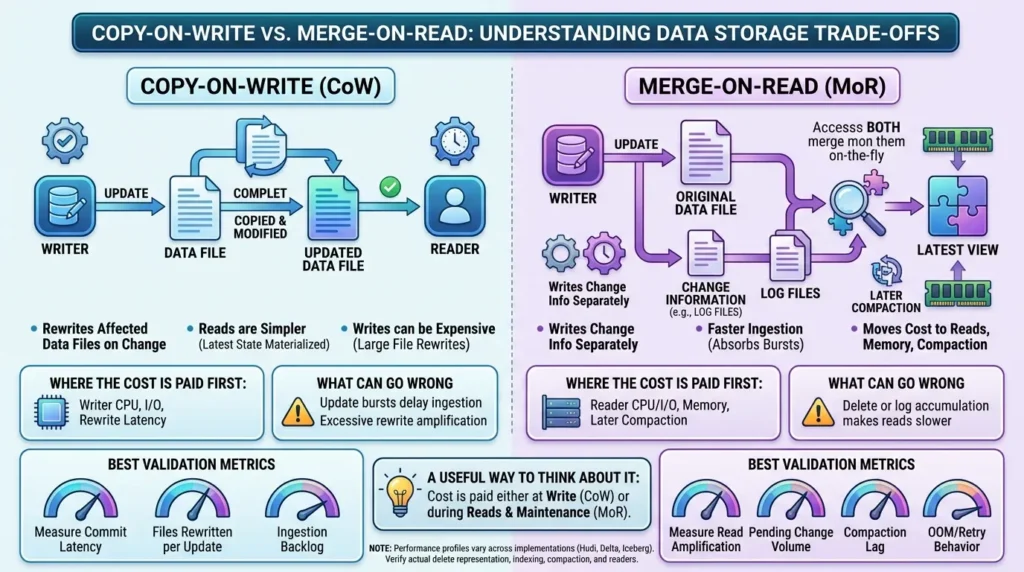
Merge-on-Read writes change information separately and merges it with base data during reads or later compaction. That can make ingestion faster and absorb bursts of updates, but it moves cost into query planning, read-time merging, memory, I/O, and compaction.
The names differ across implementations, so do not assume that “MoR” means the same performance profile in every engine. Check the actual delete representation, index behavior, compaction trigger, and reader implementation.
A useful way to think about it is:
| Choice | Cost paid first | What can go wrong | Best validation |
|---|---|---|---|
| Copy-on-Write | Writer CPU, I/O, and rewrite latency | Update bursts delay ingestion or create excessive rewrite amplification. | Measure commit latency, files rewritten per update, and ingestion backlog. |
| Merge-on-Read | Reader CPU/I/O, memory, and later compaction | Delete or log accumulation makes planning and reads slower than the original benchmark. | Measure read amplification, pending change volume, compaction lag, and OOM/retry behavior. |
The Hudi storage-type guidance is a useful example of how a project frames this choice: copy-on-write for simpler read-optimized behavior and merge-on-read when faster ingestion and asynchronous compaction are worth the operational trade-off. Apply the same reasoning when evaluating Delta and Iceberg implementations; do not transfer the Hudi defaults to another format without testing.
Benchmark warning: A write benchmark that measures only ingestion latency can reward merge-on-read while hiding the compaction and query cost that production will pay later.
CDC and incremental processing: where the decision becomes concrete
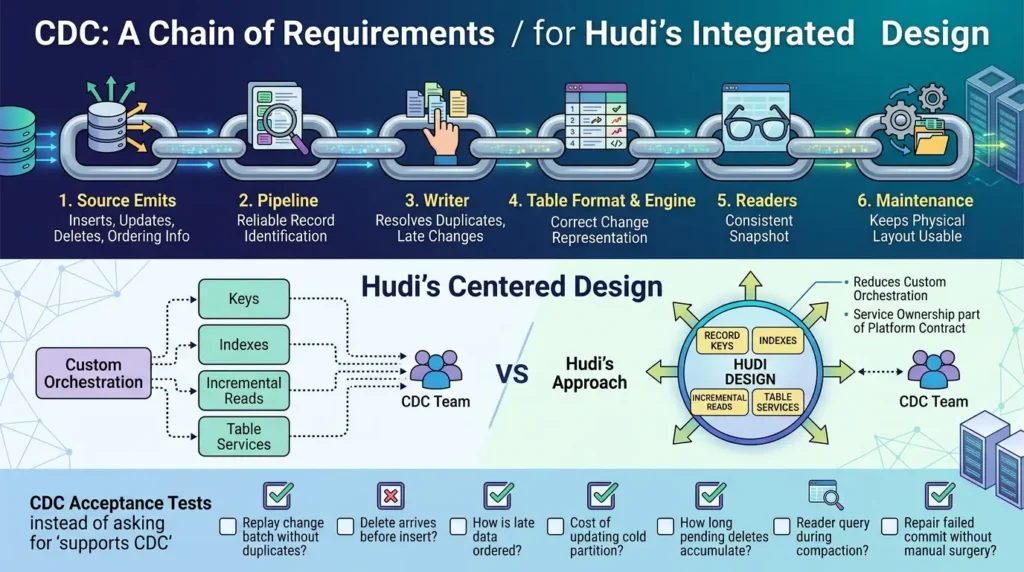
CDC is not one feature. It is a chain of requirements:
- The source must emit inserts, updates, deletes, and ordering information.
- The pipeline must identify a record reliably.
- The writer must resolve duplicates and late-arriving changes.
- The table format and engine must represent the change correctly.
- Readers must see a consistent snapshot.
- Maintenance must keep the physical layout usable.
Hudi’s design places record keys, indexes, incremental reads, and table services near the center of this chain. That can reduce the amount of custom orchestration a CDC team needs to build, but it also makes key design and service ownership part of the platform contract.
Iceberg and Delta also document update and delete workflows, but the real comparison depends on the exact engine, file and delete representation, and compaction path. The Delta update and delete documentation confirms the operation surface; it does not, by itself, prove a latency result for your data. A table that accepts a merge is not necessarily a table that will keep low-latency reads under a high update rate.
Use these acceptance tests instead of asking which format “supports CDC”:
- Can the pipeline replay the same change batch without creating duplicates?
- What happens when a delete arrives before the corresponding insert?
- How is late data ordered?
- What is the cost of updating a cold partition?
- How long can pending deletes or log records accumulate?
- Can a reader query the latest consistent state during compaction?
- Can the team inspect and repair a failed commit without manual file surgery?
Engine and catalog compatibility: the layer most comparison tables hide
An open table format is only useful if the engine and catalog can perform the operations your team needs. Build a matrix with one row per operation, not one row per engine.
| Operation | Iceberg | Delta Lake | Hudi | What to record |
|---|---|---|---|---|
| Read snapshot | Verify engine and catalog integration. | Verify transaction-log reader and runtime version. | Verify snapshot and table-type reader behavior. | Engine version, catalog, connector, and test query. |
| Append | Check commit conflict and file-size behavior. | Check schema enforcement and transaction-log behavior. | Check keying, deduplication, and write mode. | Throughput, commit latency, files per commit. |
| Update/delete | Check row-level change representation and reader merge behavior. | Check merge implementation and runtime-specific optimizations. | Check record keys, indexes, COW/MOR, and table services. | Read amplification, rewrite volume, and correctness under replay. |
| Time travel/rollback | Verify snapshot retention and rollback procedure. | Verify version history, retention, and runtime support. | Verify timeline, instant, and rollback semantics. | Recovery time, retention policy, and permissions. |
| Maintenance | Expire snapshots, remove orphan files, rewrite data files and manifests. | Validate vacuum, optimization, clustering, and platform-specific jobs. | Validate compaction, clustering, cleaning, archiving, and indexing. | Owner, schedule, resource budget, alert, and recovery path. |
| Governance | Check catalog identity, namespaces, permissions, and multi-engine policy. | Check catalog and platform governance separately from Delta. | Check metadata ownership and table-service permissions. | Who can write, alter, expire, compact, and restore? |
The word supported is too vague for a production matrix. Use three labels instead: readable, operationally supported, and owned by the platform team. A connector may read a table while the platform team cannot safely run deletes, maintenance, or rollback through that connector.
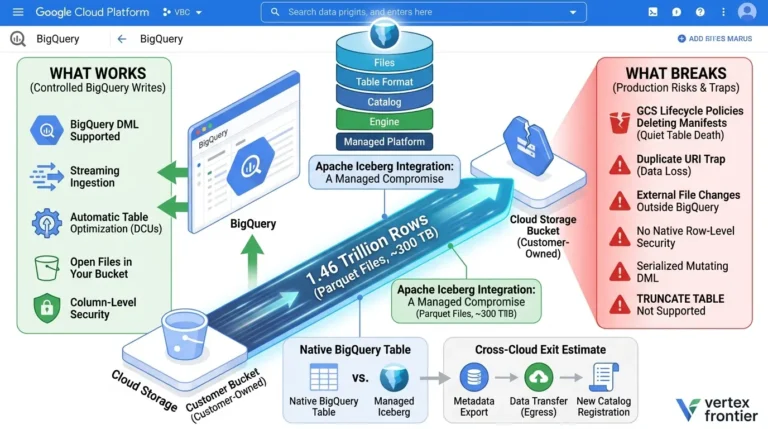
A concrete example of why this matters: our Apache Iceberg on BigQuery guide documents which table-management SQL, DML, and maintenance operations behave differently on BigQuery than in Spark-native stacks.
A dated compatibility baseline you can actually audit
Compatibility changes faster than comparison articles. The following baseline was checked against official project pages on August 19, 2026. It is a starting point for a test matrix, not a promise that every operation works in every managed service.
| Format | Official baseline checked | Engine/runtime evidence visible in the official material | What the baseline tells you | What you still must verify |
|---|---|---|---|---|
| Apache Iceberg | Iceberg 1.11.0, released May 19, 2026 | Official runtime artifacts list Spark 4.1, 4.0, and 3.5, plus Flink 2.1, 2.0, and 1.20 bundles. | The project publishes engine-specific runtime artifacts instead of treating “Iceberg support” as one undifferentiated state. | Catalog, DDL/DML, branches, deletes, maintenance procedures, and connector behavior in your exact engine release. |
| Delta Lake | Current Delta Lake documentation; the official porting guide records version boundaries rather than one universal runtime. | The docs describe Spark-first capabilities and connectors/readers for Spark, Flink, Hive, Trino, Athena, and other engines. | Delta compatibility is particularly sensitive to the library/runtime and the platform around it. The porting guide documents changes around Delta 3.0, 2.2, 2.1, and earlier boundaries. | Pin the delta-spark version, connector, catalog, deletion/merge features, retention behavior, and non-Databricks reader semantics. |
| Apache Hudi | Hudi 1.2.0 release notes and the current quick-start documentation | The official quick start lists Spark 4.1, 4.0, 3.5, 3.4, and 3.3 support for the 1.2.x line, with Flink 2.1 support described in the release material. | Hudi’s support matrix is tied to bundle and engine combinations, and the table-service surface is part of the compatibility story. | Record keys, indexes, COW/MOR behavior, compaction, clustering, cleaner, catalog sync, and reader support for every table type. |
The safest way to publish this table on your own site is to add a review date, a verified project URL, and the exact connector version beside every compatibility claim. The word “supports” should never survive a release review without an operation attached to it.
Maintenance is part of the format decision, not housekeeping
Every format creates an operating model. The question is whether the work is explicit and scheduled, built into table services, delegated to a managed platform, or quietly left for someone to discover later.
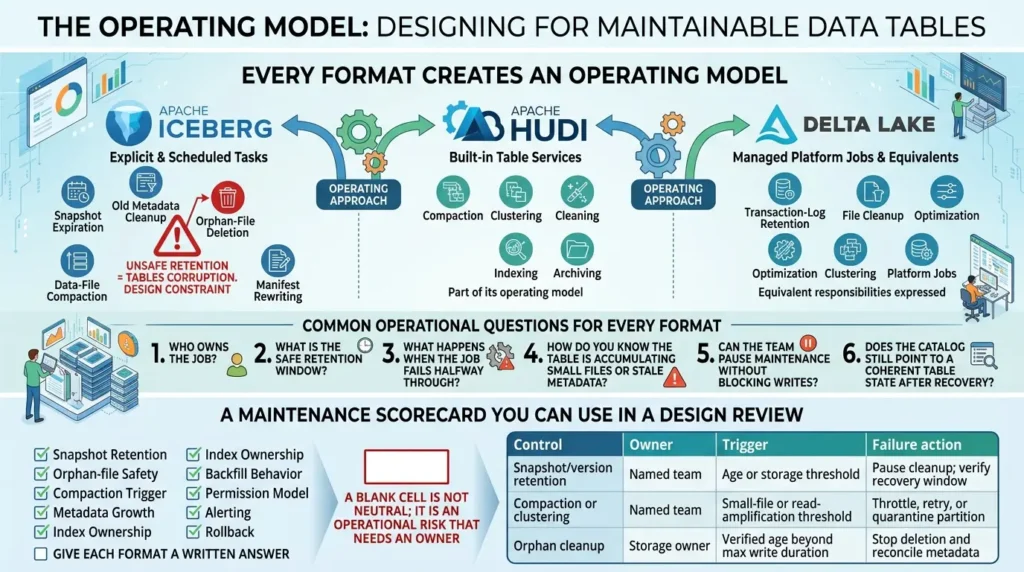
For Iceberg, the official maintenance guide documents snapshot expiration, old metadata cleanup, orphan-file deletion, data-file compaction, and manifest rewriting. It also warns that deleting orphan files with an unsafe retention interval can corrupt a table if an in-progress write is mistaken for an orphan. That is a design constraint, not a footnote.
For Hudi, table services such as compaction, clustering, cleaning, indexing, and archiving are part of its operating model. For Delta, the equivalent responsibilities may be expressed through transaction-log retention, file cleanup, optimization, clustering, and platform jobs. The names differ, but the questions are the same:
- Who owns the job?
- What is the safe retention window?
- What happens when the job fails halfway through?
- How do you know the table is accumulating small files or stale metadata?
- Can the team pause maintenance without blocking writes?
- Does the catalog still point to a coherent table state after recovery?
A maintenance scorecard you can use in a design review
Give each format a written answer for snapshot retention, orphan-file safety, compaction trigger, metadata growth, index ownership, backfill behavior, permission model, alerting, and rollback. A blank cell is not neutral; it is an operational risk that still needs an owner.
| Control | Owner | Trigger | Failure action |
|---|---|---|---|
| Snapshot/version retention | Named team | Age or storage threshold | Pause cleanup; verify recovery window |
| Compaction or clustering | Named team | Small-file or read-amplification threshold | Throttle, retry, or quarantine partition |
| Orphan cleanup | Storage owner | Verified age beyond max write duration | Stop deletion and reconcile metadata |
A fair benchmark protocol for Iceberg, Delta Lake, and Hudi
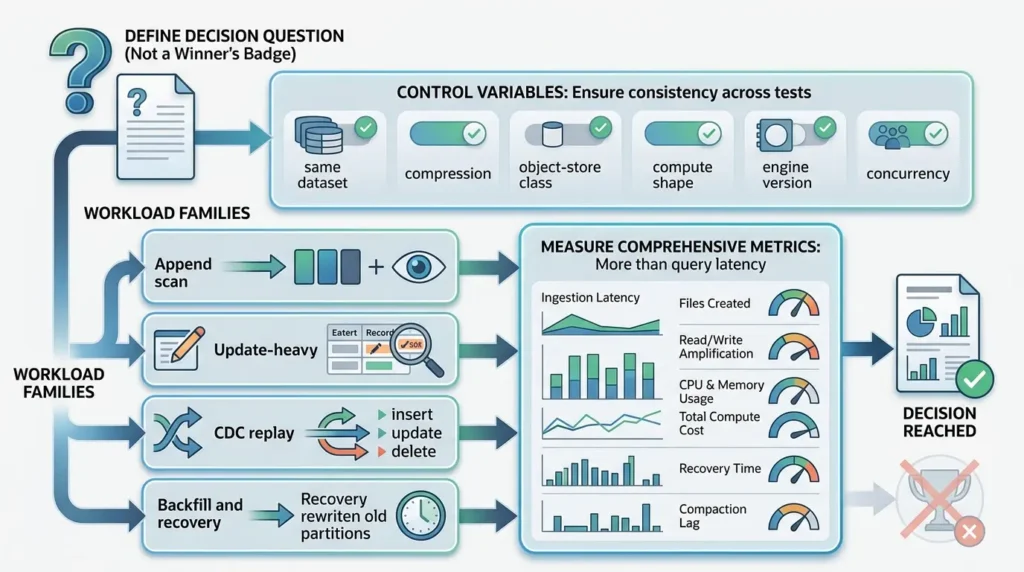
A benchmark should answer a decision question, not produce a winner’s badge. Before you run it, write down what decision the result will change.
Control the variables
Use the same logical dataset, object-store class, compression assumptions, partition intent, record distribution, compute shape, engine version, concurrency level, cache state, and maintenance policy where comparison is technically possible. If a format requires a different operating model, do not hide that difference; record it as part of the result.
Run at least four workload families:
- Append scan: append data, then measure scan planning and query latency.
- Update-heavy: update a fixed percentage of existing records and measure write amplification.
- CDC replay: replay inserts, updates, deletes, duplicates, and late events.
- Backfill and recovery: rewrite older partitions, interrupt a commit or maintenance job, and measure recovery.
Measure more than query latency
Record ingestion latency, commit latency, files created, file-size distribution, metadata size, read amplification, compaction lag, CPU and memory, object-store requests, failed retries, recovery time, and total compute cost. If you measure only the first successful query, you are measuring a demo.
A benchmark-result template for the final report
Do not fill this table with a single “winner” number. Use one row per test and keep the conditions visible when the result is copied into an architecture record.
| Test ID | Workload | Format + version | Engine + version | Operation mix | Primary metric | Result | Cost / resource | Maintenance state | Decision note |
|---|---|---|---|---|---|---|---|---|---|
| B-01 | Append scan | ________ | ________ | Append: ___% | p95 query latency | ________ | ________ | Cold / warm / compacted | ________ |
| B-02 | CDC replay | ________ | ________ | U: ___% / D: ___% / late: ___% | ingest-to-query lag | ________ | ________ | Pending changes: ___ | ________ |
| B-03 | Backfill + recovery | ________ | ________ | Backfill: ___ TB | recovery time | ________ | ________ | Interrupted at: ________ | ________ |
Every blank is deliberate. The template prevents a benchmark from becoming an unsupported performance claim and makes the cost of maintenance visible beside the latency result.
Benchmark worksheet: what must be in the report?
Record the dataset size and cardinality, update ratio, delete ratio, key distribution, partition layout, file target size, compression, engine and connector versions, cluster shape, cache policy, concurrency, maintenance schedule, retention settings, object-store request cost, and the exact queries. Attach the table properties and write options. If another engineer cannot reproduce the test from the report, the result is evidence of a run—not a benchmark protocol.
Migration, coexistence, and the exit path
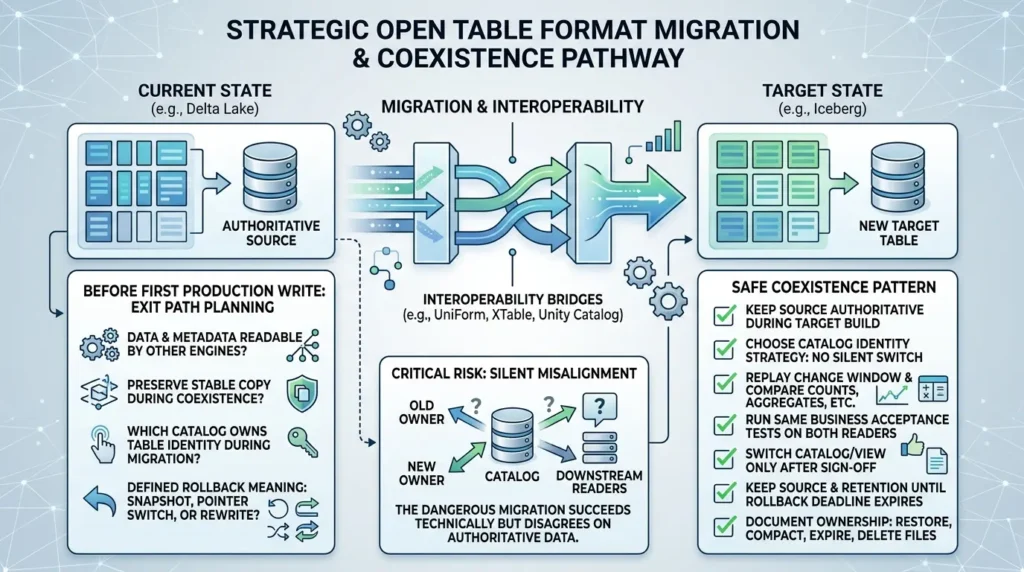
A table-format decision is easier to reverse when the team plans the exit path before the first production write. The exit plan should answer four questions:
- Can another engine read the data and metadata?
- Can the team preserve a stable copy during coexistence?
- Which catalog owns the table identity during migration?
- What does rollback mean: restore a snapshot, switch a catalog pointer, or rewrite data into another format?
Interoperability projects are evolving. The Delta Lake overview of open-table-format interoperability discusses projects such as UniForm, XTable, and Unity Catalog that aim to bridge formats. Hudi’s official FAQ also describes using Apache XTable to translate Hudi metadata into Iceberg metadata in place for certain table types. These are useful capabilities, but they should not be treated as a universal interchange guarantee. Verify the table type, engine, catalog, feature coverage, and rollback behavior in your environment.
A safe coexistence pattern
- Keep the source table authoritative while the target is built or exposed.
- Choose a catalog identity strategy so readers do not silently switch formats.
- Replay a bounded change window and compare counts, aggregates, null rates, duplicate keys, and representative queries.
- Run both readers against the same business acceptance tests.
- Switch the catalog or view only after the acceptance record is signed.
- Keep the source and its retention window until the rollback deadline expires.
- Document which team can restore, compact, expire, and delete files in each state.
The most dangerous migration is not the one that fails loudly. It is the one that succeeds technically while the old owner, new owner, catalog, and downstream readers disagree about which table is authoritative.
Three worked scenarios: how the answer changes
These are decision scenarios, not claims that one format wins everywhere.
Scenario 1: A multi-engine analytics lake
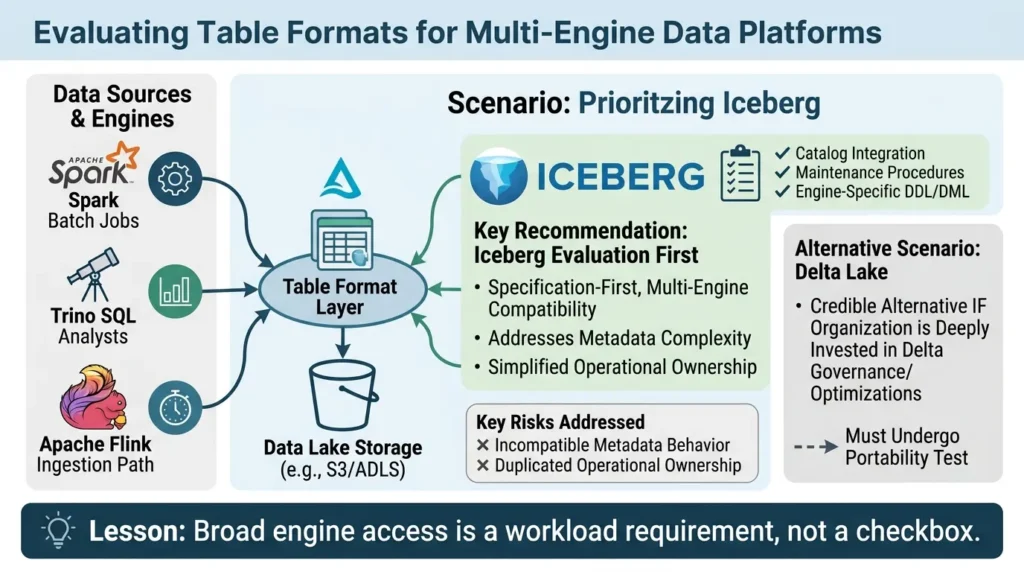
A platform team serves Spark batch jobs, Trino analysts, and a Flink ingestion path. The tables are mostly append-oriented, but the team expects partition and schema changes as products grow. The key risk is not raw write latency; it is incompatible metadata behavior and duplicated operational ownership.
In this scenario, Iceberg deserves the first evaluation because a specification-first, multi-engine table layer aligns with the platform’s main constraint. The team should still test the catalog, row-level changes, maintenance procedures, and engine-specific DDL/DML.
If the organization is already deeply invested in Delta-native governance and optimization, Delta remains a credible alternative, but the portability test becomes part of the decision.
Lesson: broad engine access is a workload requirement, not a checkbox.
Scenario 2: A Databricks-centered lakehouse
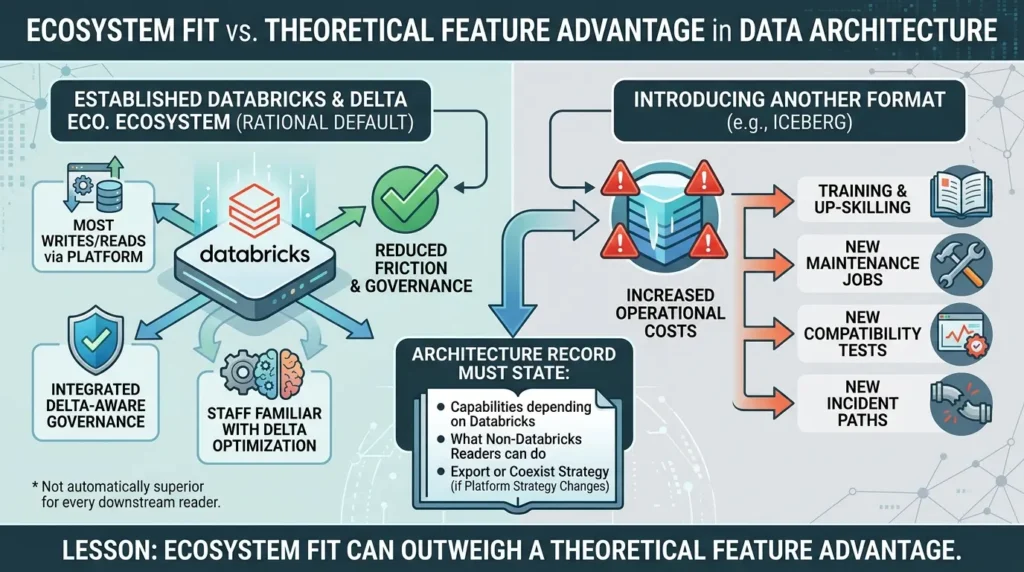
A data organization runs most writes and reads through Databricks, uses Delta-aware governance, and has operational staff familiar with Delta optimization. The cost of introducing another format includes training, new maintenance jobs, new compatibility tests, and new incident paths.
Here Delta may be the rational default because the surrounding platform reduces execution and governance friction. That does not make it automatically superior for every downstream reader. The architecture record should state which capabilities depend on Databricks, what non-Databricks readers can do, and how the team would export or coexist if platform strategy changed.
Lesson: ecosystem fit can outweigh a theoretical feature advantage.
Interview tip: While open table formats bridge the lakehouse gap, interviewers still evaluate how you design downstream analytical marts. For questions on grain, star vs. snowflake schemas, and metric consistency, check our Data Warehouse Interview Questions guide.
Scenario 3: A CDC pipeline with keyed mutable records
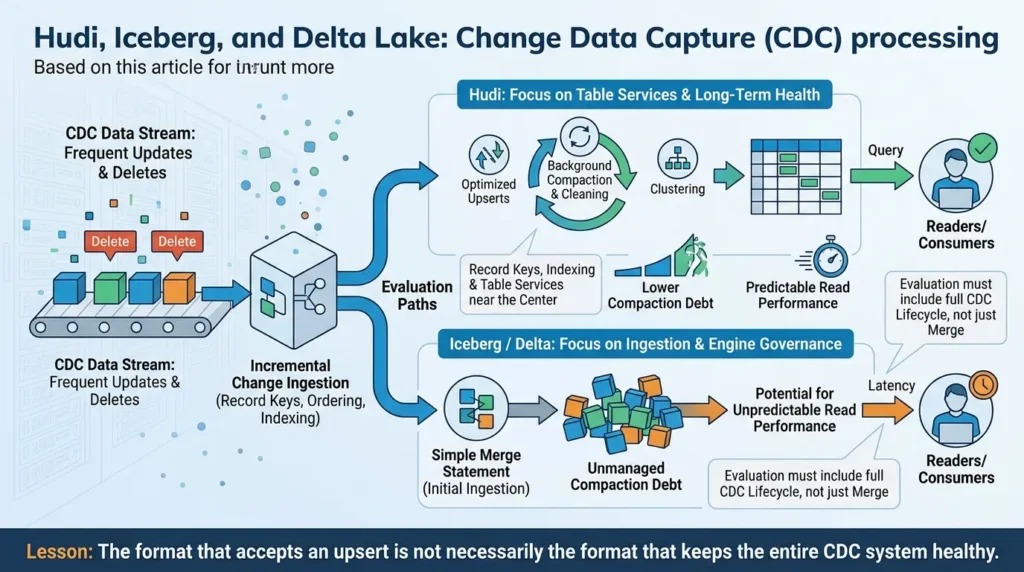
A product database emits frequent updates and deletes. Consumers need incremental changes, duplicates must be resolved by key and ordering, and ingestion latency matters more than simple full-table scans. The main risk is letting delete and compaction debt grow until reads become unpredictable.
Hudi deserves a serious evaluation because its design puts record keys, incremental processing, indexing, and table services near the center. The team must test whether its key model matches the source, whether table services keep up, and whether every reader understands the resulting table state.
Iceberg or Delta may still be right if the organization’s engines and governance make them cheaper to operate, but the evaluation must include the full CDC lifecycle rather than a single merge statement.
Lesson: the format that accepts an upsert is not necessarily the format that keeps the entire CDC system healthy.
Common mistakes when comparing the three formats
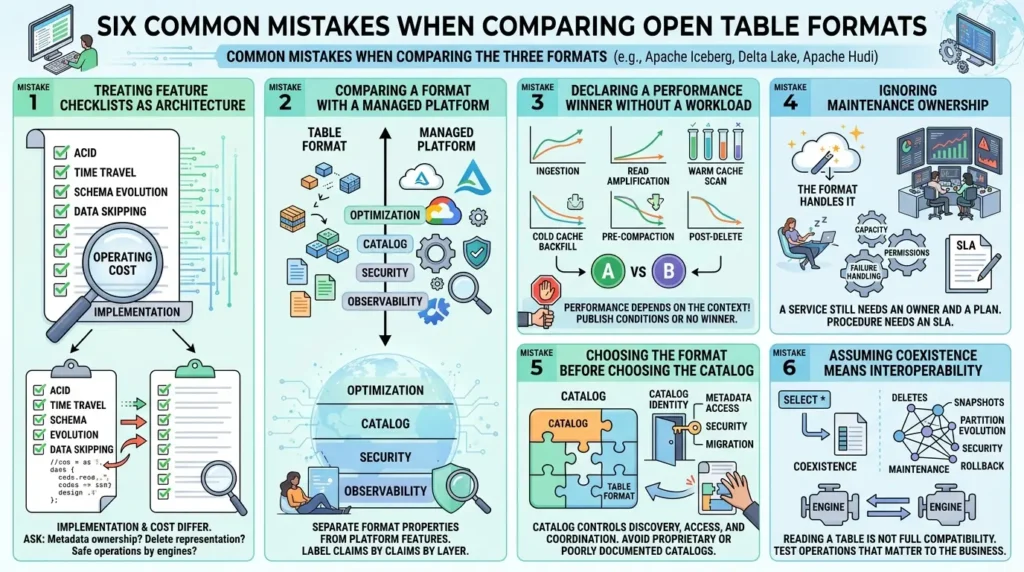
Mistake 1: Treating feature checklists as architecture
ACID, time travel, schema evolution, and data skipping appear across the market. They matter, but the implementation and operating cost still differ. Ask who owns the transaction metadata, how deletes are represented, and which engine can perform the operation safely.
Mistake 2: Comparing a format with a managed platform
Databricks, AWS, Snowflake, and other platforms may provide optimization, catalog, security, and observability features that are not properties of the table format itself. Label each claim by layer.
Mistake 3: Declaring a performance winner without a workload
A format can win ingestion and lose read amplification. It can win a warm-cache scan and lose a cold-cache backfill. It can look efficient before compaction and expensive after delete-file accumulation. Publish the conditions or do not publish the winner.
Mistake 4: Ignoring maintenance ownership
A built-in table service still needs capacity, alerts, permissions, and failure handling. A manual maintenance procedure still needs an owner and an SLA. “The format handles it” is not an operating plan.
Mistake 5: Choosing the format before choosing the catalog
Catalog identity controls how engines find the table, who can alter it, and how migration is coordinated. A technically portable format can still become operationally difficult if the catalog is proprietary or poorly documented.
Mistake 6: Assuming coexistence means interoperability
Reading a table from another engine is not the same as preserving deletes, snapshots, partition evolution, security, maintenance, and rollback. Test the operations that matter to the business, not just SELECT *.
A decision record you can take to the architecture review
Complete these statements in writing:
- Our dominant workload is __________, and its update/delete ratio is __________.
- The required freshness target is __________.
- The writers are __________, and the readers are __________.
- The catalog owner is __________.
- The maintenance owner is __________.
- The table must support these operations: __________.
- The acceptable recovery time is __________.
- The benchmark will control __________.
- The rollback path is __________.
- We will reconsider the choice if __________ changes.
Which format should a platform team shortlist?
Shortlist Iceberg when multi-engine portability, schema evolution, partition evolution, and large-scale analytics are the center of gravity. Shortlist Delta Lake when the team’s platform, governance, and operating muscle are already Delta/Spark-centered. Shortlist Hudi when keyed mutations, CDC, incremental reads, indexing, and table services are the core problem. If two or more answers apply, run the controlled bake-off instead of forcing a universal winner.
When none of the three is the right answer
An open table format is not a universal replacement for every storage and serving system. If the workload needs high-concurrency OLTP, strict row-level constraints, transactional point updates, cross-table transaction boundaries, or sub-second serving with predictable indexed lookups, a relational database, key-value store, search system, or serving warehouse may be a better layer.
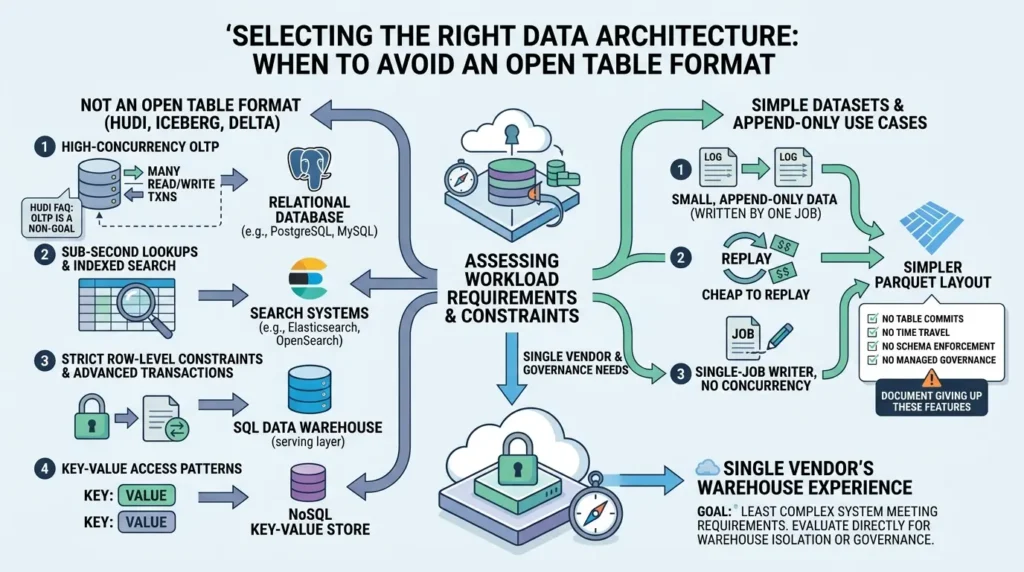
Hudi’s own FAQ explicitly describes OLTP as a non-goal, which is a useful reminder that “supports updates” does not mean “is an OLTP database.” The same boundary should be applied to Iceberg and Delta: table-level transactional behavior is not a promise of full relational database semantics.
You may also choose none of the three when the data is small, append-only, written by one trusted job, and already cheap to replay. In that case, a simpler Parquet layout can be reasonable if the team does not need table-level commits, time travel, schema enforcement, concurrent writers, or managed governance. The decision should be intentional: document what you are giving up and when the dataset will cross the threshold that justifies a table format.
Finally, if the primary requirement is a single vendor’s warehouse isolation, semantic layer, or governed serving experience, evaluate that warehouse directly instead of treating a lake table format as a substitute. The goal is not to make every dataset look like a lakehouse table. The goal is to give each workload the least complex system that still meets its correctness and operating requirements.
Final verdict: choose the operating model you can maintain
The most useful answer to Apache Iceberg vs Delta Lake vs Hudi is conditional.
Choose Iceberg when the platform needs an open, multi-engine table layer and the team is willing to own catalog, compatibility, and maintenance discipline.
Choose Delta Lake when the organization’s existing platform and operational muscle make Delta the lowest-risk path, especially in a Databricks- or Spark-centered environment.
Choose Hudi when mutable records, CDC, incremental processing, indexing, and table services are the main problem, not side features.
Then test the decision against the part that comparison articles usually underplay:
- what happens after the first successful write?
- Who expires history?
- Who compacts files?
- Who repairs a failed commit?
- Who owns the catalog?
- How does a second engine read the table?
- What is the rollback path?
- Which costs grow when the workload changes?
A format decision that answers those questions is more valuable than a table that declares a winner. It gives the team a system it can operate, measure, and leave safely if the assumptions change.
Choosing between Iceberg, Delta, and Hudi is also a common senior interview question, see how to frame the answer in our Data Engineering Interview Questions & Answers guide.
For ETL-specific preparation that drills into CDC, incremental loading, and pipeline recovery, see our 50-question ETL Interview Questions guide.
Make your format decision review-ready
Ready for your architecture review?
Turn the comparison into a documented decision with workload scoring, compatibility checks, benchmark fields, maintenance ownership, and an explicit exit path.
Free download · No email required
Frequently asked questions
Is Apache Iceberg better than Delta Lake?
What is the main difference between Hudi and Iceberg?
Which table format is best for CDC and streaming upserts?
Which format is best for Databricks?
Can Iceberg, Delta Lake, and Hudi use the same Parquet files?
What should a fair Iceberg vs Delta vs Hudi benchmark measure?
Does an open table format remove the need for a data warehouse?
📋 Article Timeline & History
Successfully updated on October 16, 2026 with the latest details.
This article was originally published on August 20, 2026.

Was this article helpful?



[…] Apache Iceberg vs Delta Lake vs Hudi: Which Table Format Should You Choose? […]
[…] Apache Iceberg vs Delta Lake vs Hudi: Which Table Format Should You Choose? […]
[…] Apache Iceberg vs Delta Lake vs Hudi: Which Table Format Should You Choose? […]
[…] Apache Iceberg vs Delta Lake vs Hudi: Which Table Format Should You Choose? […]
[…] The comparison above is BigQuery-specific: both Delta Lake and Hudi support broader native read/write capability on their home platforms. For the full format-level comparison, architecture, ecosystem maturity, and engine support beyond BigQuery, see Apache Iceberg vs. Delta Lake vs. Hudi. […]