
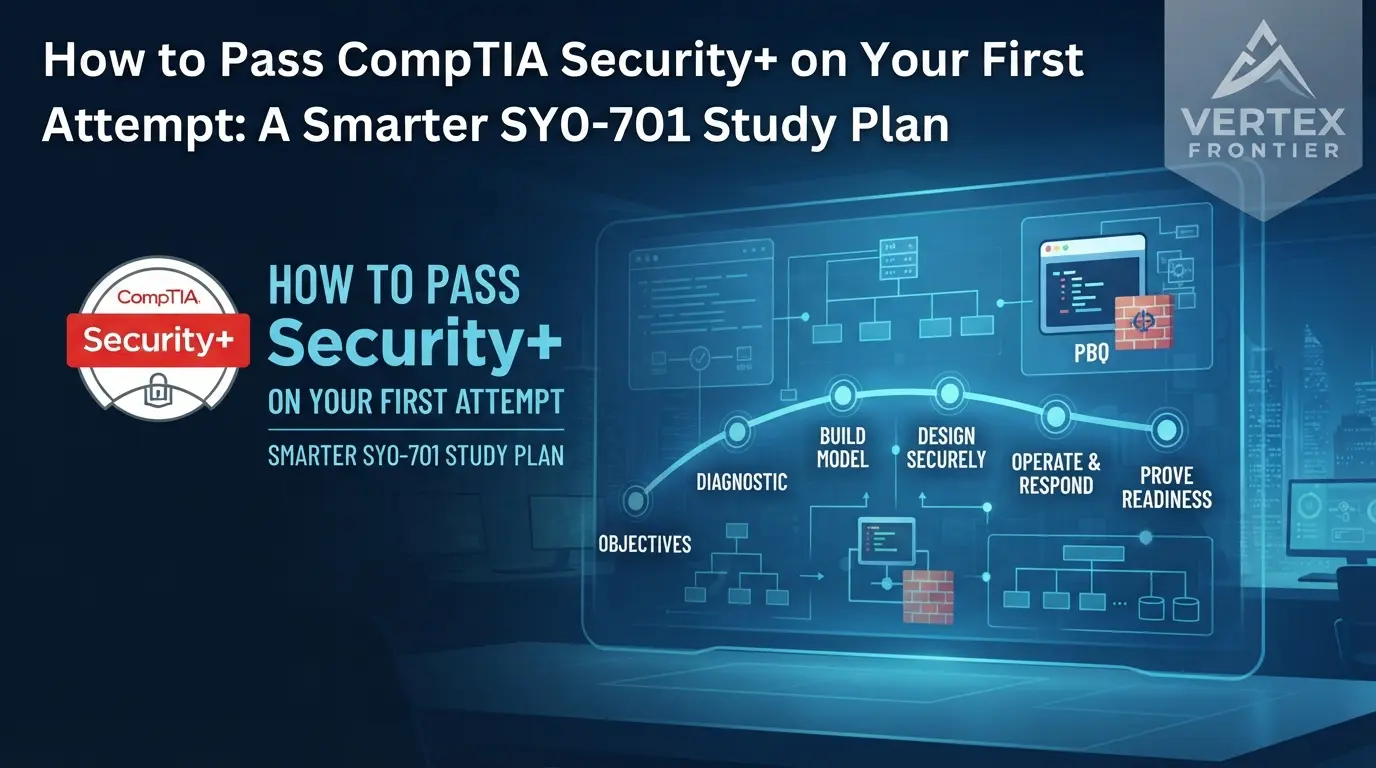

If you are searching for a Security+ study plan, you probably want more than another list of videos and practice tests. You want to know what to study, how much is enough, whether your practice scores mean anything, and what to do when the exam presents a scenario you have never seen before.
That is the real problem with most Security+ advice: it treats preparation as a content-collection exercise. Add one course, one book, six practice exams, a stack of flashcards, and hope the combination produces a passing score.
A better approach is to treat the exam as a readiness problem. You need evidence that you can explain the objectives, apply them in unfamiliar scenarios, review your own mistakes, and work under time pressure. A high score on one familiar question bank is not enough.
This guide gives you that framework. It covers the SY0-701 exam structure, the five official domains, a flexible study plan, performance-based questions (PBQs), practice-score interpretation, resource selection, common failure modes, and the difference between earning a certification and becoming employable in security.
Key takeaways
Click any topic to expand or collapseWhat is CompTIA Security+ SY0-701?
CompTIA Security+ is a vendor-neutral cybersecurity certification. “Vendor-neutral” means the objectives focus on concepts that apply across tools and platforms: identity, access control, network security, cryptography, risk, incident response, governance, and secure operations.
It does not mean that passing the exam proves you can operate every firewall, SIEM, cloud platform, or identity product in production. The certification gives you a broad security vocabulary and a structured baseline. Hands-on ability still needs to be built through labs, work experience, projects, or a role-specific training path.
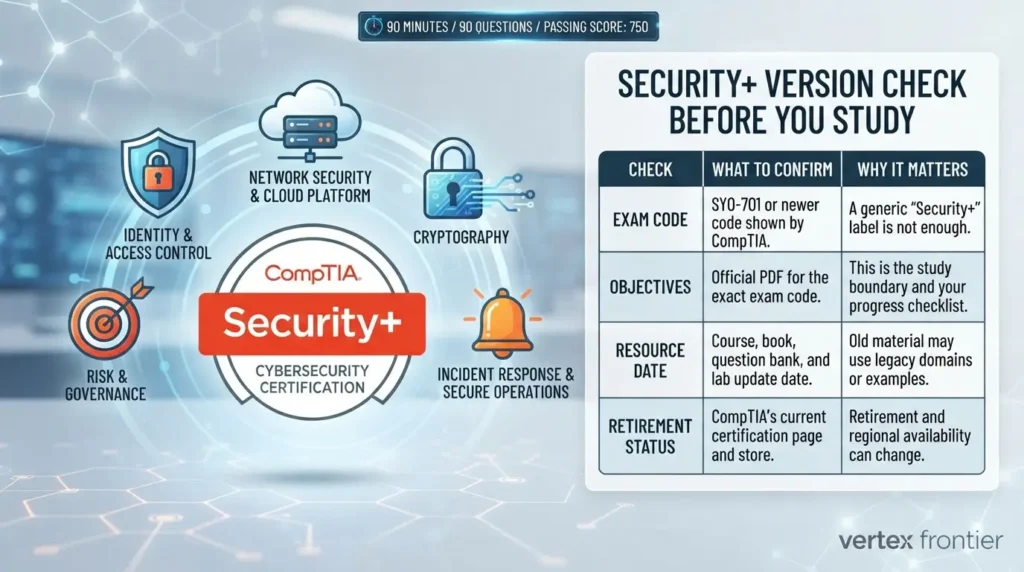
According to CompTIA’s SY0-701 exam page, the exam has a maximum of 90 questions, combines multiple-choice and performance-based questions, lasts 90 minutes, and lists a passing score of 750 on a 100–900 scale. CompTIA recommends Network+ knowledge and two years of experience in a security or systems-administration role, but CompTIA’s exam guidance makes clear that exams do not require a formal education, training, or certification prerequisite.
The version question matters more than it used to
The original draft of this article treated SY0-701 as permanently current. That is too strong. CompTIA’s main Security+ page currently distinguishes V7 from a forthcoming V8 and says V8 is expected around November 17, 2026. The SY0-701 page also lists retirement dates by language, including June 11, 2027 for English.
That creates a simple rule: before booking, check the exam code printed on the voucher and the current CompTIA objectives. Do not assume that a course labeled “Security+” is aligned with the version you plan to take. A resource can still be useful for fundamentals while being outdated for objectives, domain emphasis, or terminology.
Security+ version check before you study
| Check | What to confirm | Why it matters |
|---|---|---|
| Exam code | SY0-701 or the newer code shown by CompTIA | A generic “Security+” label is not enough. |
| Objectives | The official PDF for the exact exam code | This is the study boundary and your progress checklist. |
| Resource date | Course, book, question bank, and lab update date | Old material may use legacy domains or examples. |
| Retirement status | CompTIA’s current certification page and store | Retirement and regional availability can change. |
Is Security+ worth it?
For many early-career IT professionals, yes but the reason is more specific than “it unlocks cybersecurity.” Security+ can help you demonstrate structured security knowledge when your work history does not yet show much security responsibility. It can also appear as a screening requirement in roles that involve security operations, systems administration, compliance, or defense-related work.

The value depends on the role you are targeting. If you want to become a security analyst, the exam can give you a useful foundation. If you already have substantial experience and a higher-level certification, it may add less technical depth. If you are applying to a specific government or defense role, read the actual vacancy and qualification matrix instead of relying on a general statement about DoD requirements.
DoD language needs particular care. DoD Manual 8140.03 replaced and cancelled DoD 8570.01-M and uses work roles and proficiency requirements. The official DoD 8140 qualification-matrix guidance explains that qualifications are mapped to specific work roles and levels, and components may impose additional requirements. Security+ is a listed qualification option for certain roles; it is not a universal pass for every DoD, federal, or contractor position.
A practical way to decide
Security+ is a sensible next step if you can answer “yes” to most of these questions:
- Do you want a broad security foundation rather than a single-vendor credential?
- Do job descriptions in your target market repeatedly mention Security+ or an equivalent baseline?
- Can you commit regular study time and some hands-on practice?
- Are you willing to learn why an answer is correct instead of memorizing a question bank?
- Do you have a plan for what comes after the exam, labs, a portfolio, a junior security role, or a role-specific certification?
If you only want a higher salary without changing your skills or responsibilities, the certificate is unlikely to solve the whole problem. The credential can support a career move. It cannot substitute for experience, communication, troubleshooting, or evidence that you can work safely with real systems.
The five SY0-701 domains and how to prioritize them
The most important correction to the earlier article is the domain map. The legacy percentages, 24%, 21%, 25%, 16%, and 14%, should not be used for SY0-701 planning. The current V7 structure is different.
SY0-701 domain weights
| Domain | Weight | Study emphasis |
|---|---|---|
| 1. General Security Concepts | 12% | Security controls, fundamental concepts, change management, and basic security architecture. |
| 2. Threats, Vulnerabilities, and Mitigations | 22% | Threat actors, malware, vulnerabilities, social engineering, and mitigation choices. |
| 3. Security Architecture | 18% | Secure network and cloud design, segmentation, resilience, and infrastructure decisions. |
| 4. Security Operations | 28% | Identity, access, vulnerability management, monitoring, incident response, automation, and recovery. |
| 5. Governance, Risk, and Compliance | 20% | Policies, risk, third-party relationships, audits, privacy, awareness, and compliance. |
The weights are useful for allocating time, but they should not become a second form of memorization. A 28% domain with weak understanding deserves attention; a 12% domain you cannot explain may still create avoidable mistakes.
A better prioritization rule
Use this order when deciding what to study next:
- Start with the official objectives.
- Mark every objective as explain, recognize, apply, or unknown.
- Multiply your uncertainty by the domain weight.
- Study the highest-risk combination first.
- Re-test with new questions, not the same questions you just memorized.
This is more useful than saying “spend most of your time on Domain 4.” It combines exam weight with your actual gap.
Domain weights tell you where the exam allocates attention. Your error log tells you where your preparation is leaking points.
How long should you study for Security+?
There is no honest universal answer. A person with Network+ knowledge, systems experience, and several hours each evening may need a very different schedule from a career changer who is still learning ports, authentication, operating systems, and basic networking.
The popular six-week plan can work as a structure, but it is not a “sweet spot” that applies to everyone. Treat it as one template, then adjust it based on weekly hours, prior knowledge, accessibility needs, and diagnostic results.

A flexible six-week plan
Week 1: Establish the boundary. Download the current official objectives. Take a diagnostic test without studying first. Do not obsess over the score. Use it to identify unfamiliar terms, weak domains, and question types that slow you down.
Week 2: Build the mental model. Study General Security Concepts and Threats, Vulnerabilities, and Mitigations. Learn the difference between related terms: vulnerability versus threat, exploit versus payload, authentication versus authorization, and preventive versus detective controls.
Week 3: Design securely. Study Security Architecture. Draw simple diagrams for segmentation, DMZs, VPNs, cloud responsibility, high availability, backup design, and zero-trust-style access decisions. If you cannot explain the diagram without looking at the lesson, it is not learned yet.
Week 4: Operate and respond. Give the largest block of time to Security Operations. Study identity, access, logging, vulnerability management, incident response, automation, recovery, and secure administration. Pair each topic with a small lab, diagram, log-reading exercise, or written scenario.
Week 5: Govern and integrate. Study Governance, Risk, and Compliance. Then begin timed mixed sets that combine all five domains. Review every wrong answer and every correct answer you guessed.
Week 6: Prove readiness. Use fresh, timed practice sets. Revisit only the objectives that your error log identifies. Practice reading scenarios carefully, skipping an item when necessary, returning to it, and using the remaining time for review.
If six weeks is too fast, stretch the same sequence to 10 or 12 weeks. If you have only two weeks, reduce scope carefully: prioritize the objectives, preserve review time, and do not mistake passive video completion for readiness.
The readiness framework: when should you book the exam?
The common advice is to wait until you score 80% on a particular provider’s tests. That sounds simple, but it is not a validated rule. Community reports are contradictory: some candidates report passing after scores in the 70–80% range, while others report failing after scoring around 95% on a practice provider.
Repeated questions, different difficulty levels, domain gaps, and memorization can all distort the result.
Use a five-part readiness check instead.
The five-signal readiness check
| Signal | Ready looks like | Warning sign |
|---|---|---|
| Objective coverage | You can explain each objective in plain language. | You recognize the term but cannot explain its use. |
| First-attempt performance | You perform consistently on unseen questions. | You improve only after repeating the same test. |
| Error review | You can state why the right answer wins and why the others lose. | You read the explanation and move on. |
| Timed mixed practice | You can work across domains without losing control of time. | One difficult question causes a long pause. |
| Scenario transfer | You can apply the concept to a new diagram, log, policy, or incident. | You depend on the exact wording from your course. |
A practice score is still useful. It is just not the whole decision. Track the score, domain, question source, first-attempt result, confidence, and error type. Your error type is often more informative than your percentage.
A useful error taxonomy
- Knowledge gap: You did not know the concept.
- Recognition gap: You knew the concept but did not recognize the wording.
- Application gap: You knew the definition but chose the wrong control in context.
- Reading gap: You missed a qualifier such as “first,” “best,” “most,” or “not.”
- Process gap: You ran out of time or changed correct answers without a reason.
- Memory gap: You need spaced review for acronyms, ports, protocols, or frameworks.
This is the contrarian point: the fastest way to improve may be to spend less time taking new tests and more time classifying why the last test went badly.
How to prepare for Security+ PBQs without chasing leaks
CompTIA describes PBQs as problem-solving items that can use simulations or virtual environments. Its general PBQ guidance gives examples such as firewalls, network diagrams, terminal windows, and operating systems.
CompTIA does not publish a fixed SY0-701 PBQ count on the product page, so avoid articles that confidently promise a specific number or exact topic distribution.
PBQs are not simply “hard multiple-choice questions.” They test whether you can use knowledge in a task. The safest preparation is to practice the underlying skills with authorized material and small, controlled labs.
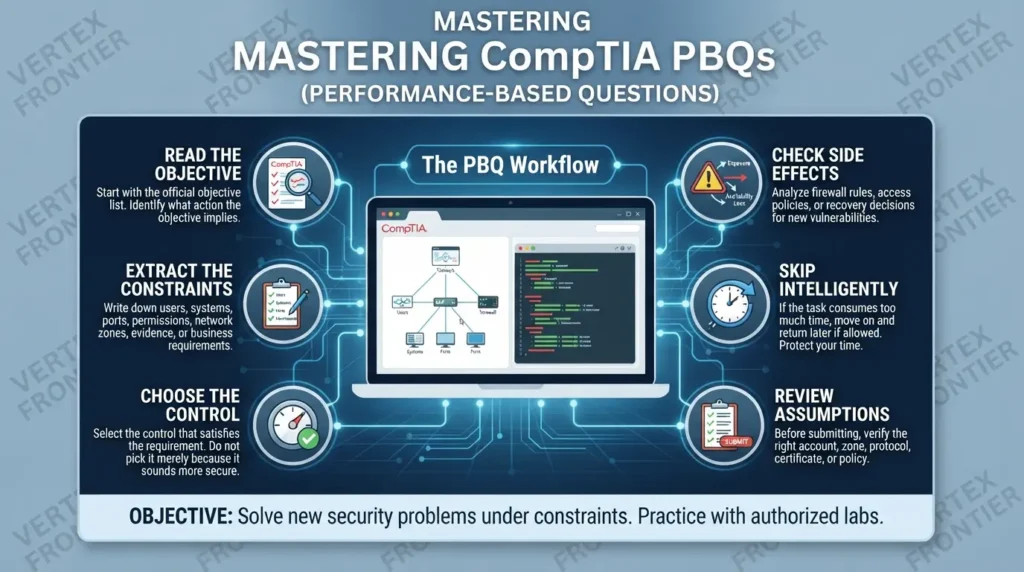
The PBQ workflow
- Read the objective, not the rumor. Start with the official objective list and identify what action the objective implies.
- Extract the constraints. Write down the users, systems, ports, permissions, network zones, evidence, or business requirement in the scenario.
- Choose the control that satisfies the requirement. Do not pick a control merely because it sounds more secure.
- Check side effects. A firewall rule, access policy, or recovery decision can create a new exposure if you ignore least privilege or availability.
- Skip intelligently. If the interface or task is consuming too much time, move on and return later if the exam interface allows it. Candidate reports disagree about the best order, so use a strategy that protects your time rather than copying someone else’s preference.
- Review assumptions. Before submitting, check whether you configured the right account, zone, protocol, certificate, or policy.
Do not seek, share, or reproduce live exam questions or NDA-protected material. The objective is not to predict the test screen. It is to become capable of solving a new security problem under constraints.
Choosing study resources without wasting money
There is no single best Security+ course for every learner. The better question is: what job does each resource perform?
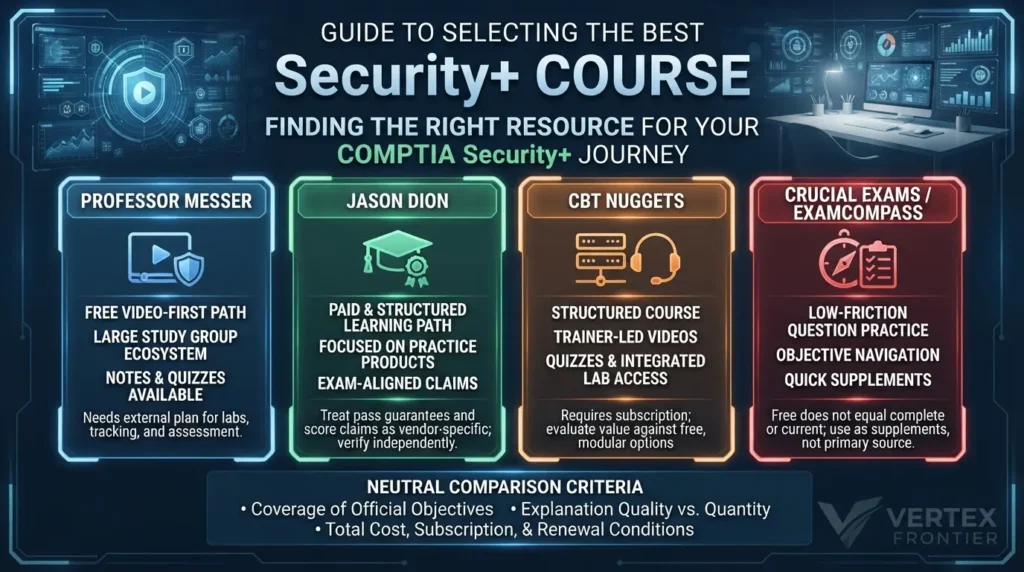
Professor Messer’s SY0-701 course is known for a free video-first path and a large ecosystem of study groups, notes, quizzes, and practice products. It can work well as a primary explanation source, but you still need a plan for labs, objective tracking, and assessment.
Jason Dion’s Security+ training and practice products are positioned as a paid, structured learning and practice path. Treat any provider’s pass guarantee, score guidance, or alignment claim as a vendor claim unless independent evidence supports it. Do not assume that a practice percentage maps to CompTIA’s scaled score.
CBT Nuggets’ Security+ training page emphasizes a structured course, trainer-led videos, quizzes, and lab access. Its fit depends on whether you value a subscription and lab environment over a free, modular path.
Crucial Exams and ExamCompass can be useful for low-friction question practice and objective navigation. Free does not automatically mean complete, current, or equivalent to the live exam, so use them as supplements.
A neutral resource comparison should consider:
- Exact exam code and last update date.
- Coverage of the official objectives.
- Explanation quality, not just question quantity.
- PBQ or lab-style practice and its limitations.
- Accessibility: captions, transcripts, audio, mobile access, and reading load.
- Cost, renewal, refund, subscription, and affiliate conditions.
- Whether the resource teaches concepts or mainly trains recognition of repeated questions.
If you have a commercial relationship or affiliate link, disclose it clearly. Trust is worth more than a short-term click.
Two practical labs that make the material stick
You do not need an expensive home lab to benefit from hands-on learning. Choose small exercises that force you to make a security decision and explain it.

Lab 1: Identity and least privilege
Create a simple role matrix for three users and three resources. Define which user can read, modify, administer, or access each resource. Then document how MFA, account lifecycle, privileged access, and logging reduce risk.
This connects authentication, authorization, least privilege, separation of duties, and auditing. For a deeper enterprise example, see Vertex Frontier’s guide to non-human identity security, but keep the Security+ explanation vendor-neutral.
Lab 2: Recovery and incident response
Create a ransomware response checklist. Include alert validation, isolation, evidence preservation, communication, backup verification, restoration order, and a post-incident improvement step. Then ask what would happen if backups were connected, untested, or unavailable.
This turns a list of ransomware terms into a recovery decision. Vertex Frontier’s enterprise ransomware protection strategy can provide a more advanced follow-up on immutable backups, detection signals, restore testing, and SIEM/SOAR integration.
For cryptography and key-management concepts, link to the deeper TPM vs HSM vs Secure Enclave comparison rather than repeating its full technical analysis in this certification guide.
Common mistakes that cause otherwise prepared candidates to fail

Mistake 1: Studying a course instead of the objectives
Completing 30 hours of video feels productive, but completion is not coverage. Keep the official objectives open and mark what you can explain, apply, and still need to revisit.
Mistake 2: Treating 750 as 75%
CompTIA reports 750 on a 100–900 scaled scale. It does not publish a simple raw-question conversion. Do not build a study decision around the idea that 75% correct equals a pass.
Mistake 3: Repeating one question bank until the score looks safe
Repeated exposure can create familiarity without understanding. Use fresh questions and explain every answer, including correct answers you guessed.
Mistake 4: Overfocusing on acronyms
Acronyms matter, but the exam also asks you to choose controls, interpret scenarios, and identify the best response. For every term, learn its purpose, trade-off, and example.
Mistake 5: Ignoring Governance, Risk, and Compliance
The governance domain can feel less exciting than malware or network diagrams. It is still 20% of the current SY0-701 structure. Study policies, risk treatment, third-party risk, audits, privacy, and awareness as decision-making tools.
Mistake 6: Treating PBQ videos as a substitute for practice
Watching someone solve a simulated task is passive. Pause, predict the next action, draw the diagram, or reproduce the concept in an authorized lab before checking the solution.
Mistake 7: Believing Security+ alone proves job readiness
The certificate shows a baseline of knowledge. Employers may still expect troubleshooting, documentation, scripting, cloud administration, identity operations, communication, or security-tool experience.
Before and after: what a better study process looks like
Before: A learner watches a course, takes the same practice tests repeatedly, celebrates an 82%, and books the exam without knowing which objectives produced the missed answers.
After: The learner starts with the official objectives, takes an unseen diagnostic, builds an error log, studies the highest-risk domain, practices a scenario, completes a timed mixed set, and books only after multiple readiness signals agree.
The second process may feel slower during the first week. It is usually more efficient over the full preparation cycle because every study session answers a specific question: what do I still fail to explain or apply?
The premium-study rule
Do not ask, “How many resources have I finished?” Ask, “What can I now explain, apply, and diagnose that I could not handle last week?” That question produces a more honest readiness signal than a growing playlist or a single practice-test percentage.
What happens after you pass?
Security+ is not the end of a security path. It is a useful checkpoint. Choose the next step based on the work you want to do:
- Security operations: build log-analysis, detection, incident-response, and vulnerability-management practice.
- Identity and access: learn directory services, MFA, privileged access, lifecycle management, and authorization design.
- Cloud security: choose one cloud platform and learn its identity, network, logging, and key-management controls.
- Governance and risk: practice policy writing, risk registers, third-party reviews, audit evidence, and security awareness.
- Systems or network administration: strengthen operating systems, networking, hardening, backups, and troubleshooting.
For practical identity examples, Vertex Frontier’s articles on Entra passkey deployment mistakes and the Entra app-protection passkey issue can serve as advanced follow-up reading. They are vendor-specific implementation articles, not substitutes for the vendor-neutral exam objectives.
Remember renewal as well. CompTIA’s Security+ renewal guidance states that Security+ certifications under the CE program are valid for three years and require 50 CEUs through the relevant renewal path. Check the current policy before planning your renewal because fees and eligibility conditions can change.
Final advice
The most reliable way to pass Security+ is not to find a magic course, a perfect score, or a secret PBQ list. It is to build a feedback loop: objectives, explanation, application, timed practice, error review, and version checks.
Use the certification to prove a foundation. Then build the hands-on evidence that turns that foundation into useful work. That combination is more durable than a badge on its own, and it gives you a study process you can reuse for every technical exam that follows.
FAQs: how to pass CompTIA Security+
What is the passing score for CompTIA Security+ SY0-701?
CompTIA lists a passing score of 750 on a 100–900 scaled scale. That score is not the same as 75% correct, and CompTIA does not publish a simple raw-question percentage conversion.
How many questions are on Security+ SY0-701?
The SY0-701 exam has a maximum of 90 questions and a 90-minute time limit. It includes multiple-choice and performance-based questions.
Is Network+ required before Security+?
No. CompTIA recommends Network+ knowledge and two years of relevant experience, but those are recommendations rather than formal prerequisites for taking the exam.
Is scoring 80% on a Security+ practice test enough to pass?
Not by itself. Practice-test scores vary by provider and can be distorted by repeated questions or memorization. Combine the score with objective coverage, first-attempt performance, error analysis, timed mixed practice, and the ability to explain unfamiliar scenarios.
How should I prepare for Security+ PBQs?
Study the official objectives, practice applying controls to diagrams and scenarios, use authorized simulations or labs, and develop a time-management plan. Do not seek or reproduce live exam questions or NDA-protected material.
Is Security+ required for every DoD or government IT job?
No universal statement is safe. DoD 8140 qualification depends on the position, work role, proficiency level, component requirements, and—in contractor situations—applicable contract and policy language. Check the specific vacancy and current DoD qualification matrix.
How long does Security+ certification last?
Security+ certifications under CompTIA’s continuing-education program are normally valid for three years. The renewal path and current CEU requirements should be checked on CompTIA’s renewal page before your certification expires.

Was this article helpful?



[…] concepts also form the backbone of the Security Architecture domain in the CompTIA Security+ exam, our SY0-701 study plan maps them into a complete preparation framework if you’re working […]
[…] identity, are core topics in the Threats, Vulnerabilities, and Mitigations domain of the CompTIA Security+ exam. Our SY0-701 study plan walks through how to prioritize them for the […]
[…] discussed here are all covered in the Security Operations domain of the CompTIA Security+ exam, our SY0-701 study plan breaks down where they fit in the broader certification […]
[…] attack patterns are exam staples in the Security Operations domain, if you're preparing for the CompTIA Security+ SY0-701 exam, our study plan ties these attack techniques back to the objectives you'll be tested […]
[…] in this fix all sit inside the Security Operations domain of the CompTIA Security+ exam, our SY0-701 study plan covers them as part of a complete certification preparation […]
[…] protocols are covered in the Security Architecture domain of the CompTIA Security+ exam, see our SY0-701 study plan for […]
[…] management, for humans or non-humans, is a core focus of the Security Operations domain in the CompTIA Security+ exam; our SY0-701 study plan covers it in […]